
Last Updated: | Author: Munir Ardi
You can ask The Salvation Army about donating a car through its official vehicle donation channel. Enter your ZIP code at The Salvation Army’s official vehicle donation page or contact the organization through that site, then confirm whether your vehicle is accepted locally, who handles the transfer, and what happens to the proceeds. The Salvation Army explicitly cautions that vehicle types accepted vary by location. A donor should not assume a universal pickup time, free tow for every vehicle, or a guaranteed tax deduction.
This article covers the donor’s title, collection, privacy, and tax steps. For a broad comparison before choosing a beneficiary, read our guide to car donation programs. If you need transportation assistance rather than a place to give a car, the application process is a separate topic.
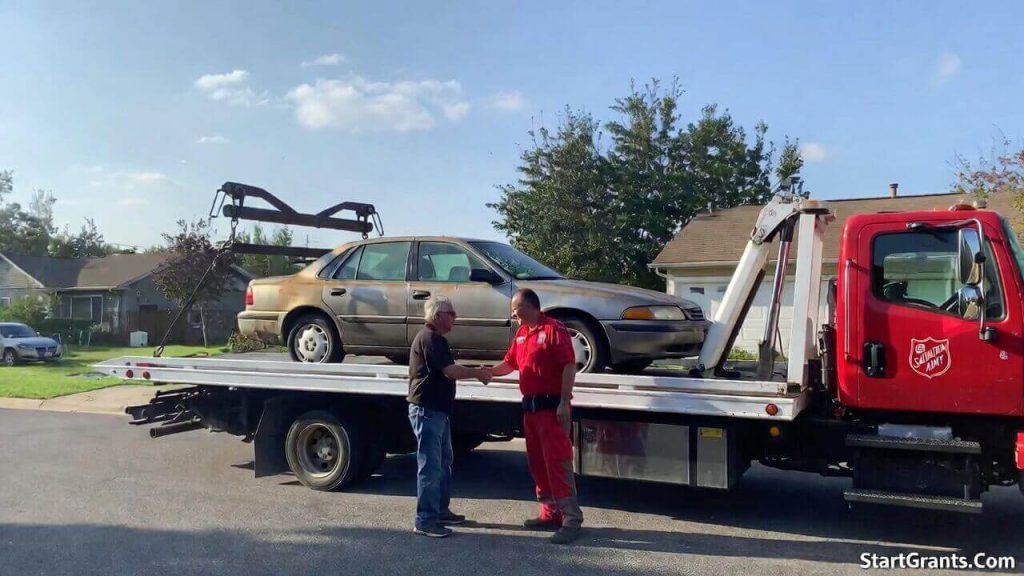
Ask the official vehicle program whether pickup is offered for your car and address.
Where do Salvation Army vehicle donations go?
The Salvation Army’s official vehicle donation page connects vehicle donations with The Salvation Army’s Adult Rehabilitation Centers (ARCs), which offer residential support for adults facing various life challenges, including substance use issues. This is a specific program purpose, not a promise that the gross auction amount from your car funds a named participant or that every donation pays for a six-month course of care. Ask the receiving program which legal organization takes title to the car and how its vehicle donations support the centers in your area.
After collection, the vehicle may be evaluated and sold through an authorized process. Transportation and sale costs can affect the amount available for programs. The gross sale proceeds used in certain IRS calculations are not the same as the net support received by a center. Do not assume that the charity directly repairs your car and gives it to a family, or that disaster relief and shelters automatically receive proceeds from a vehicle donation made to an ARC program.
The ARCs describe support that includes a residential setting and activities aimed at helping participants rebuild daily routines. If you specifically want to support emergency shelters or disaster response, ask whether your local vehicle program permits that designation; do not infer it from the wider Salvation Army name. The donor should also ask whether the car will be sold as a usable vehicle, sold for parts, or handled in another way. These choices can affect the practical value of a damaged car and the documents you eventually receive.
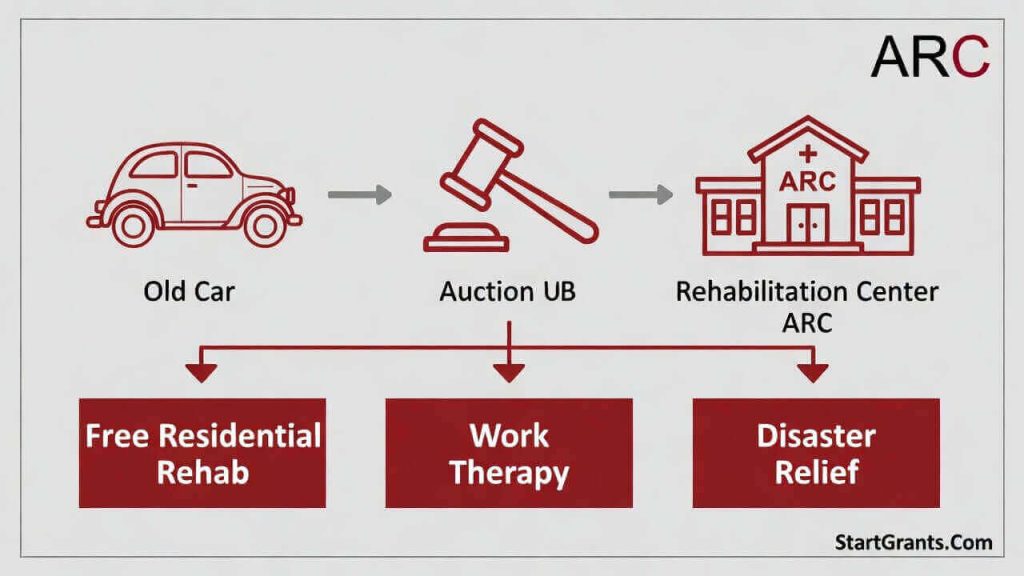
Confirm the receiving organization and ask how the local vehicle program supports rehabilitation services.
How should I check a processing partner?
A vehicle program may use a contracted intake service, tow company, or sales partner. Start from The Salvation Army’s official vehicle donation page; follow the link or instructions provided there rather than an advertisement whose connection to the charity is unclear. Ask the operator to state the receiving organization’s name, any charge to you, the person or entity named as transferee, and who sends the final acknowledgment. No fixed percentage of sale revenue or specific auction operator can be assumed without the program’s documentation.
What vehicles can be offered?
Tell the program what you have before assuming it will accept it. The official Salvation Army site says differing regulations and considerations mean not all vehicle types are accepted at all locations. Some locations may consider running and nonrunning passenger cars; motorcycles, RVs, boats, trailers, commercial trucks, and equipment require a specific eligibility check. A salvage vehicle may still be useful, but its condition, accessibility, transport cost, and paperwork matter. There is no published nationwide rule that four inflated tires alone decide acceptance.
- Car or SUV: Disclose whether it starts, rolls, and has major accident or flood damage.
- Nonrunning or heavily damaged vehicle: Explain missing wheels, locked brakes, a flat tire, a blocked driveway, or other towing obstacles.
- Boat, RV, or motorcycle: Ask about registration, keys, a trailer when relevant, storage, and local capacity.
- Commercial vehicle or estate property: Confirm the registered owner and the documentation needed to authorize transfer.
What if the title is missing or a lien remains?
Contact your state motor vehicle agency about a duplicate or electronic title, a deceased owner’s estate, co-owner signatures, and any outstanding lien. The charity may require proof of ownership or a lender release. It is inaccurate to say that a lender automatically owns every financed vehicle, or that one national title rule governs every donation. Never sign a blank title for an unidentified buyer or let someone take the car before you understand the receiving organization’s instructions.
For a car inherited from a relative, it may be the estate representative rather than the person currently driving it who can legally approve a transfer. For a paid-off car, the title can still display a lien until the record is updated or a release is supplied. Resolve these issues before requesting a firm tow date. When asking about an RV or boat, mention whether a trailer has its own title and registration; a donation of two registered assets may require two sets of documents.
The four practical stages of donating a car
1. Initiate the request through the official channel
Use the ZIP-code vehicle option on The Salvation Army’s official vehicle donation page. Be ready with the year, make, model, VIN, mileage, vehicle address, general condition, and title status. Ask whether your specific vehicle qualifies, whether towing or a drop-off option is available, and how long scheduling could take. If you are offered a free tow, get confirmation that it applies to your car rather than general household donation pickup. Record the organization and the appointment details.
2. Prepare the ownership records correctly

Follow the exact state and authorized program instructions before signing a title.
Check the legal owner’s name, liens, odometer requirements, transferee information, and state-specific instructions. If multiple people are named on the title or the vehicle belongs to an estate, ask which signatures are required. Do not use correction fluid or guess where to sign. Keep permitted copies and any lien release with your records. A temporary tow receipt does not by itself settle title transfer or prove a deductible value.
3. Protect personal data and document pickup
Take belongings, toll transponders, parking passes, and garage remotes out of the car. Erase saved navigation locations, paired contacts, and payment credentials when feasible. Photograph the vehicle and record the mileage and date. Verify the tow operator’s connection to your scheduled donation, then obtain a dated handover record identifying the vehicle and recipient or agent.
Ask your state agency whether plates must stay, be removed, or be returned; the draft’s blanket instruction to remove them in nearly all states was not supportable. Similarly, speak with your insurer before changing coverage. Your state’s registration and insurance obligations may extend beyond the moment the vehicle leaves your driveway.
If the pickup operator is late or changes the location, keep the vehicle legally parked and insured as required while you wait. Do not hand keys and title to a person who cannot identify the donation request. A timestamped photo and receipt can help if you later receive parking tickets or toll charges. If an electronic toll account lists the car’s plate, ask the toll agency to unlink it under its own rules; removing only the windshield device may not close a plate-based charge.
4. Finish state transfer and retain the charity’s acknowledgment
Check whether your state requires a sale, donation, or transfer notice and when it must be filed. A Notice of Transfer and Release of Liability is a California term; it is not the universal name of the paperwork. For an example of state-specific procedures, see California DMV title-transfer instructions. Save the confirmation along with the initial receipt and any later IRS-compliant acknowledgment. If a toll or parking notice arrives afterward, your transfer evidence can help you address it with the issuer.
IRS tax rules: sale price does not equal an automatic deduction
First verify the legal recipient through IRS Tax Exempt Organization Search. A vehicle gift is a noncash charitable contribution, subject to the donor’s own tax situation and the tax-year rules. According to IRS Publication 526, when a qualified organization sells an eligible vehicle and a donor claims more than $500, the deduction is generally limited to the lesser of the vehicle’s fair market value or the charity’s gross sale proceeds, unless a documented exception applies. The IRS also describes when IRS Form 1098-C information or an equivalent statement must accompany a return. Do not use an online trade-in estimate or an auction result alone as your final tax calculation.
| Situation | General federal rule | Record to check |
|---|---|---|
| Charity sells an eligible vehicle and donor claims over $500 | Usually the lesser of fair market value or gross sale proceeds | Charity acknowledgment, Form 1098-C or equivalent, and applicable filing rules |
| Vehicle sells for $500 or less | Generally the lesser of $500 or fair market value, subject to other rules | Good-faith value estimate and required substantiation; $500 is no guarantee |
| Qualifying use, significant improvement, or transfer to a needy individual | Specific IRS exception may alter sale-proceeds limit | Certification of actual use or transfer and current IRS instructions |
These are general rules, not a tax estimate for your donation. The IRS and your tax professional can help determine which documentation and filing rules apply for the year you donated.
An example that avoids overpromising
Suppose a car has a supportable fair market value of $3,200 and the charity sells it for $4,000. Under the ordinary sale rule for an otherwise eligible claim above $500, the smaller amount, $3,200, sets the value ceiling. If the same car sells for $2,700, the gross sale proceeds generally set the lower ceiling. Neither example says how much tax you save: deductibility depends on other requirements, including the donor’s filing situation. A car sold for $200 does not automatically create a $500 deduction, either.
A donor should keep the date of the gift, vehicle identification, original handover receipt, final acknowledgment, and any written description of the charity’s actual use or sale. If the acknowledgment has not arrived before filing, ask the organization about its timing and follow the current IRS instructions; guessing at sale proceeds or substituting a tow ticket can undermine a valid claim. Form 8283 may also apply for noncash contributions above applicable thresholds, so the vehicle form is not always the only paperwork to check.
A Muslim Perspective
A Muslim donor may view a vehicle donation that supports rehabilitation as voluntary sadaqah. Because The Salvation Army is a Christian organization, ask how its services and vehicle proceeds are used if that distinction matters to your intention. Do not declare a donation zakat eligible solely because a charity serves people in need; the fund’s use and recipient criteria require separate review with a qualified zakat adviser.
If the car has an unpaid loan, first address ownership, the lien, and lender consent under the applicable contract and state rules. Questions about riba or the religious status of donating an encumbered asset call for individual guidance, not a universal ruling here. Record the recipient, any restrictions, and the handover to support a transparent charitable gift; an IRS deduction follows tax law, not religious intent.
Compare vehicle programs by their actual purpose
Salvation Army vehicle proceeds support the ARC mission described by its program. If your goal is to help a local employment organization, compare Goodwill car donation. For other missions, consider Make-A-Wish vehicle donation, Purple Heart vehicle donation, or KQED vehicle donation. The parent comparison above helps you examine operators, use of proceeds, acceptance, and current terms without assuming each program works alike.
Frequently Asked Questions
Does The Salvation Army accept a nonrunning car?
It may, depending on the local vehicle donation program, the car’s condition, location, ownership documents, and towing logistics. Contact the official program with an accurate description before arranging collection.
Is towing always free?
The Salvation Army advertises donation pickup services, but do not assume every vehicle is eligible for a free tow in every location. Ask the vehicle program or its approved processor whether your pickup is available and whether any cost applies.
Can I donate a car without a title?
A missing title or unresolved lien can delay a donation. Ask your state motor vehicle agency about a replacement title or other acceptable ownership records, and confirm the receiving program’s requirements before scheduling pickup.
How much can I deduct for a Salvation Army car donation?
A deduction is not guaranteed. When a qualified recipient sells an eligible vehicle, a claimed deduction over $500 generally cannot exceed the lesser of its fair market value or gross sale proceeds unless an IRS exception applies. Your filing and documentation requirements also matter.
When will the program pick up my car?
The pickup window depends on your location, the vehicle’s condition, paperwork, and the availability of an approved operator. Ask the program for a confirmed appointment rather than relying on a nationwide turnaround promise.
Can I leave my car at a Salvation Army family store?
Do not leave a vehicle at a retail or goods drop-off location unless the vehicle donation program explicitly authorizes that site. Start through The Salvation Army’s official vehicle donation channel.
Should I remove my license plates before pickup?
Follow your state motor vehicle agency’s instructions. Plate removal, surrender, and transfer rules vary by state; also ask your insurer when coverage can be changed. Keep proof of handover and complete any required state notice.