Last Updated: July 2026 | Author: Munir Ardi
In the volatile economic climate of 2026, a single unexpected medical bill, a sudden job loss, or a broken vehicle transmission can push a stable family into an immediate financial crisis. When the threat of eviction looms or the utility company threatens to shut off the power in the middle of winter, waiting months for government assistance is not a viable option. You need immediate intervention.
For millions of Americans, that critical lifeline is the Salvation Army emergency financial assistance program. As one of the largest and most established charitable organizations in the world, the Salvation Army possesses the infrastructure to deploy rapid, localized funding to keep families in their homes and the lights on.
Before diving into the specific application process for the Salvation Army, it is highly recommended to understand the broader landscape of charitable relief. Anchor your crisis strategy by reviewing our foundational master guide on Community and Humanitarian Donations.
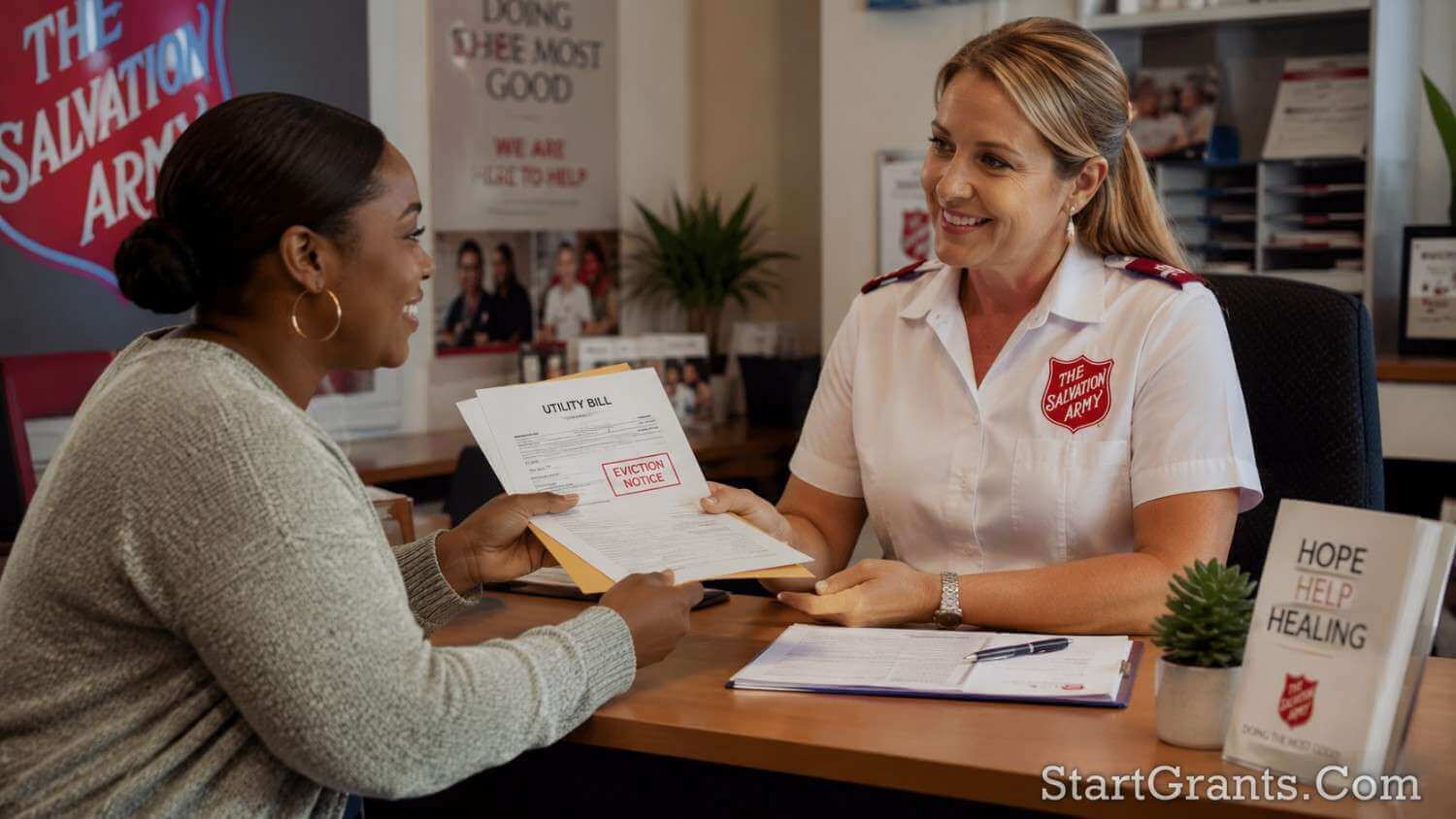
The Salvation Army provides vital financial lifelines for families facing imminent eviction or utility shut-offs.
Phase 1: Understanding Salvation Army Emergency Financial Assistance
The Salvation Army is a Christian church and an international charitable organization. However, you do not need to be a Christian to receive their help. Their humanitarian mission dictates that they provide assistance based strictly on financial need and human dignity, without discrimination.
The capital they distribute is classified as a Grant, not a loan. This is a crucial distinction. When people search for Salvation Army grants, they are actually looking for this exact emergency safety net. If you are approved for Salvation Army emergency financial assistance to pay your rent, you do not have to pay the money back, and it accrues zero interest. This provides a safe harbor for desperate families who might otherwise fall victim to predatory payday lenders charging 400% interest rates.
The Scope of Their Financial Assistance
Because the Salvation Army operates through localized community centers (corps), the exact amount of funding available varies widely depending on your zip code and the local chapter’s current budget. Generally, their emergency financial assistance covers:
- Rent/Mortgage Assistance: Direct payments to landlords to stop imminent eviction proceedings.
- Utility Assistance: Payments to gas, electric, or water companies to prevent shut-offs or restore disconnected services.
- Emergency Travel: If you are trapped away from home due to a crisis, the organization sometimes provides bus vouchers or gas cards. Learn the specific logistics of this scenario in our guide on How to Get Home When Stranded.
Phase 2: The Application Process (Documentation is Everything)
The Salvation Army does not hand out cash. To prevent fraud, all emergency financial assistance is paid directly to the vendor (your landlord or your utility company). To qualify, you must undergo a strict vetting process with a local caseworker.
Step 1: Locate Your Local Chapter
Do not call the national headquarters. You must go to the official Salvation Army website and use their “Location Search” tool. Enter your zip code to find the community center that specifically services your county.
Step 2: Gather the Required Proof
Caseworkers operate under strict auditing rules. If you show up to an appointment without documentation, you will be turned away. You must bring:
- Government-issued ID: For all adults in the household.
- Proof of Emergency: A formal, written 3-day eviction notice from your landlord, or a final disconnect notice from the utility company.
- Proof of Income: Recent pay stubs, unemployment letters, or SSI benefit statements demonstrating that you lack the funds to pay the bill.
- The Actual Bill/Lease: The document must clearly show your name, address, and the account number or landlord’s contact information so the Salvation Army can issue the check.
Pro-Tip: Navigating the Interview
Securing an appointment and passing the caseworker interview requires preparation. If you want a deeper look at how the Salvation Army processes your crisis and verifies your need through their assistance programs, watch this official breakdown: Pathway of Hope/Emergency Assistance:
Phase 3: Synergizing Federal and Community Resources
The Salvation Army often acts as a bridge, but their funds are finite. A local chapter might only be able to cover $300 of your $900 utility bill. To survive a severe financial crisis, you must learn to “stack” community resources.
If the Salvation Army cannot cover the full amount, they will often require you to apply for federal assistance simultaneously. For utilities, the premier federal program is the Low Income Home Energy Assistance Program (LIHEAP), managed by the U.S. Department of Health & Human Services (HHS). By combining a LIHEAP grant with Salvation Army emergency financial assistance, you can completely eradicate massive utility debt.
Furthermore, if you require community-level support beyond just rent—such as subsidized child care, health and wellness programs, or emergency housing—you should simultaneously explore assistance from other institutional giants. Read our breakdown on accessing YMCA Financial Assistance to broaden your safety net.
Protecting the Most Vulnerable
During extreme weather (such as winter freezes or summer heatwaves), utility assistance is a matter of life and death, particularly for senior citizens on fixed incomes. Many Salvation Army chapters have specific, reserved funding pools specifically dedicated to protecting the elderly. If you are advocating for an older family member, understand the specialized channels available by reading our guide on how to Donate to Save the Elderly and access senior-specific grants.
Phase 4: The Muslim Perspective (Halal Relief, Riba, & Hibah)
For Muslim families facing a severe financial crisis in the United States, seeking help from a Christian organization like the Salvation Army often raises profound theological and ethical questions. When a Muslim family is threatened with eviction, they must navigate this crisis with strict adherence to Islamic financial jurisprudence (Shariah) to ensure their survival does not compromise their faith.
Is it Halal to Accept Money from the Salvation Army?
The fundamental question is: Can a Muslim accept financial assistance from a non-Muslim, faith-based organization?
According to mainstream Islamic scholarship, the answer is Yes. In Islamic Fiqh, accepting unconditional humanitarian aid to alleviate poverty, prevent homelessness, or secure basic utilities falls under the category of Hibah (a gift) or general Sadaqah (charity). The Prophet Muhammad (?) engaged in trade, accepted gifts, and formed treaties with non-Muslims.
However, there is one strict condition: The aid must be unconditional. A Muslim cannot participate in another religion’s theological rituals (like attending a church service or participating in non-Islamic prayers) as a mandatory prerequisite to receiving the money. The Salvation Army’s official policy is to serve humanity “without discrimination,” meaning they do not force applicants to participate in religious rituals to receive emergency financial assistance. Therefore, accepting their help to prevent an eviction is Halal.

Receiving unconditional humanitarian aid from non-Muslim charities is Halal, but Muslim families also have access to dedicated Islamic organizations like ICNA Relief.
Avoiding the Trap of Riba (Payday Loans)
When faced with a Friday eviction notice, panic sets in. If community funds are dry, many people resort to taking out predatory “Payday Loans” or “Title Loans” to cover the rent. These loans often carry annualized interest rates exceeding 400%.
In Islam, taking a loan that stipulates the payment of interest is explicitly Riba, which is one of the most severe major sins (Kaba’ir). A Muslim must exhaust every single Halal avenue—including swallowing their pride and asking family, the local Masjid, or secular charities like the Salvation Army for a Hibah (gift)—before even considering a Riba-based loan. Surviving a crisis through Riba strips the Barakah (blessing) from the home and plunges the family into a cycle of inescapable debt.
Islamic Institutional Alternatives (ICNA Relief)
While secular and Christian charities are permissible to use, Muslim families should also utilize the rapidly growing network of domestic Islamic charities. Organizations like ICNA Relief USA and Islamic Relief USA have established robust, nationwide networks of food pantries, transitional housing, and emergency financial assistance programs funded entirely by Zakat and Sadaqah from the Muslim community.
When a Muslim family receives assistance from an organization like ICNA Relief, they are receiving Zakat funds explicitly mandated by Allah (?) for their exact situation (falling under the Asnaf of Al-Masakin or the destitute). Reaching out to these Islamic institutions first not only provides financial salvation but strengthens the internal fabric and social safety net of the Ummah (community).
Conclusion
Surviving a financial emergency in 2026 requires rapid, decisive action. The Salvation Army emergency financial assistance program is a vital, localized weapon against homelessness and utility disconnection. By meticulously gathering your documentation (eviction notices, pay stubs, and IDs) and professionally presenting your case to a local caseworker, you can secure the debt-free grants needed to stabilize your life.
For the Muslim family in crisis, this secular safety net is entirely Halal to utilize, provided the aid remains unconditional. By fiercely rejecting the Haram trap of Riba-laced payday loans and actively seeking out domestic Islamic charities like ICNA Relief as primary lifelines, you can navigate the most terrifying financial storms while protecting your family and retaining absolute spiritual purity.
Frequently Asked Questions (FAQs)
Q1: Does the Salvation Army give you cash directly?
A: No. To prevent fraud and ensure the funds are used exactly as intended, the Salvation Army will almost always issue a direct payment (via check or electronic transfer) straight to your landlord, mortgage lender, or utility company. They do not hand out cash to applicants.
Q2: Do I have to pay back Salvation Army emergency financial assistance?
A: No. The financial assistance provided by the Salvation Army is a charitable grant, not a loan. There is no expectation of repayment, and it accrues zero interest. Once the crisis is averted, they simply hope you will regain stability and perhaps volunteer or donate in the future to help others.
Q3: Can the Salvation Army help if I haven’t received a shut-off notice yet?
A: Usually, no. Because their funds are extremely limited and the demand is so high, most local Salvation Army chapters require you to prove you are in an “imminent crisis.” This means you typically must possess a formal 3-day eviction notice or a final utility disconnect notice before they will intervene.
Q4: Is it Halal for a Muslim to take charity from a Christian church?
A: Yes, it is Halal. In Islamic jurisprudence, accepting unconditional humanitarian aid (Hibah or Sadaqah) from non-Muslims or secular organizations to survive poverty or emergency is completely permissible. The only restriction is that the Muslim applicant cannot be forced to participate in non-Islamic religious rituals to receive the aid.
Q5: If I get an eviction notice, is it permissible in Islam to get a payday loan to survive?
A: No. Taking out a payday loan or any commercial loan that charges interest is strictly Riba, which is explicitly Haram in Islam. A Muslim must seek out Halal alternatives, such as zero-interest loans (Qard Hasan) from family/community members, or charitable grants from the Masjid, ICNA Relief, or secular agencies like the Salvation Army to avoid the severe spiritual consequences of Riba.
Disclaimer: The information provided in this article is for educational and informational purposes only. We are not a federal agency, a representative of the Salvation Army, or a religious fatwa council. Salvation Army funding availability fluctuates heavily based on local zip codes and seasonal budgets. Always consult directly with your local Salvation Army corps for specific documentation requirements, the U.S. Department of Health & Human Services for LIHEAP eligibility, and a qualified Islamic finance scholar regarding the acceptance of external Hibah and the strict avoidance of Riba during personal financial crises.