Last Updated: | Author: Munir Ardi
Yes, you can donate a running or eligible non-running vehicle through the Purple Heart Foundation vehicle donation program. The foundation advertises free pickup across the United States, then its vehicle processing partners sell the vehicle and send net proceeds to veteran support programs. The donor must verify ownership, complete state transfer requirements, and follow IRS documentation rules before claiming any charitable deduction. Start with the Purple Heart Foundation vehicle donation page.
This review focuses on the Purple Heart Foundation vehicle donation program: what the organization says it does, which vehicles it considers, how pickup and transfer work, and what a donor can realistically deduct. If you are still comparing recipient charities, use our guide to comparing car donation programs. This page is for donors, rather than a guide to receiving a free car.
A donated vehicle may generate proceeds for Purple Heart Foundation veteran programs after processing costs.
Who Receives the Donation and How Is the Money Used?
The charity presented on the official donation page is the Purple Heart Foundation; its site also uses the name Purple Heart Service Foundation. The Military Order of the Purple Heart is a veteran membership organization with a separate history. The draft conflated these names and attributed a congressional charter to the vehicle donation charity. Use the legal entity and employer identification number shown in your actual acknowledgment when checking its tax status in the IRS Tax Exempt Organization Search.
According to the foundation’s Purple Heart Foundation mission and programs, its mission covers Purple Heart recipients and other honorably discharged veterans and their families. It describes critical assistance grants, resources relating to traumatic brain injury and post-traumatic stress, mental health and suicide prevention, academic scholarships, and service dogs. These are organization-level programs: a donor cannot assume that the proceeds of one specific car will pay for a particular veteran’s legal representation, prosthesis, or treatment.
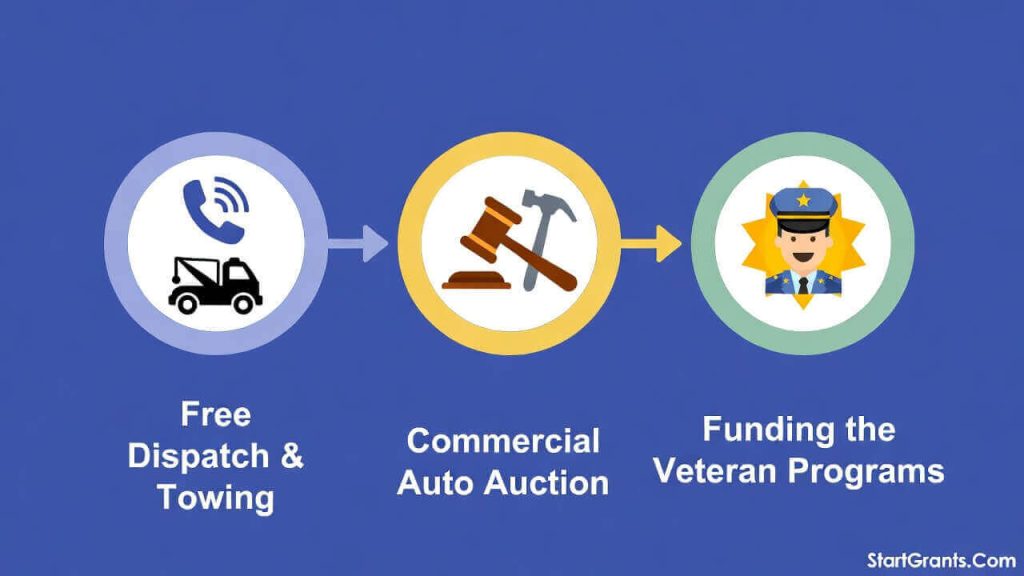
Pickup and sale come before the foundation receives the net proceeds; actual sale method and costs vary by vehicle.
The foundation’s vehicle donation FAQs explain the financial distinction: the donor pays no pickup charge, while sale proceeds first cover towing and processing expenses. Net proceeds then go to the foundation. There is no verified universal percentage of sale price that reaches programs, and a charity rating alone cannot prove how your particular car will be sold. Ask the foundation for its latest financial disclosures if administrative costs matter to your decision.
Which Vehicles Does Purple Heart Consider?
The foundation says its donation program considers vehicles in all 50 states and Washington, DC. It lists cars, trucks, SUVs, motorcycles, RVs, boats, trailers, campers, off-road vehicles, airplanes, heavy equipment, and farm machinery. “Considered” does not mean every asset will be accepted; local towing, ownership records, access, and potential sale value still matter. Verify specialty vehicles with the vehicle donation FAQs.
Running Cars and Non-Running Cars
A running car may be easier to collect and sell, but its sale price and any tax deduction cannot be predicted in advance. The foundation also says it can accept most non-running cars if the vehicle is in one piece, includes an engine, is towable, and a tow truck can reach it. A missing engine or inaccessible parking location may prevent pickup. Do not rely on the old draft’s four-inflated-tires rule or promise that any rusted vehicle will be taken.
RVs, Boats, Motorcycles, and Estate Vehicles
For a boat, RV, trailer, or other specialty asset, describe the vehicle’s size, running condition, location, attached trailer, and title documents before scheduling. If an inherited vehicle belongs to an estate, the person authorized to transfer it may need estate paperwork. Ask the processor and your state motor vehicle agency what signatures are needed; rules differ by jurisdiction.
Title and Lien Checks
The official Purple Heart Foundation vehicle donation page says the vehicle must have a clear title and, if a lienholder appears, a lien release even if the debt was already paid. If you cannot locate a title, contact the issuing motor vehicle agency about a replacement and ask the donation team whether your state permits an alternative process. Do not sign a blank, incorrectly completed, or predated title on the assumption that a tow driver can repair the mistake.
How to Donate and Protect Your Records
| Stage | Your action | What to confirm |
|---|---|---|
| Before intake | Verify the charity, gather title and any lien release, note the VIN and vehicle condition. | Confirm the receiving legal entity and current instructions on its official site. |
| Schedule pickup | Submit the official vehicle form or call the number shown there. Describe access and non-running issues. | Confirm the tow operator, appointment, and what documents to hand over. |
| At handoff | Remove belongings and connected devices; record the date, vehicle, recipient, and paperwork. | Follow your state’s title and plate rules; obtain pickup documentation. |
| After pickup | File any state notice of transfer; follow state instructions on registration and insurance. | Retain submission proof and confirm title processing. |
| After sale | Retain the acknowledgment and sale statement; review IRS rules if you itemize. | Match the charity name, vehicle VIN, gross proceeds, and relevant Form 1098-C details. |
State paperwork and pickup timing vary. Confirm the applicable procedure before transferring the vehicle.
1. Start From the Official Donation Page
Enter the year, make, model, condition, VIN, address, and title information through the Purple Heart Foundation vehicle donation page or call the phone number published there. The embedded form and pickup provider may use a different business name from the charity; confirm that the organization credited on your receipt is the one you selected. According to the vehicle donation FAQs, most vehicles can be picked up within 72 hours after intake, but that is an estimate rather than a service guarantee; sale can take approximately four to 12 weeks.
2. Prepare the Title and Confirm the Driver
Ask where the title must be signed, whether all owners must sign, and whether a paid-off loan still needs a lien release. Confirm the dispatched towing company through the vehicle donation team before handing over your keys or title. Keep copies of the transfer documents and obtain a pickup record. A free tow means no out-of-pocket pickup fee; processing costs still affect the net amount reaching the charity.
3. Remove Personal Data and Follow State Plate Rules
Check your state’s notice-of-transfer and license plate rules after donating a vehicle.
Remove documents in the glove box, garage remotes, toll tags, parking passes, and any device paired to the infotainment system. Delete saved navigation addresses, Bluetooth contacts, and connected account credentials if the vehicle permits a reset. The vehicle donation FAQs explicitly says license plate removal depends on the state: some states require you to remove or return plates, while others do not. Ask your motor vehicle agency before pickup.
4. Notify the State and Handle Insurance in the Right Order
State procedures may require a notice of sale, notice of transfer, registration cancellation, or plate surrender. The foundation says donors must complete any required state notification themselves and should not assume the tow driver files it. Preserve proof of submission. Its vehicle donation FAQs advise completing required state notification before canceling insurance; ask your state agency and insurer about your precise timing. The draft’s claim that every state uses an “NRL” form on the pickup day was too broad.
What Is the Actual Tax Deduction?
A vehicle donation is a noncash charitable contribution, not a grant or a cash reimbursement to you. Eligibility for a federal deduction depends on the recipient charity’s status, the donor’s tax situation, substantiation, and applicable IRS rules. Verify the recipient with the IRS Tax Exempt Organization Search and read IRS Publication 526; receiving a pickup receipt alone does not set a deductible amount.
When the Charity Sells the Vehicle for More Than $500
Under the usual sale rule, the deduction is limited to the lesser of the vehicle’s fair market value or the charity’s gross sale proceeds. For example, if it sells for $4,500 but its actual fair market value on the donation date was $3,800, the usual limit is $3,800, assuming the donor otherwise qualifies. The IRS recognizes special exceptions, including qualifying significant intervening use or material improvement and certain below-market transfers to a needy person. This guide does not assume the foundation uses an exception for your vehicle. The IRS Form 1098-C information describes the charity’s acknowledgment and the donor’s substantiation requirements.
When the Vehicle Sells for $500 or Less
The usual deduction cannot exceed the lesser of $500 or fair market value, subject to the other applicable conditions. A $200 sale does not automatically make every donor eligible to deduct $500. Use a defensible condition-based value, save the receipt, and follow IRS Publication 526 for the thresholds and additional Form 8283 requirements that apply to your return.
The foundation says it generally sends the IRS Form 1098-C for vehicles sold for more than $500 within 30 days of sale if the donor supplies the identifying information needed for the form. Its vehicle donation FAQs say a Social Security number is not required to make the donation itself, although a tax identification number may be needed for the tax form. Share sensitive numbers only through a channel you have independently verified with the official organization, and consult a qualified tax professional for your circumstances.
How to Check the Charity and Compare Alternatives
Use the foundation’s own Purple Heart Foundation vehicle donation page rather than a similar-sounding advertisement. It expressly states that it is not affiliated with Cars Helping Veterans. Compare the legal organization on the donation form, pickup confirmation, and final acknowledgment, then confirm deductible status through the IRS Tax Exempt Organization Search. A processor may handle towing and sale without itself being the recipient charity. Do not infer a fixed percentage for veteran programs or a guaranteed tax benefit from a promotional headline.
If the particular mission matters most, compare the donor process for Make-A-Wish vehicle donations and Salvation Army vehicle donations. For practical differences in title transfer and how a local affiliate may receive proceeds, see Goodwill vehicle donation procedures. Readers specifically comparing public media can consult KQED vehicle donation. These are different recipient missions; inspect each organization’s current official terms before choosing.
A Muslim Perspective
A vehicle donation intended as sadaqah can reflect generosity and care for veterans, regardless of a recipient’s faith. Explain your intended beneficiary and ask the foundation how unrestricted vehicle proceeds are used. A voluntary vehicle donation is not automatically eligible as zakat; ask a qualified scholar or local zakat administrator before counting it toward that obligation. If a lender still has a lien, resolve the lender’s legal rights and the title requirements first. Do not assume that an outstanding interest-bearing loan makes every charitable act impermissible or that donating the vehicle settles the debt. Transparent paperwork and honest descriptions of its condition help protect everyone involved.
Final Decision
The Purple Heart Foundation advertises nationwide intake, free donor pickup, and support for veterans and families through its published programs. It considers many types of vehicles, including most towable non-running cars. The decisive checks are the exact legal charity on your receipt, title and state transfer instructions, the vehicle’s acceptance, and the IRS documentation that applies after a sale. Those steps let you choose the cause deliberately without assuming a particular veteran benefit or deduction amount.
Frequently Asked Questions
Is the Purple Heart car donation program legitimate?
The Purple Heart Foundation advertises an active nationwide vehicle donation program. Start at its official website, identify the legal charity named on your receipt, and check that organization in the IRS Tax Exempt Organization Search before claiming a deduction. The foundation says it is not affiliated with Cars Helping Veterans.
Does Purple Heart accept a car that does not run?
It considers most non-running vehicles if they are in one piece, have an engine, can be towed, and are accessible to a tow truck. Ask the vehicle donation team about your specific vehicle; acceptance is not guaranteed.
Is towing free when I donate a car to Purple Heart?
The foundation says donors do not pay for pickup. Towing and processing costs are deducted from the vehicle sale price before net proceeds are sent to the foundation; its processing vendor covers costs that exceed the sale price.
Can I donate a car without a title?
The foundation says you need a clear title or appropriate lien release. If the title is missing or an estate, joint owner, or lien complicates ownership, ask its vehicle donation team and your state motor vehicle agency which documents are required before arranging pickup.
How much can I deduct for a Purple Heart car donation?
A deduction is not automatic. If you itemize and meet IRS requirements, the usual limit when the charity sells the car for more than $500 is the lesser of its fair market value or gross sale proceeds, subject to specific exceptions. For a sale of $500 or less, the usual limit is the lesser of $500 or fair market value. Keep the required acknowledgment and consult IRS Publication 526.
When will Purple Heart pick up my vehicle?
The foundation says most vehicles can be picked up within 72 hours after intake, but availability varies. Confirm the appointment with its vehicle donation team and do not treat the estimate as a guaranteed deadline.
Who handles the tow and sale?
The foundation says professional local towing companies collect vehicles and its vehicle donation processing vendor handles the sale and donor support. Confirm the tow company and title instructions through the contact details on the foundation website before handing over keys.
What does the vehicle donation support?
Net proceeds support the Purple Heart Foundation and its programs for Purple Heart recipients and other honorably discharged veterans and families. Its published programs include critical assistance grants, mental health and brain injury resources, academic scholarships, and service dogs. A single car is not earmarked for a specific recipient or benefit unless the foundation confirms that arrangement.