Last Updated: | Author: Munir Ardi
You may be able to donate a car to a participating local Goodwill organization, but the first step is to confirm that your Goodwill has an authorized vehicle program. Goodwill organizations operate locally; acceptance, processing partners, towing, and the use of proceeds can differ. Start with Goodwill’s local organization locator, contact the organization responsible for your area, and follow its instructions before signing a title or scheduling a tow.
This page explains the donor’s process and the IRS rules for a potential vehicle deduction. For a broader comparison of charities and operating models, see our comparison of car donation programs. Donating a vehicle to Goodwill is distinct from applying to receive a car through a charity.
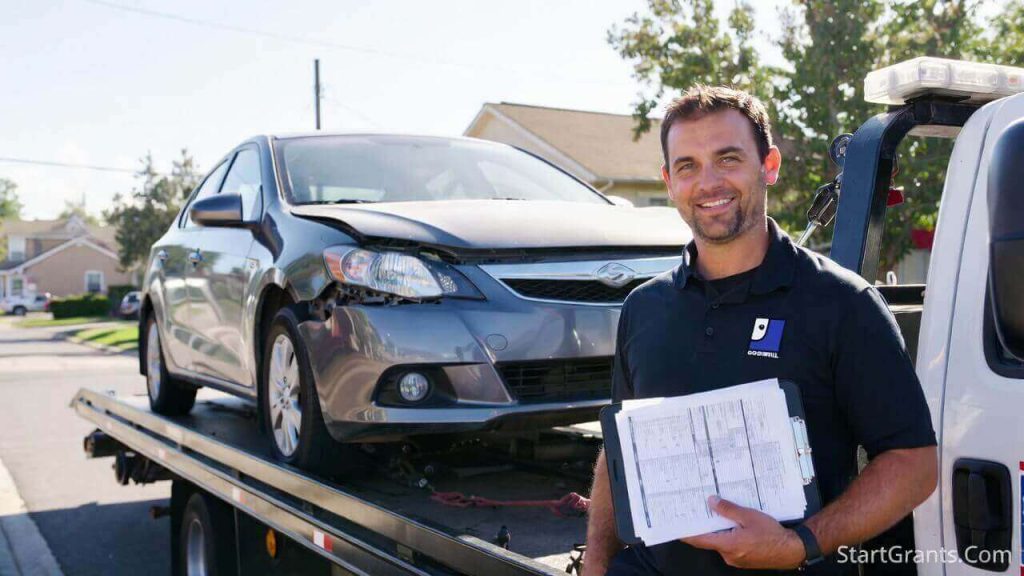
Confirm the pickup service and any charges with your local Goodwill vehicle program.
Where a Goodwill car donation can make a difference
Goodwill is known for stores, but its local organizations also provide employment-related services. Goodwill Industries International’s explanation of its local network describes a network of local organizations, rather than one uniform national vehicle donation operation. A participating local Goodwill may sell a donated vehicle and use resulting funds to support services under its own mission. Ask which organization will receive your gift, whether a partner handles the car, and how the proceeds are allocated.
Depending on the local organization, employment services may include job preparation, vocational training, help for people with disabilities, placement services, or support for people facing other barriers to work. Programs vary, so an individual car donation cannot be claimed to fund a particular certification course, a named participant, or a specific dollar amount unless that organization confirms it. The vehicle is commonly converted into funding; this article is not an offer to give the vehicle directly to a low-income household.
If a particular outcome matters to you, ask the local organization what it actually offers: training in a trade, help preparing a resume, employer introductions, or services tailored to people with disabilities. Its annual report or program page can be more informative than a generic promise that every car pays for a specific course. The proceeds from your own car might be small after transportation and sale costs, particularly if it is heavily damaged. Goodwill’s broader employment mission can still be a reason to give, but it should be described honestly.
How to find the actual vehicle program
A standard Goodwill thrift-store donation counter may not be equipped to receive a motor vehicle. Find your local organization’s website through Goodwill’s local organization locator and look for its current vehicle donation instructions. Confirm the legal recipient’s name and whether the site directs you to a separate vehicle processor. If a third-party form appears, verify it through the local Goodwill website before entering your address, VIN, or title information.
Does every local Goodwill use CARS?
No single processor should be assumed for the entire network. Some organizations use partners such as Charitable Adult Rides & Services (CARS); others may operate a different process or have no vehicle donation program. Ask who will answer questions, collect the car, sell or otherwise handle it, and issue the acknowledgment. Do not infer how much money returns to Goodwill merely from the processor’s name. If that amount matters to you, request the organization’s explanation of program expenses and beneficiary allocation.
Likewise, do not assume a nationwide free tow, a 24-hour hotline, or a pickup within a fixed number of days. The local program can explain its service area, schedule, fees if any, and procedure for remote or difficult-to-move vehicles.
Useful questions for the intake team: Is this a donation to the local Goodwill named on your site? Who will appear on my title and pickup receipt? Is the tow operator a contractor? Will the vehicle be sold, reused, or transferred another way? When will the charity send any tax acknowledgment? What changes if the vehicle cannot be loaded where it sits? Keep the answers with your donation records. These questions are especially useful when an advertising page or third-party form uses Goodwill’s name without making the receiving organization clear.
What kinds of vehicles might be accepted?
Give the intake team the year, make, model, VIN, location, general condition, and whether the vehicle starts and rolls. Include any missing wheels or tires, collision damage, lien, or title issue. A working car may have resale value; a nonrunning car may still be considered for parts or recycling. Acceptance and net proceeds depend on the program and real condition, not a universal rule that every damaged car has value.
- Running or nonrunning cars: Ask whether the program accepts the condition described and how it will collect the car.
- RVs, boats, motorcycles, ATVs, and commercial vehicles: Some processors consider these, but towing, storage, registration, and trailer needs can change the decision.
- Vehicles with missing parts: Explain what is missing rather than assuming that four inflated wheels are the only requirement.
- Vehicles with a lien or uncertain ownership: Ask what ownership and lien-release records are necessary before scheduling a transfer.
What if the title is missing?
Do not sign or hand over an incomplete document. Contact the state motor vehicle agency about replacing the title or other legally accepted proof of ownership, then ask the authorized Goodwill program what it can accept. Rules for co-owners, inherited vehicles, liens, and electronic titles differ. A missing paper title is a problem to resolve, but it is not accurate to claim that every state and every organization follows an identical prohibition.
For an older family car, also check whether the name on the registration and title matches the donor’s current legal name. A change after marriage or a death in the family can require more paperwork. If you have recently paid off financing, obtain the lender’s lien-release documentation and confirm when the state title record was updated. Avoid promising a pickup date to the charity until you know the papers are ready; a vehicle that can be moved physically may still be difficult to transfer legally.
Goodwill car donation: a practical four-step process
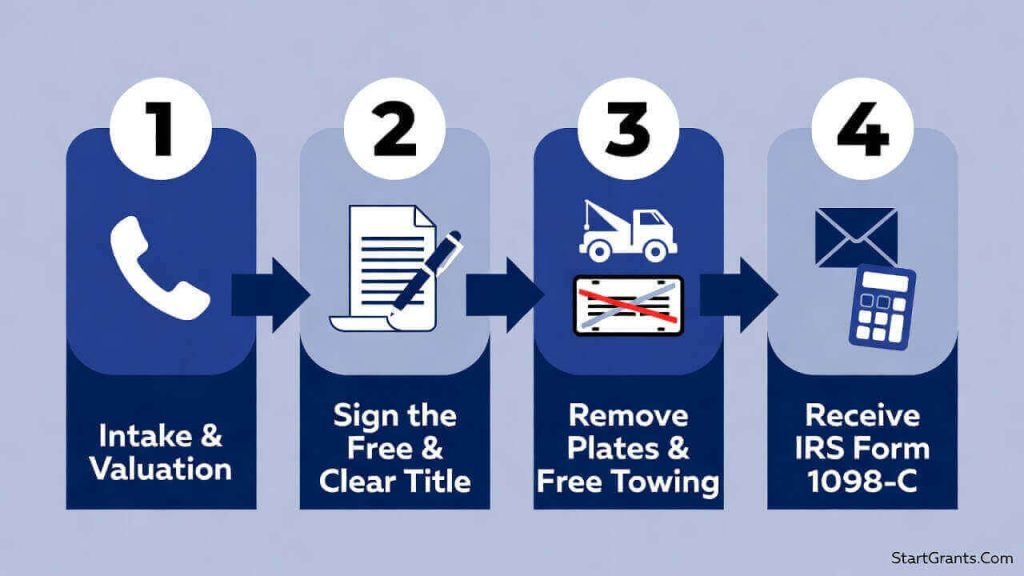
The local Goodwill and state motor vehicle agency supply the actual forms and timing.
Step 1: Confirm the recipient and arrange intake
Use the local Goodwill’s official website or its confirmed partner. Ask if it accepts your vehicle at your address, whether pickup is available, whether you would owe a fee, and where the proceeds go. The vehicle description helps the dispatcher plan appropriate equipment; a preliminary estimated value is not your IRS deduction. Record the intake confirmation and the organization’s legal name.
Step 2: Prepare the title and ownership documents
Review your state’s instructions for signing as an owner, any co-owner signatures, odometer statement, lien release, and a required notice of transfer. Follow the receiving program’s instructions for the name of the transferee; do not sign a blank transfer or guess which line the tow operator wants. If you have an unpaid auto loan, contact the lender and the program first. Paying it off or securing lender authorization may be necessary to transfer clear ownership, but neither the lien nor the donor’s faith changes state title law.
Step 3: Prepare for pickup and protect your information
Remove personal property and check the trunk and glove compartment. Delete paired phones, navigation addresses, and garage-door credentials when possible. Remove or close out toll transponders and ask the toll agency about linked plates. States differ on whether plates stay with the car, are removed, or must be surrendered. Keep insurance in place until you confirm the transfer and any state insurance requirements with your insurer and motor vehicle agency; there is no universal moment to cancel it.
At handover, confirm the operator’s identity and obtain a dated receipt that identifies the vehicle, recipient or agent, and transfer. Follow your state’s notice or registration steps afterward. For example, California DMV’s title-transfer guidance describes California’s title-transfer process; residents elsewhere must check their own state’s rules. Our California car donation guide provides state-focused context.
Ask whether the pickup operator needs keys, current registration, or access to a locked parking area. If the vehicle is in a garage, behind another car, or on a narrow street, disclose that before dispatch. Take photos of the vehicle and license plates for your own records, and note the odometer reading when required. If the scheduled tow is delayed, continue to follow state registration and insurance obligations until the actual transfer occurs. Once completed, keep the transfer confirmation separately from the initial pickup receipt; they document different stages.
Step 4: Keep acknowledgment and tax records
Save the initial receipt, signed title copies when lawful, transfer notice, and any later acknowledgment from the recipient. If the vehicle is sold, the organization’s final statement may report gross sale proceeds. Under applicable IRS rules, donors claiming certain vehicle deductions need Form 1098-C or a statement containing equivalent information; IRS Form 1098-C information explains the form. An initial towing receipt alone may not establish the deductible amount.
Understand the potential tax deduction before deciding
A vehicle donation is not automatically a tax refund. Your filing situation, recipient’s eligibility, vehicle’s fair market value, how the organization uses or sells it, and substantiation all matter. Check the recipient through IRS Tax Exempt Organization Search and review the current tax-year instructions. IRS Publication 526 explains that when a qualified charity sells an eligible vehicle and a donor claims more than $500, the allowable value is generally the lesser of the vehicle’s fair market value or the charity’s gross sale proceeds, unless a documented statutory exception applies. Additional reporting requirements may apply.
| What happens | General value rule | What to check |
|---|---|---|
| Charity sells a qualifying vehicle; claimed value above $500 | Generally the lesser of fair market value or gross sale proceeds | Qualified recipient, acknowledgment, Form 1098-C or equivalent, applicable filing requirements |
| Charity sells the vehicle for $500 or less | Generally the lesser of $500 or fair market value, subject to other limits | Actual fair market value and substantiation; $500 is a cap, not a guaranteed deduction |
| Charity makes qualifying significant use or improvement, or gives/sells it at a discount to a needy person for charitable purposes | A statutory exception may change the sale-proceeds limit | Specific certification and current IRS instructions |
These are general federal rules, not a calculation of your deduction. IRS requirements and individual tax circumstances determine any allowable amount.
For example, a donor should not assume that a $3,000 auction sale produces a $3,000 deduction: the vehicle’s fair market value, eligibility, and reporting still matter. A vehicle sold for $200 likewise does not automatically produce a $500 deduction. The amount may differ from the financial benefit that the local Goodwill receives after program expenses. Ask a qualified tax professional about your return rather than relying on an online resale estimate.
Illustrative calculation, not a tax estimate: suppose an otherwise eligible car has a supportable fair market value of $2,400 and a charity sells it for $3,000. Under the usual sale rule for a claim above $500, the smaller figure is $2,400, subject to the donor’s other tax requirements. If the same car instead sells for $1,900, gross proceeds generally set the lower ceiling. Neither example tells you how much your taxes fall, and neither applies automatically when an IRS exception for the charity’s use is documented. Keep the final acknowledgment rather than entering an appraisal or online listing price without checking the rules.
Three risks worth checking before the tow arrives
Insurance, plates, and state transfer
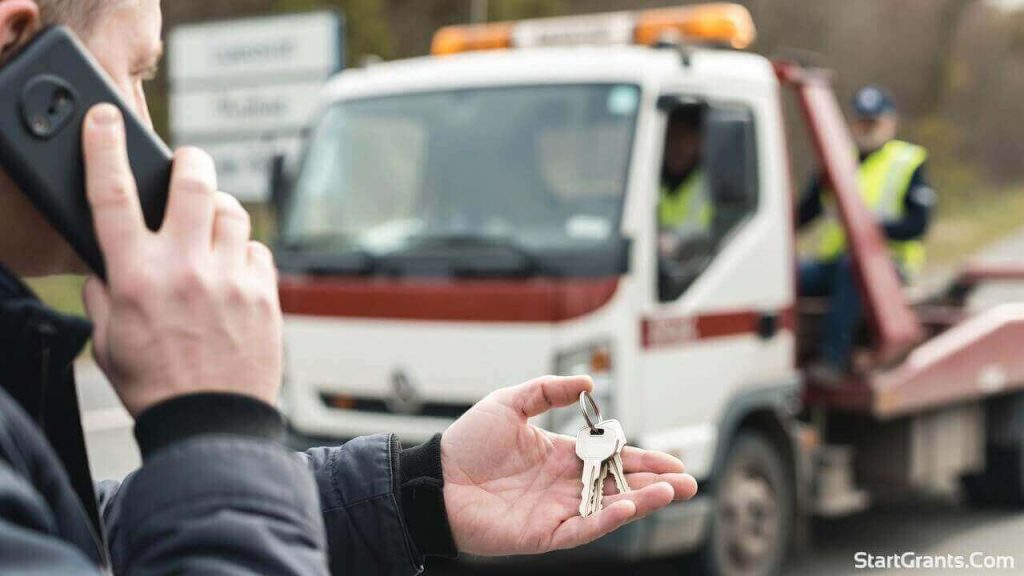
Confirm state transfer and insurance requirements before changing coverage.
Do not rely on the instruction to remove plates in every state or cancel insurance as soon as the vehicle leaves. First confirm the steps required by your state and insurer, then keep a record of dates and acknowledgment. A collection receipt, state transfer filing, registration change, and cancellation confirmation serve different purposes.
Lookalike donation pages and unclear intermediaries
Start from the local Goodwill organization found through Goodwill’s locator. Verify any linked vehicle processor before providing a VIN or identity information. Compare the legal recipient’s name with its tax-exempt listing if you plan to claim a charitable deduction. Do not assume that every processor is for-profit or that a particular partner keeps a fixed percentage without published evidence.
Toll tags and stored vehicle data
Remove toll devices and review linked plate accounts, garage remotes, parking passes, and any payment data in the car. Clear saved contacts or GPS destinations where practical. Keep proof of the transfer and check later notices; a sale through an auction does not automatically close your toll or registration accounts.
Some vehicles also store preferred destinations in a separate navigation account or companion mobile app. Sign out of those services if available and review connected payment settings. If you receive a toll or parking notice dated after the handover, use your recorded transfer date, receipt, and state confirmation to contest it through the issuing agency’s process. Do not assume that simply deleting an app from your phone cancels a toll tag or ownership record.
A Muslim Perspective
Some Muslim donors view a vehicle gift supporting job access as voluntary sadaqah. Confirm where the proceeds go if that purpose matters to your giving. A car with an outstanding loan raises practical questions about ownership and lender consent; ask your lender and state agency what is needed before transfer. Questions about riba or whether a particular gift qualifies as zakat call for a qualified adviser and the recipient’s distribution policy. Do not assume that donating to Goodwill automatically meets a zakat obligation.
Keeping an honest record of the condition, recipient, and handover supports the charitable intent and prevents disputes. A possible U.S. tax deduction is governed by tax law; neither a religious motive nor a desire to maximize a deduction changes the evidence needed for the claim.
Compare other vehicle donation purposes
Goodwill may be a fit if you want to support the work of a participating local organization. If you are comparing a different mission, read about Salvation Army vehicle donation, Make-A-Wish vehicle donation, Purple Heart vehicle donation, or KQED vehicle donation. Each has its own recipient, program terms, and operating model; verify current details on the actual charity’s site before choosing.
Frequently Asked Questions
Does Goodwill accept cars that do not run?
Some local Goodwill vehicle donation programs consider nonrunning cars, but acceptance depends on the organization, location, condition, title, and towing logistics. Confirm the vehicle details with the specific program before arranging pickup.
Is towing free for every Goodwill car donation?
Do not assume nationwide free towing. Ask the local Goodwill or its authorized processing partner whether pickup is available at your location, whether it costs anything, and who will collect the car.
Can I donate a car without a title?
Title requirements vary by state and by receiving program. Contact the local Goodwill and your state motor vehicle agency before proceeding; a replacement title or other approved ownership documentation may be required.
How much can I deduct for donating a car to Goodwill?
A deduction is not guaranteed. If the gift qualifies and the charity sells an eligible vehicle, a claimed deduction over $500 generally cannot exceed the lesser of the vehicle’s fair market value or the charity’s gross sale proceeds, unless a statutory exception applies. Other tax and documentation rules also matter.
When will my donated car be picked up?
Timing depends on the local program, your location, vehicle condition, paperwork, and the tow provider’s availability. Ask for a pickup window and a written handover record instead of relying on a nationwide turnaround estimate.
Will Goodwill take an RV, boat, motorcycle, or ATV?
Some local programs consider additional vehicle types, but acceptance, towing, and title rules vary. Identify the exact item and its condition when contacting the authorized program.
Do I need a smog certificate or emissions test before donating?
Requirements depend on the state and the way ownership is transferred. Do not assume that a charitable transfer automatically waives every emissions requirement; ask the local vehicle program and state motor vehicle agency.
Can I drop off a vehicle at a Goodwill store?
Do not leave a vehicle at a retail donation site without written instructions. Ask the local vehicle donation program whether it offers an authorized drop-off location and what documents you must bring.