
Last Updated: May 2026 | Author: Zee
The hidden cost of higher education is transportation. While scholarships and federal grants might cover your tuition and textbooks, they rarely account for the fact that you still need a way to physically get to campus, commute to your unpaid internship, or clock in at your part-time job. For low-income college students and adult learners without access to reliable public transit, a broken-down car is not just a mechanical issue; it is a financial crisis that can force you to drop out of school entirely.
When desperate students face this crisis, their first instinct is often to sign a predatory, high-interest auto loan just to stay afloat. Do not fall into this trap.
The Baseline Strategy: You are already fighting an uphill battle against educational debt. Before you take on the massive financial burden of a predatory auto loan, you must review our master guide on government grants for student loan repayment to ensure your existing federal debt is managed properly. Once your educational debt is legally minimized, you must pivot to addressing your transportation needs using the national philanthropic infrastructure. In this tactical guide, we will reveal how low-income students can access free donated vehicles, highly subsidized car ownership programs, and campus-based transit grants.
When your financial aid exceeds the cost of your tuition, the university will issue you a “refund check” for your living expenses. Many students immediately think this money can be used to buy a reliable vehicle to get to class.
CRITICAL WARNING: The Title IV Car Purchase Ban
Do not use your Federal Pell Grant or federal student loan refund checks to buy a car outright. Even if you have successfully completed your application and received a massive refund check, Title IV rules state that financial aid can be used for “transportation expenses” (such as gas, insurance, repairs, and bus passes), but it is strictly illegal to use federal funds to purchase a vehicle. The Legal Workaround (Expense Swapping): If you need a car, you must use a strategy called “Expense Swapping.” Use your federal grant refund strictly to pay your rent and buy groceries. By doing this, you free up your personal work income. You can then legally use your personal paycheck to buy a used car.

Non-profit car donation programs rescue thousands of low-income students from transportation crises, allowing them to commute to campus and graduate.
Phase 1: The National Charity Infrastructure (1-800-Charity Cars)
The federal government does not have a direct program that hands out free cars to college students. However, the government heavily subsidizes the non-profit sector by offering massive tax write-offs to wealthy citizens who donate their used vehicles to charity. This creates a massive, nationwide inventory of free cars that are specifically reserved for low-income individuals.
If you are a student struggling to survive, your first target should be the 1-800-Charity Cars program (also operating as FreeCharityCars.org). Since its inception, this organization has distributed thousands of free, reliable vehicles to struggling families, victims of domestic violence, and individuals transitioning from public assistance to the workforce.
To win a vehicle through this program, you do not just fill out a form and wait. It operates on an active community-voting system. You must create a profile, share your story—detailing exactly how the lack of a car is preventing you from finishing your college degree and escaping poverty—and gather votes from the online community.
Phase 2: Regional Powerhouses (Subsidized Ownership)
If you need a car immediately and cannot wait for a national voting process, you must target regional “Welfare-to-Work” transportation programs. While these organizations primarily target single parents and low-income workers, college students who are actively employed or participating in job-training programs often qualify.
Vehicles for Change (Mid-Atlantic Region)
If you live in Maryland, Virginia, or the surrounding areas, Vehicles for Change is the premier auto grant organization. They repair donated cars and award them to eligible low-income families for as little as $900. While not 100% free, this is a massive grant that bypasses traditional auto financing. To qualify, you must be working at least 30 hours a week (or balancing work and school) and secure a referral from a partnering social service agency.
Good News Garage (New England)
Operating in states like Massachusetts, Vermont, and New Hampshire, the Good News Garage partners directly with state government agencies (like the Department for Children and Families) to distribute free refurbished cars. If you are a low-income student who is also receiving state assistance (such as SNAP or TANF), you may be eligible to receive a completely free, inspected vehicle simply by requesting a referral from your state caseworker.
You do not have to resort to high-interest used car lots. Watch this in-depth breakdown from MotorWeek detailing exactly how non-profit organizations refurbish donated vehicles, train mechanics, and hand the keys directly to low-income families and students to help them achieve financial independence:
Phase 3: Campus-Based Emergency Retention Grants
Sometimes, the solution to your transportation crisis is not acquiring a completely new vehicle, but simply finding the cash to fix the one you already have. A blown transmission or a broken alternator can cost anywhere from $500 to $2,000. If you do not have this cash, you do not have to resort to high-interest payday loans.
Instead, you must look inward at your university’s financial aid department.
The FSEOG and Emergency Relief Funds
The federal government provides participating universities with the Federal Supplemental Educational Opportunity Grant (FSEOG). While this is typically awarded to undergraduates with exceptional financial need to cover tuition, many universities maintain a separate, private pool of “Emergency Retention Grants.”
These emergency grants are specifically designed for one purpose: to prevent a student from dropping out due to a sudden, unforeseen financial crisis. If your car breaks down and you cannot commute to campus, you must immediately march into your financial aid office. Bring the mechanic’s written estimate for the repair. Explain clearly that without a functional vehicle, you will be forced to withdraw from the semester. Universities will often issue a one-time, tax-free emergency grant of $500 to $1,000 to cover the car repair directly, ensuring you stay enrolled.
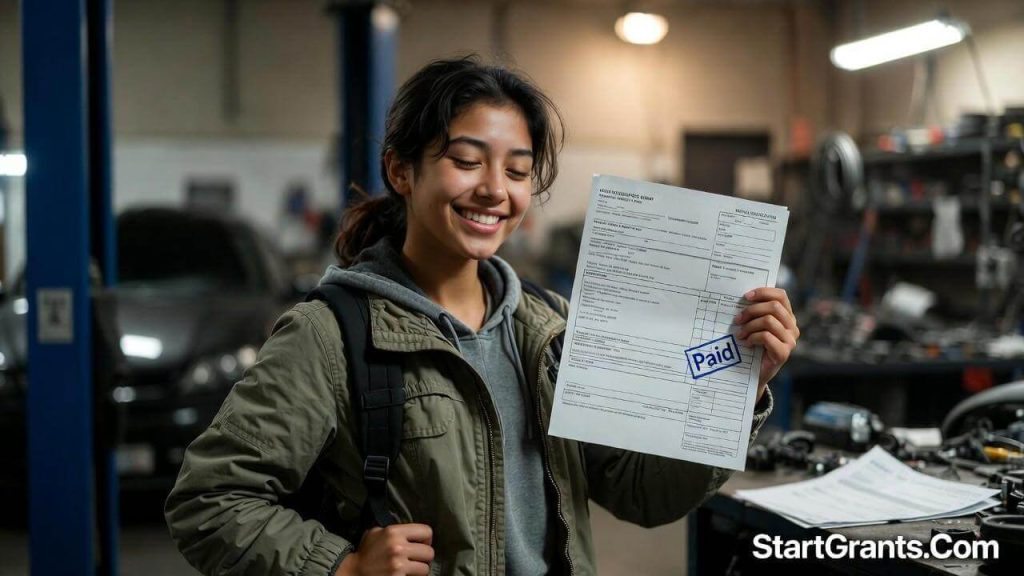
Many universities offer one-time emergency retention grants to help low-income students pay for critical car repairs and avoid dropping out.
Phase 4: The Muslim Perspective (Navigating Transportation Without Riba)
For Muslim college students, acquiring a vehicle presents a severe spiritual roadblock. The vast majority of standard auto dealerships push buyers into high-interest auto loans. Engaging in these contracts violates the strict Islamic prohibition against Riba (usury).
When you are a broke college student, the temptation to sign a predatory, 15% interest loan just to get a reliable car is immense. You must resist this. Your strategy must focus on completely bypassing traditional auto financing.
First, aggressively pursue the non-profit donation routes mentioned above, such as 1-800-Charity Cars, which award vehicles completely free of debt. Second, if you must purchase a vehicle, avoid dealership financing entirely. Utilize your community network. Many local Islamic centers and Muslim philanthropic organizations offer interest-free (Qard Hasan) micro-loans for essential living expenses, including buying a cheap, reliable “cash car” outright. Never compromise your spiritual integrity for a depreciating asset; the philanthropic infrastructure exists to keep you debt-free.
Phase 5: Bridging the Gap (Relocation Strategies)
What happens if you are placed on a two-year waiting list for a charity car, and your university denies your request for emergency repair funds? You cannot simply give up and drop out. You must change the battlefield.
If you cannot afford to maintain a car to commute 30 miles to campus, the most mathematically sound decision is to eliminate the commute entirely. You need to move closer to your university or secure on-campus housing. While breaking a lease and renting a moving truck is expensive, the financial aid system can absorb this shock. To execute this maneuver successfully, you must review our tactical guide on securing grants for moving expenses so you can relocate to a walkable distance from your classes without draining your bank account.
Conclusion: Securing Your Commute
Transportation is the hidden barrier to higher education, but it is a barrier you can strategically dismantle. Car grants for students are not cash checks handed out by the government; they are highly targeted, philanthropic safety nets designed to keep you enrolled.
Your first line of defense is the massive network of vehicle donation charities like 1-800-Charity Cars and regional powerhouses like Vehicles for Change. If you already own a vehicle that needs critical repairs, weaponize your university’s emergency retention grants and FSEOG funds to pay the mechanic. For Muslim students, navigating these zero-interest channels is not just a financial tactic, but a spiritual necessity to avoid predatory Riba.
Do not fall for internet scams promising ‘free government cars.’ The government does not mail out car keys. Instead, they fund local Community Action Agencies and provide Pell Grants to offset your living expenses. Take control of your commute. Call your local 211 hotline today, ask for transportation assistance programs, and secure the mobility you need to finish your degree.
Frequently Asked Questions (FAQs)
Q1: Does the government give out free cars to college students?
A: No. The federal government does not have a program that directly hands out free cars to individuals. However, the government heavily subsidizes the non-profit sector through tax write-offs, allowing charities to collect donated vehicles and distribute them to low-income students and families.
Q2: How can I apply for a charity car?
A: You must apply through national organizations like 1-800-Charity Cars or regional programs like Vehicles for Change. The application process usually requires you to prove your low-income status, share your story, and demonstrate that a vehicle is absolutely necessary for you to maintain employment or attend college.
Q3: Will my university pay to fix my broken car?
A: They might. Many universities offer “Emergency Retention Grants” funded by private endowments or federal FSEOG money. If you can prove to your financial aid office that you will be forced to drop out because you cannot afford a critical car repair, they may issue a one-time grant to cover the mechanic’s bill.
Q4: What is the Good News Garage?
A: Operating primarily in the New England region, the Good News Garage is a massive non-profit that repairs donated vehicles and provides them to low-income individuals. To qualify, you usually need a direct referral from a state social services agency.
Q5: Can international or Muslim students get car grants?
A: Yes. Charity car programs do not discriminate based on religion. For Muslim students specifically looking to avoid interest (Riba) on auto loans, securing a donated vehicle through a non-profit or seeking an interest-free community micro-loan is the most effective way to secure transportation without compromising spiritual beliefs.
Q6: Does Vocational Rehabilitation provide cars for students with disabilities?
A: Vocational Rehabilitation (VR) will rarely buy a car outright, but if you have a documented disability, they will often pay 100% of the cost to modify an existing vehicle (such as installing hand controls or wheelchair lifts) so you can commute to college.
Q7: What is the “Ways to Work” auto loan program?
A: Ways to Work is a program run by some Community Action Agencies that provides very low-interest auto loans (typically for cars under $10,000) to low-income individuals with bad credit who need transportation to remain in school or keep their jobs.
Q8: Is it legal to use student loans for gas and car insurance?
A: Yes. Gas, routine maintenance (like oil changes), and car insurance fall under the ‘Cost of Attendance’ transportation allowance. You can legally use your student loan or grant refund checks to pay for these specific commuting expenses.
Important Disclaimer: StartGrants.com is an independent information portal. We are not a government agency and do not provide direct grants or products. Always verify the current status of programs with the providing organization.