Last Updated: | Author: Munir Ardi
Quick answer: Many U.S. maternity units provide diapers, wipes, basic newborn-care items, disposable underwear, maternity pads, and a peri bottle for use during the hospital stay. Some also provide formula when needed, breastfeeding supplies, a newborn hat, or other items. However, there is no nationwide take-home package, and an item available in your room is not automatically yours to keep.
These supplies may not be free in the strict sense. Their cost may be included in a facility charge, covered by insurance or Medicaid, treated as a hospital amenity, or billed separately. Before packing anything, ask your nurse which patient-specific supplies may go home and which items belong to the hospital.
If you need more than a short-term hospital supply, start with our broader guide to free baby stuff for low-income families.
What Baby Supplies Do Hospitals Usually Provide?
Hospital packing lists illustrate why local confirmation matters. Kaiser Permanente lists newborn diapers, swaddling blankets, and hats among items generally available, while Banner Health lists diapers, wipes, postpartum products, breastfeeding support, and formula when medically needed. These examples describe their facilities and do not create a national entitlement. Check the Kaiser Permanente hospital-packing guidance and Banner Health maternity packing list.
| Category | Often available during the stay | What to confirm |
|---|---|---|
| Diapering | Newborn diapers, wipes, and disposable changing pads | Whether patient-specific leftovers may go home |
| Newborn care | Bulb syringe, hat, simple shirt, comb, or baby-care products | Which products are assigned to your baby and which belong to the unit |
| Postpartum recovery | Disposable underwear, maternity pads, peri bottle, cold packs, and perineal-care products | What is appropriate after your type of delivery and what may go home |
| Feeding | Lactation support, access to a hospital-grade pump, pump parts, bottles, or formula when appropriate | Whether any pump kit, storage container, nipple, bottle, or formula is supplied for discharge |
| Clothing and linens | Gowns, towels, pillows, swaddling blankets, hats, or shirts | Whether the item is a gift, a disposable item, or reusable hospital property |
Important: This is a comparison of commonly reported categories, not a promise from any hospital. Supplies, billing, feeding practices, and take-home rules can change.
A digital thermometer, pacifier, nipple shield, manual pump, newborn outfit, sleep sack, or large formula supply should be treated as a possible extra—not a standard benefit.

Maternity units commonly keep basic newborn supplies in the room, but families should ask which items may be taken home.
Can You Take Leftover Hospital Supplies Home?
Often, but only when the supplies were issued for you or your baby and a staff member confirms that they may go home. Some facilities allow patients to keep opened disposable packages that cannot return to general stock. That is a local policy and infection-control practice—not a universal law that makes every item in the room yours.
Before discharge, gather the remaining supplies and ask, “Which of these items should we take home, and which should stay here?”
Items you may be allowed to keep
- Opened diapers and wipes assigned to your baby
- A bulb syringe or another single-patient newborn-care item
- Disposable underwear, pads, peri bottle, and cold packs issued for your recovery
- A personal pump kit or tubing that the hospital cannot reuse
- Formula bottles or feeding supplies specifically provided for discharge
Items that usually remain hospital property
- Hospital-grade electric breast pumps
- Bassinets, monitors, and reusable medical equipment
- Pillows, sheets, towels, gowns, and reusable swaddling blankets
- Unopened bulk supplies from a cart, cabinet, or storage room
Some facilities intentionally give a hat, shirt, blanket, sleep sack, diaper bag, or keepsake. Others provide similar items only during the stay. Ask rather than relying on appearance.
Formula, Breastfeeding, and Pumping Supplies
Tell the care team how you plan to feed your baby and ask for clear, nonjudgmental instructions. What is supplied should reflect the feeding plan, clinical needs, and hospital policy.
If you use infant formula
The hospital may use small ready-to-feed bottles and disposable nipples while the baby is admitted. Some facilities provide a limited discharge supply; others do not offer formula samples to take home. Before leaving, confirm the product, feeding amount, storage instructions, and how you will obtain the next supply.
Use only unopened, unexpired formula intended for your baby and follow the label and discharge instructions. CDC guidance says prepared formula should generally be used within two hours of preparation and within one hour after feeding begins; leftovers from a feeding should be discarded. Powdered formula is not sterile, and extra precautions apply to babies younger than two months, babies born prematurely, and babies with weakened immune systems. Review the CDC formula preparation and storage guidance.
If paying for formula will be difficult, use our guide to baby formula assistance programs and check what WIC covers for newborns. Hospital samples are not a dependable long-term supply.
If you breastfeed or pump
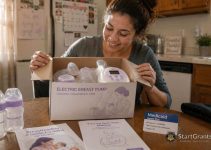
You may receive help from a nurse or lactation professional and access to a hospital-grade pump. Depending on the facility and your needs, you might receive a personal pump kit, storage containers, breast pads, lanolin, hydrogel pads, or a nipple shield. Ask for fitting and use instructions; availability is not guaranteed.
HealthCare.gov states that most Marketplace and other non-grandfathered health plans must cover breastfeeding support, counseling, and a breast pump. The plan may decide whether the pump is manual or electric, rented or purchased, and when it can be obtained. See the official breastfeeding-benefits guidance. Medicaid rules and suppliers vary by state and plan; our separate guide explains how to request a breast pump through Medicaid.
Will the Hospital Give You a Free Car Seat?
Usually not. There is no nationwide requirement that every hospital give families a car seat. The facility may require a safe transportation plan, but discharge procedures and state child-restraint laws vary.
Some hospitals, public health departments, health plans, and community organizations operate limited car-seat programs. Apply before delivery rather than depending on last-minute inventory. See ways to find a free or low-cost infant car seat. NHTSA also provides official car-seat selection, installation, and inspection resources.
What Changes if Your Baby Is in the NICU?
NICU supplies are selected for medical care rather than a standard giveaway package. The unit provides what the baby needs while admitted. At discharge, the team may teach caregivers about specialized formula, fortified breast milk, medications, feeding equipment, monitors, or other prescribed products. Take-home equipment depends on the discharge plan, insurance authorization, supplier arrangements, and clinical need.
Ask for the NICU social worker or case manager early. They may assist with insurance coordination, equipment orders, WIC referrals, transportation, lodging, and hospital financial assistance. Our focused resource covers financial assistance for NICU parents.
Could These Supplies Appear on Your Hospital Bill?
Possibly. A facility may include routine products in a bundled charge, list some supplies separately, or treat particular items as no-charge amenities. Coverage and patient cost-sharing also vary. Taking home a patient-specific leftover does not necessarily generate a new charge at discharge, but no national rule makes every item free.
- Compare the provider bill with your insurer’s Explanation of Benefits.
- Ask the billing department for an itemized bill if a charge is unclear.
- Question duplicate charges, products you did not receive, or a balance that does not match the Explanation of Benefits.
- Ask for the hospital’s written financial-assistance policy before putting an unaffordable balance on a credit card.
The CMS medical-bill rights portal explains federal protections against certain surprise bills. For broader options, see help paying hospital bills after childbirth.
A Muslim Perspective
Confirming that a supply was given to you supports amanah and avoids uncertainty about ownership. Do not assume that unopened hospital stock or reusable property is a gift.
If a hospital balance is unaffordable, request its charity-care policy and ask whether an interest-free installment arrangement is available. Review third-party medical financing carefully: the Consumer Financial Protection Bureau’s medical-financing guidance warns that some products use deferred interest or other costly terms. A family experiencing genuine hardship may also ask a mosque or Muslim charity about zakat, sadaqah, or baby-supply assistance, but eligibility is determined by the organization. Consult a qualified scholar about a specific contract or religious ruling.

Before discharge, ask which patient-specific postpartum and newborn supplies may be packed.
How to Ask for Supplies Respectfully
Be direct and specific. Staff may have limited discretion or may refer you to a social worker.
Do not remove unopened bulk packages from a cart or storage area. If the unit cannot provide more supplies, ask for a diaper-bank, WIC, health-department, hospital-foundation, or community referral.
Call Before Delivery: Questions to Ask
- Which newborn and postpartum supplies are available during the stay?
- Which patient-specific leftovers may be taken home?
- What must we bring for the trip home?
- Does the unit provide formula, lactation supplies, or personal pump parts at discharge?
- Could any supplied products appear as separate charges?
- Can a social worker help with diapers, feeding supplies, a car seat, or the bill?
Save This Hospital Discharge Supplies Checklist
[ ] Call labor and delivery and ask what the unit supplies.
[ ] Pack a going-home outfit and an appropriate car seat.
[ ] Confirm which disposable leftovers may go home.
[ ] Leave reusable equipment, linens, and unopened unit stock.
[ ] Ask for written feeding and product-use instructions.
[ ] Request a social-worker referral before discharge if supplies are unaffordable.
[ ] Review the itemized bill and Explanation of Benefits.
If the Hospital Supply Is Not Enough
Hospital leftovers are a short-term bridge. For ongoing needs:
- Diapers: Use our guide to emergency diaper assistance near you.
- Safe sleep: Ask for a local referral and review free crib and safe-sleep programs.
- Clothing: Check verified free baby clothing programs.
- Starter samples: Compare the real requirements and costs of baby boxes and welcome kits.
Frequently Asked Questions
Can I ask the nurse for extra diapers before I leave?
Yes. Explain that you are on a tight budget and ask whether a small additional supply is available. The hospital may provide some, limit the amount, or refer you to a social worker or local diaper program.
Do hospitals give newborns free pacifiers?
Some do, but not all. Availability can depend on hospital policy, your feeding plan, and the baby’s medical needs. If a pacifier was opened for your baby, ask whether it may go home.
Will taking leftover supplies add charges to my bill?
Not necessarily, but hospitals bill supplies differently. Confirm what may go home and review the itemized bill and Explanation of Benefits instead of assuming every product was free.
Can I take formula home if I am breastfeeding?
Ask the baby’s care team. Hospitals may not distribute routine formula samples, and any supplementation should fit your informed feeding plan or a medical recommendation. If formula is provided, confirm how to store and use it safely.
Do hospitals give you a breast pump to keep?
A hospital-grade pump used during admission normally remains hospital property. A personal manual pump or pump kit may sometimes be provided. For a take-home pump, check your health plan’s requirements and approved supplier.
Do I need to bring a going-home outfit and car seat?
Bring a weather-appropriate outfit. If the baby will travel in a vehicle, arrange an appropriate rear-facing car seat. Do not assume the hospital will provide either item.
Can I take the hospital’s receiving blanket home?
Only if staff confirms that it is a gift. Reusable swaddling blankets and other linens often belong to the hospital, although some facilities give families a blanket or sleep sack.
Important Disclaimer: StartGrants.com is an independent information portal. It is not a hospital, insurer, government agency, medical provider, or supplier of baby products. Hospital inventory, take-home rules, billing, insurance coverage, and assistance eligibility vary. Confirm details with your hospital and health plan, and follow instructions from your medical team and product manufacturer.