Last Updated: | Author: Munir Ardi
Dental patient assistance programs can help eligible people obtain covered, discounted, or donated treatment. The main routes are Medicaid or CHIP, community health centers, dental schools, charitable clinics, and programs serving specific patients. There is no single program that guarantees free dental work for everyone, and assistance often comes as treatment rather than a cash grant.
Start with your dental needs, existing coverage, and ability to pay. This guide helps patients choose a route and find the next application or provider. Our broader dental grants and financial assistance directory also distinguishes patient assistance from funding for dental education.
Compare Dental Assistance Options
| Route | Who Should Check It | What to Confirm |
|---|---|---|
| Medicaid or CHIP dental benefits | Enrolled children and eligible adults | Covered procedures, state rules, participating dentists, and authorization |
| Health center sliding fee program | Patients needing affordable local care, including uninsured people | Dental services, income documentation, discount, and remaining charge |
| Dental school clinic | Patients whose treatment needs fit a teaching clinic | Case acceptance, supervised care, fees, and appointment schedule |
| Free clinic or charitable event | People seeking services offered by a local event or clinic | Current dates, intake rules, procedures, and capacity |
| Donated Dental Services | Financially eligible adults meeting age, disability, or medical criteria | Local application status, treatment suitability, and waitlists; not emergency care |
| Specialized charitable program | Applicants meeting a program’s orthodontic or survivor criteria | Eligibility, fees, exclusions, volunteer availability, and approval before treatment |
Benefits, fees, application acceptance, and provider availability change. Confirm current terms directly. A discount is not a grant, insurance is not donated care, and financing is debt.
Emergency Dental Assistance
For an urgent dental problem, seek an assessment before researching long-term funding. A hospital ER can assess serious symptoms and provide appropriate emergency medical care, although definitive dental treatment may still require a dentist. Do not assume all ER visits result in the same prescription or that hospital dental services are prohibited by law.
At most Medicare-participating hospital emergency departments, EMTALA requires screening for an emergency medical condition and stabilization or an appropriate transfer when necessary, regardless of ability to pay. It does not make the visit free. Review CMS emergency room rights and ask about hospital financial assistance after urgent needs are addressed.
For clinic calls, after-hours options, and a staged treatment plan when you cannot pay upfront, use our guide to finding urgent dental care with little or no money. Free events and long-waitlist charities are not substitutes for timely emergency assessment.
Community Health Centers: Income-Based Dental Care
HRSA-funded health centers serve insured and uninsured patients, and many offer dental care. Use HRSA’s Find a Health Center tool, then call the listed location to ask which dental services it actually provides. HRSA’s affordable healthcare resources explain this route.
The sliding fee discount program uses income and family size. For services subject to the program, patients at or below 100% of the federal poverty guidelines receive a full discount, although a nominal charge may apply. Partial discounts apply above 100% through 200%. Clinics set their schedules within applicable requirements; there is no universal $15–$30 visit price or standard set of discount percentages. See HRSA’s sliding fee rules.
Ask which documents are accepted and what alternatives exist if you lack a pay stub or tax return. If you cannot pay the discounted charge, explain that and request help under the clinic’s inability-to-pay and billing policies. Neither a locator listing nor a discount guarantees an immediate appointment, dentures, or implant treatment.
Dental Schools, Free Clinics, and Local Referrals
Dental schools may provide reduced-fee treatment by students supervised by licensed dentists. Dental hygiene schools may offer preventive services. These are different services, and neither option guarantees free comprehensive care. The National Institute of Dental and Craniofacial Research’s dental care guide explains how to find these resources.
Ask about screening charges, case acceptance, urgent intake, appointment length, and the cost of the complete treatment plan. Some teaching appointments take longer or require repeated visits, so consider transportation and time away from work.
For charitable events, consult America’s Dentists Care Foundation’s Mission of Mercy and other free clinic listings. Confirm the specific organizer’s patient instructions; services and intake rules differ. Remote Area Medical’s patient FAQ explains that its clinics operate first come, first served with limits based on volunteer availability and capacity.
Call 211 or review its healthcare expense resources for local referrals and transportation assistance. A referral does not mean funding or treatment has been approved.
Donated Dental Services for Eligible Adults
Dental Lifeline Network’s Donated Dental Services program coordinates donated comprehensive treatment for financially eligible adults. Applicants must meet at least one eligibility category: age 65 or older, permanent disability, or a qualifying medical need. Available insurance and benefits must be used first. Treatment depends on the volunteer dentist; implants, sedation, and complex care may not be provided. Review the official DDS application and eligibility requirements.
Use the state program directory to check whether applications are accepted in your area and whether an exception applies. Do not assume that every county is open or that veteran status automatically guarantees acceptance.
DDS is not an emergency service. Its official FAQ warns that waitlists and the time needed to connect patients with dental offices make it unsuitable for urgent treatment.
Dental Benefits and Assistance for Specific Patients
Children: Medicaid, CHIP, and Routine Care
Medicaid covers dental care for enrolled children through EPSDT, including pain and infection relief, tooth restoration, and maintenance of dental health. CHIP also requires dental coverage. EPSDT is a benefit, not a loophole or cash grant. Adult Medicaid dental benefits vary by state. See the federal Medicaid dental overview.
Use the InsureKidsNow dentist locator, then confirm that the office accepts your child’s plan and new patients. Our children’s dental assistance guide focuses on that separate pathway.
Braces: Charitable Treatment Can Still Have Fees
Start by asking your child’s plan about medically necessary orthodontic coverage and authorization. Charitable orthodontic programs have separate eligibility rules and limited provider availability:
- Smiles Change Lives currently lists ages 7–18, financial and clinical criteria, a $30 nonrefundable application fee, and a $650 nonrefundable required family contribution per child.
- Smile for a Lifetime currently lists ages 10–18, financial, dental, and school-related criteria, a $20 application fee, and a $480 final fee after approval and provider matching. Prequalification does not guarantee a scholarship.
These fees were checked October 10, 2026. Read the current application before paying; eligibility, fees, and matching availability can change.
Our guide to assistance with children’s braces covers the orthodontic search in more detail. Treat cavities and urgent problems rather than waiting for an orthodontic award.
Pregnant Patients
Pregnancy does not create an automatic nationwide dental grant or identical dental benefits in every state. Confirm your state Medicaid benefits, coverage period, and participating providers. The ADA’s pregnancy guidance states that necessary preventive, diagnostic, restorative, and surgical dental care is safe throughout pregnancy. Tell your dentist about the pregnancy and medications; coordinate individual questions with your prenatal clinician.
Use our dental assistance guide for pregnant patients as the topic-specific route, while verifying coverage with your state and treatment recommendations with your clinicians.
Older Adults and People With Medicare
Original Medicare usually does not cover routine dental care, dentures, or implants. It may cover specific dental services linked to certain covered medical treatments, including qualifying transplant, cancer treatment, and dialysis situations. Coverage is not limited to life-threatening dental emergencies. Review Medicare’s current dental coverage explanation.
Some Medicare Advantage plans offer dental benefits, but services, networks, limits, and patient costs differ. The CMS dental coverage guidance explains this distinction. Review the actual plan documents rather than assuming a standard dental allowance or switching coverage solely for an advertised benefit.
Our dental assistance guide for seniors with Medicare addresses the age and coverage pathway; community clinics and DDS may also be relevant.
Veterans
VA dental care depends on the veteran’s benefits class and circumstances, not simply enrollment in VA healthcare. For example, a compensable service-connected dental condition falls under Class I; qualifying 100% disability or individual unemployability circumstances fall under Class IV. Other classes provide different services. Check the official VA dental eligibility guide before assuming coverage.
For the separate veteran pathway, see our guide to dental benefits and assistance for veterans. VA benefits and charitable donated care are distinct options, each requiring its own eligibility review.
Dentures, Restorative Treatment, and Cosmetic Offers
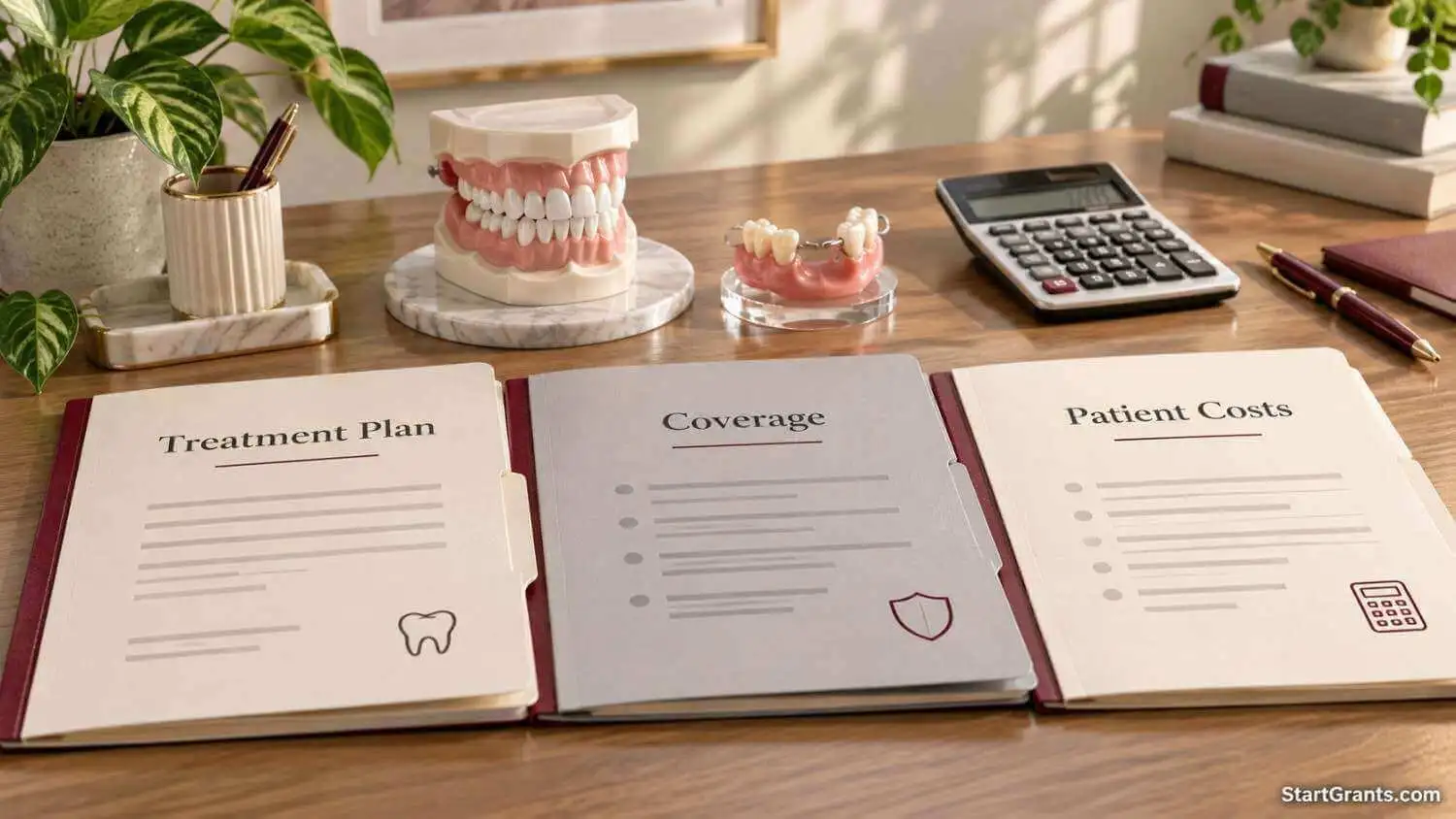
Ask a dentist to distinguish treatment needed for health and function from elective cosmetic work. For missing teeth, request appropriate options and itemized costs, including extractions, laboratory work, adjustments, and follow-up. A discount on one procedure may not cover the rest of the plan.
Our guide to denture assistance and funding options focuses on replacement teeth. Confirm whether your insurer, clinic, or donated-care program covers the proposed denture and all associated services.
An offer advertised as a cosmetic dentistry grant may be a partial discount restricted to participating dentists. Obtain the regular price, reduction, remaining patient balance, conditions, and financing terms in writing. Our review of cosmetic dentistry grants and discounts examines that specific search. Do not assume implants, veneers, or full-mouth restoration will be free.
Dental Injuries Related to Domestic or Sexual Violence
Give Back a Smile coordinates donated treatment for eligible adult survivors with dental injuries related to abuse. Its current application screens for damaged or missing front teeth, being away from abusive situations for at least one year, and the ability to complete multiple appointments. Treatment and volunteer availability are not guaranteed; implants are not standard treatment. Start with the official Give Back a Smile application page.
The linked current sample application and criteria specify a $20 application fee, exclusions, and online-only submission. They also distinguish optional permission to share a story or images from application information. Read privacy and consent choices carefully, especially if contact from an organization could create a safety concern.
Our dental assistance guide for survivors of domestic violence covers this specialized need. Recent injuries and urgent symptoms need clinical attention rather than waiting to satisfy a charity’s eligibility period.
How to Apply Without Taking on Unnecessary Debt
- Get a diagnosis and written plan. Ask which procedures are urgent, what alternatives are appropriate, and what each stage costs.
- Verify existing benefits. Ask about participating providers, authorization, limits, and remaining patient charges before nonemergency treatment.
- Confirm program fit and current intake. Check age, income, medical criteria, geographic coverage, fees, waitlists, and whether approval must precede treatment.
- Submit only requested information. Use the verified program’s application process. Keep copies and ask about documentation alternatives where needed.
- Plan for the whole course of care. Budget for transport, repeat appointments, prescriptions, laboratory work, and follow-up that may not be included.
- Ask about assistance before financing. Review the total repayment amount, interest, fees, and promotional deadlines before signing.
A medical credit card or installment loan is not a grant. Deferred interest can produce substantial charges if the promotional balance is not paid according to the agreement. The CFPB’s medical financing guidance recommends checking insurance and financial assistance first. Do not assume a future charity award will repay an existing credit card balance.
A Muslim Perspective
Distinguish donated treatment, insurance benefits, discounts, and debt. If avoiding riba is a priority, examine the full payment agreement, including deferred interest and late-payment provisions. A promotional label alone does not establish whether an arrangement meets your religious requirements.
Possible community routes include sadaqah, a properly administered zakat fund, or qard hasan. Eligibility and availability must be assessed; financial hardship alone does not automatically make someone eligible for zakat. Ask a qualified scholar about the specific arrangement and the fund’s rules.
Providing truthful documents and respecting restricted funds are part of amanah. Protect clinical and financial information, and avoid sharing a child’s or survivor’s story publicly as a condition of informal help without understanding the consequences. Clinical treatment choices belong with a dentist; this guide does not issue a fatwa or recommend delaying emergency care or removing a salvageable tooth to avoid financing.
Save This Dental Assistance Checklist
- [ ] I addressed urgent symptoms before waiting for funding.
- [ ] I have an itemized treatment plan and understand appropriate alternatives.
- [ ] I checked benefits, provider participation, authorization, and patient costs.
- [ ] I verified the program’s current eligibility and local application status.
- [ ] I know whether assistance is donated care, a discount, a benefit, or debt.
- [ ] I confirmed fees, excluded services, and approval-before-treatment rules.
- [ ] I planned for transportation, repeated appointments, and follow-up.
- [ ] I reviewed privacy, consent, and payment terms and kept copies.
Frequently Asked Questions
Are dental patient assistance programs always free?
No. Some programs donate treatment, while others provide insurance benefits or reduced fees. Application fees, family contributions, excluded procedures, and follow-up costs may apply. Ask for your total remaining cost before committing.
Does Original Medicare pay for routine dental care or dentures?
Usually not. Original Medicare may cover specific dental services connected to certain covered medical treatments. Some Medicare Advantage plans offer dental benefits, but coverage and costs vary. Confirm the exact procedure and plan terms before treatment.
Can a dental charity pay off an existing medical credit card balance?
Do not assume so. A program may provide future treatment rather than repay past borrowing. Check its written rules on prior expenses and reimbursement, and ask the treating provider about any available billing assistance. An award is not guaranteed debt relief.
Can Donated Dental Services help with an emergency?
No. Dental Lifeline Network states that its programs do not provide emergency treatment. Application acceptance and waitlists vary by location. Seek an urgent dental assessment or emergency medical care when symptoms require it instead of waiting for DDS.
What should I expect at a dental school clinic?
Some schools offer reduced-fee care by students supervised by licensed dentists. Ask about screening, case acceptance, fees, who performs treatment, and the number and length of visits. Teaching clinics do not guarantee acceptance, free treatment, or same-day urgent care.
Important disclaimer: StartGrants.com is an independent information portal, not a dental provider, insurer, assistance administrator, lender, or religious authority. We do not issue grants or provide individualized medical, insurance, financial, or religious advice. Confirm current eligibility, application status, fees, benefits, and services with the official program or provider. Seek a licensed clinician for symptoms and treatment decisions, and a qualified scholar for specific religious questions.