
Last Updated: May 2026 | Author: Zee
There are few things in life more debilitating than an acute dental emergency. When a severely decayed tooth hits the nerve or an abscess swells your jaw, the pain overrides your ability to work, sleep, or think clearly. When this crisis collides with an empty bank account and no dental insurance, the situation can quickly spiral into full-blown panic.
Before you make any drastic financial decisions, take a deep breath. We are going to help you navigate this crisis. If you are looking for a broad overview of long-term funding, you can refer to our master hub on dental patient assistance programs. However, this specific guide is built for triage. You need immediate pain relief and clinical intervention today, not next month.
In this 2026 crisis guide, we will show you exactly how to fix bad teeth with no money immediately, the critical mistakes you must avoid (like going to the ER), and the Islamic perspective on navigating medical debt under duress.
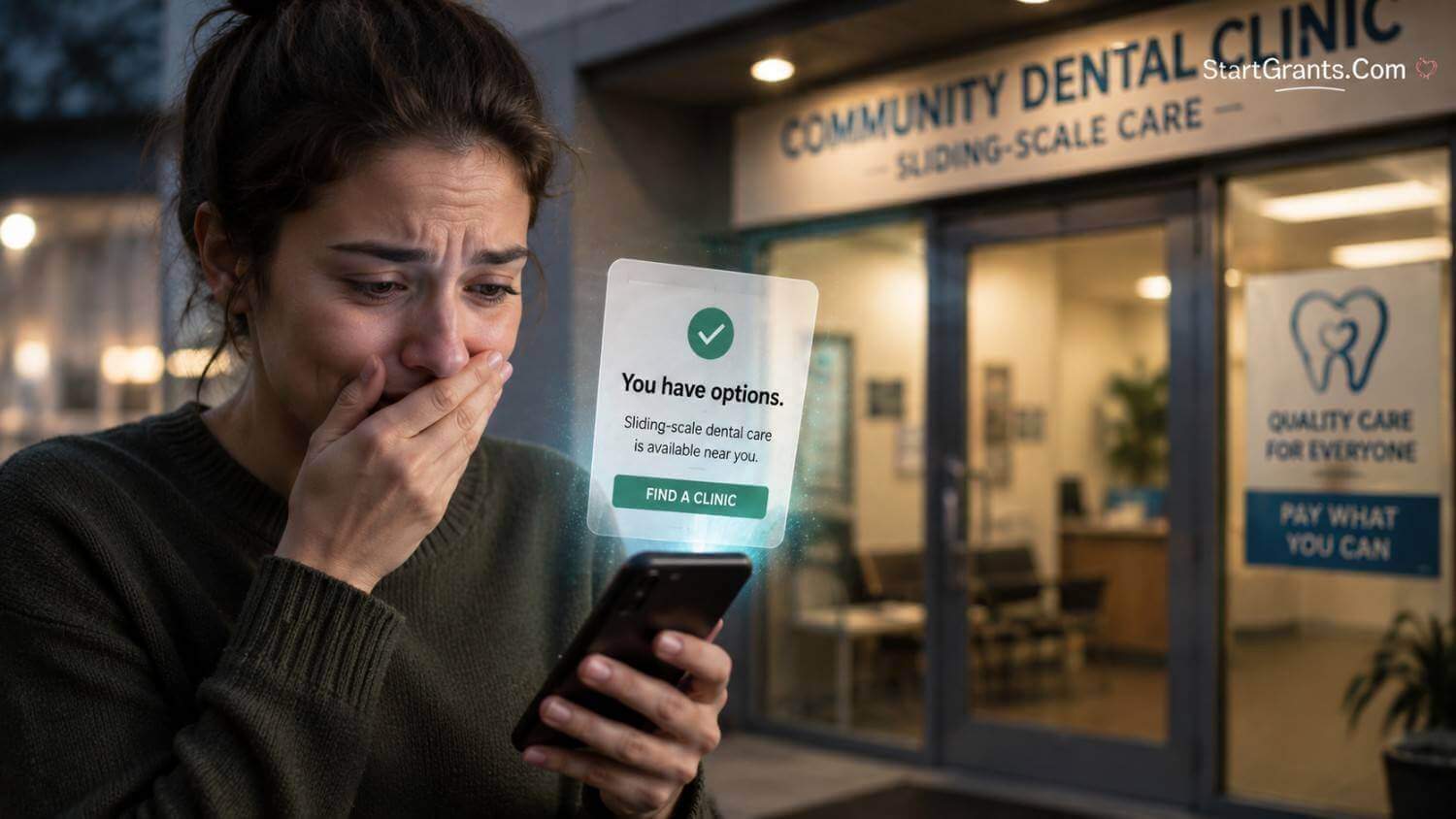
A dental emergency combined with an empty bank account is a terrifying experience, but immediate relief options exist if you know exactly where to look.
Phase 1: The ER Trap (What NOT to Do)
When the pain becomes unbearable in the middle of the night, the first instinct for many uninsured people is to rush to the hospital Emergency Room. Do not do this unless your airway is physically swelling shut or you have a life-threatening fever.
Hospital ERs in the United States are legally prohibited from turning you away, but they are generally not staffed with dentists. An ER doctor cannot legally extract a tooth or perform a root canal. They will merely look at your mouth, hand you a prescription for a 3-day supply of antibiotics and painkillers, and send you home.
The catastrophic result? A few weeks later, you will receive an emergency room bill for $1,000 to $2,500, and your tooth will still be rotting in your mouth. You must bypass the ER and seek out dedicated dental professionals.
Phase 2: Immediate Action Charitable Resources
If you literally have zero dollars to your name, you must rely on immediate philanthropic interventions. These organizations specialize in crisis management.
1. Local Salvation Army and United Way (Call 211)
Your absolute first step should be to dial 2-1-1 on your phone (the Essential Community Services number in the US) or contact your local Salvation Army chapter. While they are not dentists, many local chapters hold emergency “Dental Vouchers.” If you qualify for extreme hardship, they will hand you a voucher that you can take to a partnered local dentist who will extract the infected tooth for free.
2. Free Dental “Pop-Up” Clinics (Missions of Mercy)
Organizations like the America’s Dentists Care Foundation (ADCF) and state-level “Missions of Mercy” host massive, weekend-long free dental clinics in gymnasiums and stadiums. Hundreds of volunteer dentists gather to provide free extractions, fillings, and cleanings to anyone who shows up, no questions asked. Search online for “Mission of Mercy [Your State] 2026” to see if an event is happening near you this month.
Pro-Tip: Surviving a Free Dental Event
Because these events are entirely free, people often start lining up at 2:00 AM. Watch this video to understand what to expect and how to prepare for a Mission of Mercy pop-up clinic:
Phase 3: Ultra-Low-Cost Alternatives (If You Have $50 – $100)
If you cannot secure a free voucher but can scrape together $50 to $100 by borrowing from friends or selling an item, your options expand significantly.
1. Dental Schools (Emergency Triage Clinics)
Almost every university with an accredited dental school operates an “Emergency Care” or “Urgent Care” walk-in clinic. Because you are being treated by dental students (strictly supervised by licensed oral surgeons), the cost of an emergency extraction is heavily subsidized. You typically must arrive right when the doors open at 7:00 AM, as patients are seen on a first-come, first-served basis.
2. Federally Qualified Health Centers (FQHCs)
As mentioned in our main assistance guide, FQHCs operate on a sliding scale. If you are unemployed or living below the poverty line, they cannot legally deny you emergency care due to an inability to pay the full fee. They will adjust the cost of the extraction down to a “nominal fee,” which is usually between $15 and $40, depending on the clinic’s policy.
Note: Once the emergency is resolved and the infected tooth is extracted, you will likely be left with a missing tooth. When you are financially stabilized, you can explore our guide on cosmetic dentistry grants to find funding for a bridge or a dental implant to restore your smile.
Phase 4: The Muslim Perspective (Medical Debt and Riba)
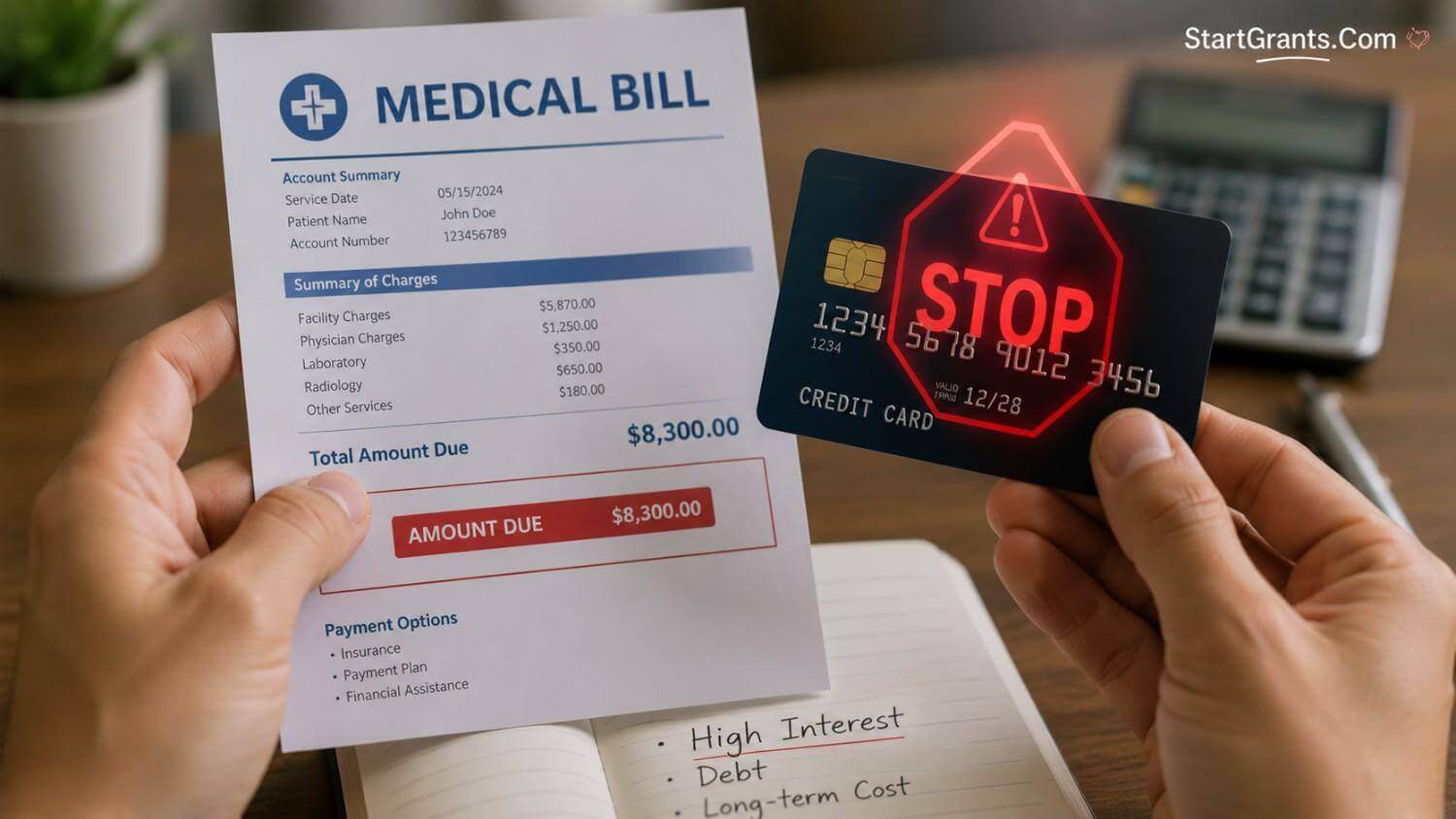
Desperation often leads to predatory medical loans. Exploring charitable grants and sliding-scale clinics protects you from the crushing burden of high-interest debt.
When a patient is screaming in pain in a dental chair, many private dentists will push them to apply for a medical credit card (like CareCredit) to finance a $1,500 root canal. For Muslims, this presents a severe theological and financial crisis due to the strict prohibition against Riba (usury or interest).
The Danger of Deferred Interest
Medical credit cards often advertise “0% interest for 12 months.” However, this is usually deferred interest. If a Muslim family misses a single payment or fails to pay the entire balance off within the promotional window, an exorbitant interest rate (often 26% or higher) is retroactively applied to the original balance. Entering into a contract with a predatory Riba clause is strictly forbidden (Haram) in Islamic finance.
The Principle of Dharurah (Necessity)
Islamic jurisprudence has a principle called Dharurah (necessity), which dictates that “necessities permit the prohibited.” If a Muslim is facing a genuinely life-threatening systemic infection from an abscess and taking an interest-bearing loan is the absolute only way to save their life, scholars may grant a temporary dispensation.
However, a toothache rarely qualifies for this extreme exception if other Halal alternatives exist. Because options like pulling the tooth at a sliding-scale FQHC for $30, or waiting for a free charity clinic, are available, Muslims are highly encouraged to choose the cheaper, Riba-free extraction route rather than taking out an interest-bearing loan to save the tooth with an expensive root canal and crown.
Conclusion: Stop the Pain, Avoid the Debt
A dental crisis requires a cool head and swift action. Do not let desperation drive you into the ER trap, and do not sign predatory loan agreements that will haunt you for years.
By leveraging the 211 network for emergency vouchers, arriving early at a university dental school, or finding a federally funded sliding-scale clinic, you can successfully have the infected tooth treated immediately—even if your pockets are completely empty. Your primary goal right now is to eliminate the infection; you can worry about cosmetic restoration once you are out of danger.
Frequently Asked Questions (FAQs)
Q1: Can I extract my own tooth at home to save money?
A: Absolutely not. “DIY dentistry” is incredibly dangerous. Pulling a tooth without sterilized surgical instruments and proper anesthetics can lead to massive blood loss, fragments of the root breaking off in your jaw, and deadly systemic infections that can travel to your brain or heart.
Q2: Will a free clinic do a root canal instead of pulling the tooth?
A: Almost never. Root canals and the accompanying porcelain crowns require multiple visits, extensive lab work, and hundreds of dollars in materials. Free pop-up clinics and emergency charity vouchers are designed for “triage” (stopping the immediate threat). In 99% of cases, the only free or ultra-low-cost option offered will be an extraction.
Q3: What if I have a dental emergency on a Sunday?
A: This is the toughest scenario. Most FQHCs and dental schools are closed on weekends. If you cannot find an open emergency dentist, you can manage the swelling with over-the-counter anti-inflammatories (like Ibuprofen) and cold compresses until Monday morning. Again, only go to the ER on a Sunday if your face is severely swollen or you are having trouble breathing.
Q4: Do I need to be a US citizen to get emergency care at an FQHC?
A: No. Federally Qualified Health Centers receive federal funding specifically to treat vulnerable populations regardless of their ability to pay or their immigration status. You do not need to provide proof of citizenship to receive emergency sliding-scale care.
Q5: What if my child’s severe pain is caused by crooked or impacted teeth?
A: If your child’s dental crisis is the result of severe misalignments (like teeth growing into the palate or crushing neighboring roots), an emergency extraction might only be a temporary fix. For long-term correction of pediatric structural issues, you will need orthodontic intervention. We highly recommend reviewing our guide on how to get free braces for kids to secure funding for their ongoing treatment.
Important Disclaimer: StartGrants.com is an informational directory, not a medical provider. A severe dental infection can be life-threatening. If you experience difficulty breathing, swallowing, or a fever over 101°F, seek immediate emergency medical attention regardless of cost. Always consult local Islamic scholars regarding specific Fiqh rulings on medical debt.