
Last Updated: May 2026 | Author: Robert
Every year, millions of Americans participate in the time-honored tradition of “spring cleaning.” We empty our closets, pack heavily worn jeans and slightly faded sweaters into large black trash bags, and drop them off at the nearest charity bin. While the act of giving declutters our homes and supports a good cause, an astonishing number of people drive away without realizing they just threw away hundreds—sometimes thousands—of dollars in potential tax deductions.
Learning exactly how to value clothing donations is one of the most misunderstood, yet financially rewarding, aspects of personal finance. The Internal Revenue Service (IRS) strictly regulates how citizens can claim charitable deductions for donated goods. If you simply guess the value of your old clothes, you are either shortchanging yourself out of a massive tax refund, or you are risking a severe audit penalty by over-inflating your numbers. (To understand how tactical clothing valuation fits into your overarching philanthropic strategy, look at our comprehensive guide to donations and fundraising.)
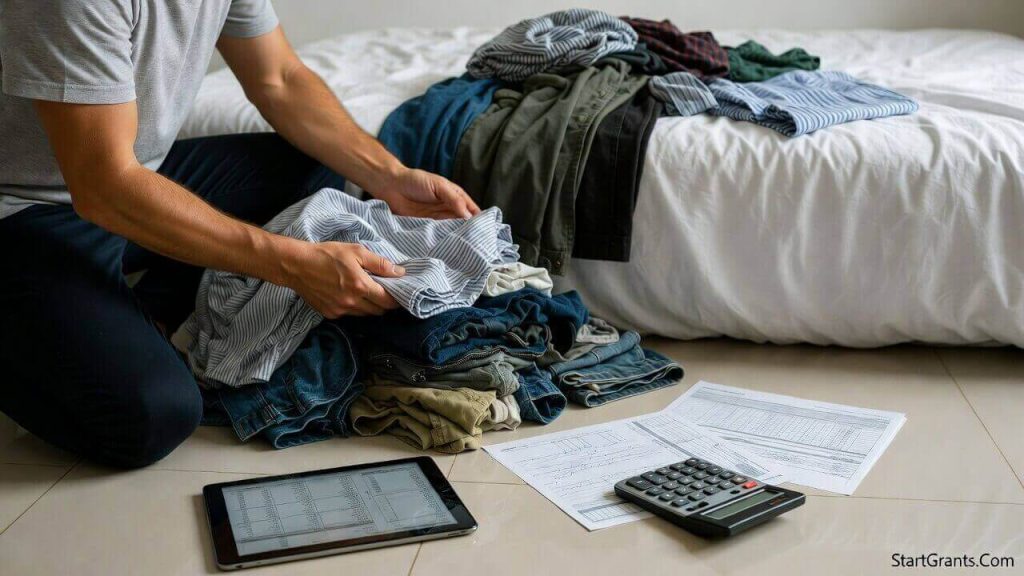
Stop guessing your tax deductions. Every piece of clothing you donate has a specific Fair Market Value (FMV) governed by IRS rules.
Phase 1: The Valuation Battlefield (Why Your Old Clothes are Worth Money)
Before you throw a single shirt into a donation bin, you must fundamentally change how you view your old clothes. To a charity, your used garments are inventory that can be sold to fund their community programs. To the IRS, those same clothes are considered a deductible non-cash charitable contribution.
The Biggest Mistake Donors Make
The most common and dangerous mistake people make is valuing their donations based on the original purchase price. If you bought a designer winter coat for $300 five years ago, it is completely irrelevant to the IRS today. The moment you wore that coat, its value plummeted. The government only cares about what that specific item is worth at the exact moment you drop it off at the charity center.
If you claim a $300 tax deduction for a five-year-old coat, you are committing tax fraud in the eyes of the government. You must learn to separate your emotional attachment to the clothing (and the memory of how much you originally paid for it) from its cold, hard economic reality.
Phase 2: Demystifying “Fair Market Value” (FMV) & IRS Rules
The cornerstone of all clothing valuation is a term the IRS calls Fair Market Value (FMV). Understanding this concept is the absolute key to maximizing your tax deduction legally.
What is Fair Market Value?
According to the official IRS Publication 561 (Determining the Value of Donated Property), Fair Market Value is defined as the price that property would sell for on the open market between a willing buyer and a willing seller, with neither being required to act, and both having reasonable knowledge of the relevant facts.
In plain English: What would a stranger browsing a local thrift store be willing to pay for your used shirt today? That is your FMV.
The “Good Used Condition” Mandate
The IRS is incredibly strict about the physical state of the clothing you donate. To claim any tax deduction at all, the IRS mandates that clothing and household items must be in “good used condition or better.” This means:
- Zero Value ($0): Clothes with permanent stains, missing buttons, broken zippers, severe fading, or torn seams cannot be legally claimed on your taxes. If a thrift store cannot sell it, the IRS will not let you deduct it.
- Exceptions: The only exception to the “good condition” rule is if you donate a single clothing item (like a rare vintage dress or high-end designer bag) that you claim is worth more than $500, AND you include a certified written appraisal with your tax return.
The Clothing Condition Matrix: What Does “Good” Actually Mean?
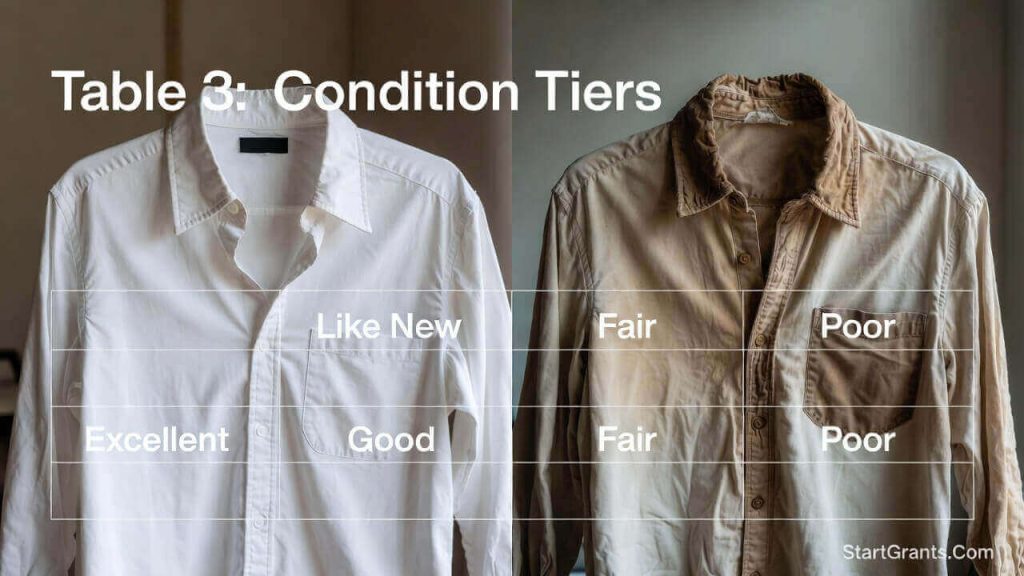
The IRS will reject your deduction if your clothes are permanently stained or torn. Only donate items in “good used condition or better.”
The IRS phrase “good used condition” is highly subjective, which often leads to taxpayers overvaluing their donations. To accurately appraise your items and avoid auditor scrutiny, you must grade your clothing against a strict retail standard. Thrift stores and tax professionals generally categorize donated clothing into three distinct tiers:
1. Like New (Premium Valuation)
- Visual Indicators: The garment appears completely unworn. Colors are perfectly vibrant, there is absolutely no fabric pilling, seams are perfectly intact, and original tags might still be attached.
- Valuation Strategy: You can value these items at the absolute highest end of the valuation guide.
2. Good to Very Good (Standard Valuation)
- Visual Indicators: The garment has been worn and washed, but it still maintains its structural integrity. There is minor fading or very slight fabric wear, but all zippers work smoothly, all original buttons are present, and there are no visible stains, odors, or stretched-out elastic bands.
- Valuation Strategy: This is where 85% of your donations will fall. Value these in the exact middle of the valuation guide ranges.
3. Fair or Poor (Zero Valuation – Do Not Donate)
- Visual Indicators: Missing buttons, broken zippers, permanent sweat stains, pet odors, severe fabric pilling, stretched collars, or small holes.
- Valuation Strategy: Do not claim these on your taxes. The IRS will assign them a $0 value. Instead of donating them to a retail charity, bag them separately and label them as “Textile Recycling” so the charity can sell them to rag dealers by the pound.
Phase 3: The Valuation Master Guide (Item by Item Breakdown)
Because the IRS does not provide a fixed, official price list for every brand of clothing, taxpayers must rely on established valuation guides provided by major charities like Goodwill and the Salvation Army. These guides reflect the actual thrift store prices across the country.
Below is a comprehensive breakdown to help you estimate the Fair Market Value of your donations. (Note: These are average estimates for standard brands. High-end designer labels in excellent condition can be valued higher, provided you have photographic evidence).
1. Men’s Clothing Valuation
Men’s clothing, particularly professional attire, holds its value relatively well if kept in pristine condition.
- Dress Shirts (Long & Short Sleeve): $3.00 – $12.00
- Casual Shirts (T-shirts, Polos): $1.00 – $6.00
- Sweaters & Cardigans: $3.00 – $15.00
- Jeans & Casual Pants: $4.00 – $12.00
- Dress Pants/Slacks: $5.00 – $15.00
- Two-Piece Suits: $15.00 – $60.00
- Winter Coats & Heavy Jackets: $15.00 – $40.00
- Shoes (Dress & Athletic): $4.00 – $25.00
- Accessories (Belts, Ties): $1.00 – $5.00
2. Women’s Clothing Valuation
Women’s clothing is the most frequently donated category, which means thrift stores have massive inventory. Valuation heavily depends on the current style and season.
- Blouses & Casual Shirts: $2.00 – $12.00
- Dresses (Everyday wear): $4.00 – $20.00
- Evening Gowns/Formal Wear: $10.00 – $60.00
- Skirts: $3.00 – $12.00
- Jeans & Slacks: $4.00 – $12.00
- Sweaters: $4.00 – $15.00
- Winter Coats: $10.00 – $40.00
- Shoes (Heels, Boots, Flats): $4.00 – $25.00
- Handbags & Purses: $3.00 – $20.00 (Designer bags must be appraised separately).
Special Note on Formal Wear: High-value formal garments are often drastically undervalued by donors. If you are clearing out expensive evening gowns or teenager’s formal wear, do not simply throw them in a standard donation bin. To maximize their social impact and your tax deduction, read our specialized guide on where to donate prom dresses for charity to ensure they reach specific high school students in need.
3. Children’s Clothing Valuation
Because children outgrow their clothes so quickly, this category experiences the highest turnover rate. Items must be free of the typical stains and wear associated with childhood play.
- Shirts & Tops: $1.00 – $6.00
- Pants & Jeans: $2.00 – $10.00
- Dresses & Skirts: $2.00 – $12.00
- Sweaters & Jackets: $3.00 – $15.00
- Snowsuits/Heavy Coats: $5.00 – $20.00
- Shoes & Boots: $2.00 – $10.00
4. Baby Clothing & Infant Gear Valuation
Infant clothing is often donated in bulk because babies outgrow outfits in mere weeks. To value baby clothes accurately, group similar items together (e.g., “bundle of 5 onesies”).
- Baby Onesies & Bodysuits: $0.50 – $2.00
- Infant Sleepers & Pajamas: $1.00 – $3.00
- Baby Coats & Buntings: $3.00 – $8.00
- Specialty Outfits (Christening/Holiday): $5.00 – $15.00
5. Activewear & Maternity Clothing Valuation
High-quality activewear and maternity clothes are highly sought after in thrift stores because they are expensive to buy new and are generally worn for short periods.
- Maternity Dresses & Pants: $4.00 – $12.00
- Maternity Tops: $3.00 – $8.00
- Athletic Leggings (Lululemon, Nike, etc.): $5.00 – $15.00
- Performance Jackets/Fleece: $8.00 – $20.00
- Sports Bras (Gently Used): $2.00 – $6.00
Pro-Tip for Valuation: If you are donating highly recognizable, premium brands (e.g., Patagonia, Lululemon, North Face), you should look up what similar used items are actively selling for on platforms like eBay, Poshmark, or Mercari. Print out the completed sales pages as proof of their higher Fair Market Value.
If you are still struggling to understand how to apply the Goodwill Valuation Guide to your personal wardrobe, watching a tax professional break down the rules can be incredibly helpful. Watch this clear explanation on how noncash charitable contributions actually work on your tax return:
Phase 4: The Spiritual Valuation (Sadaqah & The Muslim Perspective)

In Islamic tradition, donating clothing is not about throwing away trash; it is an act of Sadaqah that requires offering something you still love and value.
While the IRS evaluates your old clothing purely on its economic utility in a thrift store, there is a much higher, spiritual metric of valuation that completely changes how you should approach donating. For Muslim taxpayers and those who operate from a faith-based perspective, donating clothing is never about simply clearing out closet space or seeking a tax write-off. It is an act of worship.
In the Islamic tradition, the valuation of a donated item is measured by the quality of the item and the sincerity of the intention. Islam strictly prohibits the practice of donating items that are essentially “trash”—clothes that are ripped, permanently stained, or completely worn out.
The core philosophy of Islamic giving (Sadaqah) is rooted in maintaining the dignity of the recipient. The Qur’an establishes the ultimate standard for valuing charitable donations in Surah Ali ‘Imran (3:92): “Never will you attain the good [reward] until you spend [in the way of Allah] from that which you love. And whatever you spend – indeed, Allah is Knowing of it.”
This means the true spiritual value of a clothing donation is unlocked when you donate an item that you actually still like, rather than a garment you despise. By giving a high-quality winter coat or a beautiful dress in excellent condition, you fulfill the highest form of charity while simultaneously ensuring your donation easily passes the IRS “Good Used Condition” mandate. Good theology directly translates into excellent tax compliance.
Phase 5: Record-Keeping & The $500 IRS Trap
Once you have separated your high-quality, spiritually valuable clothing from the items that should genuinely just be recycled as rags, you must meticulously document your inventory. This is where 90% of taxpayers fail during an audit.
You cannot simply drop off four black trash bags full of clothes at a charity center, ask for a blank receipt, and later tell your accountant, “I think that was about $800 worth of clothes.” The IRS requires a paper trail.
How to Create an Ironclad Inventory List
Before you tie the bags shut, lay everything out on your bed or living room floor.
- Take Wide-Angle Photos: Snap a few pictures showing the sheer volume of the clothing.
- Itemize by Category: Create a simple spreadsheet or handwritten list. Do not write “One bag of clothes.” You must write: “5 men’s dress shirts, 3 women’s sweaters, 4 pairs of children’s jeans.”
- Assign the FMV: Next to each item, write down your estimated Fair Market Value based on the guide in Phase 3.
- Get the Receipt: When you drop the items off, the charity will give you a dated receipt. Staple your itemized list and your photos to that receipt.
Utilizing Digital Tax Tools (The “ItsDeductible” Strategy)
If writing out a physical spreadsheet seems too tedious, technology can streamline your record-keeping. Financial software companies have developed specific applications designed to track the Fair Market Value of your charitable donations in real-time.
One of the most popular tools is TurboTax ItsDeductible. This free application allows you to input your donated clothing items directly from your smartphone as you pack them into bags. The software automatically assigns the IRS-approved Fair Market Value to each item based on its condition and current thrift store pricing data. At the end of the year, the app instantly tallies your total noncash contributions and easily imports the data directly into your tax return, ensuring you never miss out on a deduction or violate the $500 threshold requirement without warning.
The $500 Threshold (The Audit Trap)
The IRS considers clothing to be a “noncash charitable contribution.” If the total value of all your noncash contributions for the entire tax year is under $500, your itemized list and the charity receipt are usually sufficient.
However, if you claim a total deduction that is over $500 for the year, you have triggered a new level of IRS scrutiny. You are now legally required to fill out and attach IRS Form 8283 (Noncash Charitable Contributions) to your tax return.
If you claim a single, individual clothing item (like a rare vintage wedding dress) is worth more than $500, you cannot just use a thrift store guide. You must obtain a qualified written appraisal for that specific item. Never attempt to guess your way around the $500 rule.
Did your clothing donations exceed $500 this year? Do not panic. Filling out the required IRS Form 8283 is easier than you think if you have kept a meticulous itemized list. Watch this excellent, step-by-step walkthrough of exactly how to fill out the form without triggering an audit:
Phase 6: Where to Drop Your Valued Clothes (Logistics)
You now understand the Fair Market Value of your garments, you understand the spiritual weight of providing high-quality items, and you have documented everything perfectly to satisfy IRS Form 8283. Your clothes are bagged, itemized, and sitting by the front door.
The next logistical step is figuring out exactly where to take them.
Not all charities operate the same way. Some organizations run massive, nationwide retail thrift store operations, while others focus on direct local community distribution. Some require you to drive to a physical location during business hours, while others offer convenient, 24/7 standalone drop boxes in grocery store parking lots.
To ensure your meticulously valued clothing actually reaches a certified 501(c)(3) organization (which is mandatory for your tax deduction), you need to choose a reputable drop-off location. If you are ready to load up your car, we have compiled a dedicated guide highlighting the 5 places for easy clothes donation drop-off. This resource will help you find the most convenient and trustworthy organizations operating in your local area, ensuring your donation process is as seamless as your tax preparation.
Phase 7: The Ripple Effect (How Your Clothes Change Lives)
Understanding the Fair Market Value and mastering the IRS tax code is essential for your financial health, but the true value of your donated clothing extends far beyond a spreadsheet. When you drop off that perfectly documented bag of high-quality garments, you are triggering a massive ripple effect in the community.
Where do your clothes actually go?
Depending on the charity you choose, your clothing takes one of two primary paths: The Retail Path or The Direct Assistance Path.
1. The Retail Path (Funding the Mission)
Major organizations like Goodwill or the Salvation Army typically place your gently used clothing on their thrift store racks. When a shopper buys your old winter coat for its Fair Market Value of $20, that money doesn’t go into a corporate bank account. It is immediately funneled into job training programs, addiction recovery centers, and emergency housing operations. Your coat was literally transformed into a paycheck for someone rebuilding their life.
2. The Direct Assistance Path (Clothing the Vulnerable)
Many smaller, hyper-local nonprofits, community centers, and religious organizations skip the retail phase entirely. They operate “clothing closets” or specific outreach programs where garments are given away for free to those facing extreme poverty or recovering from disasters.
For a single mother trying to re-enter the workforce, a donated professional suit is not just a tax deduction; it is the confidence she needs to pass a job interview. If you want to understand the sheer scale of this need and how various organizations distribute these garments, you should explore our comprehensive guide on clothing assistance for low-income families from various sources. This will show you exactly how your “spring cleaning” becomes a vital lifeline for families struggling to make ends meet.
Specialized Community Programs
The impact of clothing donations also fuels highly specialized, niche assistance programs across the country. For example, Native American tribes often manage their own internal welfare systems to support their citizens. A prime example of this is the Chickasaw Nation Clothing Grant, which provides specific financial and material assistance to ensure tribal youth have adequate clothing for school. When you donate to organizations that support these localized grants, your everyday garments help preserve community stability and educational readiness for marginalized populations.
Conclusion & The Valuation Master Strategy
Donating your old clothes should never be a mindless chore. It is a strategic financial move, a legal responsibility, and a profound act of spiritual charity.
By taking the time to separate the unusable rags from the high-quality garments, consulting a Fair Market Value guide, snapping a few photos, and securing a dated receipt, you protect yourself from the dreaded IRS audit while maximizing your legal tax refund. More importantly, by treating your donations as a dignified transfer of wealth rather than just taking out the trash, you actively participate in a multi-million dollar charitable ecosystem that clothes the vulnerable and funds life-saving community programs.
Stop throwing away your deductions. Lay out your garments tonight, open the valuation guide above, and turn your spring cleaning into an ironclad tax strategy.
Frequently Asked Questions (FAQs)
Q1: Can I deduct the original price I paid for my clothing?
A: No. This is the most common IRS violation. You can only deduct the Fair Market Value (FMV) of the item, which is the price a willing buyer would pay for it in a thrift store today. If you bought a shirt for $50 five years ago, its FMV today might only be $4.
Q2: What happens if I donate clothes but forget to get a receipt?
A: If your total noncash donations for the year are under $250, the IRS may accept your own reliable written records (like an itemized list and photos). However, for any single drop-off valued at $250 or more, a formal, written acknowledgment (receipt) from the charity is legally required. Always ask for a receipt.
Q3: How do I value high-end designer clothing or vintage items?
A: Standard thrift store valuation guides do not apply to rare or luxury items (like a vintage Chanel bag or a pristine wedding dress). To claim a high value for these items, you must look up comparable sales of the exact item on resale sites like eBay or Poshmark and keep printouts as proof. If you claim a single item is worth more than $500, you must get a professional written appraisal.
Q4: Are undergarments or heavily worn socks tax-deductible?
A: No. The IRS explicitly states that clothing must be in “good used condition or better.” Heavily worn, stained, or torn items, including used undergarments and socks, hold zero Fair Market Value and cannot be legally claimed on your taxes.
Q5: What is IRS Form 8283 and when do I need it?
A: IRS Form 8283 (Noncash Charitable Contributions) is a tax form you must fill out and attach to your tax return if the total value of all your donated property (clothing, furniture, electronics) exceeds $500 for the year. It requires you to detail how you acquired the items and how you determined their Fair Market Value.
Q6: Can I claim a tax deduction for donating my wedding dress?
A: Yes, but you must be careful. Wedding dresses are almost always valued at over $500. Because of this, you cannot simply drop it off and use a thrift store guide. To legally claim a wedding dress donation, you must obtain a qualified, written appraisal from a certified professional before you donate it, and you must file IRS Form 8283.
Q7: Are clothing drop-boxes in parking lots legitimate for tax purposes?
A: It depends. Not all large metal drop-boxes belong to registered 501(c)(3) charities; many are operated by for-profit textile recycling companies. If you place your clothes in a for-profit bin, you cannot claim a tax deduction. Always read the label on the physical bin to ensure it displays a registered charity’s logo and tax ID number. Furthermore, because drop-boxes do not issue physical receipts on the spot, you should take a time-stamped photo of yourself dropping the bags into the bin as proof of your donation.
Q8: Will claiming clothing donations trigger an IRS tax audit?
A: Claiming a reasonable amount of donated clothing will not automatically trigger an audit. Millions of taxpayers do it every year. However, the IRS computer system will flag your return if your noncash charitable deductions seem disproportionately large compared to your overall income. For instance, if you earn $40,000 a year but claim you donated $15,000 worth of old clothes, that will almost certainly trigger an audit. Always be honest, value your items accurately, and keep your receipts.
Q9: Can I deduct clothing donations if I take the Standard Deduction on my taxes?
A: Generally, no. To actually receive a financial tax break for your charitable clothing donations, you must “itemize” your deductions on Schedule A of your tax return. Because the federal Standard Deduction is currently very high, most taxpayers do not itemize. However, it is still highly recommended to track your clothing’s Fair Market Value, as these donations—when combined with medical expenses and mortgage interest—could be the exact trigger that pushes you over the threshold to profitably itemize at the end of the year.
Important Disclaimer: StartGrants.com is an independent information portal. We are not a government agency and do not provide direct grants or products. Always verify the current status of programs with the providing organization.