
Last Updated: | Author: Munir Ardi
Quick answer: Families can often find free baby clothes through local clothing closets, baby banks, family resource centers, faith-based organizations, shelters, and neighborhood gifting groups. Most assistance is local, so available sizes, appointment rules, eligibility, and pickup methods vary.
Contact several organizations before the due date, ask for the baby’s current size plus one or two sizes ahead, and confirm what documents—if any—you must bring. For diapers, feeding supplies, safe-sleep products, and other essentials, start with our broader guide to free baby stuff for low-income families.
Where to Get Free Baby Clothes Near You
Start with organizations that already assist pregnant people, infants, or households experiencing financial hardship. A service does not need to call itself a “baby bank” to carry infant clothing; a community action agency, shelter, food pantry, family resource center, or faith community may maintain a small closet.
| Where to ask | What may be available | What to confirm |
|---|---|---|
| Baby banks and clothing closets | Onesies, sleepers, pants, socks, coats, maternity clothes, and sometimes diapers | Current sizes, service area, appointment, referral, and visit limits |
| Family resource programs | Donated clothing, prepacked bundles, vouchers, or baby-boutique items | Whether items are free, referral-based, or connected to voluntary classes |
| Faith-based charities | Clothing closets, thrift-store vouchers, emergency assistance, or referrals | Local services, documents, appointments, and any participation conditions |
| Diaper banks and partner agencies | Primarily diapers; some partners may also have clothing or baby supplies | Whether clothing is offered and whether families must use a distribution partner |
| Neighborhood gifting groups | Bags or bundles of outgrown clothes in assorted sizes | Condition, sizes, pickup safety, and group rules |
| Shelters and case-management programs | Emergency clothing, vouchers, or partner referrals | Whether assistance is restricted to current clients or families in crisis |
Inventory note: Donated supplies change frequently. Call before traveling and do not rely on an old social-media post.
Start With 211 and Local Baby Banks
Call 211 or use 211’s official resource service when you do not know which organizations serve your ZIP code. Say that you need infant clothing and specify the size, season, ZIP code, transportation limitations, and whether the need is urgent.
Ask for several service categories:
- Baby banks and baby pantries
- Children’s clothing closets
- Family resource centers
- Community action agencies
- Faith-based material assistance
- Domestic-violence or family shelters, when relevant
- Pregnancy and parenting support programs
211 provides referrals, not guaranteed inventory. Contact each organization before visiting.
Ask diaper banks about partner services
The National Diaper Bank Network member directory lists more than 240 community-based diaper banks. Their core service is diapers, so the directory does not promise clothing. However, a member or distribution partner may know a nearby baby pantry or clothing closet. Ask about clothing separately and use our focused guide to emergency diaper assistance.
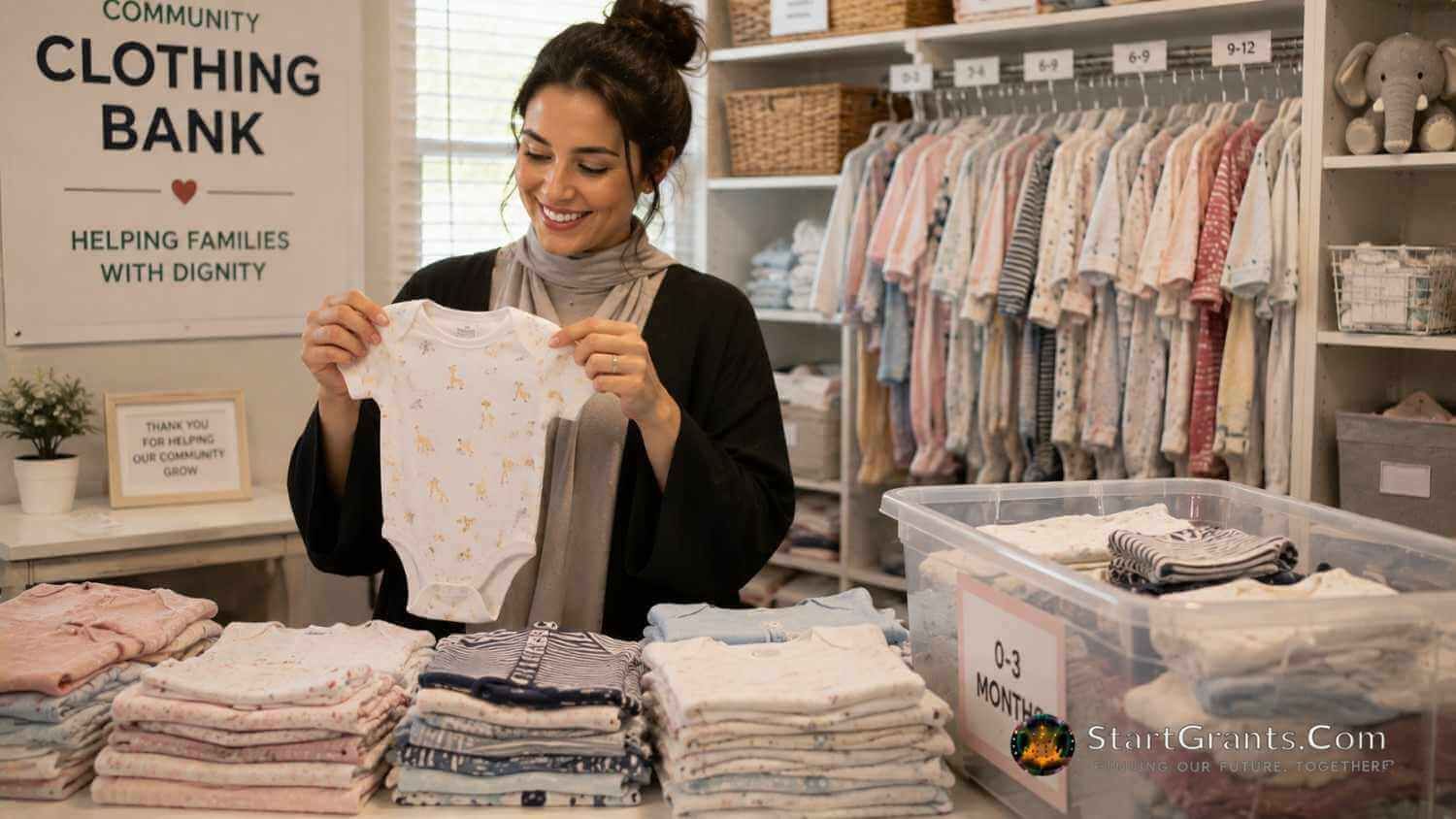
Local clothing closets may offer gently used infant apparel, but sizes and pickup rules depend on current donations.
National Charities: Services Are Local
A familiar national name can be a useful locator, but it does not guarantee one uniform baby-clothing program. Local branches determine services based on donations, funding, staff, partnerships, and community needs.
The Salvation Army
Some Salvation Army centers operate clothing assistance, thrift-store vouchers, shelters, or family services, while others focus on different needs. Use the official Salvation Army location search, select a local center, and ask specifically about infant clothes. Do not assume that a retail thrift-store employee can issue a free voucher without a program referral.
Catholic Charities and other faith communities
Catholic Charities agencies, parishes, mosques, Islamic centers, synagogues, and interfaith organizations may run clothing drives, baby closets, refugee services, or emergency funds. Availability is local. Our separate guide explains how to verify Catholic Charities baby assistance before visiting.
Ask whether assistance requires local residency, an appointment, identification, a caseworker referral, or participation in any activity. If a condition makes you uncomfortable, request a different referral through 211.
Family Resource Centers and Pregnancy Programs
Some family resource and pregnancy-support programs maintain baby closets or boutiques. Others provide points for voluntary educational activities. Before enrolling, clarify the terms rather than assuming that attendance, counseling, or religious participation is mandatory.
- Do you currently have the sizes and seasonal items I need?
- Are the clothes free, voucher-based, or connected to activities?
- Do you serve my county or ZIP code?
- What documents or referrals are required?
- How often may a household receive clothing?
- Can I select items, or will I receive a prepared bundle?
If you are in a shelter or maternity residence, ask the case manager first. Client-serving programs may have partnerships that are not open to public walk-ins.
Does WIC Pay for Baby Clothes?
No. USDA describes WIC as providing healthy foods, nutrition education, breastfeeding support, and referrals. It is not a clothing allowance, and WIC benefits cannot be used as general-purpose money for baby clothes. Review the official USDA WIC program description.
WIC staff may still know local baby closets or family programs. For the program’s actual newborn benefits, see what WIC covers for newborns.
Will Medicaid pay for baby clothes?
Medicaid is health coverage, not a standard clothing benefit. A managed-care plan may offer care-management referrals, member rewards, or local value-added services, but these vary and should not be presented as a guaranteed clothing allowance. Call the number on your plan card.
Can TANF cash assistance help?
TANF is administered by states. Eligibility, benefit amounts, payment methods, and purchase restrictions differ. A qualifying household may be able to use cash assistance toward essential clothing subject to state rules, but TANF is not a dedicated free-clothing program. Verify the details through your state agency.
Use Neighborhood Gifting Groups
Neighborhood exchanges can be useful when charity inventory is limited or a household does not meet program requirements. Offers depend entirely on what community members choose to give.
Buy Nothing
Buy Nothing allows members to create “Ask” posts for gifts they would like to receive. Use the official Buy Nothing quick-start instructions and request a specific size and season without publishing sensitive medical, benefit, or financial information.
Freecycle and free local listings
Freecycle groups and free marketplace listings may contain clothing bundles. Search by size and terms such as “baby clothes lot,” “newborn clothes,” and “free infant clothes.” Never send a deposit for an item advertised as free.
Pickup and privacy safety
- Use a public meeting place when practical, or bring another adult to a porch pickup.
- Do not send a stranger your Social Security number, benefit-card information, bank details, or identity documents.
- Confirm the approximate quantity, sizes, condition, and location before traveling.
- Decline an offer that unexpectedly becomes a shipping-fee, deposit, survey, or subscription arrangement.
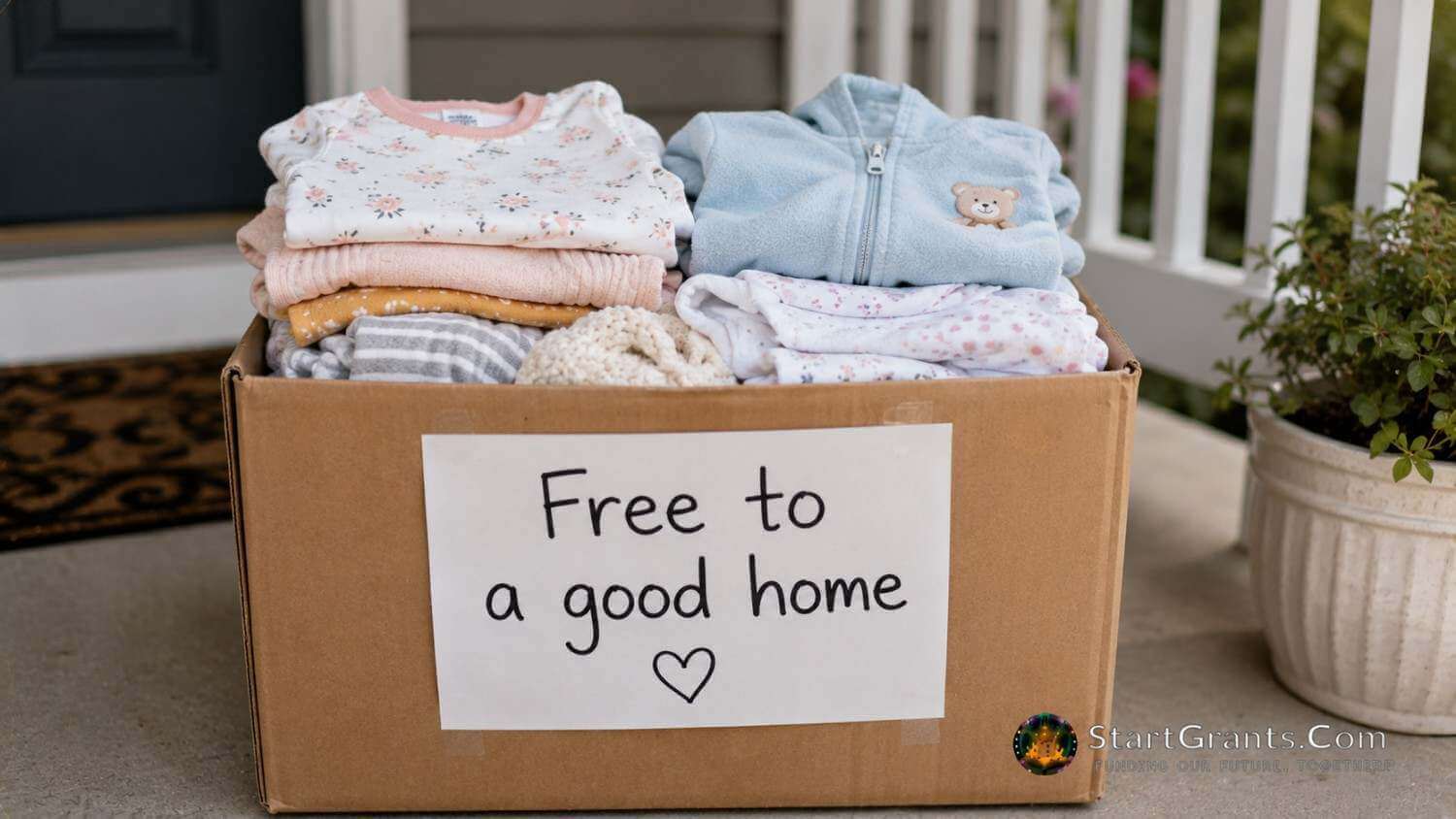
Neighborhood gifting groups can provide useful clothing bundles, but inspect the garments and use safe pickup practices.
How to Prepare for a Clothing-Closet Visit
- List useful sizes. Ask for the current size and one or two sizes ahead rather than relying entirely on newborn clothing.
- Match sizes to seasons. Estimate which size the baby may wear when the weather changes.
- Bring only requested documents. Requirements may include identification, address, proof of pregnancy or the child’s age, income information, or a referral.
- Confirm distribution limits. Ask how many items or visits are allowed and whether clean outgrown clothes may be returned.
- Inspect before leaving. Check seams, elastic, zippers, fasteners, stains, odors, pests, and care labels.
Save This Free Baby Clothes Checklist
[ ] Call 211 and request several local resource categories.
[ ] Contact each organization before traveling.
[ ] Ask for current and next sizes in the appropriate season.
[ ] Confirm appointment, referral, residency, and document rules.
[ ] Inspect every garment for damage, contamination, and recalls.
[ ] Wash according to the care label before use.
[ ] Avoid bulky coats beneath a car-seat harness.
Are Second-Hand Baby Clothes Safe?
Most clean, intact, correctly sized second-hand garments can be reused. However, donated clothing should still be inspected:
- Search the CPSC recall database, especially for sleepwear, robes, outerwear, and sleep sacks.
- Reject items with mold, pest evidence, persistent smoke or chemical odors, or contamination that cannot be removed.
- Repair or discard loose buttons, snaps, beads, decorations, broken zippers, and long cords that could create choking, scratching, or entanglement risks.
- Wash and dry each item according to its care label. A detergent marketed specifically for babies is not automatically required; discontinue any product that appears to irritate the baby’s skin.
- Choose a proper fit. Oversized garments can bunch around a newborn’s face, while tight elastic may restrict movement or leave marks.
A Muslim Perspective
Accepting clothes clearly offered as a gift or charitable assistance can help meet a child’s needs, reduce waste, and avoid unnecessary debt. Confirm that the giver or organization intended the items for you, respect distribution limits, and pass usable clothes to another family when they are outgrown.
A local mosque or Islamic center may operate a clothing drive, women’s committee, family-services program, sadaqah fund, or zakat committee. Availability and zakat eligibility are not automatic. Ask about the program’s terms and consult a qualified scholar when you need a ruling about zakat, ownership, or a financing arrangement.
If You Need More Than Baby Clothes
- For pregnancy clothing, see free maternity clothes for low-income families.
- For discharge supplies, review baby and postpartum supplies hospitals may provide.
- For promotional samples, compare baby boxes and welcome kits and their costs.
- For safe sleep, search for free crib and safe-sleep programs.
Frequently Asked Questions
Can I get free baby clothes mailed to my home?
Sometimes a local organization may arrange delivery for a client who cannot travel, but there is no general federal program that mails baby clothes to every eligible family. Most programs use local pickup, appointments, partner referrals, or neighborhood exchanges.
Do I need to prove that I have a low income?
It depends on the provider. A charity may request identification, address, income information, benefit enrollment, or a caseworker referral. Neighborhood gifting groups generally do not use income tests. Ask before visiting.
Will the baby clothes be new or used?
Most clothing closets distribute gently used donations. New items may be available after a retailer donation or seasonal drive, but new clothing and specific brands are not guaranteed.
Can I request several baby sizes at once?
You can ask, but each program controls its limits. If inventory permits, request the current size and one or two sizes ahead, matched to likely seasonal needs.
Does WIC or Medicaid pay for baby clothes?
No standard WIC or Medicaid benefit pays for everyday baby clothing. WIC may provide community referrals, and a Medicaid case manager may know local resources. Confirm any managed-care extras directly with the individual plan.
Are second-hand baby clothes safe?
They can be when they are clean, intact, correctly sized, and not recalled. Inspect fasteners, cords, zippers, seams, elastic, and decorations; follow the care label; and reject an item with mold, contamination, or an unresolved recall.
Can I exchange clothes that do not fit?
Usually not unless the program has an exchange policy. Ask before pickup. If exchanges are unavailable, offer clean, usable items back to the closet or another family.
Important Disclaimer: StartGrants.com is an independent information portal. It is not a government agency, charity, clothing provider, benefits administrator, medical provider, or religious authority. Programs, inventory, eligibility, and pickup rules can change. Confirm current details with the local organization and consult an appropriate professional about safety, benefits, or religious questions.