
Last Updated: | Author: Munir Ardi
A breast pump can cost more than a family expected, but Medicaid may cover one. The important word is may: Medicaid is jointly funded by the federal government and the states, and each state administers its own program within federal rules. Pump type, timing, prescription requirements, approved suppliers, replacement parts, and member cost can therefore differ by state and health plan.
This guide explains how to verify your actual benefit and order a pump without relying on a seller’s promise. If you are also building a broader baby-supplies plan, start with our free baby stuff for low-income families guide.

Does Medicaid Cover a Free Breast Pump?
There is no single national Medicaid breast-pump policy that gives every enrollee the same equipment. Medicaid.gov explains that states administer Medicaid under federal requirements. A state may provide the benefit through fee-for-service Medicaid, a managed care organization, or both, and the rules can differ between those arrangements.
Do not confuse Medicaid with Marketplace or many private health plans. The federal preventive-services rules generally require non-grandfathered private plans to cover breastfeeding support and equipment without cost sharing. HealthCare.gov notes that those plans may still decide whether the covered pump is rented or new, manual or electric, and provided before or after birth. Those private-plan rules should not be presented as a universal guarantee for every Medicaid member.
If your Medicaid plan covers a pump at no member cost and you follow its rules, people often call it a “free” pump. Never assume that a pump, upgrade fee, shipping charge, or accessory will be paid until the plan confirms it.
Compare the Coverage Path Before Ordering
| Coverage path | What to ask | Next step |
|---|---|---|
| Medicaid managed care | Covered model, order, prior authorization, supplier, timing, and costs | Call the plan on your card |
| Fee-for-service Medicaid | State coverage criteria, billing provider, and documentation | Ask the state agency |
| WIC clinic | Local pump loan, supply, or lactation referral | Ask your local WIC office |
| Private or Marketplace plan | Preventive coverage and covered pump type | Check plan terms separately from Medicaid |
Coverage and availability vary. The table does not establish eligibility or guarantee a no-cost pump.
How to Get a Breast Pump Through Medicaid
1. Call Your Medicaid Plan Before Contacting a Seller
Use the member-services number on your current insurance card. If you do not know which plan manages your care, contact your state agency through the official Medicaid state directory.
Ask these questions and record the answers:
- Is a breast pump covered under my current benefit package?
- Which types are covered: manual, personal electric, double electric, wearable, or hospital-grade rental?
- Do I need a prescription, written order, diagnosis, or prior authorization?
- Who may write the order—my OB-GYN, midwife, primary-care clinician, pediatrician, or another provider?
- Must I use a durable medical equipment supplier, pharmacy, hospital, or other contracted vendor?
- When may I order, and when may the supplier ship the pump?
- Is there a copayment, upgrade charge, deposit, or shipping fee?
- Are flanges, valves, tubing, storage containers, or replacement parts covered?
Plan rules and supplier contracts change. A vendor’s website may show that it “accepts Medicaid,” but that does not prove it is contracted with your state, your managed care plan, or your benefit package.
2. Get Only the Documentation Your Plan Requires
Some plans require a prescription or detailed written order; others may not. Do not wait for an arbitrary pregnancy week or insist that a clinician use wording copied from a commercial website. Ask member services what documentation is required and when it becomes valid.
If you need a specific pump because of premature birth, separation from the baby, low milk transfer, physical limitations, or another clinical issue, ask your clinician or lactation professional to document the need. Documentation does not guarantee approval, but it can help the plan review the correct request.
3. Use an Approved Supplier
Request the plan’s current list of in-network suppliers. Depending on the plan, the correct channel may be a DME supplier, pharmacy, hospital, or another contracted provider. Before giving a company sensitive information, confirm its name and phone number against the plan’s directory.
Ask the supplier to show two separate amounts:
- the models covered with no member payment; and
- any optional upgrade amount you would have to pay yourself.
An expensive upgrade is not automatically better for your body, schedule, or milk supply. Consider suction settings, flange availability, portability, noise, battery use, and whether replacement parts are easy to obtain. A lactation professional can help if you are unsure.
4. Confirm Timing and Delivery
There is no nationwide Medicaid shipping date. Some plans permit delivery during pregnancy; others require a certain gestational age, proof of delivery, or postpartum order. Ask for the expected ship date and a tracking number. If your address changes, update both Medicaid and the supplier promptly.
5. Check the Package Before First Use
Confirm the model, all included parts, and whether the device is yours to keep or a rental that must be returned. Keep the packing slip, benefit confirmation, supplier contact, serial number, and return instructions. Do not open an optional upgrade until you understand the charge and return policy.
Which Pump and Supplies Might Be Covered?
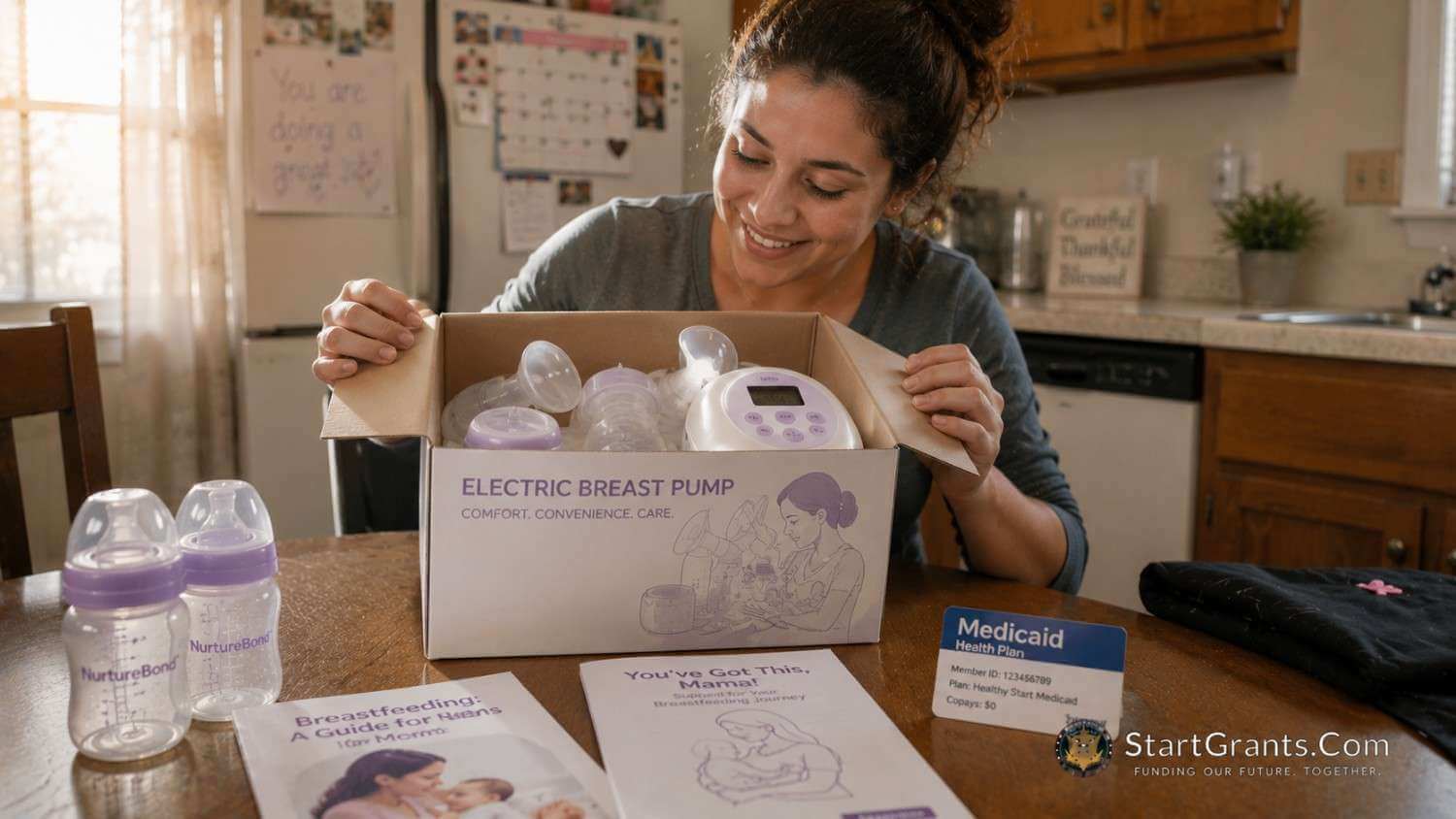
Coverage may include a manual pump, a new personal electric pump, or a rental hospital-grade pump. A wearable model may be covered, excluded, or available only with an upgrade payment. The same uncertainty applies to replacement valves, tubing, flanges, milk-storage containers, batteries, and cleaning supplies.
For many non-grandfathered private plans, the current HRSA-supported preventive-services guideline includes comprehensive lactation support, double-electric pumps, pump parts and maintenance, and milk-storage supplies. That guideline is helpful when discussing private coverage, but it should not be used to promise the same package under every Medicaid plan.
A hospital-grade rental is not simply a luxury upgrade. It may be requested when a baby is premature or hospitalized, when parent and baby are separated, or when the treating team identifies another clinical need. Families facing a prolonged hospitalization can also review our guide to financial assistance for NICU parents.
WIC May Be an Alternative or Additional Resource
WIC provides nutrition education and breastfeeding support to eligible pregnant, postpartum, and breastfeeding participants, infants, and young children. Local services can include peer counseling, referrals, and—in some locations and circumstances—access to a manual or electric pump or a hospital-grade loaner. Pump inventory, priority rules, loan terms, and documentation are determined locally, so a WIC participant is not automatically guaranteed a particular pump.
Ask your clinic what it offers and whether Medicaid must be tried first. The federal WIC breastfeeding page explains the program’s support role. For a clearer breakdown of food benefits and local variation, see what WIC covers for newborns.
Breastfeeding and pumping do not work for every family, and needing formula is not a moral failure. If your clinician recommends supplementing or switching, our baby formula assistance guide explains programs that may reduce the cost.
What to Do if Medicaid Denies the Pump
- Ask for the denial in writing. Do not rely only on a supplier saying “insurance rejected it.”
- Read the exact reason. Common fixable problems include a missing order, wrong billing code, out-of-network supplier, early request, or missing prior authorization.
- Ask the clinician and supplier to correct errors. If the requested model is not covered, ask the plan which alternative is covered and what evidence is required for an exception.
- Use the appeal instructions and deadline in the notice. Federal Medicaid managed care rules explain how an enrollee can request a plan appeal following an adverse benefit determination. Confirm that your situation qualifies and follow the notice. Request an expedited review only when the plan’s rules allow it and delay could seriously jeopardize health.
- Contact the state Medicaid agency or member advocate. Use the official state directory above if the plan does not explain the process.
While an appeal is pending, ask the hospital lactation department, WIC clinic, community health center, or local mutual-aid group about a temporary manual pump or hospital-grade rental. Assistance is based on local availability and should never be described as guaranteed.
A Muslim Perspective
Muslim parents may be balancing medical needs, modesty, work, and questions about public benefits. The following points are practical guidance, not a personal fatwa.
Breastfeeding Is Honored, but Families Should Not Be Shamed
Qur’an 2:233 discusses nursing for up to two years for parents who wish to complete the period, along with consultation, responsibility, and fair support. It should not be turned into a promise that every mother can breastfeed exclusively or a reason to ignore pain, insufficient intake, medication needs, disability, trauma, or mental health. Seek medical and lactation advice when feeding is difficult; protecting the parent and baby matters.
A Medicaid Benefit Is Not an Interest-Bearing Loan
Medicaid is a federal-state health coverage program, not a loan that a member repays with interest. A covered pump is a health-plan benefit; it should not be relabeled as zakat, takaful, or Bait al-Mal. Those Islamic concepts have their own rules. This factual distinction may help when asking a trusted scholar about a family’s circumstances, but StartGrants should not declare that every insurance arrangement is universally “100% halal.”
Ask for Privacy and Modesty at Work
Most nursing employees have federal rights to reasonable pump breaks and a private space—other than a bathroom—that is shielded from view and free from intrusion for up to one year after birth. The U.S. Department of Labor’s PUMP at Work guidance explains coverage and limited exceptions. A Muslim employee can request a lockable or clearly occupied space, but the same privacy right is available regardless of religion. State law or employer policy may provide additional protection.
Before returning to work, ask in writing where the space is, how access is controlled, where milk can be stored, and where parts can be washed. If prayer and pumping times overlap, plan with the employer, but keep the requests distinct so neither accommodation becomes confused with the other.
Use Zakat or Sadaqah Carefully When Coverage Is Unavailable
A local mosque, zakat committee, Muslim social-service organization, or general community charity may be able to help with a pump or rental. There is no national guarantee. Explain the medical and financial need honestly, ask whether the fund’s eligibility rules cover equipment, and find out whether it pays the family or the supplier directly. Do not claim that a named charity buys breast pumps unless that specific local program has confirmed it.
Ask Early About Donor Milk and Milk Kinship
This issue is separate from obtaining a pump, but it can arise unexpectedly in a NICU. Muslim scholars and institutions have differing opinions about donor milk banks and the conditions under which milk kinship (rada’ah) is established. For example, the International Islamic Fiqh Academy published updated guidance in 2025; consult a qualified scholar about how it applies to your hospital’s donor-milk process and family’s circumstances.
If donor milk is offered, ask the medical team whether it comes from one or multiple donors, what identity or traceability records are retained, and whether there is time to consult a knowledgeable local scholar. Do not assume the hospital can disclose a donor’s identity. In an urgent medical situation, do not delay necessary care without speaking promptly with the treating clinician and a qualified scholar familiar with neonatal medicine.
Safety, Cleaning, and Ongoing Costs
Do not buy or accept a used personal pump unless the manufacturer identifies it as a multiple-user model. The FDA considers most breast pumps single-user devices; hospital-grade multiple-user pumps require a new personal collection kit.
Follow the manufacturer’s instructions and the CDC breast-pump hygiene guidance. Parts that contact milk need careful cleaning, and some situations call for sanitizing. Ask the plan or supplier about the warranty and replacement schedule before paying for valves, membranes, tubing, flanges, bottles, storage bags, or a cooler yourself.
If pumping problems are part of a broader postpartum recovery issue, review options for financial help with postpartum care. Contact a clinician promptly for fever, worsening breast redness, severe pain, signs of dehydration, or concern that the baby is not getting enough milk.
A Simple Call Script
You can say:
That conversation—not a national promise or vendor advertisement—is the safest starting point for getting the correct pump through Medicaid.
Frequently Asked Questions
Does every Medicaid plan provide a free breast pump?
No. Medicaid coverage and administrative rules vary by state, eligibility group, delivery system, and health plan. Call the number on your card and verify the benefit before ordering.
Do I always need a prescription?
No national rule makes the same prescription process apply to every Medicaid member. Your plan may require a prescription, written order, medical documentation, or prior authorization. Ask what is required and who may submit it.
Will Medicaid cover a wearable pump?
It depends on the plan. A wearable model may be covered, excluded, or offered only with an upgrade charge. Ask for the no-cost models and the exact optional upgrade amount.
When should I order the pump?
Use your plan’s timing rule. Some plans allow prenatal ordering, while others limit shipment until a particular point in pregnancy or after birth. There is no universal “28-week” or “30-day” Medicaid rule.
Can I receive a new pump with every pregnancy?
Frequency limits vary. Some plans use a per-pregnancy or multi-year limit, and rental equipment follows different rules. Ask the plan to state its current frequency policy.
Are replacement parts and storage bags covered?
Possibly. Coverage, quantity, replacement intervals, approved brands, and supplier rules differ. Verify each item before buying it.
Can WIC give me a pump if Medicaid does not?
A local WIC agency may offer a pump, loaner, breastfeeding support, or referral based on eligibility, assessed need, policy, and inventory. Participation does not guarantee a particular model.
Is a Medicaid-covered pump an interest-bearing benefit?
No. Medicaid coverage is not a loan that the member repays with interest. Religious rulings about a person’s broader insurance circumstances can vary, so families seeking a fatwa should ask a qualified scholar rather than relying on a universal online label.
What should I do if the request is denied?
Request the denial in writing, identify whether information is missing, ask about a covered alternative, and follow the appeal instructions and deadline in the notice. Contact the state Medicaid agency if the plan does not explain your rights.