
Last Updated: | Author: Munir Ardi
After months or years of cancer treatment, a family may reach the end of life with savings depleted and new funeral expenses due immediately. Unfortunately, a cancer diagnosis does not create an automatic federal funeral grant, and most well-known cancer nonprofits fund needs during active treatment—not burial or cremation after death.
Help may still be available, but it usually comes from several sources: a hospital or hospice social worker, a narrowly targeted childhood-cancer or local memorial fund, county disposition assistance, survivor benefits, veteran benefits, faith communities, and carefully documented fundraising. For the complete list of public and community options, also consult our financial assistance for funeral expenses guide.

The Most Important Fact: Treatment Aid Is Not Funeral Aid
Many online lists blur these two categories. Transportation to chemotherapy, lodging near a treatment center, prescription copay assistance, food, rent, and childcare are valuable, but they are not interchangeable with funeral funding. Some programs require the person with cancer to be alive, in active treatment, and approved before an expense occurs.
When calling any organization, use a precise question: “Does your current program pay funeral, burial, cremation, cemetery, or memorial expenses after the patient has died?” If the answer is no, ask for a referral—but do not describe its treatment program as a funeral grant.
What Major Cancer Organizations Actually Provide
CancerCare
CancerCare’s official financial-assistance page says current limited funding is for specified cancer-related needs such as transportation, home care, childcare, lodging, and certain specialized programs. Applicants generally must have a confirmed diagnosis, be in active treatment or meet the stated surgery condition, live in the United States or Puerto Rico, and satisfy financial guidelines.
This means CancerCare should not be presented as a national funeral-grant provider. Its oncology social workers and Helping Hand database may help locate other resources, and its counseling services can support grieving families, but availability and eligibility must be confirmed directly.
American Cancer Society
The American Cancer Society offers cancer information, referrals, Road To Recovery transportation in participating communities, Hope Lodge and other lodging resources, end-of-life information, and grief guidance. Its specialists are available at 1-800-227-2345. The organization’s official pages do not promise to pay funeral homes or maintain a guaranteed nationwide pool of local “cancer memorial grants.”
Call ACS for navigation and information, especially before death when treatment and end-of-life planning are still underway. Treat any referral as a lead to verify—not as approved funding.
Blood Cancer United
The Leukemia & Lymphoma Society now operates under the name Blood Cancer United. Its financial programs address barriers to blood-cancer care and have diagnosis, insurance, income, citizenship or residency, physician, and program-specific requirements. Its public financial-assistance page does not say that unused patient-aid balances can be transferred to funeral expenses after death.
Blood Cancer United does provide end-of-life, grief, benefit, and referral information. Families of a child may also find Final Farewell in its resource directory, but that is a separate nonprofit with its own application and funding.
Family Reach and similar treatment-focused nonprofits
Family Reach focuses on everyday financial barriers during cancer care, including food, housing, utilities, and transportation. A healthcare professional may be able to apply for current assistance while the patient is receiving care. Historical reports or old partner announcements should not be used as proof that funeral costs are covered today. Verify the current eligible-expense list before relying on any program.
Sources That May Actually Help With Funeral Costs
1. The hospital’s oncology social worker or financial navigator
Contact the hospital, cancer center, pediatric oncology program, or clinic where the patient was treated. Ask for social work, case management, patient navigation, or financial navigation. Even after death, the department may know about hospital foundation funds, local funeral homes offering reduced rates, county programs, pediatric memorial funds, and faith-based assistance.
A referral is especially useful because some local funds accept applications only from a licensed social worker, hospice employee, or healthcare professional. Ask the worker to state which programs are currently open and whether approval must occur before signing a funeral contract.
2. Hospice social work and bereavement services
Medicare-certified hospice care includes medical social services and grief or loss counseling for the family. Hospice does not normally pay funeral costs under the Medicare hospice benefit. However, its social worker may know the county disposition procedure, cooperating funeral homes, charitable funds, and documentation needed locally.
If the patient died at home without hospice, call the last treating hospital or oncology practice. You can also call 211 and the county human-services office. There is no need to wait for a “retroactive” hospice assignment, which generally is not available after death.
3. Childhood-cancer and child-loss organizations
Families who lose a child may have options not available after an adult death:
- The TEARS Foundation offers funeral financial assistance and emotional support after pregnancy, infant, or child loss in specified programs and regions. Check its current guidelines.
- Final Farewell serves qualifying U.S. families after the death of a child under 18 or a qualifying dependent adult child. Funding is not guaranteed.
- Kaden’s Cause states that it considers funeral, cremation, cemetery, monument, and urn needs for families of children age five and younger across the United States.
- Local pediatric cancer foundations may have memorial assistance, but many help only during active treatment. Ask the pediatric oncology social worker to verify current coverage.
For organizations serving both adults and children, see our fact-checked directory of charities that may help with funeral costs.
4. County or municipal indigent burial programs
If the deceased person’s estate and family cannot afford basic disposition, the county, city, or public administrator may arrange or contribute to an indigent burial or cremation. Program names, financial tests, responsible-relative rules, and available choices differ widely. Approval may be required before the family selects a funeral home or pays a deposit.
Call the county social services department, coroner, medical examiner, public administrator, or 211. Ask who administers “indigent burial,” “disposition assistance,” or “unclaimed decedent” services. These programs can restrict provider, service type, cemetery, ceremony, and timing; they do not necessarily reimburse a contract already signed. Our guide to funeral expenses for low-income families explains the application route.
5. Crime victim compensation
If the death resulted from a qualifying crime, state or territorial victim-compensation programs may reimburse funeral and burial expenses. Cancer does not prevent a claim if a crime legally caused the death, but ordinary death from illness is not a qualifying crime. Deadlines, law-enforcement reporting, eligible applicants, covered costs, and benefit limits vary.
6. Veteran burial and memorial benefits
A veteran who died from cancer may qualify for VA burial benefits, but veteran status alone does not guarantee every allowance. Eligibility and amounts depend on discharge, whether the death was service-connected, where burial occurs, who paid, and other conditions.
For eligible non-service-connected deaths on or after October 1, 2025, VA’s published maximums include a $1,002 burial allowance and $1,002 plot allowance when applicable. For an eligible service-connected death on or after September 11, 2001, the published maximum burial allowance is $2,000. National-cemetery benefits may include a gravesite, opening and closing, perpetual care, government marker, burial flag, and certificate. Do not add every benefit as if it were a cash payment.
If an active-duty member or eligible military family needs emergency communication or financial assistance, the American Red Cross Hero Care Network may coordinate a request with the appropriate military aid society. Read our contextual guide to Red Cross funeral-related assistance for military families.
7. Social Security and employer benefits
Social Security’s lump-sum death payment is $255, not a general funeral grant. It is limited to a qualifying spouse or, when no eligible spouse exists, certain eligible children. An application generally must be made within two years. Monthly survivor benefits are separate and may be available to eligible family members.
Also ask the deceased person’s employer, union, pension administrator, and insurer about group life insurance, accidental-death coverage, survivor benefits, final wages, health savings accounts, or employee benevolent funds. Cancer deaths are generally covered by ordinary life insurance if the policy was in force and the claim is valid, but exclusions, contestability, misrepresentation, lapse, and policy terms can affect payment. Contact the insurer rather than assuming approval or denial.
Reduce the Funeral Price Before Filling the Gap
The latest widely cited NFDA General Price List study reports a 2023 median of $8,300 for an adult funeral with viewing and burial and $6,280 for viewing and cremation. These figures do not necessarily include every cemetery, monument, cash-advance, or related charge—and they are not quotes for your location.
Under the Federal Trade Commission Funeral Rule, consumers have important price-shopping rights:
- Funeral homes must give price information by telephone when asked.
- You must receive a General Price List to keep when you visit.
- You may select individual goods and services instead of buying a package, subject to the provider’s basic services fee and actual legal requirements.
- No state requires routine embalming for every death. Timing and refrigeration rules differ.
- A funeral provider offering direct cremation must offer an alternative container; a casket cannot be required for direct cremation.
- You may supply a casket or urn purchased elsewhere without the funeral home charging a handling fee merely because it came from a third party.
What About Whole-Body Donation?
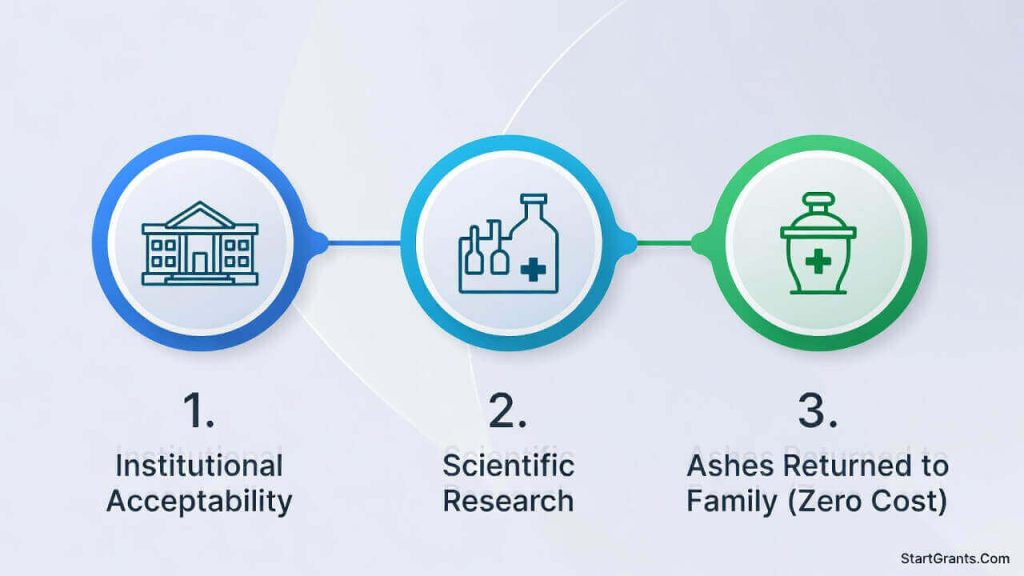
Some medical schools or accredited donation programs pay certain transportation and eventual cremation costs for accepted donors. Acceptance is never guaranteed, even if preregistration occurred. Distance, timing, infectious disease, autopsy, trauma, body condition, weight, or program capacity may affect acceptance. The family may still pay for death certificates, memorial services, transportation beyond the service area, or an alternative disposition if the donation is declined.
Contact the named medical-school program directly—preferably before death—and keep a backup plan. Be cautious with for-profit body-broker arrangements and do not describe donation as a government funeral benefit.
Muslim Perspective: Planning an Affordable Janazah After Cancer
Muslim families should contact a local mosque, Islamic center, or Janazah coordinator before authorizing a general funeral-home package. The coordinator may already work with a Muslim funeral director, ghusl team, cemetery, and transportation provider. This can protect religious needs while reducing duplicated services.
- Request an itemized Janazah estimate: transportation, refrigeration, ghusl facilities, kafan, permits, funeral-home fee, cemetery plot, opening and closing, and marker may be separate.
- Ask about cancer-treatment precautions: chemotherapy, radiation implants, medical devices, autopsy, or medical examiner involvement may require professional guidance. Follow the healthcare provider, funeral director, and applicable public-health rules.
- Confirm who performs ghusl: discuss same-gender attendants, personal protective equipment, body handling, and whether the medical condition changes the safe procedure.
- Ask about mosque assistance: a community may offer a Janazah fund, sadaqah, negotiated cemetery rate, volunteers, or fundraising. None is nationally guaranteed.
- Seek qualified guidance on Zakat: a financially distressed family or eligible debt may qualify under some interpretations, but StartGrants does not issue a religious ruling. Ask the fund administrator and a trusted scholar about the actual case.
- Avoid unnecessary high-cost debt: ask about sadaqah, qard hasan, direct vendor donations, or a transparent community collection before using a funeral loan or credit card.
Islamic communities generally seek prompt burial, but there is no single U.S. “24-hour law.” Hospital release, medical examiner review, permits, weekends, cemetery schedules, and state rules can affect timing. A coordinator can help the family move quickly without making unsafe or inaccurate promises.
Crowdfunding the Remaining Amount
Fundraising is more credible after benefits, discounts, and assistance have been applied. Publish the itemized remaining need, explain who controls the funds, identify the beneficiary, and update donors if the budget changes. When appropriate, ask the funeral home whether donors can pay it directly.
Do not claim that chemotherapy bills legally transfer to relatives or that a charity application is already approved. Our guide on how to ask for funeral donations respectfully includes transparent wording and privacy precautions.
Documents to Gather

- Death certificate or temporary verification from the hospital or funeral home
- Applicant identification and proof of relationship or authority
- Itemized funeral-home and cemetery estimates
- Proof of household income, benefits, assets, and the deceased person’s estate when required
- Cancer diagnosis or treatment verification only when a specialized fund requests it
- Insurance, employer, union, VA, Social Security, county, and crowdfunding information
- Police or victim-compensation documents if the death involved a crime
- Written decisions and case numbers from programs already contacted
A Practical Order of Calls
- Oncology or hospice social worker
- County social services, coroner, or public administrator
- Two or more funeral homes for comparable itemized prices
- Life insurer, employer, union, pension, and Social Security
- VA, military aid society, or Tribal office when applicable
- Child-loss or local cancer memorial programs that match eligibility
- Mosque, church, synagogue, or other community network
- Crowdfunding for the verified remaining gap
Frequently Asked Questions
Does the American Cancer Society pay funeral expenses?
Its official services emphasize information, referrals, treatment transportation, lodging, and support rather than a nationwide funeral-payment program. Call for navigation, but verify any referred program separately.
Can CancerCare assistance be used after the patient dies?
CancerCare’s current financial program generally requires a confirmed diagnosis and active treatment or a stated surgery condition, and lists specified treatment-related needs. It should not be presented as a general funeral grant.
Can medical debt disqualify a family from funeral assistance?
Each program uses its own financial rules. Medical debt may help document hardship, but it does not guarantee approval. Programs may evaluate income, assets, estate resources, residence, and other available benefits.
Will life insurance pay when death was caused by cancer?
An in-force life insurance policy generally can cover a cancer death, but payment depends on the policy, beneficiary, lapse status, contestability, application accuracy, and exclusions. Submit a claim to the insurer for a formal decision.
Is direct cremation always about $1,000?
No. Prices vary by market, transportation distance, permits, crematory charges, weight policies, and optional services. Request comparable itemized quotes rather than relying on a national estimate.
What help exists after a child dies from cancer?
The TEARS Foundation, Final Farewell, Kaden’s Cause, and some local pediatric-cancer organizations may help qualifying families. Age, geography, timing, expenses, and available funding differ.
Does hospice pay for the funeral?
Medicare hospice coverage does not normally pay funeral costs. Hospice social workers and bereavement teams may identify local programs, reduced-cost providers, and required application steps.
Can a mosque help with Janazah costs?
Some mosques maintain hardship or Janazah funds, negotiate provider rates, organize volunteers, or collect donations. Assistance is local and not guaranteed; contact the mosque’s Janazah coordinator promptly.
Important disclaimer: StartGrants.com is an independent information portal. It is not affiliated with, endorsed by, or an agent of any government agency, cancer organization, charity, hospice, funeral provider, insurer, mosque, or crowdfunding platform mentioned here. Programs, funding, eligibility, service areas, and benefit amounts can change. Confirm current rules and obtain written approval from the official provider before signing a funeral contract or paying. This article provides general information, not legal, tax, medical, financial, funeral-directing, insurance, or religious advice.