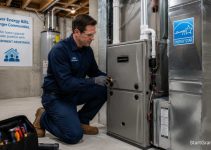
Last Updated: | Author: Munir Ardi
A working refrigerator is essential for safely storing food and medicine, but there is no single federal program that gives every low-income household a free refrigerator. The strongest government-supported route is usually the Weatherization Assistance Program (WAP), which may replace an inefficient refrigerator when a local energy audit approves it. Utilities, local governments, charities, and reuse programs may offer other options, but availability varies by ZIP code and funding.
This guide explains what is genuinely available in 2026, what is not covered, and how to apply without paying someone to “unlock” a government benefit. For assistance with several household energy upgrades, start with our energy-efficiency assistance guide for homeowners.

Is There a Federal Free Refrigerator Program?
No federal agency operates a nationwide refrigerator giveaway for individual households. Federal funding may reach families through state, tribal, territorial, utility, or local programs, but those administrators set the application process, covered products, priority rules, and available inventory.
| Possible source | What it may provide | What it does not guarantee |
|---|---|---|
| Weatherization Assistance Program | Energy audit and approved replacement of an inefficient refrigerator or freezer | Replacement based only on age, income, or a broken appliance |
| Electric utility | Income-qualified replacement, appliance exchange, rebate, recycling incentive, or discount | A free new refrigerator from every utility |
| HOMES rebate program | Potential appliance measure inside an approved whole-home energy-savings project | A stand-alone national refrigerator coupon |
| Community Action Agency or local government | Flexible emergency assistance, referral, or locally funded appliance program | Identical services in every county |
| Charity or reuse organization | Donated appliance, voucher, repair assistance, or reduced-price used refrigerator | New equipment, delivery, installation, or a warranty |
1. Apply Through the Weatherization Assistance Program
The U.S. Department of Energy’s Weatherization Assistance Program helps qualifying low-income households reduce energy costs and improve home safety. It is a service program—not a cash grant paid to the applicant.
DOE’s official description of whole-house weatherization specifically includes replacing refrigerators and freezers with energy-efficient models among possible electric baseload measures. That does not mean every approved household receives one. The local provider normally performs an energy assessment and selects measures that satisfy its technical, cost-effectiveness, funding, and state-plan requirements.
Who may qualify?
DOE’s general framework allows households at or below 200% of the federal poverty level, while states may use an approved LIHEAP income standard. Households receiving certain benefits may also qualify under applicable rules. States commonly prioritize households with older adults, people with disabilities, children, high energy burdens, or high residential energy use.
Homeowners and renters can apply. Weatherization work in a rental home normally requires the property owner’s permission, and multifamily properties have additional requirements. Use DOE’s official WAP application directory to find the administrator serving your area.
What to ask the WAP provider
- Is refrigerator testing included in the energy assessment?
- Does the current state plan allow refrigerator replacement?
- Must the old refrigerator be operating so its energy use can be measured?
- Who selects, delivers, installs, and owns the replacement?
- Must the old appliance be removed or recycled?
- What size, accessibility features, or medical-storage needs can be considered?
- How long is the current waiting list?
WAP uses a whole-house approach. The same audit may find that insulation, air leakage, heating, or cooling consumes far more energy than the refrigerator. If so, the provider—not the applicant—determines the approved work. Related StartGrants guides cover home-insulation assistance, central-heating assistance, and financial assistance for air conditioning.
2. Ask Your Electric Utility About Income-Qualified Appliance Programs
Some utilities replace inefficient refrigerators for income-qualified customers, while others offer rebates, discounts, appliance recycling incentives, or home energy assessments. These are not standardized national benefits.
Use the EPA’s utility income-eligible program directory and ENERGY STAR Rebate Finder, then confirm the offer directly with the utility. A ZIP-code result is a lead, not an approval.
Questions that prevent costly mistakes
- Is this a replacement program, purchase rebate, recycling payment, or loan?
- Must the existing refrigerator work, meet a minimum age, or exceed an energy-use threshold?
- Does the program require an energy audit before purchase?
- Is the customer required to use an approved retailer or contractor?
- Does the benefit include delivery, door reversal, installation, hauling, and disposal?
- Must the customer pay first and wait for reimbursement?
- Can the utility combine its benefit with WAP or a local rebate?
Recycling programs often require surrendering an operating older refrigerator and may offer only a small incentive. They are different from replacement programs. Never give away the household’s only working refrigerator until the replacement, delivery date, and total out-of-pocket cost are confirmed in writing.
3. Check State Home Energy Rebates—With Important Limits
Two federally funded rebate programs are administered locally: HOMES and HEEHR. Program status and design differ among states, territories, and tribes.
HOMES may include appliances in a larger project
The Home Owner Managing Energy Savings program supports whole-home projects that achieve modeled or measured energy savings. DOE lists appliances among possible project measures, but HOMES is not a stand-alone free-refrigerator program. The local administrator determines whether a refrigerator can be included, how savings are calculated, and which contractors or products qualify.
DOE describes rebates of up to $8,000 for qualifying projects, depending on household income, project cost, program design, and energy savings. “Up to” is not the amount every applicant receives. Use the official Home Energy Rebates status page before signing a purchase agreement. Our government help for greener homes guide explains broader whole-home projects.
HEEHR does not offer a refrigerator-specific rebate
The High-Efficiency Electric Home Rebate program covers specified categories such as heat pumps, heat-pump water heaters, certain electric cooking equipment, heat-pump clothes dryers, insulation, wiring, and electrical panels. A household should not expect the frequently advertised “$840 appliance rebate” to pay for a refrigerator. That cap applies to eligible electric cooking equipment or a heat-pump clothes dryer—not a standard refrigerator.
There is no federal refrigerator tax credit for 2026
A household refrigerator is not listed as eligible property under the federal Energy Efficient Home Improvement Credit. In addition, the IRS states that the applicable home-energy credits ended for property placed in service after December 31, 2025. Do not let a seller subtract a nonexistent 2026 federal refrigerator credit from the advertised price.
4. Contact Community Action and Local Government
A Community Action Agency may administer WAP and LIHEAP, operate flexible crisis funds, or know county-specific appliance programs. Use the Office of Community Services “Find Your CAA” resource.
Also contact the city or county housing, community-development, aging, disability, or human-services department. Some jurisdictions use local, utility, Community Development Block Grant, or charitable funds for essential home repairs and appliances. Ask whether the program is:
- a grant, voucher, reimbursement, loan, or donated-item program;
- limited to homeowners, renters, older adults, people with disabilities, or particular ZIP codes;
- open now or accepting names for a waiting list; and
- able to cover delivery and removal of the old appliance.
LIHEAP may help with home-energy bills and crises, but it is not a national refrigerator-purchase benefit. Lowering an overdue utility balance may stabilize the household budget, while the refrigerator request should be directed to WAP, the utility’s appliance program, or local flexible assistance.
5. Use 211 and Local Charities Without Expecting a Guarantee
Call 211 or search the local 211 directory for appliance banks, furniture banks, emergency household-goods programs, church or mosque funds, community foundations, and nonprofit repair services. A local Salvation Army, St. Vincent de Paul, Catholic Charities agency, Habitat for Humanity ReStore, or independent furniture bank may be worth contacting, but their services are not uniform.
Habitat ReStores generally sell donated goods at reduced prices; they should not be described as a nationwide source of free refrigerators. Other charities may issue a voucher or arrange a donated appliance only after an intake assessment. Inventory, delivery area, documentation, and waiting time can change daily.
When calling, state the practical need clearly:
- the household has no working refrigerator;
- food or temperature-sensitive medication is at risk;
- the household can or cannot transport the appliance;
- the doorway and refrigerator-space measurements; and
- whether landlord permission is available.
6. What SNAP, TANF, and Other Benefits Can—and Cannot—Do
SNAP benefits are restricted to eligible food and food-producing seeds or plants. They cannot be used to purchase a refrigerator. The official USDA SNAP purchase list should be used instead of social-media claims.
TANF cash-assistance policies are set by states. A cash benefit may provide general household support under applicable state rules, but TANF is not a federal refrigerator grant and no applicant should be promised a special appliance payment. Ask the state agency whether an emergency, diversion, or supportive-services benefit exists.
SSI, Social Security, Medicaid, Medicare, and WIC also should not be presented as national free-refrigerator programs. A case manager, health-plan coordinator, or benefits counselor may know a local flexible fund, but coverage must be confirmed before purchase.
7. If You Rent, Check the Lease Before Buying
Whether a landlord must provide or repair a refrigerator depends on the lease, housing program, and state or local law. Air conditioning, heat, and major appliances do not have identical legal treatment in every jurisdiction.
- Check whether the refrigerator is listed as a landlord-provided appliance.
- Report the failure in writing and keep photographs and copies of messages.
- Ask for the repair timeline and instructions for protecting food.
- Do not remove, replace, or dispose of the landlord’s appliance without written permission.
- Contact a local tenant-help organization or legal-aid office before withholding rent or deducting repair costs.
Renters may apply for WAP, but the provider normally needs owner authorization for work involving the property or its appliances.
How to Apply for Refrigerator Assistance

- Document the problem. Record the model and serial number, age if known, temperature readings, visible damage, and any repair diagnosis. Unplug equipment only when the manufacturer, utility, fire department, or qualified technician says it is unsafe to leave connected.
- Contact WAP and the utility. Apply to both when allowed; their eligibility and waiting lists are different.
- Call the Community Action Agency and 211. Ask for appliance replacement, furniture-bank, emergency-household-goods, and repair referrals.
- Gather requested records. These may include identification, proof of household income, utility bills, lease or ownership documents, and benefit letters. Requirements vary; do not send sensitive records to an unverified social-media account.
- Measure before accepting a unit. Record opening width, height, depth, door swing, nearby walls, electrical outlet, and delivery path.
- Confirm every included service. Ask about delivery, stairs, water-line connection, old-unit removal, installation, warranty, and repairs.
- Get approval before buying. Many programs do not reimburse purchases made before authorization.
- Request a written denial or waiting-list status. The document may identify an appeal, missing record, or another program.
What to Do When the Refrigerator Stops Cooling
Protecting food is more urgent than completing an assistance application. The FDA recommends keeping a refrigerator at 40°F (4°C) or below and a freezer at 0°F (-18°C). Use an appliance thermometer because the control dial may not show the actual temperature.
During a power outage, FoodSafety.gov says a closed refrigerator keeps food safe for about four hours. A full closed freezer holds its temperature for about 48 hours, or about 24 hours when half-full. These time estimates assume the doors remain closed.
- Move essential perishables to a cooler with enough ice or cold packs to keep them at 40°F or below.
- Do not taste food to decide whether it is safe. Unsafe food may look and smell normal.
- Discard perishable refrigerated food after four hours without power unless a thermometer confirms it remained at 40°F or below.
- Contact a pharmacist about medication that exceeded its labeled storage temperature; do not guess whether it remains usable.
- Use a food pantry or meal program for short-term support if replacing spoiled groceries creates hardship.
How to Evaluate a Donated or Used Refrigerator
A used appliance can solve an urgent problem, but “free” can become expensive if it is unsafe, inefficient, or impossible to deliver. Before accepting it:
- check the exact dimensions, door swing, outlet requirements, and delivery path;
- ask to see it operating and verify that the refrigerator reaches 40°F or below;
- inspect the cord, plug, seals, shelves, hinges, interior liner, and signs of pests or mold;
- search the model number in the CPSC recall database;
- ask who pays for transport, setup, repairs, and disposal if it fails;
- avoid transporting a refrigerator on its back when the manufacturer prohibits it, and follow the manufacturer’s waiting period before reconnecting power; and
- arrange lawful refrigerant recovery and disposal rather than abandoning the old appliance.
Compare the yellow EnergyGuide label or estimated annual energy use when possible. A very old free refrigerator may cost more to operate than a newer efficient model. For households planning multiple upgrades rather than only an emergency replacement, compare whole-home programs before purchasing.
Muslim Perspective: Essential Appliances, Zakat, and Responsible Financing
A refrigerator helps protect food, infant nutrition, medication, and family health. Muslim households can seek public benefits and charitable assistance while checking whether the help is a genuine grant, donated item, rebate, loan, or rent-to-own contract.
Distinguish assistance from debt
WAP services, an approved utility replacement, and a charitable appliance normally are not conventional loans. Applicants still must provide accurate information and follow the program’s conditions. Ask whether any amount becomes repayable after a move, sale, incorrect application, missed inspection, or early disposal.
Review financing carefully
Rent-to-own and “no credit needed” offers can make a refrigerator available quickly but may produce a total cost far above the cash price. Review the annual percentage rate or lease cost, fees, late-payment consequences, early-purchase option, repossession terms, warranty, and total of payments. Families concerned about riba or other contract terms should show the complete agreement to a trusted scholar or qualified Islamic-finance adviser before signing rather than relying on an advertisement’s label.
Ask local zakat and sadaqah programs
A mosque, zakat committee, Islamic charity, refugee-support organization, or mutual-aid group may help with an essential appliance, repair, delivery, or temporary food costs. Funds, recipient criteria, geography, and documentation vary, so assistance should not be promised. Bring the repair diagnosis, price estimate, measurements, and proof of applications to other programs.
Accepting and cleaning a used refrigerator
A used refrigerator should not automatically be treated as religiously unsuitable. Clean and sanitize removable parts and food-contact surfaces according to the manufacturer’s instructions, discard contaminated materials, and verify safe operating temperature. Households with specific questions about ritual purity can consult a trusted local scholar while still following public-health cleaning guidance.
Frequently Asked Questions
Does the federal government give low-income families free refrigerators?
There is no universal federal refrigerator giveaway. WAP may replace an inefficient refrigerator when a local audit approves it, and utilities or local programs may offer separate assistance.
Can WAP replace a refrigerator that is completely broken?
Possibly, but replacement is not automatic. The provider must follow its state plan, audit method, cost-effectiveness rules, available funding, and procedures for evaluating equipment that is not operating.
What is the income limit for WAP?
DOE’s general framework uses household income at or below 200% of the federal poverty level, while states may use an approved LIHEAP standard and other eligibility pathways. The local administrator makes the official determination.
Can renters receive a refrigerator through weatherization?
Renters can apply for WAP, but appliance or property work normally requires owner permission and must satisfy rental-property requirements. Responsibility for a failed refrigerator also depends on the lease and local law.
Does the $840 HEEHR appliance rebate cover refrigerators?
No refrigerator-specific $840 HEEHR rebate exists. That amount applies to eligible electric cooking equipment or a heat-pump clothes dryer, subject to the local program’s rules.
Can SNAP or an EBT card pay for a refrigerator?
No. SNAP benefits are for eligible food and food-producing seeds or plants, not household appliances.
Is there a federal tax credit for buying an efficient refrigerator in 2026?
No. Household refrigerators are not listed as eligible property under the federal Energy Efficient Home Improvement Credit. The IRS also states that this particular credit applies only to qualifying improvements made through December 31, 2025.
How long is refrigerated food safe after a power outage?
A closed refrigerator generally keeps food safe for about four hours. Perishable food should be discarded after that unless a thermometer confirms it remained at 40°F or below.
Is it permissible for a Muslim family to accept refrigerator assistance?
A public benefit, rebate, or charitable appliance is not automatically the same as an interest-bearing loan. Verify the program’s conditions and seek contract-specific guidance from a trusted scholar or Islamic-finance adviser when needed.