Last Updated: July 2026 | Author: Munir Ardi
Sudden Cardiac Arrest (SCA) is one of the leading causes of death in the United States, striking over 350,000 individuals outside of hospitals every year. In an SCA event, the heart abruptly stops beating. Every minute that passes without defibrillation reduces the victim’s chance of survival by a staggering 10%. By the time an ambulance arrives, it is often too late. The only definitive treatment is an Automated External Defibrillator (AED).
Despite their life-saving capability, AEDs are notoriously expensive. A single unit, complete with a wall cabinet, pediatric pads, and backup batteries, can easily cost between $1,500 and $2,500. For underfunded schools, rural fire departments, and community non-profits, this price tag is an insurmountable barrier. Fortunately, massive federal pipelines and private foundations exist specifically to deploy automated external defibrillator grants to institutions in need.
Before launching an institutional application for medical hardware, it is critical to understand the overarching federal architecture that funds public health and first responders. Anchor your funding strategy by reviewing our master pillar: Medical Research and Institutional Grants.
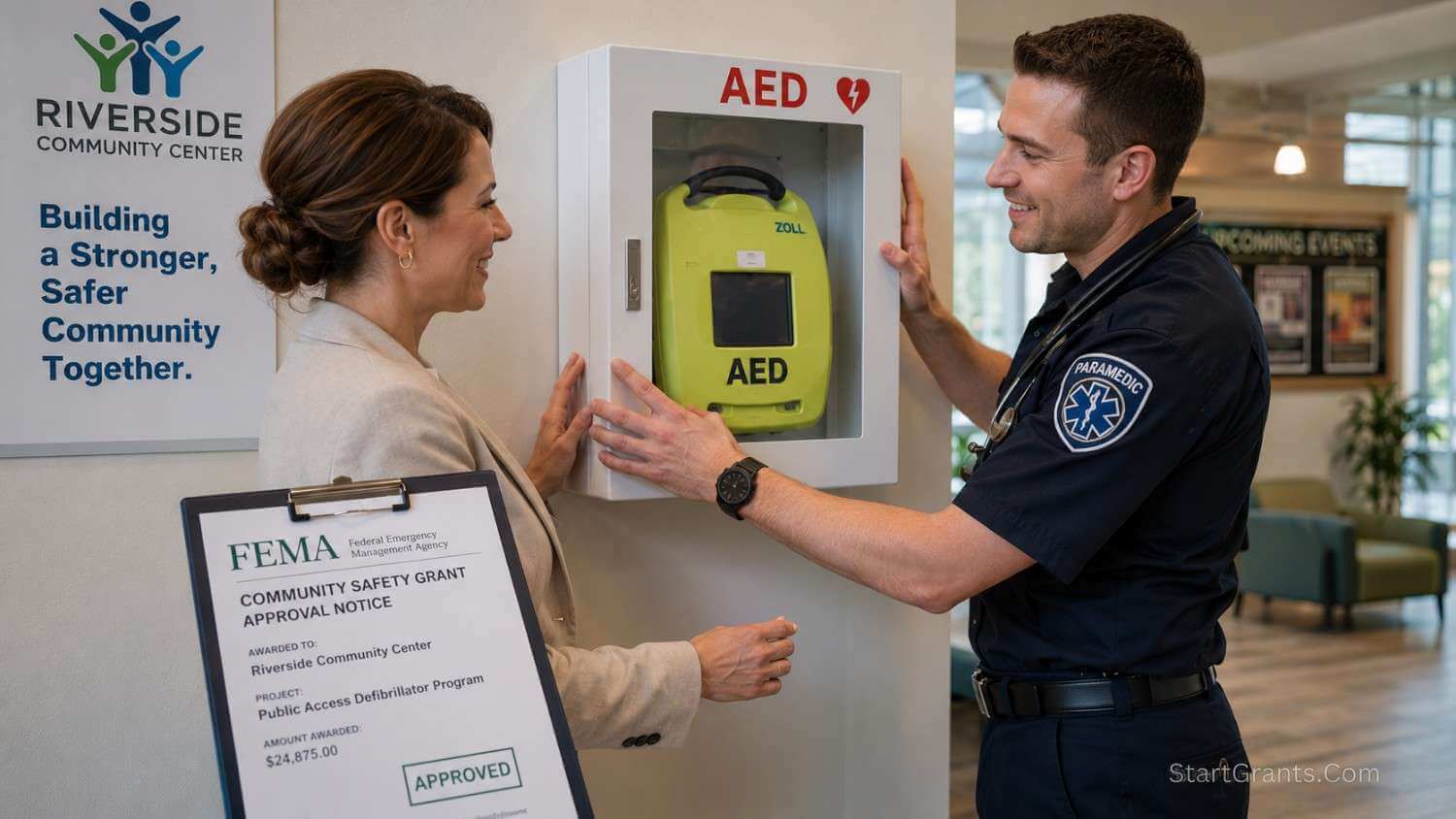
Automated External Defibrillators (AEDs) are critical life-saving devices, but their high cost often deters schools and community centers. By securing federal and foundation grants, organizations can equip their facilities to survive cardiac emergencies.
Phase 1: First Responders (The Federal Pipeline)
If your organization is a fire department, EMS agency, or state-affiliated first responder unit, your primary target is not a private charity; it is the federal government. The Department of Homeland Security, via the Federal Emergency Management Agency (FEMA), operates the massive Assistance to Firefighters Grant (AFG) program.
The AFG explicitly funds the purchase of life-saving equipment, including equipping every single response vehicle with an AED. Because rural and volunteer departments are notoriously underfunded, they receive priority scoring in these grant reviews. To master the specific federal bureaucracy required to win these funds, deploy our targeted strategy guide: AED Grants for Fire Departments.
Synergizing First Responder Grants: A smart grant writer never stops at just medical equipment. When applying for federal aid, you must stack your proposals to secure comprehensive funding across all operational silos. If you are updating your department’s medical gear, you must simultaneously secure capital for community outreach by pursuing Fire Prevention Grants. Furthermore, if you operate a municipal police force, ensuring your K-9 units and patrol cars are equipped with both trauma kits and AEDs is vital; uncover those funds in Police K9 Grants.
Phase 2: Schools, Non-Profits, & Community Centers
If you are not a federal or state first responder, FEMA will not fund your AED. Public schools, sports leagues, and 501(c)(3) community centers must pivot their focus toward massive private and corporate endowments dedicated to public health.
- Hopey’s Heart Foundation: Founded in memory of a student-athlete who passed away from SCA, this foundation provides free AEDs specifically to eligible schools, community centers, and youth sports organizations to protect young athletes on the field.
- Firehouse Subs Public Safety Foundation: This incredibly lucrative corporate foundation awards grants to hometown heroes and community organizations specifically to purchase life-saving equipment, including massive bulk orders of AEDs for municipal buildings and schools.
Phase 3: The Bureaucratic Shield (Compliance & Training)
A fatal mistake made by amateur grant writers is asking a foundation only for the cost of the machine. The government and private foundations know that an AED is useless if the battery is dead or if the staff is terrified to use it.
To win an automated external defibrillator grant, your proposal must present an impenetrable “Bureaucratic Shield.” Your grant budget must explicitly include:
- CPR & AED Certification: You must request funds to hire a certified instructor (e.g., from the American Heart Association or Red Cross) to train your entire staff. If you are wondering how long does CPR certification last and how to get it funded through this grant, most official certifications are valid for exactly two years. Your grant proposal must include the cost of the initial training and a timeline for recertification before the cards expire.
- The Maintenance Plan: AED batteries and electrode pads expire every 2 to 4 years. Your proposal must outline exactly who is responsible for checking the device monthly and how future pad replacements will be funded.
- Medical Direction: Many states legally require AEDs deployed in public buildings to be registered with the local EMS system and overseen by a licensed physician (Medical Direction). Ensure your grant covers this compliance fee.
Pro-Tip: Real-World Grant Distribution in Action
Understanding how massive healthcare networks distribute their AED grants can give your organization a strategic advantage when drafting your proposal. To see a successful philanthropic initiative in action—and to understand the community impact that medical centers look for when selecting grant recipients—watch this powerful overview of the Revive and Survive program by Franciscan Health:
Phase 4: The Muslim Perspective (Hifz al-Nafs, Riba, Gharar, & Zakat)
For Islamic centers, Masjids, and Muslim-led community organizations operating in the United States, equipping the facility with an AED is not merely a public safety recommendation; it is the physical manifestation of profound theological duty. However, securing the capital and managing the liability of this medical device requires strict adherence to Islamic financial jurisprudence (Shariah).
The Theology of Hifz al-Nafs
In the framework of Islamic Law (Maqasid ash-Shariah), the supreme objective after the preservation of faith is Hifz al-Nafs (the preservation of human life). The Qur’an unequivocally states: “…And whoever saves one life – it is as if he had saved mankind entirely” (Al-Ma’idah 5:32). When hundreds of congregants gather for Jum’ah (Friday prayers) or Tarawih, the statistical probability of a cardiac event increases. A Masjid board that neglects to install an AED is failing in its divine mandate to protect its congregation. Securing these devices through grants is an act of high worship.
The Trap of Riba (Corporate Credit Cards)
Because an AED package costs $2,000, underfunded Masjids often put the purchase on a corporate credit card. If donations are slow and the balance is not paid immediately, the bank applies compounding interest.
In Islam, any transaction that incurs interest is explicitly Riba, which is strictly Haram (forbidden). Purchasing life-saving equipment using Riba-laced debt destroys the spiritual Barakah (blessing) of the institution. A Muslim board must adamantly refuse this trap. This elevates the pursuit of Grants (Hibah) into a religious necessity, as grants require zero repayment and are 100% Halal capital.

Installing an AED in a Masjid is a profound manifestation of Hifz al-Nafs (preserving life). However, Muslim boards must ensure the device is funded through Halal grants or Sadaqah Jariyah, strictly isolating restricted Zakat funds from fixed asset purchases.
Zakat vs. Sadaqah Jariyah: The Fixed Asset Rule
When the Masjid launches a fundraiser for an AED, a massive theological error frequently occurs: misusing Zakat.
In Islamic Fiqh, Zakat is a divine tax strictly restricted to eight specific human categories (the Asnaf), primarily the destitute and the poor. Zakat funds absolutely cannot be used to purchase a wall-mounted AED for a community building. An AED is a fixed corporate asset. Using Zakat to buy facility equipment is a severe spiritual violation of the Amanah (trust) given by the donors.
Instead, the purchase of an AED must be funded exclusively through government/corporate Grants, general Sadaqah, or Sadaqah Jariyah (continuous charity). Because an AED will remain on the wall for years, ready to save a life, anyone who donates toward its purchase through Sadaqah Jariyah will receive continuous divine reward, even after their death, every time the machine is mobilized.
Gharar and Liability (The Good Samaritan)
Masjid boards often fear installing an AED due to liability: “What if we use it on a congregant and they die? Will the Masjid be sued?” Fortunately, all 50 states have “Good Samaritan Laws” that legally protect untrained bystanders who use an AED in good faith during an emergency.
However, to secure institutional grants, foundations will legally mandate that the 501(c)(3) maintains comprehensive Commercial General Liability Insurance. Traditional commercial insurance involves Gharar (excessive uncertainty). Because genuine B2B Takaful (Islamic cooperative insurance) is virtually non-existent in the U.S., Islamic scholars apply the principle of Dharurah (legal and operational necessity), permitting the Masjid to purchase the required commercial policy to protect the community from ruinous lawsuits and satisfy grant compliance.
Conclusion
Securing automated external defibrillator grants requires presenting your facility as a fully prepared, legally compliant safe zone. By bypassing standard donations and aggressively targeting FEMA’s AFG program for first responders, or corporate endowments like Firehouse Subs for schools, you can secure this $2,000 piece of hardware completely debt-free. Your proposal must prove you have the budget for training and long-term maintenance.
For the Muslim community, equipping the local Masjid with an AED is the ultimate fulfillment of Hifz al-Nafs. By fiercely rejecting the predatory trap of Riba-laced credit cards in favor of Halal Hibah and Sadaqah Jariyah, navigating insurance mandates ethically via Dharurah, and strictly isolating Zakat funds from fixed-asset purchases, your community center becomes a fortress of physical safety and absolute spiritual purity.
Frequently Asked Questions (FAQs)
Q1: Will the federal government buy an AED for my local community center?
A: Generally, no. Federal AED grants (like the FEMA AFG program) are strictly reserved for official first responders, such as fire departments and EMS agencies. Community centers, churches, and public schools must apply to private foundations or corporate endowments (like Hopey’s Heart Foundation) for equipment grants.
Q2: Do we have to pay the grant back if we never use the AED?
A: No. A legitimate equipment grant is non-dilutive “gift aid.” You are not penalized if the AED sits in its cabinet unused. In fact, the ultimate goal of public health funding is that the machine is never needed. The grant only requires that you properly maintain the equipment.
Q3: Why do grant committees require a budget for “Medical Direction”?
A: Many state laws dictate that an AED placed in a public facility must be registered with the local 911 dispatch center and overseen by a licensed physician (Medical Direction) who reviews the data if the machine is ever used. Grant committees require proof that you have budgeted for this legal compliance to ensure the machine isn’t confiscated by the state.
Q4: Why is it Haram for an Islamic Center to buy an AED using Zakat funds?
A: In Islamic jurisprudence, Zakat is an obligatory tax strictly restricted to specific human recipients (the Asnaf), primarily the extreme poor. Zakat cannot be used to purchase physical infrastructure or fixed assets for an organization (like an AED, new carpets, or an ultrasound machine). These items must be purchased using Sadaqah (voluntary charity) or government grants.
Q5: If an AED is purchased with a credit card, why is that considered Riba?
A: Using a credit card is not inherently Haram, but if the organization fails to pay the full balance by the due date (which often happens when donations are slow), the bank applies compounding interest to the debt. In Islam, intentionally paying interest is classified as Riba, which is strictly forbidden. Organizations must seek Halal alternatives like Hibah (grants) or Qard Hasan (interest-free community loans).
Disclaimer: The information provided in this article is for educational and informational purposes only. We are not a federal agency, a medical provider, or a religious fatwa council. FEMA AFG regulations, Good Samaritan laws, and AED compliance requirements vary heavily by state and are subject to change. Always consult directly with your local EMS coordinator for deployment rules, and seek guidance from a qualified Islamic finance scholar regarding Halal institutional structuring, Zakat separation, and commercial insurance mandates.