
Last Updated: | Author: Munir Ardi
Private K-12 schools can pursue several kinds of public and private support, but most federal education funding is not a cash grant paid to the school. The main federal pathway is equitable services delivered or arranged by a public agency for eligible private-school students and educators. Other possibilities include state school-choice programs, FEMA security funding for qualifying nonprofits, and competitive grants from foundations or companies.
This guide is for private, independent, and faith-based school administrators evaluating institutional funding. It does not cover tuition assistance for one family or free supplies for an individual student. For a broader directory of campus projects, see K-12 school facility and program grants.
Important distinction: Equitable services, vouchers or education savings accounts, and competitive grants are different funding mechanisms. A school should not record or describe all of them as unrestricted grant revenue.
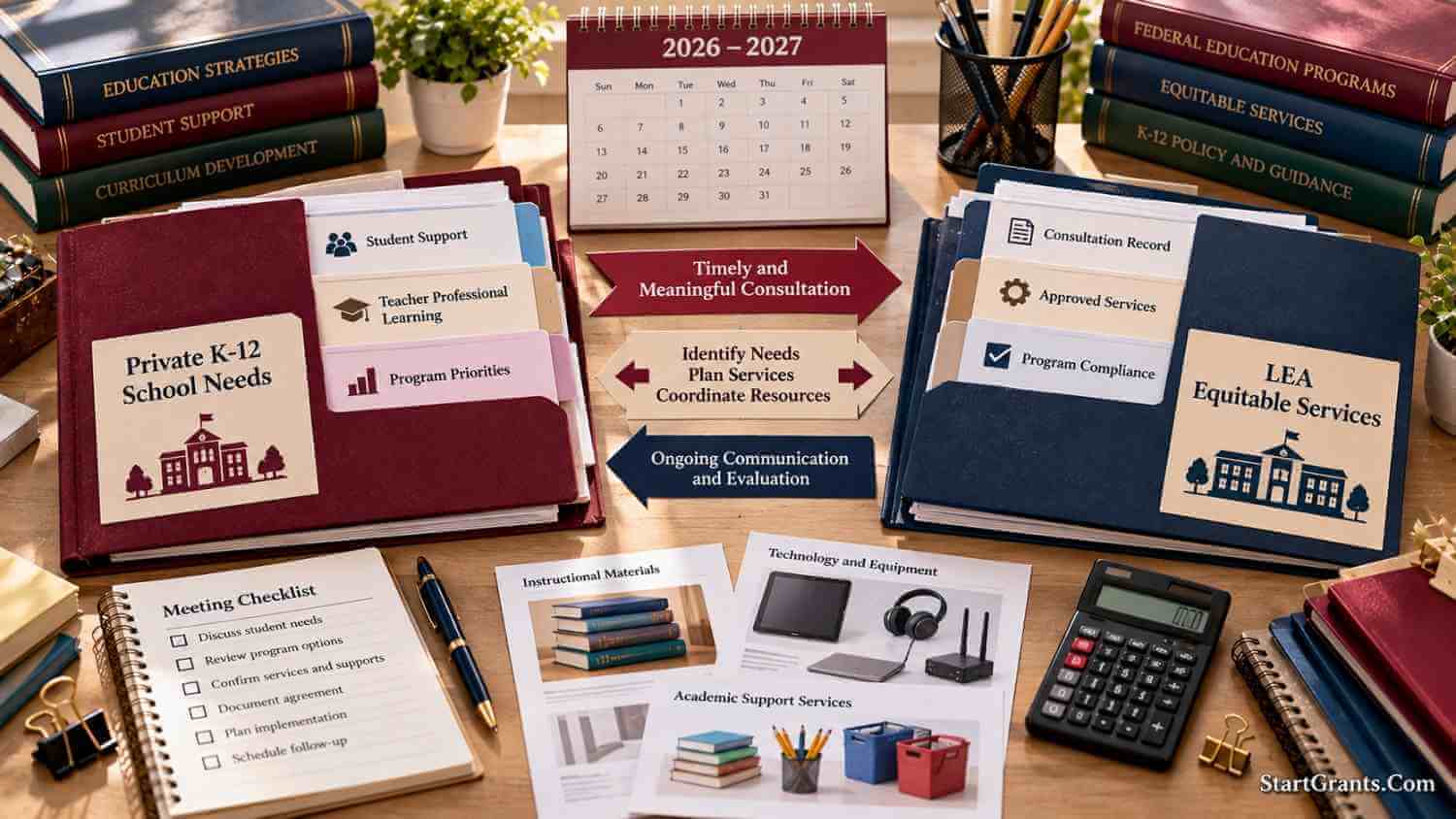
Private-School Funding Options at a Glance
| Funding pathway | What the school may receive | Who controls or awards it | First action |
|---|---|---|---|
| ESEA equitable services | Eligible instructional services, professional learning, or other approved benefits | The LEA or another responsible public agency retains control of funds | Request timely and meaningful consultation |
| IDEA Part B equitable services | Services for some parentally placed private-school children with disabilities | The LEA calculates and administers a proportionate share | Contact the LEA responsible for the private school’s location |
| State choice programs | Tuition payments or approved educational expenses tied to an eligible student | A state agency, scholarship organization, parent account, or program administrator | Check provider eligibility and participation rules in the school’s state |
| FEMA NSGP | Approved security equipment, planning, training, exercises, or contracted security costs | FEMA funds states; eligible nonprofits apply as subapplicants through their State Administrative Agency | Review the current NOFO and state deadline before preparing a vulnerability assessment |
| Foundation or corporate grants | Restricted project support, donated value, or occasionally general support | The funder under its published eligibility and award terms | Confirm that private schools or the school’s nonprofit entity are eligible |
Program availability, eligible costs, award amounts, and deadlines can change. Verify the current rules with the administering agency or funder before budgeting.
How ESEA Equitable Services Work
The Elementary and Secondary Education Act requires participating local educational agencies to consult with appropriate private-school officials about equitable services under applicable programs. The U.S. Department of Education explains that control of federal funds remains with the LEA or other public agency and that services must be secular, neutral, and nonideological. Review the Department’s official ESEA equitable-services resources and non-public education FAQ.
This means a private school generally cannot request that the LEA hand over its calculated share or reimburse any purchase the school makes independently. The parties consult about student needs, eligible services, providers, delivery, assessment, and how the LEA will evaluate the program. Final arrangements must follow the governing federal program.
Title I, Part A
Title I equitable services are designed for eligible private-school students who reside in participating public-school attendance areas and are identified as needing additional academic help under the program’s rules. Attendance at a private school alone does not make every student eligible. Services may include supplemental instruction or related supports, but the LEA remains responsible for their design and administration after consultation. The Department’s Title I equitable-services guidance describes these requirements.
Title II, Part A and Title IV, Part A
Depending on local participation and needs, Title II equitable services may support eligible professional-development activities for private-school educators. Title IV equitable services may address well-rounded education, safe and healthy students, or effective use of technology. These categories do not guarantee a particular device, counseling position, or after-school program. The proposed activity must be allowable, necessary, reasonable, supplemental, and agreed through consultation.
If student mental-health needs are a priority, compare the equitable-services route with the separate funding paths in our guide to grants for school counseling programs.
Start consultation early
- Identify the LEA or public agency responsible for each applicable program.
- Send a written request to participate before the LEA finalizes its annual plans and budgets.
- Bring enrollment, residence, academic-needs, staff-development, and program information requested by the LEA.
- Document the topics discussed, the services proposed, the delivery schedule, and how disagreements will be handled.
- Do not order equipment or hire a provider on the assumption that the LEA will reimburse the school.
Private-school officials may use the applicable complaint process if they believe consultation was not timely and meaningful or the law was not followed. The better first step is a documented discussion with the LEA and, when needed, the state’s equitable-services ombudsman.
IDEA Services for Parentally Placed Students
The Individuals with Disabilities Education Act creates a separate equitable-services framework for children with disabilities whose parents place them in private schools. The LEA must conduct child-find activities and calculate a proportionate share of IDEA Part B funds, but a parentally placed private-school child does not have an individual entitlement to the same services the child would receive in public school. Some eligible children may receive services under a services plan after consultation and the LEA’s decisions about how the proportionate share will be used.
The U.S. Department of Education’s May 2024 IDEA questions and answers for parentally placed private-school children is the appropriate starting point. Families considering a placement decision should also speak directly with the responsible LEA because voluntarily choosing private school differs legally from a public placement in a private setting.
State Vouchers, ESAs, and Tax-Credit Scholarships
State school-choice programs vary widely. A voucher may direct a state-funded tuition benefit to an eligible student’s private school. An education savings account may allow a parent to pay approved educational expenses. A tax-credit scholarship is commonly awarded through an authorized scholarship organization. These are not interchangeable, and they are usually student- or family-based benefits rather than unrestricted institutional grants.
A private school may need to register as a participating provider, satisfy health and safety standards, administer required assessments, submit financial reports, limit charges, or follow nondiscrimination and student-record rules. Some programs restrict how funds may be spent or require repayment after an ineligible payment. Use the U.S. Department of Education’s education-choice resource hub to understand the categories, then verify current requirements with the relevant state agency or authorized program administrator.
FEMA Nonprofit Security Grant Program
The Nonprofit Security Grant Program is a competitive preparedness grant for eligible nonprofit organizations at high risk of a terrorist or other extremist attack. A qualifying nonprofit private school or faith-based school may be able to seek support for approved target-hardening and security activities. It is not a general construction, operating, or educational-technology grant.
For fiscal year 2026, FEMA published an NSGP funding opportunity with $300 million available nationally. The current notice sets the authoritative limits, eligible costs, and submission dates. Nonprofit organizations do not submit a direct application to FEMA; they apply as subapplicants through their State Administrative Agency under FEMA’s NSGP process. State deadlines are normally earlier than FEMA’s deadline.
Typical preparation includes confirming nonprofit eligibility, completing a facility-specific vulnerability assessment, writing an investment justification, and connecting each requested cost to an identified risk. Read the official FEMA NSGP page and the current notice rather than relying on an award limit from an earlier cycle.
Private Foundations and Corporate Support
Private grants can support projects that do not fit an equitable-services program, but no national foundation should be treated as an automatic source of money for private schools. Many funders limit geography, accept proposals only by invitation, exclude religious instruction, or fund only organizations with recognized tax-exempt status.
Search by a defined project and local benefit rather than by the phrase “free grant.” A concise concept memo should identify the problem, students served, project budget, measurable result, implementation timeline, and plan for costs after the grant ends. Confirm eligibility before preparing a full proposal.
- Instructional project: tutoring, laboratory materials, literacy, arts, or STEM enrichment.
- Student support: counseling, accessibility, food support, or transportation when the funder’s rules permit it.
- Facility project: library furniture, a playground, accessibility, or energy improvements, with separate quotes and a maintenance plan.
- Community partnership: a project delivered with a nonprofit, library, college, or local business.
For narrower project research, see funding options for library furniture and the verified forms of support described in Target community and education assistance. A local gift-card donation or community-voting program is not the same as an unrestricted institutional grant.
Build a Compliant Funding File
Save This Private-School Funding Checklist
[ ] Confirm the school’s legal name, nonprofit status, and authorized signatory.
[ ] Separate institutional grants from equitable services and family-directed tuition benefits.
[ ] Request ESEA and IDEA consultation before local planning deadlines.
[ ] Record the residence and eligibility data required for participating students without collecting unnecessary personal information.
[ ] Check whether a state choice program requires provider registration, testing, audits, or repayment.
[ ] Match every proposed expense to the funder’s current allowable-cost rules.
[ ] Maintain quotes, approvals, invoices, inventory records, and proof of program results.
[ ] Calendar reporting, renewal, closeout, and equipment-disposition requirements.
A Muslim Perspective
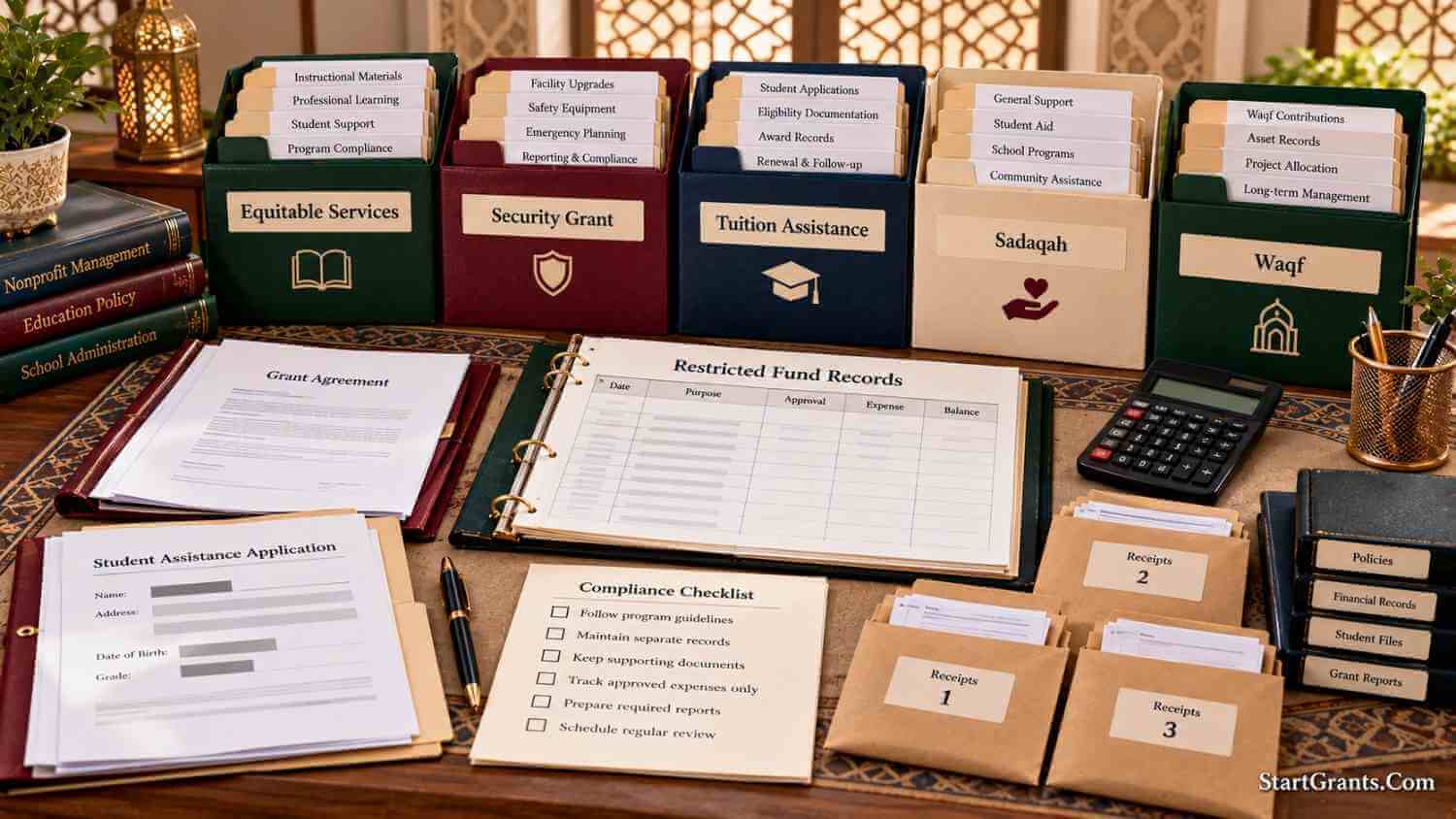
Islamic schools can explore the same equitable-services and nonprofit-security pathways available to other eligible private or faith-based schools. Administrators should respect the program’s written purpose: federal equitable services cannot pay for religious instruction, and restricted grant money must be used and documented exactly as agreed.
Zakat, sadaqah, and waqf may also support education, but they are not interchangeable. Whether a particular school expense or student qualifies for zakat can depend on the recipients, ownership of the funds, local practice, and the interpretation followed by the donor or institution. Keep restricted charitable funds separate, protect family financial information, and obtain guidance from a qualified Islamic scholar and an accountant familiar with nonprofit compliance. Interest-bearing borrowing also deserves review of the contract and appropriate religious and financial advice; this article does not issue a ruling.
Frequently Asked Questions
Can a private K-12 school receive federal education money directly?
Usually not through ESEA or IDEA equitable services. The responsible public agency retains control of those funds and provides or arranges approved services for eligible private-school students or educators. A private school may separately qualify for a competitive federal program when the current notice expressly lists its type of organization as eligible.
Does every private-school student qualify for Title I services?
No. Title I eligibility depends on federal and local rules, including where the student lives and whether the student is educationally at risk. The LEA identifies participants and designs supplemental services after consultation with private-school officials.
Can a private school require the district to buy laptops or reimburse training?
No. Private-school officials may present documented needs during consultation, but the activity must be allowable under the applicable program. The public agency controls the funds and cannot reimburse an independent purchase merely because the school considers it useful.
Do parentally placed private-school students have an individual right to IDEA services?
No. IDEA requires child find, consultation, and a proportionate-share calculation, but an individual parentally placed child does not have an entitlement to all services the child would receive in public school. The LEA determines which eligible children will receive services and prepares services plans when applicable.
Are vouchers and education savings accounts grants to the school?
Generally, no. They are state-created benefits tied to eligible students or families, although payments may reach an approved school for tuition or other authorized expenses. Provider rules, covered costs, accountability requirements, and repayment provisions vary by state and program.
Can a religious private school apply for the Nonprofit Security Grant Program?
A religious private school may be eligible if it meets the current nonprofit, risk, location, and program requirements. It applies as a nonprofit subapplicant through its State Administrative Agency, not directly to FEMA, and should use the current funding notice and state deadline.
Can private-school grants pay for a new building?
Only when the specific funder and award terms allow the proposed capital expense. ESEA equitable services are not unrestricted construction money, and NSGP is limited to approved security purposes. Schools should seek capital funders whose published eligibility and allowable costs fit the project.
What records should a private school keep?
Keep consultation records, eligibility documentation, written approvals, grant agreements, budgets, quotes, invoices, inventory records, outcome reports, and correspondence about changes. Retain records for the period required by the administering agency or funder and protect student and family information.
Disclaimer: StartGrants.com is an independent information portal and is not affiliated with the U.S. Department of Education, FEMA, a state education agency, or any grantmaker. Program eligibility, deadlines, allowable costs, and funding levels can change. Confirm current rules with the responsible agency or funder and consult qualified education, nonprofit-compliance, accounting, or legal professionals when appropriate.




I am looking for grants to help end childhood obesity using a vertical gardening system using compost to teach kids how to eat healthy in schools. They can learn to be self sustaining and bring that knowledge to the community and families to further spread the word.