
Last Updated: August 2026 | Author: Munir Ardi
The era of cheap gasoline is permanently over. With volatile global oil markets and a rapidly accelerating climate crisis, the transition to Electric Vehicles (EVs) is no longer just an environmental ideal; it is a vital economic strategy for American families. However, there is a massive roadblock: the sticker price. Brand new EVs routinely cost between $40,000 and $70,000, pricing the average consumer entirely out of the green revolution.
To prevent the automotive industry from stalling and to meet aggressive national climate goals, the United States government has intervened with unprecedented financial force. If you are searching for government grants electric cars, you must understand that the federal treasury is actively subsidizing these vehicles to make them affordable for the middle and working classes.
Before you walk into a dealership, you must understand how these massive vehicle subsidies fit into the broader ecosystem of personal federal aid. Establish your foundational strategy by reviewing our master pillar: Free Government Grants for Individuals: The 2026 Application Guide.
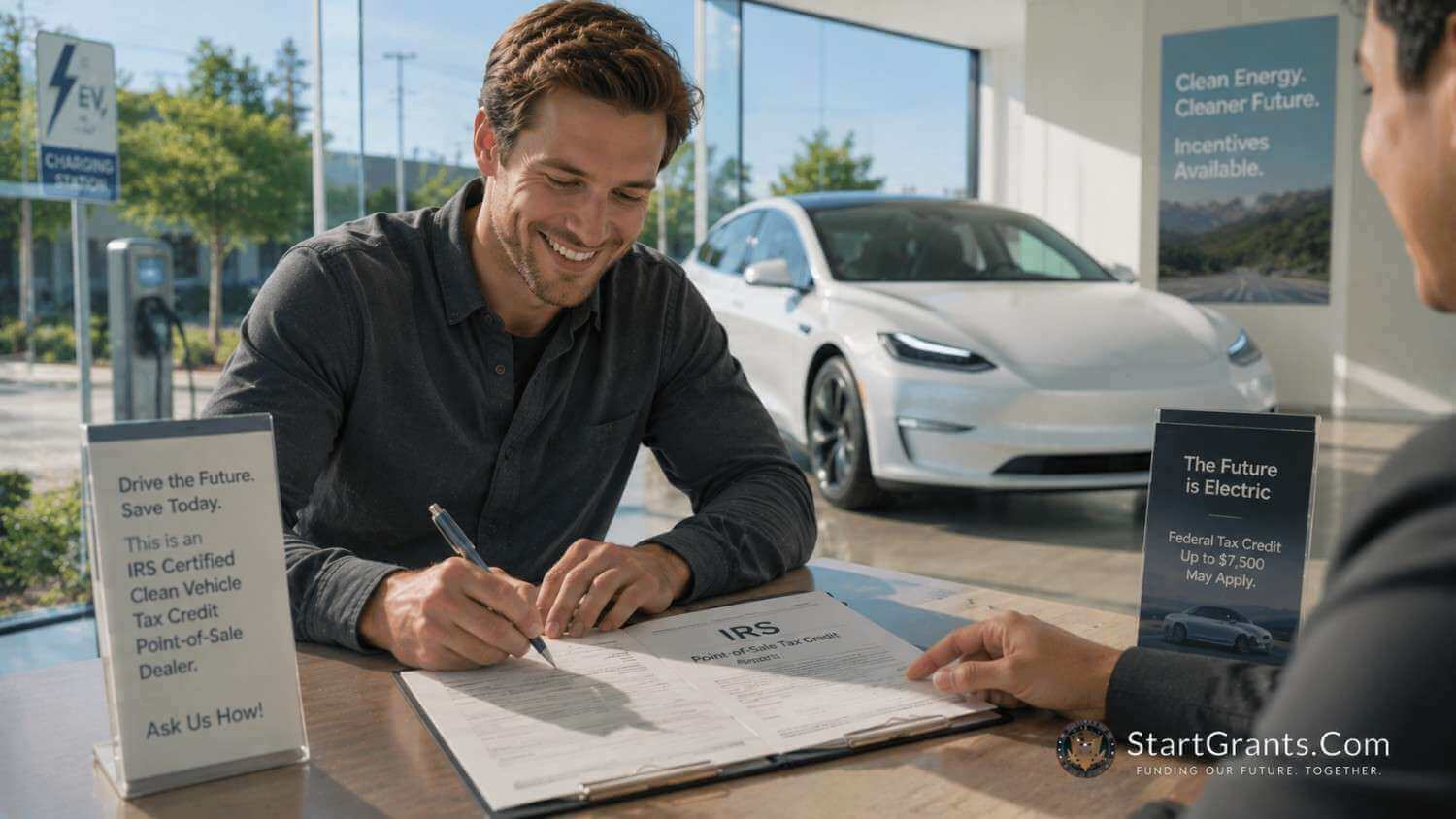
The federal government does not mail physical grant checks for vehicles. Instead, they provide up to $7,500 in point-of-sale tax credits that act as an instant cash discount at the dealership.
Phase 1: The Federal “Grant” (The Point-of-Sale Rebate)
The greatest misconception buyers have is expecting a physical check in the mail from the government to buy a Tesla. The federal government does not issue direct cash “grants” for personal vehicles. Instead, through the Inflation Reduction Act (IRA), they created a mechanism that is actually much faster: The Point-of-Sale Tax Credit.
Previously, buyers had to wait until tax season to claim their EV credit. As of recent IRS updates, this credit can now be transferred directly to the car dealership at the exact moment of purchase. The dealer lowers the sticker price of the car instantly, and the government reimburses the dealer later. For the consumer, it functions exactly like an instant cash grant.
- New EVs: Eligible buyers can receive an instant discount of up to $7,500 on qualifying new electric or plug-in hybrid vehicles.
- Used EVs: The government also heavily subsidizes the secondary market. Buyers can receive up to $4,000 (or 30% of the sale price, whichever is less) off a qualifying used EV.
You can verify which specific makes and models qualify for this federal money by checking the official FuelEconomy.gov database.
Pro-Tip: Claiming Your Instant EV Discount
Navigating the dealership finance office can be intimidating. Many dealers still do not understand the new point-of-sale transfer rules, which can cost you thousands. To understand exactly what forms you need to sign and how to ensure the $7,500 acts as an instant cash discount at the register, watch this essential, highly authoritative breakdown by Kelley Blue Book (KBB): The Federal EV Tax Credit | 2025 Edition:
Phase 2: State-Level EV Grants (Stacking the Cash)
If you only utilize the federal rebate, you are leaving thousands of dollars on the table. The most strategic buyers “stack” their federal discount with state-level EV grants and rebates.
States with aggressive climate goals—such as California, New York, Colorado, and Massachusetts—offer their own separate cash rebates. For example, California’s Clean Vehicle Rebate Project (CVRP) or its successor programs can add thousands of dollars in extra discounts for low-to-moderate-income buyers. Because state grants operate independently of the federal IRS credit, you can combine them to slash $10,000 to $12,000 off the total price of an electric vehicle.
Phase 3: Synergizing Personal Government Assistance
Purchasing an electric car introduces new operational realities into your life, specifically regarding how you fuel it. You must synergize your EV purchase with other personal assistance programs to maximize your financial relief.
- Understanding “Free Money”: Many citizens fail to claim EV rebates because they do not understand the tax code. A point-of-sale tax credit is mathematically identical to a free cash grant. To understand the psychology and bureaucracy of legally claiming these funds, read our guide on How to Get Free Money From the Government.
- Funding the Home Charger: You cannot simply plug an EV into a standard wall outlet if you want a fast charge; you need a Level 2 Home Charging Station. These can cost $1,500 to install. Fortunately, many local utility companies and state energy boards offer specific utility grants to cover the installation costs. Learn how to navigate these local utility subsidies in How to Apply for Government Grants for Personal Use.
Phase 4: The Bureaucratic Trap (MSRP Caps & Dealer Compliance)
The federal government has placed strict bureaucratic guardrails on EV funding to ensure the money goes to the middle class, not billionaires buying luxury sports cars.
The Income and Price Caps:
- MSRP Limits: The federal $7,500 grant only applies to new cars priced under $55,000, and SUVs/Trucks under $80,000. Used EVs must be priced under $25,000 to qualify for the $4,000 grant.
- Income Limits: To qualify for the new EV credit, your Modified Adjusted Gross Income (MAGI) must be below $150,000 (single) or $300,000 (married). For used EVs, the limits drop to $75,000 (single) and $150,000 (married).
The Ultimate Dealer Trap: Even if you and the car both qualify, you will not get the instant discount if the dealership is not registered with the IRS. The dealership must be officially registered on the IRS Energy Credits Online portal. Before you test drive a car, look the salesperson in the eye and ask, “Is this dealership actively registered with the IRS to process point-of-sale EV credits?” If they say no, walk away.
Phase 5: The Muslim Perspective (Murabaha, Riba, Gharar & Khalifah fil Ardh)
For Muslim families in the United States, transitioning to an electric vehicle is not just a smart financial move; it deeply aligns with Islamic environmental ethics. However, navigating the American auto-financing system to purchase these high-tech vehicles presents severe spiritual traps that must be handled with strict adherence to Islamic financial jurisprudence (Shariah).
Environmental Stewardship (Khalifah fil Ardh)
In Islam, humanity is designated as Khalifah fil Ardh (Stewards or Vicegerents of the Earth). Protecting the environment, reducing toxic emissions, and ensuring the planet remains habitable for future generations is a divine Amanah (trust). Intentionally choosing to drive a zero-emission electric vehicle, aided by government grants, is a modern manifestation of honoring this sacred stewardship.
The Trap of Auto Loans and Riba
While the $7,500 federal point-of-sale rebate (which acts as a Hibah or Halal gift) drastically reduces the price of the EV, most families still cannot afford to pay the remaining $30,000 balance in cash. The finance manager at the dealership will aggressively push a standard 60-month or 72-month auto loan to cover the rest.
This is the ultimate spiritual trap. Conventional auto loans require the buyer to pay back the principal along with compounding interest over the life of the loan. In Islamic finance, intentionally engaging in a contract that stipulates the payment of interest is explicitly Riba. Engaging in Riba is one of the most severe major sins in Islam and completely eradicates the Barakah (blessing) from your household. A Muslim buyer must adamantly refuse these predatory, interest-bearing dealer loans.
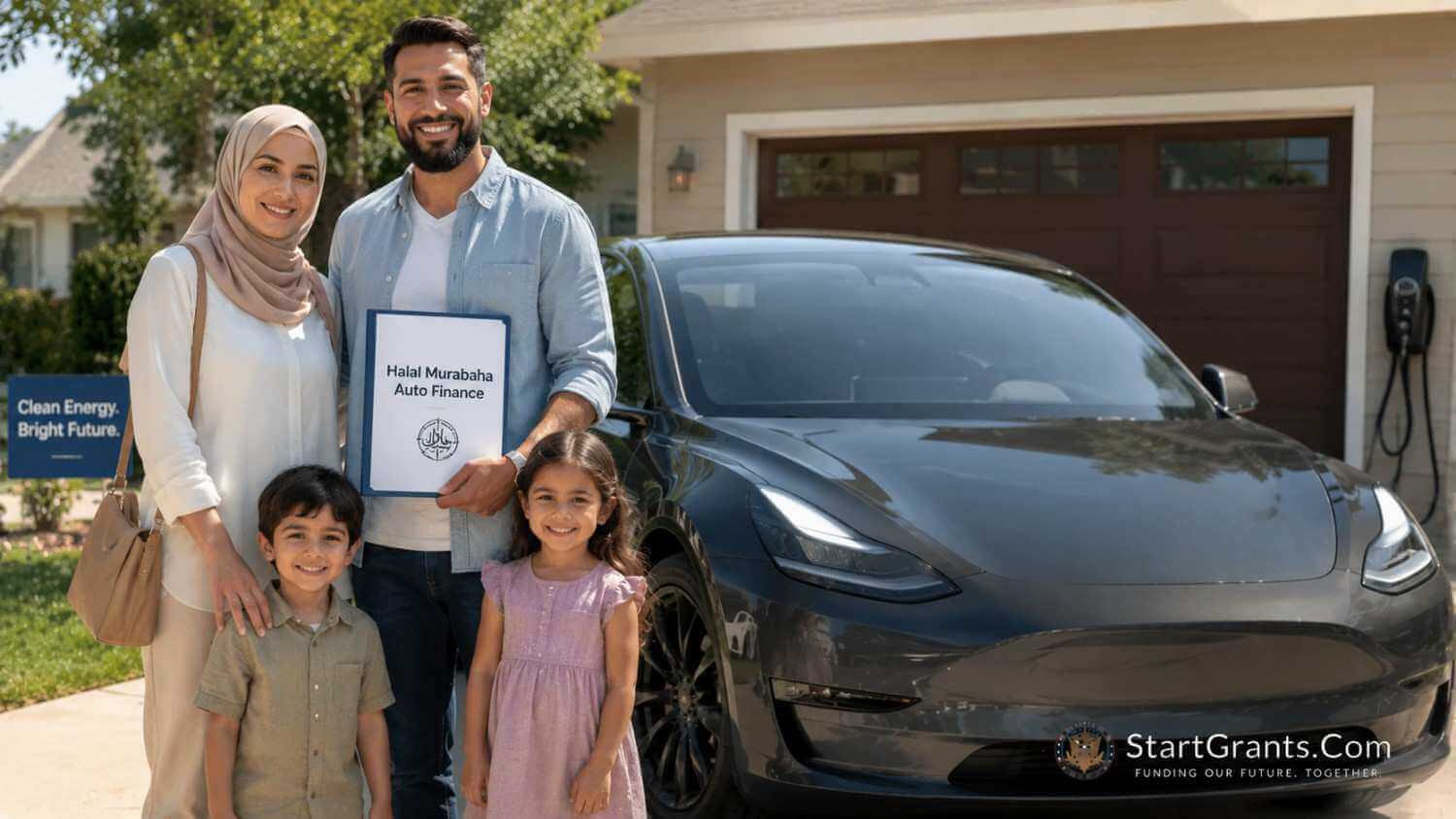
Adopting green technology aligns perfectly with the Islamic duty of environmental stewardship. By utilizing government EV rebates and securing Halal Murabaha auto financing, Muslim families can drive into the future without the spiritual burden of Riba.
Halal Auto Financing (Murabaha)
If you cannot pay cash for the remainder of the vehicle, you must utilize Halal financing alternatives. The most common Islamic structure for buying a car is Murabaha (cost-plus financing).
In a Murabaha contract, you approach a Shariah-compliant financial institution (such as a specialized Islamic Credit Union or Halal auto financier). The institution purchases the EV directly from the dealership. They then sell the car to you at a pre-agreed, fixed markup price, which you pay in monthly installments. Because the price is fixed upfront and there is no compounding interest penalty for time, it is a Halal trade transaction. It requires more effort to set up than standard dealer financing, but it guarantees your vehicle is acquired ethically.
Gharar and Mandatory Auto Insurance
Before you can drive your new electric vehicle off the dealership lot, state law mandates that you carry comprehensive Auto Liability Insurance. Furthermore, if you finance the vehicle, the financier will mandate full collision coverage. Traditional commercial auto insurance contains Gharar (excessive uncertainty) and elements of gambling.
Ideally, Muslim drivers should use Takaful (Islamic cooperative insurance). However, because authentic automotive Takaful is practically non-existent in the U.S. consumer market, contemporary Islamic scholars universally apply the principle of Dharurah (legal and operational necessity). This permits the Muslim driver to purchase the state-mandated commercial policy to avoid arrest, protect their family from catastrophic financial lawsuits, and satisfy financing laws, provided their intent is purely survival and compliance, not speculative profit.
Conclusion
Securing government grants for electric cars is entirely about mastering the bureaucracy of the modern tax code. By ensuring your income meets the federal limits, selecting a vehicle under the MSRP cap, and strictly negotiating only with IRS-registered dealerships, you can capture up to $7,500 in instant, non-dilutive capital to join the clean energy revolution.
For the Muslim family, purchasing an EV is a profound intersection of environmental stewardship and financial discipline. By fulfilling the duty of Khalifah fil Ardh, fiercely rejecting the trap of Riba-laced dealer loans in favor of Halal Murabaha financing, and navigating auto insurance mandates via Dharurah, you ensure that your journey into the future of transportation is paved with absolute spiritual purity and uncompromising Barakah.
Frequently Asked Questions (FAQs)
Q1: Will the government mail me a check if I buy an electric car?
A: No. The federal government does not issue physical grant checks for purchasing an EV. They provide a federal tax credit (up to $7,500 for new, $4,000 for used). Under current IRS rules, you can transfer this credit directly to the car dealership at the time of purchase, acting as an instant cash discount off the sticker price of the car.
Q2: Can I get the EV grant if I buy a used Tesla or Nissan Leaf?
A: Yes! The federal government offers a tax credit of up to $4,000 (or 30% of the sale price, whichever is lower) for qualifying used electric vehicles. However, the used EV must cost less than $25,000, be at least two model years old, and be purchased from an officially registered dealership (not a private seller on Craigslist).
Q3: What happens if the dealership is not registered with the IRS?
A: If the dealership has not formally registered their business through the “IRS Energy Credits Online” portal, they cannot process the point-of-sale transfer. This means you will not get the instant discount at the register, and you will have to wait until you file your annual tax return to claim the credit yourself.
Q4: Why is it Haram for a Muslim to use standard dealer financing to buy an EV?
A: Standard dealer financing (auto loans) requires the buyer to pay back the principal amount of the car plus compounding interest over several years. In Islamic finance, intentionally signing a contract that includes a clause for paying interest is classified as Riba, which is strictly forbidden (Haram). Muslims must seek Halal alternatives like paying in cash or utilizing Islamic Murabaha (cost-plus) financing.
Q5: Is it Halal to purchase commercial auto insurance for my new electric car?
A: Traditional commercial insurance contains Gharar (uncertainty) and is generally problematic in Shariah. However, because driving without insurance is illegal in almost every U.S. state and exposes the family to ruinous lawsuits, Islamic scholars universally permit purchasing the required commercial policy under the principle of Dharurah (legal necessity), due to the lack of available Takaful alternatives in the U.S.
Disclaimer: The information provided in this article is for educational and informational purposes only. We are not a federal agency, a tax law firm, a car dealership, or a religious fatwa council. IRS regulations regarding the Clean Vehicle Tax Credit, income limits, and eligible battery-sourcing requirements are highly complex and subject to frequent legislative changes. Always verify vehicle eligibility on FuelEconomy.gov, consult with a certified CPA regarding your specific tax liability, and seek guidance from a qualified Islamic finance scholar regarding Halal auto financing, Riba avoidance, and Dharurah.