Last Updated: | Author: Munir Ardi
Free school supplies can sometimes be shipped, but there is no verified nationwide program that promises every family a free backpack by mail. Most family programs use local pickup, school distribution, or limited seasonal events. Teachers have more legitimate shipping options because several nonprofits deliver funded or donated classroom materials to verified school addresses.
This guide explains which programs may ship supplies, which ones require pickup, what fees may apply, and how to protect your personal information. For other forms of school-related support, visit our financial assistance guide for K-12 students and parents.
Quick answer: Families should begin with their child’s school, 211, and verified local backpack distributions. Teachers can investigate Kids In Need Foundation, NAEIR, AdoptAClassroom.org, or an eligible DonorsChoose project. Availability is not guaranteed, and “free” products may still involve handling costs.
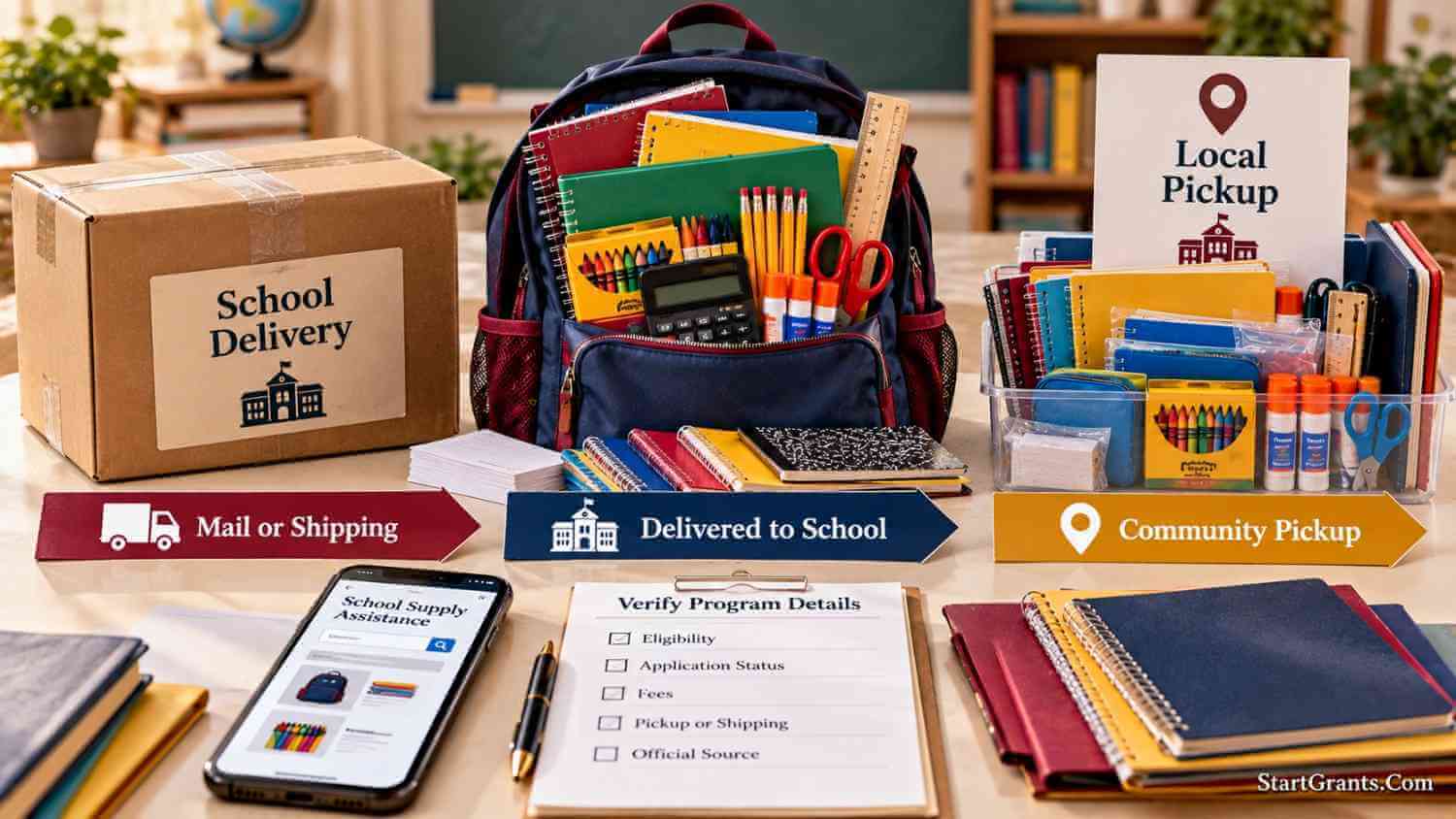
Free school supplies may be delivered to a verified school, distributed through local pickup events, or shipped under limited programs. Home delivery is not guaranteed.
Which Free School Supply Options Actually Ship?
| Option | Who it serves | Delivery method | Cost or limitation |
|---|---|---|---|
| Kids In Need Foundation | Teachers and schools in under-resourced communities | Program supplies or resource-center distribution, depending on the opportunity | Application cycles, school criteria, and availability apply |
| NAEIR Teacher’s Program | Qualified active teachers | Selected donated products are shipped; pickup may be available for some items | Products are donated, but nominal handling and processing fees apply; most shipping is free |
| AdoptAClassroom.org | Registered PreK-12 educators and schools | Marketplace vendors fulfill purchases made with available classroom funds | Registration does not guarantee donations or an award |
| DonorsChoose | Eligible public-school and Head Start educators | Materials for fully funded projects normally ship to a verified school address | The project must be eligible and fully funded; materials belong to the school or center under platform rules |
| Local backpack drives | Families meeting local program rules | Usually pickup at a school, nonprofit, store, or community event | Seasonal, location-specific, and often while supplies last |
| Buy Nothing or Freecycle | Community members | Local handoff; Buy Nothing also offers an optional shipping process | Depends on what neighbors offer and the arrangements participants make |
Programs, inventory, fees, eligibility rules, and seasonal dates can change. Confirm the current terms before submitting personal information or traveling to an event.
Verified Shipping Options for Teachers
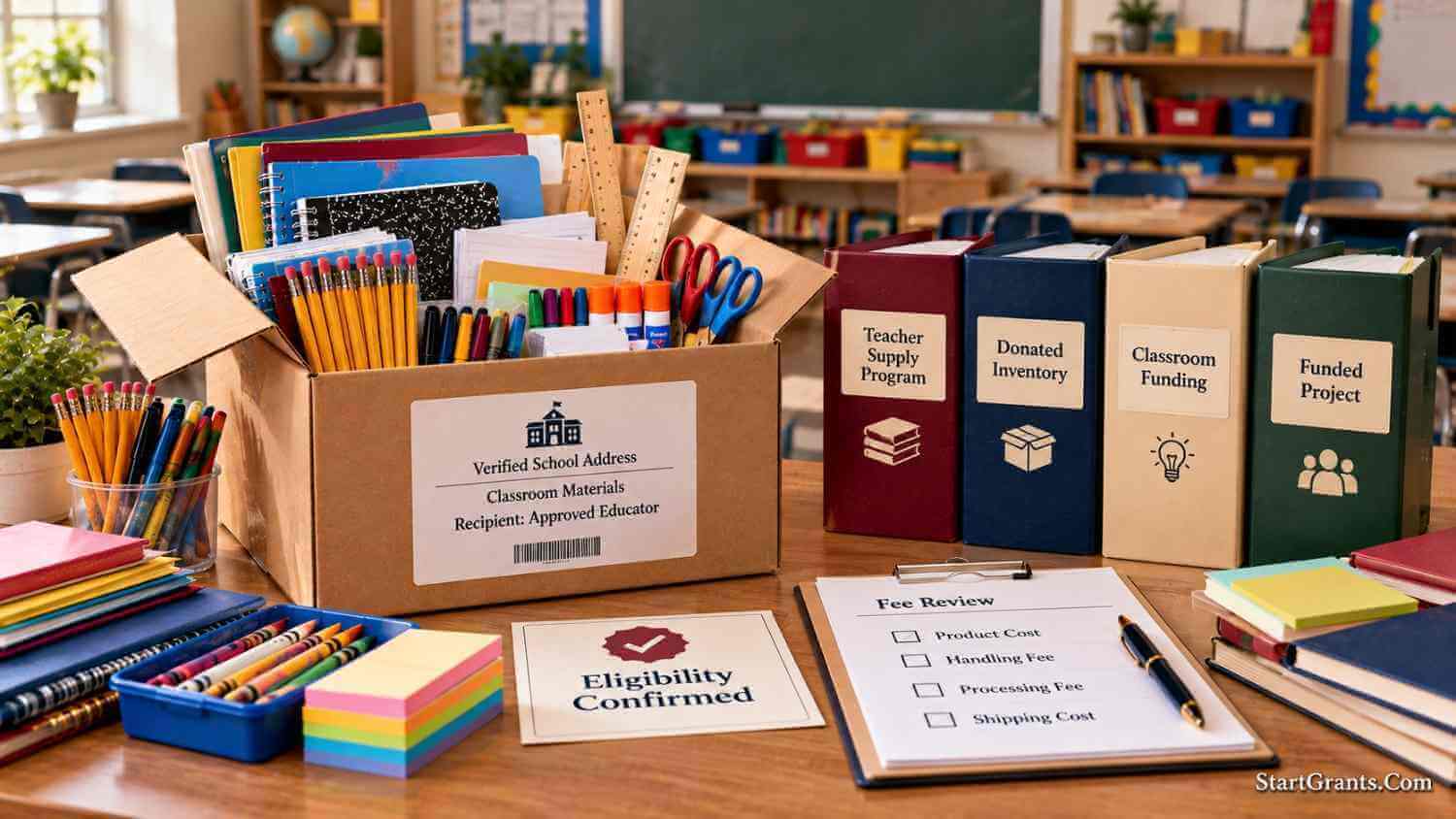
Legitimate teacher programs commonly verify eligibility and ship funded or donated classroom materials to a school address. Handling or processing fees may apply to some programs.
Kids In Need Foundation
Kids In Need Foundation supports teachers and students in under-resourced schools. Its current Supply A Teacher program focuses on schools where at least 50% of students are eligible for free or reduced-price meals. This corrects the older 70% figure in the original draft.
Teachers should not assume that an application is always open or that every applicant will receive the same box. Program cycles, participating schools, sponsors, locations, and supply formats can change. KINF also operates a National Network of Teacher Resource Centers, where participating centers provide supplies directly to educators in under-resourced schools.
NAEIR Teacher’s Program
NAEIR connects donated corporate inventory with qualified educators and nonprofit organizations. According to its current membership information, Teacher’s Program membership is free for qualified teachers. Donated products are free, but members pay nominal handling and processing fees. NAEIR states that shipping is free for most products.
Inventory changes, so this is not a guaranteed source for a particular notebook, backpack, or device. Review the fee shown for each selection before ordering. A product with a handling charge should not be described as completely free.
AdoptAClassroom.org
AdoptAClassroom.org is a classroom-funding platform, not an automatic supply-box program. Teachers can register a classroom, fundraise, and apply for funding opportunities. When money is available in the classroom account, educators can shop through a marketplace that includes more than 20 vendor partners.
Registration alone does not guarantee donations. Teachers should describe a specific classroom need, share the page through appropriate channels, and follow school policies concerning fundraising and delivered materials.
DonorsChoose
Eligible public-school and Head Start educators may create projects through DonorsChoose. When a project is fully funded, the platform purchases approved resources and generally ships them to a verified school address. Its trust and safety guidance explains that schools are vetted and materials normally ship to verified locations.
This option is not designed to mail personal supplies to a family’s home. DonorsChoose states that funded materials generally belong to the public school or Head Start center where the educator works.
Best Options for Families
For an individual household, local assistance is usually faster and more reliable than searching for a national mail-order form. Start with organizations that can confirm current inventory in the family’s ZIP code.
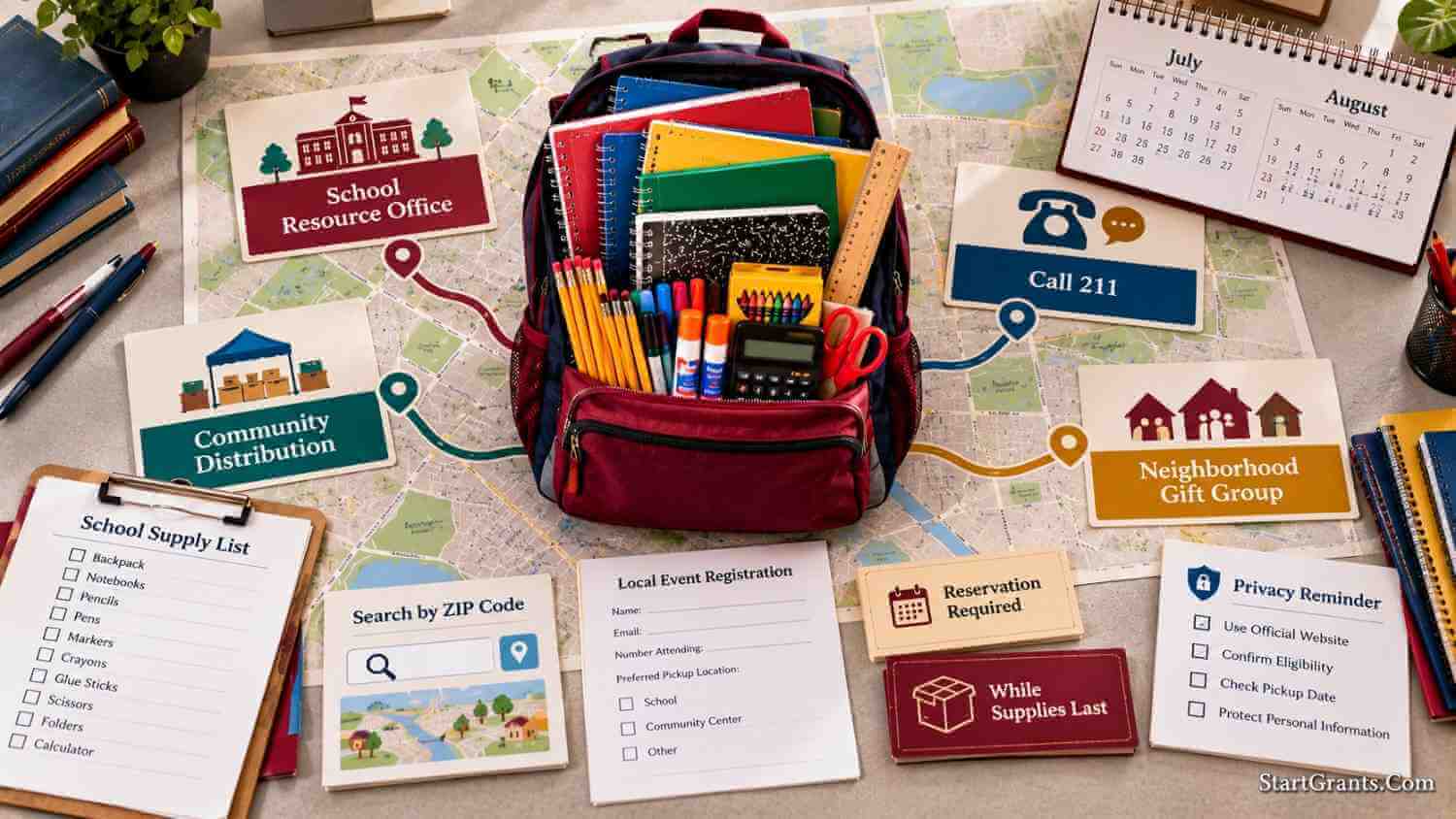
Families can ask their school, contact 211, check verified community distributions, and request unused supplies through local gift groups. Eligibility and pickup rules vary.
Ask the school before contacting national charities
Contact the school counselor, social worker, family liaison, front office, or district family-resource center. Schools may know about donated supply closets, uniform vouchers, PTA assistance, local backpack drives, or referrals that are not advertised online. Ask what documentation is required and whether supplies can be collected privately.
Families experiencing homelessness or unstable housing should ask for the district’s McKinney-Vento liaison. The National Center for Homeless Education maintains state coordinator and local liaison information. Eligibility depends on the family’s living situation; it should not be assumed solely from low income.
Call or search 211
United Way 211 connects callers with local services. Ask specifically for “school supplies,” “backpack distribution,” “school clothing,” or “student basic-needs assistance,” and provide a ZIP code. 211 is a referral service, not a guarantee that supplies are available.
Check local Salvation Army distributions
The Salvation Army operates locally, and services vary by community. Some locations hold backpack distributions or participate in seasonal Stuff the Bus campaigns, while others may not distribute supplies directly. Use the official Salvation Army location search and contact the nearest office for dates, registration rules, and availability. Do not assume that a local office can mail or deliver a backpack.
For a broader list of pickup programs, school resources, and community events, use our free school supplies for low-income families guide. That sibling page covers local assistance in more depth, while this page focuses on shipping and mail-related searches.
Ask through Freecycle or Buy Nothing
Freecycle lets members give and request free items through local Town groups. The Buy Nothing Project similarly allows members to give items or post an Ask. A specific request—such as unused binders, pencils, a calculator, or a clean backpack—is more useful than a general request for “anything.”
Most exchanges are local handoffs. Buy Nothing also offers an optional app-based shipping process, but participants should review its current privacy, packaging, and shipping rules. Never pressure a neighbor to deliver, and do not post a child’s full name, school schedule, or other sensitive information publicly.
Seasonal and Military-Family Programs
Operation Homefront Back-to-School Brigade
Operation Homefront provides free school supplies through Back-to-School Brigade family events. The official program states that supplies are limited, registration is first come, first served, and participating children must be DEERS-enrolled military dependents entering kindergarten through grade 12. Families should check the current Back-to-School Brigade page and event portal rather than relying on a rank range from an older article.
These are normally registered events, not a nationwide mail-to-home benefit. The 2026 events occurred during the back-to-school season, so families reading after an event should monitor the official page for the next cycle.
TCC School Rocks Backpack Giveaway
TCC, a Verizon-authorized retailer, held its 2026 School Rocks Backpack Giveaway at participating stores on July 26, 2026. The official 2026 event page now describes the event as completed. It should not be promoted as currently open. Families can monitor TCC’s official site next summer to see whether another event is announced.
What About TANF, Foster Care, and Company Samples?
TANF and foster-care support are administered under state-specific rules. Some jurisdictions may provide seasonal allowances, reimbursements, clothing support, or discretionary help, but there is no universal federal back-to-school bonus that every recipient receives. Ask the assigned caseworker or state administering agency about current allowable expenses and keep receipts when reimbursement is required.
The former draft advised families to email stationery manufacturers for free samples and suggested that companies often mail free-item coupons. That is not a dependable assistance program. A company may offer a public promotion or coupon, but families should not send personal hardship information or a child’s details merely to request unadvertised samples.
How to Avoid Fake “Free Backpack by Mail” Offers
A free-supply form is not automatically fraudulent, but strong claims should be verified. The Federal Trade Commission warns that scammers may impersonate known organizations or use giveaways to collect financial and personal information. Review the FTC’s guidance on social-media giveaway scams.
- Navigate to the organization’s official website instead of using an unexpected message or social-media link.
- Check whether the offer lists eligibility, dates, geographic coverage, and a real contact method.
- Do not pay by gift card, wire transfer, cryptocurrency, or payment app to “release” free supplies.
- Do not provide a Social Security number, bank login, or credit-card number for a free backpack.
- Share only the information the verified program genuinely needs and read its privacy notice.
- Ask the school or 211 whether they recognize a local event before uploading documents.
Save This School Supply Assistance Checklist
[ ] Get the exact supply list from the school before requesting items.
[ ] Ask the counselor, social worker, family liaison, or district resource office.
[ ] Search or call 211 using the family’s ZIP code.
[ ] Confirm whether an event requires registration, identification, proof of residence, or the child to attend.
[ ] Verify whether “free” teacher products include handling or processing fees.
[ ] Use an official program website and check whether the current application cycle is open.
[ ] Protect children’s names, schedules, school records, and household financial information.
[ ] Arrange safe pickup or delivery and confirm the condition of secondhand items.
A Muslim Perspective
School supplies are a practical form of sadaqah, and a mosque, Islamic school, mutual-aid group, or neighborhood organization may organize a transparent supply drive. Organizers should treat donations as an amanah: state the intended recipients, keep receipts, protect family privacy, avoid publicizing children’s hardship, and use restricted donations only for the announced purpose.
Zakat eligibility depends on the recipient and the scholarly interpretation being followed. A family’s difficulty buying supplies does not automatically establish zakat eligibility, and an unrestricted school-supply drive should not be labeled a zakat program without appropriate governance. Consult a qualified scholar when zakat funds are involved.
Families should also be cautious about using payday loans, interest-bearing credit cards, or buy-now-pay-later arrangements merely to cover a short school-supply list. Where possible, consider local assistance, sadaqah, a no-interest family loan or qard hasan, used supplies, and staged purchases. This is general information rather than a religious ruling or financial recommendation.
Frequently Asked Questions
Can families get free school supplies mailed to their homes?
Sometimes, but there is no verified nationwide program that guarantees every family a free backpack by mail. Most legitimate family programs use school distribution, local pickup, or seasonal events. Start with the school, 211, and verified organizations serving the family’s ZIP code.
Which programs ship school supplies to teachers?
Depending on current eligibility and availability, teachers may obtain shipped materials through Kids In Need Foundation programs, NAEIR, AdoptAClassroom.org, or fully funded DonorsChoose projects. Delivery is commonly made to a school or approved program address rather than a private home.
Are NAEIR school supplies completely free?
NAEIR says its donated products are free, but members pay nominal handling and processing fees. Shipping is free for most products. Teachers should review the total shown for each selection before ordering.
Does the Salvation Army mail free backpacks?
Do not assume it does. Some local Salvation Army offices organize backpack distributions or seasonal school-supply events, but services and delivery arrangements vary by location. Contact the nearest office through the official location search.
Can military families receive free school supplies?
Operation Homefront’s Back-to-School Brigade holds limited events for eligible DEERS-enrolled military dependent children entering kindergarten through grade 12. Registration is first come, first served, and the program is generally event-based rather than a national mail benefit.
Does TANF provide a nationwide back-to-school payment?
No. TANF is administered by states, territories, and tribes within federal rules. Any seasonal allowance, clothing benefit, reimbursement, or permissible purchase depends on the administering program. Recipients should ask their caseworker or agency.
How can I tell whether a free-supply offer is legitimate?
Use the organization’s official website, verify dates and eligibility, and check for a real contact method and privacy notice. Do not provide bank credentials, a Social Security number, or payment by gift card, wire transfer, or cryptocurrency to claim free supplies.
Disclaimer: StartGrants.com is an independent information portal. It is not a school district, government agency, charity, program administrator, retailer, lender, or religious authority and does not mail school supplies or process applications. Availability, eligibility, fees, inventory, and event dates can change. Verify details with the official program, school, or local service provider before submitting personal information or traveling.