
Last Updated: June 2026 | Author: Munir Ardi
When the temperature drops below freezing, a functional heating system ceases to be a modern convenience—it becomes critical life support. For low-income families, seniors living on fixed incomes, and individuals with vulnerable health conditions, a broken furnace in the dead of winter is a terrifying emergency. Purchasing and installing a brand-new residential furnace can cost anywhere from $3,000 to $6,000, an astronomical expense that is simply impossible for those living paycheck to paycheck.
Desperation during a winter freeze often leads families to take on toxic debt or resort to dangerous alternative heating methods, such as leaving ovens open or using unvented space heaters, which dramatically increases the risk of carbon monoxide poisoning and house fires. Fortunately, robust federal safety nets and charitable emergency funds exist specifically to replace broken heating systems at absolutely no cost to the homeowner.
Before exploring specific emergency heating programs, it is highly recommended that homeowners understand the broader landscape of federal home improvement funding by reviewing our main directory on energy efficiency grants for homeowners.
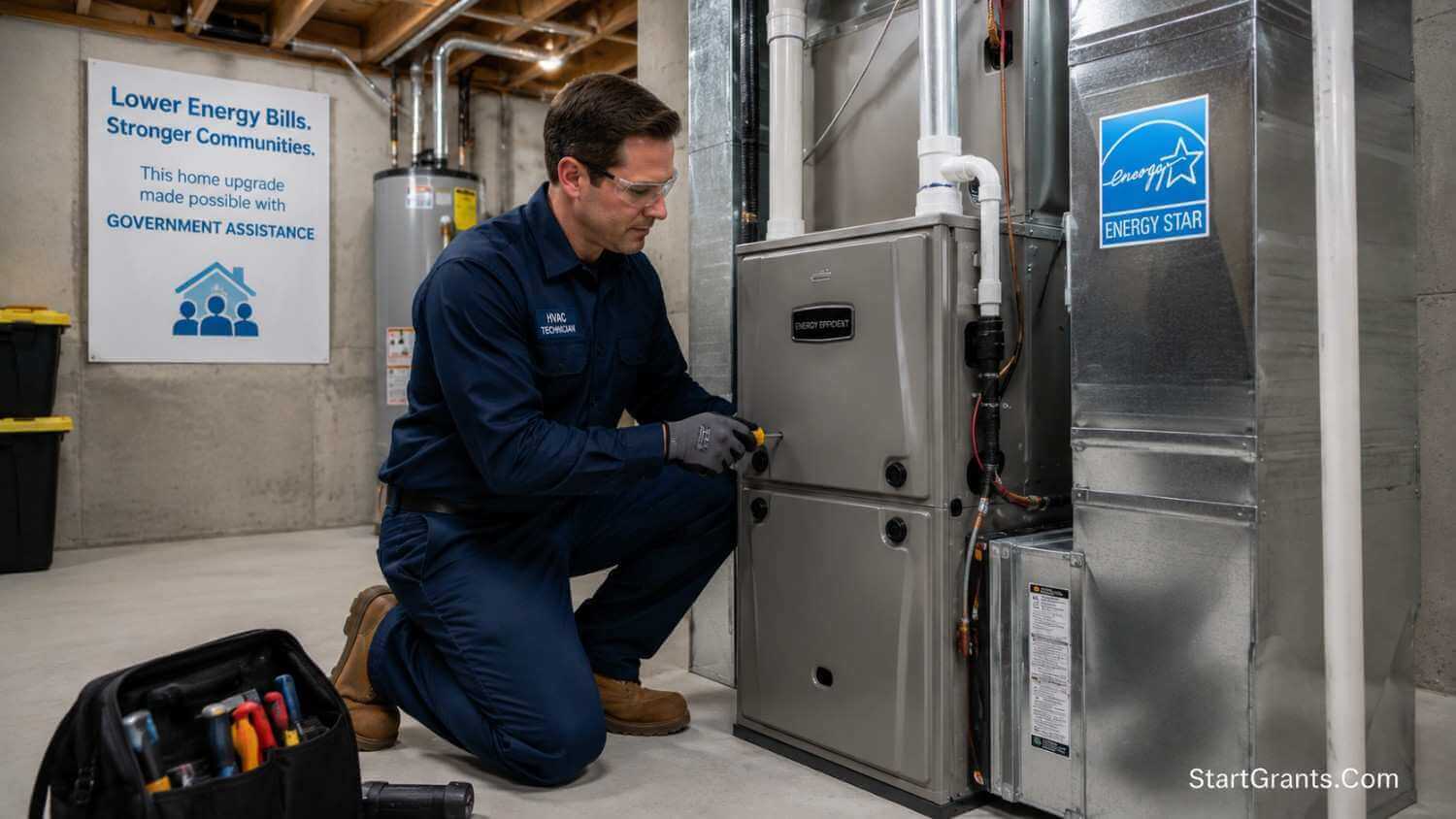
Government programs like the WAP and LIHEAP Crisis Assistance can cover the total cost of replacing a broken furnace for eligible families.
Phase 1: Assessing the Heating Emergency
Before applying for a complete replacement grant, you must determine the actual status of your heating equipment. Sometimes, a furnace that refuses to turn on is simply suffering from a dead thermostat battery, a clogged filter, or a faulty flame sensor—repairs that cost a fraction of a full replacement. However, if your furnace has a cracked heat exchanger (which leaks deadly carbon monoxide) or is over 15 years old and completely seized, a full replacement is medically and financially necessary.
Pro-Tip: Repair vs. Replace
Before panicking and applying for a complete replacement grant, you must determine if your furnace is truly at the end of its lifespan or just requires a minor, inexpensive fix. Watch this expert breakdown, Should You Repair or Replace Your Furnace?, to help you make an informed decision on your heating system’s actual status:
Phase 2: Federal Giants (LIHEAP & WAP)
If your system is officially dead, your first and most powerful line of defense is the federal government. Billions of dollars are routed to state agencies every winter specifically to prevent freezing deaths.
1. LIHEAP Crisis Assistance
Most people know the Low Income Home Energy Assistance Program (LIHEAP) as a way to get help paying winter gas and electric bills. However, LIHEAP has a specific, highly prioritized division known as Crisis Assistance. If your furnace breaks down during the winter and your home’s internal temperature drops to dangerous levels, you can apply for emergency crisis intervention.
Under this program, state agencies can dispatch an authorized HVAC contractor to your home within 48 hours. If the contractor determines the furnace cannot be safely repaired, LIHEAP crisis funds can be utilized to completely pay for and install a brand-new heating system. Because this is an emergency medical intervention, the typical long waitlists associated with federal grants are frequently bypassed.
Pro-Tip: Understanding LIHEAP Crisis Funds
Applying for emergency federal assistance requires precision, especially when your family’s warmth and safety are on the line. Watch this comprehensive guide, LIHEAP Application Tutorial for 2025-2026, to ensure you navigate the paperwork correctly and expedite your crisis heating approval:
2. The Weatherization Assistance Program (WAP)
Administered by the Department of Energy, the Weatherization Assistance Program (WAP) is designed for long-term energy efficiency rather than overnight emergencies. However, replacing an ancient, dangerously inefficient furnace falls directly under their mandate.
When you apply for a free furnace through WAP, they will also evaluate the rest of your home. A new heating system is useless if the hot air immediately escapes through the roof. Therefore, WAP will frequently bundle your furnace replacement with a government grant for home insulation. Furthermore, if you live in a region that requires comprehensive climate control year-round, you should simultaneously study how to secure financial assistance for air conditioning to prepare for the summer.
Phase 3: Utility and Local Interventions

Securing a reliable heating system ensures your family remains safe and warm during severe winter storms.
If you do not meet the strict federal poverty guidelines for LIHEAP, your local utility provider should be your next contact. Many major gas and electric companies run “Furnace Replacement Programs” for low-to-moderate-income customers. Because utility companies are mandated by the state to reduce overall grid strain, replacing your ancient 60% efficient furnace with a modern 95% efficient model benefits their bottom line.
Additionally, look into your state’s Community Action Agency (CAA). They often manage discrete pools of state-level funding specifically dedicated to helping families get a government grant to install central heating, completely separate from federal LIHEAP money.
Phase 4: The Muslim Perspective (Hifz al-Nafs, Gharar, & Riba)
In Islamic jurisprudence, protecting your family from freezing temperatures is not just a matter of comfort; it is a strict obligation under the principle of Hifz al-Nafs (Preservation of Life). A working heating system in a freezing climate is classified as a Dharuriyyat (an absolute necessity). However, the financial mechanisms used to acquire this necessity must be navigated carefully to avoid violating Islamic law.
1. The Trap of HVAC Financing and Home Warranties
When a furnace breaks, HVAC sales representatives will immediately push aggressive financing plans. These “Zero-Down” or “Rent-to-Own” contracts often carry crippling Annual Percentage Rates (APR) of 15% to 25%. This is explicitly Riba (usury), which is strictly Haram (forbidden) in Islam. Engaging in Riba destroys the Barakah (blessings) of the household and traps the family in a cycle of debt.
Furthermore, desperate homeowners often turn to commercial “Home Warranty” programs, paying monthly fees in the hope that a future breakdown will be covered. Many Islamic scholars classify these conventional warranties as containing excessive Gharar (deceptive uncertainty) and Maysir (gambling elements), as you are paying for a service that you may never use, and the company profits from your lack of claims.
2. The Halal Route: Hibah and Zakat
The safest and most spiritually sound route is to pursue government grants like WAP and LIHEAP. These federal safety nets are classified as Hibah (gifts) from public funds. They require absolutely no repayment and involve zero interest, making them 100% Halal.
If federal aid is exhausted and your home is freezing, Muslims must turn to legitimate Islamic charitable organizations. Reputable institutions like Islamic Relief USA and ICNA Relief manage domestic emergency funds sourced purely from Zakat (obligatory charity). These funds are specifically designed to rescue the Gharimin (those in debt or crisis), ensuring your family stays warm without compromising your faith.
Phase 5: Tactical Application Strategy
When your furnace breaks in January, every hour counts. Follow this tactical plan to expedite your federal application:
- Get a Written Diagnosis: Have a licensed HVAC technician provide a written statement declaring the furnace is “dead” or “unsafe to operate” (e.g., a cracked heat exchanger). This proves to the government that this is a life-safety crisis, not an aesthetic upgrade.
- Gather Medical Documentation: If anyone in the home is elderly, an infant, or suffers from respiratory/cardiovascular diseases, get a doctor’s note immediately. Medical vulnerability pushes your application to the top of the LIHEAP Crisis list.
- Prepare Financials: Have the last 30 days of pay stubs, social security cards for all residents, and your most recent gas/electric bills ready in a single folder.
- Apply in Person: Do not mail the application. Go directly to your local Community Action Agency and state clearly that you have a “No Heat Emergency.”
Conclusion: Do Not Suffer in Silence
A broken furnace in the winter is a severe emergency, but you do not have to freeze, and you do not have to sign a predatory loan to survive. Federal grants like the LIHEAP Crisis program and WAP are explicitly designed, funded, and deployed to replace your heating system for free. Gather your documentation, secure a medical priority letter if applicable, and contact your local Community Action Agency immediately to restore warmth and safety to your home.
Frequently Asked Questions (FAQs)
Q1: Will the government completely pay for a new furnace, or is it just a discount?
A: Under programs like the Weatherization Assistance Program (WAP) and the LIHEAP Crisis program, if you meet the low-income guidelines and your furnace is deemed unrepairable, the government will pay 100% of the cost for the new equipment and the professional installation.
Q2: Can I get emergency heating help if I rent my home?
A: Yes, but the process involves your landlord. Renters can apply for WAP and LIHEAP, but the landlord must sign an agreement permitting the installation of the new furnace and agreeing not to raise your rent as a direct result of the free upgrade.
Q3: How fast can I get a furnace replaced through the LIHEAP Crisis program?
A: In a declared “No Heat” emergency during freezing temperatures, state agencies are often mandated to resolve the crisis within 48 hours (and sometimes 18 hours in life-threatening situations), either by dispatching a repairman, providing emergency space heaters, or initiating a full replacement.
Q4: Are HVAC financing plans with 0% interest considered Halal?
A: It depends on the fine print. Many “0% for 12 months” plans include hidden penalties or deferred interest that retroactively applies if you miss a single payment. Because the contract is fundamentally built on an interest-bearing framework, many Islamic scholars still advise extreme caution or forbid it. Government grants (Hibah) are the safest Halal route.
Q5: What should I do while waiting for my grant approval?
A: If you are approved for a furnace replacement but are waiting for installation, contact local charities like the Salvation Army or Islamic Relief. They can provide emergency winter blankets, temporary safe heating solutions, or vouchers for warm clothing to sustain you during the waiting period.