
Last Updated: July 2026 | Author: Munir Ardi
Managing a K-12 institution in 2026 requires more than just academic excellence; it requires a sophisticated financial defense strategy. With state and federal budgets often failing to cover the rising costs of infrastructure and specialized enrichment, school administrators and PTA committees must master the art of the grant application.
Institutional funding for schools is not a single pool of money, but a fragmented landscape of government subsidies, corporate social responsibility (CSR) programs, and private foundations. Success in this field depends on your ability to match your school’s specific needs—whether it is a new playground, life-saving medical equipment, or student travel—with the right funding source.
This master directory serves as the command center for school facility and program grants. We have categorized the most reliable funding streams into four tactical divisions to help your administration secure the capital needed to enhance the learning environment.
Strategic Navigation: This specific guide focuses strictly on macro-level institutional funding and facility upgrades for school administrators. If you are an individual educator seeking classroom supplies, or a parent looking for student financial aid, you must recalibrate and visit our central command hub: The Ultimate Guide to K-12 Education Grants & Financial Assistance.

Securing funding for school facilities and programs requires an organized committee and a targeted grant application strategy.
The Admin Strategy: Building a Grant Committee
Before deploying applications, a school should never rely on a single teacher or principal to handle the workload. The most successful schools establish a “Grant Committee” comprised of PTA members and administrative staff. This team is responsible for conducting a Needs Assessment—gathering data on student demographics and equipment deficits (often utilizing federal databases like the National Center for Education Statistics)—which serves as the backbone of every successful proposal.
Before delegating your PTA or administrative team to apply for these specific funds, it is crucial to understand the anatomy of a successful school grant proposal. Review this expert briefing on modern grant writing for educators and schools:
Phase 1: Infrastructure & Safety Grants
Physical facilities are the foundation of student safety and engagement. When the general fund is depleted, specialized grants for hardware and furniture become critical.
- Library Modernization: Modernizing a media center goes beyond books. You can secure specialized grants for library furniture to create collaborative STEM spaces.
- Outdoor Development: Safe play is essential for cognitive development. Our guide on how to get school playground equipment grants breaks down the largest foundations currently funding outdoor safety.
- Life-Saving Equipment: Campus safety includes medical readiness. Ensure your school is equipped by exploring available AED grants for schools to provide automated external defibrillators at zero cost to the district.
- Athletic Safety Gear: Outfitting sports teams with modern, concussion-resistant gear is incredibly expensive. Protect your student-athletes and your budget by exploring youth football equipment grants to secure funding from massive sports endowments.
Phase 2: Enrichment & Support Programs
Funding for the “human” element of education—programs that support mental health, environmental literacy, and academic support—often comes from niche governmental and private sectors.
- Counseling & Mental Health: With rising student anxiety, schools must find grants for school counseling programs to supplement state-funded staff.
- After-School Security: Safe environments shouldn’t end at 3 PM. Review our directory of grants for after-school programs to fund tutoring and extracurricular activities.
- Environmental Education: Federal agencies offer heavy artillery for “green” schools. Learn how to get EPA environmental education grants to bring sustainable science to your classrooms.
- STEM & Robotics: Building a competitive tech program requires massive upfront capital for parts, metal, and competition fees. Learn how to secure corporate and federal STEM funds in our guide to robotics grants programs.
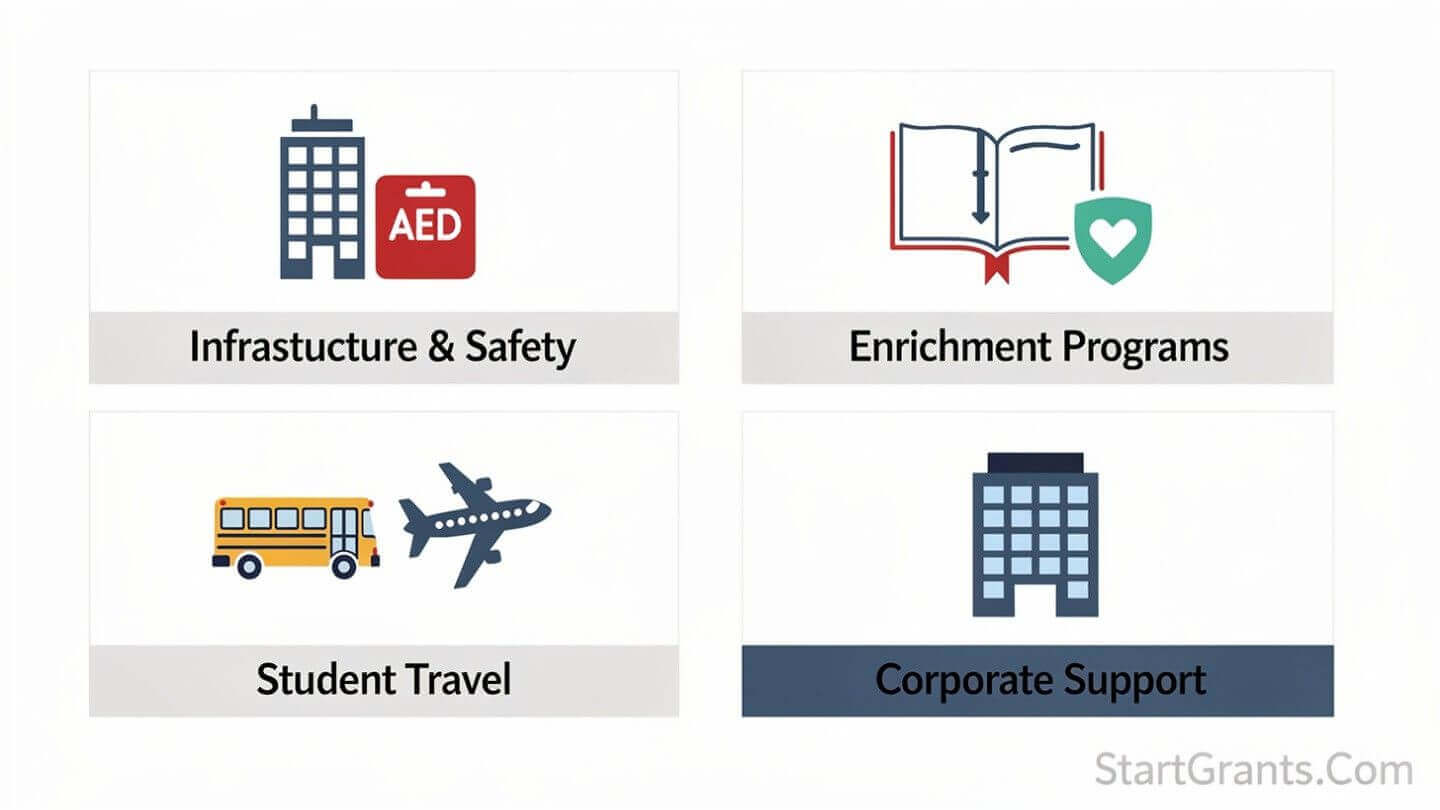
Diversify your fundraising efforts by categorizing your grant targets into infrastructure, enrichment, travel, and corporate support.
Phase 3: Student Expeditions (Travel & Experience)
Experiential learning outside the classroom is often the first casualty of budget cuts. However, specific travel endowments exist to ensure students don’t miss these life-changing opportunities.
- Local Expeditions: Transport costs are a major barrier. Secure funding through grants for school field trips to cover busing and museum entrance fees.
- Global Perspective: For older students, we have mapped out the specialized grants for high school students to travel abroad, focusing on merit-based and need-based international programs.
Phase 4: Institutional & Corporate Support
Corporations and private entities are increasingly stepping in to fill the gap left by public funding, often with faster approval times than government agencies.
- Private Sector Parity: If you are managing a non-public institution, review our guide on grants for private schools K-12 to identify funds specifically earmarked for independent education.
- Corporate Heavyweights: Large retailers and tech companies offer targeted financial aid. Master the landscape by reviewing Target grants and other corporate educational assistance.
Conclusion: The Admin Checklist
To dominate the school grant landscape, your administration should execute this checklist today:
- Assign a Primary Liaison: Designate one PTA or staff member as the official point of contact for grant communications.
- Gather Student Data: Ensure your “Free and Reduced Lunch” percentages and other socioeconomic data are updated, as these are the primary keys to qualifying for need-based grants.
- Set a Deadline Calendar: Most corporate and EPA grants have strict annual windows. Map these out to avoid the end-of-year rush.
Frequently Asked Questions (FAQs)
Q1: Who can apply for school facility grants?
A: Typically, the applicant must be a legally recognized 501(c)(3) non-profit, a public school district, or a private school with appropriate tax-exempt status. Applications are usually signed by the Principal or the District Superintendent.
Q2: Are there grants specifically for school safety equipment?
A: Yes. Beyond federal safety grants, many private foundations fund specific safety needs such as AED machines, security cameras, and playground surfacing to prevent injuries.
Q3: How much money can a school get from a single grant?
A: Corporate grants (like Target) may range from $1,000 to $5,000, while larger federal grants (like the EPA or state-level facility grants) can provide $50,000 to $500,000 for major infrastructure projects.
Q4: Can private schools apply for government grants?
A: It depends on the grant. Many federal programs are open to both public and private non-profit schools, though some specific state-funded programs may be restricted to the public sector.
Q5: What is the most important part of a school grant application?
A: The “Statement of Need.” You must clearly demonstrate, using data, how the funding will directly improve student outcomes or safety.
Important Disclaimer: StartGrants.com is an independent information portal. We are not a government agency and do not provide direct grants or products. Always verify the current status of programs with the providing organization.