
Last Updated: | Author: Munir Ardi
Searching for grants for parolees can lead to promises of a government check that does not exist. The more useful answer is this: there is no universal federal personal grant awarded simply because someone is on parole, but legitimate reentry programs, public benefits, education aid, workforce funding, and local emergency assistance may help with specific needs.
Most federal reentry grants go to government agencies, Tribal governments, colleges, or nonprofit organizations. People leaving incarceration receive services through the funded provider rather than applying to the federal government for personal cash. Eligibility, available services, and parole conditions vary by jurisdiction and individual case.
If you need a broader overview covering food, health care, housing, education, and work after a conviction, begin with Government Assistance for Convicted Felons.
Are There Government Grants Paid Directly to Parolees?
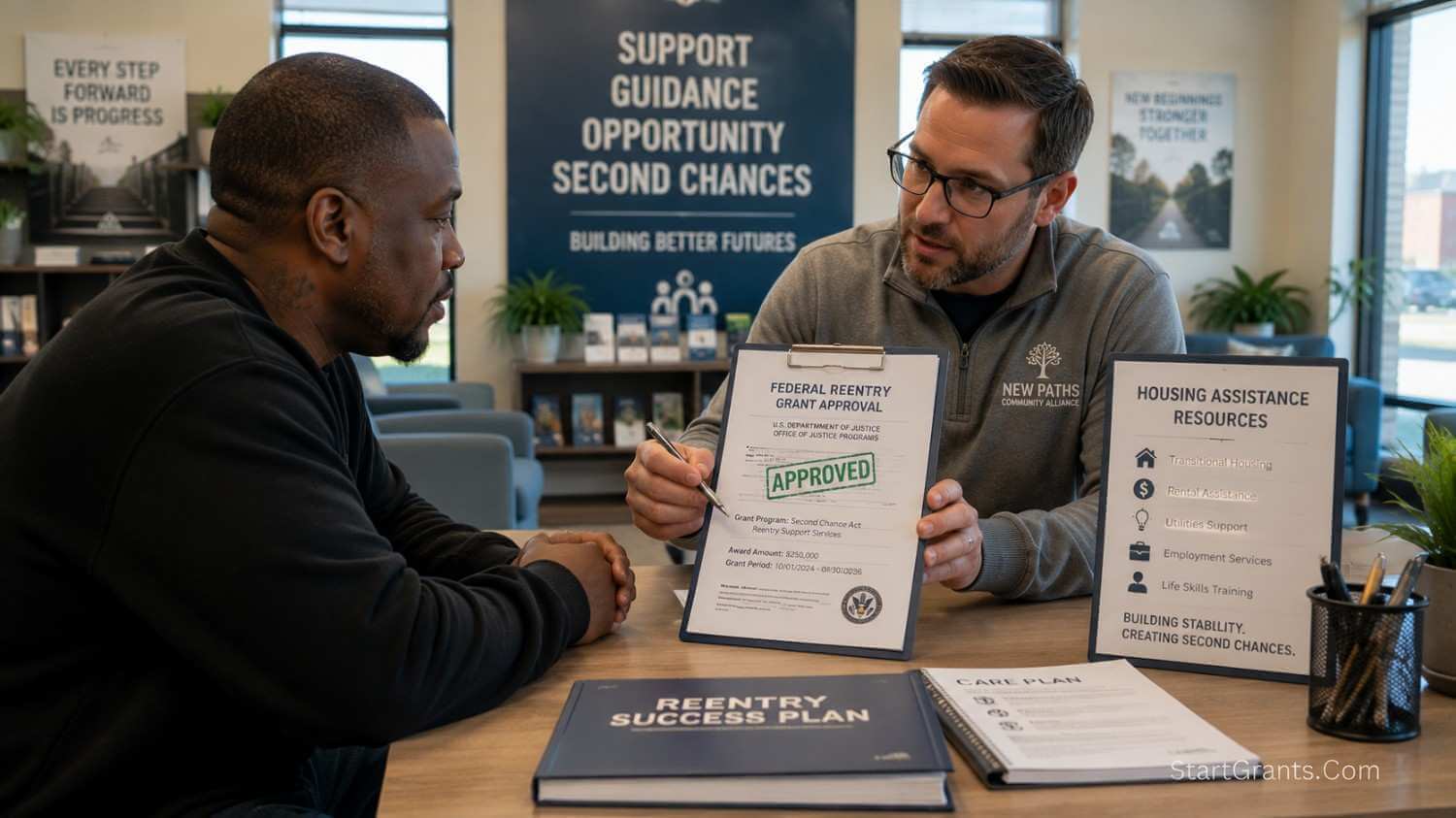
Generally, no federal program pays a personal “parolee grant” or automatic reentry check. Grants.gov explicitly states that its opportunities are not for personal financial assistance, student loans, or starting a small business. Its listings usually fund projects run by eligible organizations. Use the official Grants.gov explanation for individual applicants to avoid wasting time on ineligible applications.
There is an important exception to overly broad claims that no release money ever exists. Under Bureau of Prisons policy, some eligible people leaving federal custody may receive clothing, transportation, or a discretionary release gratuity. For qualifying federal inmates whose offenses occurred on or after November 1, 1987, the gratuity may be as much as $500, depending on need, available resources, and approval. It is not automatic, is not a grant application open to the public, and does not establish a benefit for people leaving state or county facilities. See the Bureau of Prisons release-gratuity policy.
| Type of help | Who normally applies | What a participant may receive |
|---|---|---|
| Second Chance Act grant | Eligible agencies, Tribal governments, or organizations | Services such as mentoring, treatment, housing navigation, education, or employment support |
| Public benefit | The individual or household | Food, health coverage, disability-related income, or family cash assistance if eligible |
| Education or workforce aid | The student or job seeker, usually through a school or workforce agency | Tuition assistance, approved training, career services, or supportive services |
| Local emergency help | The individual, after screening | A limited payment, voucher, transportation, clothing, or referral—only where offered |
How the Second Chance Act Helps Without Sending You a Check
The Second Chance Act authorizes federal funding for reentry work. The Bureau of Justice Assistance lists programs covering community-based reentry, education and employment, substance-use treatment, housing-related projects, and improvements to supervision systems. The eligible applicants are generally governments and organizations—not individual parolees. Review the BJA Second Chance Act program overview.
This distinction changes how you search. Instead of asking, “Where do I submit my personal Second Chance Act application?” ask your correctional reentry coordinator, supervising agency, American Job Center, or local reentry provider:
- Which organizations currently serve my ZIP code?
- Does the program accept self-referrals, or do I need a referral from supervision or a facility?
- Does it serve people with my release date, age, conviction history, or supervision status?
- Which costs can it actually cover: identification, transportation, work clothing, training, housing navigation, treatment, or something else?
- Is there a waiting list, enrollment window, residency rule, or documentation requirement?
Start With Your Written Release and Supervision Plan
Parole is not administered under one national set of conditions. Reporting schedules, travel limits, residence approval, treatment, employment expectations, electronic monitoring, fees, and restitution can differ by state, supervising authority, court order, and individual case. Do not rely on a generic internet checklist as if it were your order.
Ask for a readable copy of every condition and record the name, office number, after-hours procedure, and preferred contact method for your supervising officer. If you cannot meet a deadline or afford a required payment, communicate before the due date and ask for the official process for a payment plan, adjustment, waiver, or review. Do not assume that hardship automatically changes an order, and do not assume that one late payment automatically causes revocation.
If you face a disputed condition, threatened incarceration, or a fee you cannot pay, seek advice from a lawyer licensed in your state. USAGov provides a starting point for free and lower-cost legal help. A reentry caseworker can help organize documents, but cannot replace legal counsel.
A 72-Hour Reentry Priority List
- Confirm where and when to report. Put every appointment, test, treatment session, curfew, and check-in into a calendar.
- Secure approved shelter or housing. Ask whether the proposed address requires advance approval and what evidence is needed. For a fuller search strategy, see Housing Assistance for Felons.
- Collect identity and release documents. Keep your release papers, Social Security information, birth certificate, state ID, benefits notices, prescriptions, and supervision conditions together.
- Protect medication and treatment continuity. Ask the releasing facility or case manager where prescriptions will be filled and how appointments will continue.
- Apply only through official channels. Use state benefit agencies, official workforce offices, accredited schools, and verified nonprofits.
- Build a transportation plan. Confirm routes and backup options for reporting, interviews, work, treatment, and medical care.
Find Reentry Services That Actually Operate Near You
A national nonprofit name does not prove that a specific local office has funding, the needed service, or an open intake list. Programs can end when a grant period closes. Confirm the current provider, eligibility rules, service area, and available assistance before traveling or sending personal documents.
The U.S. Department of Labor says justice-involved programs are generally administered locally. Its American Job Center information notes that services vary and may have eligibility requirements. CareerOneStop, sponsored by the Department of Labor, also offers a ReEntry Program Finder.
When you call, ask whether assistance is a grant, a reimbursement, a voucher paid directly to a vendor, a loan, or a free service. Also ask what proof is required. Common requests include a photo ID, release papers, proof of address, income information, household details, school enrollment, a job offer, or a referral.
Public Benefits: Eligibility Comes From the Program, Not Parole Status
Being on parole neither guarantees nor automatically blocks every public benefit. Each program evaluates its own requirements, and some rules vary by state.
SNAP food benefits
SNAP is food assistance, not unrestricted cash. Apply through the state where you live. The USDA explains that state agencies handle applications and determine eligibility using income, resources, household circumstances, and other rules. In some cases, expedited processing may be available, but the state decides after reviewing the application. Use the USDA SNAP state directory. Rules affecting certain felony convictions can differ by state, so ask the state agency for a written determination rather than relying on a blanket claim.
TANF and other family assistance
TANF is a state- or Tribal-run program for eligible families in financial hardship; it is not a cash grant for all people on parole. Program names, benefit amounts, work rules, time limits, and family requirements vary. USAGov links to state and Tribal TANF programs. People without qualifying children should ask their state or county whether General Assistance or another local program exists.
Social Security and SSI after incarceration
Release does not create automatic eligibility. A person may be able to restart Social Security retirement, survivors, or disability benefits if the underlying requirements are met. SSI is limited to eligible people who are 65 or older, blind, or disabled and have limited income and resources. SSA says SSI recipients confined for 12 consecutive months or longer generally must submit a new application; shorter suspensions may be handled differently. Bring official release documents and contact SSA promptly. Read SSA’s Benefits After Incarceration guidance.
For a broader personalized search, the USAGov benefit finder covers food, health, housing, disability, education, and family programs. It screens for possibilities; it does not approve benefits.
Housing Help Is Usually a Placement or Subsidy, Not Cash in Hand
Reentry housing may include an approved family address, transitional housing, recovery housing, emergency shelter, supportive housing, or a conventional rental. Availability and supervision approval are separate questions. A bed offered by a nonprofit is not automatically approved by a supervising agency, and approval by supervision does not mean the rent is funded.
Housing Choice Voucher and public housing decisions are made by local public housing agencies under federal and local rules. Income, household composition, immigration status, waiting lists, and criminal-history policies may affect the application. HUD’s current voucher page notes that some crimes may make an applicant ineligible, but it does not support the claim that every felony creates a lifetime ban. Check the local written policy and request the reason and review procedure if denied. See HUD’s Housing Choice Voucher guidance.
Employment and Training Can Remove the Biggest Reentry Barrier
Ask an American Job Center whether you qualify for career counseling, résumé help, skills assessments, occupational training, apprenticeships, supportive services, or a reentry-specific project. Funding under WIOA or another program is not guaranteed, and the training provider usually must be approved before enrollment.
Use Jobs for People with Felonies for a broad job-search plan. If Walmart is one employer you are considering, review Does Walmart Hire Felons? without treating any company as a guaranteed second-chance employer. Trucking may be an option for some applicants, but licensing, insurer, employer, offense, drug-and-alcohol, and supervision rules matter; see Trucking Companies That Hire Felons.
If training is the better first step, compare the school’s total price, completion rate, accreditation, state approval, occupational licensing restrictions, and job placement disclosures before paying a deposit. Our guide to Trade Schools for Felons explains those checks in more detail.
Education Aid: Parole Does Not Automatically Bar Federal Student Aid
A person on parole may apply for federal student aid if they meet the normal eligibility requirements and attend an eligible college or career school. Federal Pell Grants are need-based; they are not parolee grants and do not have to be repaid in most circumstances. Even people still confined may now qualify for Pell through an approved prison education program. Federal Student Aid lists the current rules on its Pell Grant page.
Complete the FAFSA and ask the school’s financial-aid office for a written aid offer showing grants, scholarships, work-study, and loans separately. Before choosing a program, investigate whether the conviction affects licensing or employment in the intended occupation. For additional options, see College Grants for Convicted Felons.
Can Assistance Pay Parole Fees, Monitoring Costs, or Restitution?
There is no nationwide federal personal grant dedicated to parole supervision fees, electronic monitoring, drug testing, court debt, or restitution. Whether those obligations exist—and whether a waiver, reduction, payment plan, or hardship process is available—depends on the controlling law and order.
A local reentry or workforce program may have limited “supportive service” or “barrier-removal” funds, but do not assume those funds can pay court-ordered debt. Ask the provider to identify the permissible expense in writing. A payment to a landlord, transit provider, school, or work-equipment vendor is not the same as cash paid to the participant.
Beware of pages that relabel public benefits or ordinary loans as Personal Grants for Felons. Verify the funder, award terms, repayment obligation, privacy policy, and complaint channel before sharing a Social Security number or bank details.
Business Funding: Separate Grants From Loans and Contracts
A criminal record does not create a federal startup grant. Grants.gov states that its opportunities are not personal funding for starting a business. Some local competitions, nonprofits, workforce programs, or economic-development agencies may support entrepreneurship, but each has its own location, business-stage, industry, and reporting rules.
Before borrowing, calculate the annual percentage rate, origination fees, collateral risk, payment schedule, and total repayment. A loan remains debt even when marketed as “funding.” Use Business Resources and Business Grants for Felons to compare realistic pathways without assuming an award.
Passport and Travel While on Parole
Having or obtaining a passport does not by itself authorize travel. A parole or court condition may restrict leaving a state, district, or the United States. The Department of State now provides specific instructions for applying for or recovering a passport while on or after supervision, including additional documentation in some situations. Check the Department of State parole and probation passport page, then obtain any required travel permission from the supervising authority before making nonrefundable plans. Our contextual overview, Can Felons Get a Passport?, explains the distinction between passport eligibility and permission to travel.
Muslim Perspective: Reentry Help, Zakat, and Avoiding Riba
Muslim people returning from incarceration may need ordinary reentry assistance plus access to halal food, prayer, an affirming community, and culturally competent counseling. Ask a local mosque or Muslim service organization what it actually provides. Assistance may be a grocery card, clothing, transportation, mentoring, a vendor payment, or a referral; it should not be described as a grant unless that is truly how the program operates.
The Tayba Foundation National Reentry Program states that its reentry services currently operate at reduced capacity. It describes parole planning, coaching, peer mentoring, and referrals or assistance involving housing, work, mental health, clothing, and training. This does not mean every applicant will qualify or receive money. Contact the organization for its current intake process and geographic reach.

Handle zakat questions individually
Do not assume that parole status, restitution, fines, or supervision fees automatically make someone eligible for zakat. Zakat policies differ, and the facts behind a debt or expense can matter. A local zakat administrator may request income, household, debt, release, or vendor documents and may pay an approved vendor rather than the applicant. For religious guidance about eligibility or permissible uses, consult a qualified scholar who can review the individual facts and the organization’s policy.
Know whether an offer is a benefit, grant, or loan
A legitimate public benefit, charitable gift, or grant normally does not charge interest. A loan must be repaid and may carry interest and fees. Some Muslims seek to avoid interest-bearing credit because of concerns about riba; StartGrants.com does not issue religious rulings. Ask a qualified Islamic scholar or financial counselor to review the full contract—not only the product name.
Payday loans can be especially costly. The Consumer Financial Protection Bureau explains that lenders generally add finance charges and that late, rollover, returned-payment, or bank fees may also apply. Read the CFPB explanation of payday-loan costs. Before taking high-cost credit, ask about a written payment arrangement, local emergency aid, an employer advance, assistance from family or community, or a genuine qard hasan program. None is guaranteed, so verify terms and timing before relying on it.
Grant and Reentry Scam Warning
- Do not pay a “processing,” “release,” “tax,” or gift-card fee to unlock a government grant.
- Do not trust a caller who promises approval because of your criminal record or parole status.
- Do not give remote access to your phone, benefits account, email, or bank account.
- Verify government pages by typing the official
.govaddress yourself. - Verify a nonprofit through its official site, physical contact information, and current program staff.
- Get the funding type, permitted use, repayment terms, and appeal or complaint process in writing.
Save This Reentry Assistance Checklist
Documents and Questions to Prepare
Copy this plain-text checklist into a notes app or print the page. The characters [ ] are used so the checklist remains readable if WordPress removes icon fonts or special checkbox symbols.
- [ ] Written parole or supervision conditions
- [ ] Release papers and corrections contact information
- [ ] Photo ID, Social Security information, and birth certificate
- [ ] Approved address or documented housing plan
- [ ] Medication list, prescriptions, insurance, and treatment contacts
- [ ] Income, bank balance, household, rent, and utility documents for benefits
- [ ] Résumé, work history, licenses, certificates, and references
- [ ] School cost, accreditation, financial-aid offer, and licensing research
- [ ] Written explanation of any fee, voucher, grant, reimbursement, or loan
- [ ] Calendar for reporting, court, treatment, work, and application deadlines
Frequently Asked Questions
Are there government grants paid directly to parolees?
There is no universal federal personal grant awarded simply because someone is on parole. Most federal reentry grants fund eligible agencies and organizations that deliver services. Some eligible people leaving federal custody may receive a discretionary Bureau of Prisons release gratuity, clothing, or transportation, but this is not automatic and does not create a nationwide benefit for every parolee.
What is the Second Chance Act?
The Second Chance Act authorizes federal funding for government and nonprofit reentry programs. Funded services can address areas such as housing, treatment, mentoring, education, employment, and improvements to community supervision. The exact services available to an individual depend on local grantees, eligibility, capacity, and referrals.
Can an individual parolee apply for a Second Chance Act grant?
Generally, an individual seeking personal assistance does not apply for a Second Chance Act award on Grants.gov. Eligible organizations and government entities apply for program funding, and participants seek services from the funded local provider. Confirm whether the provider accepts self-referrals and whether its program is currently open.
Can a person on parole receive SNAP or TANF?
Possibly, but parole status alone does not determine eligibility. SNAP is food assistance administered by states, while TANF is state- or Tribal-run assistance for eligible families. Income, household circumstances, program rules, and state-specific restrictions may apply. Submit an official application and request a written decision.
Can Social Security or SSI benefits restart after release?
Benefits may restart if the person continues to meet the program rules and completes SSA’s required process. Bring official release papers and contact Social Security. An SSI recipient confined for 12 consecutive months or longer generally must file a new application, while other suspended benefits may follow different reinstatement rules.
Can a grant pay parole fees, monitoring costs, or restitution?
There is no nationwide federal personal grant dedicated to those obligations. A local program may have limited supportive-service funds, but permitted expenses vary and court-ordered debt may be excluded. Ask the supervising authority about any official hardship, payment-plan, waiver, or review process and seek legal advice when needed.
Can a person on parole receive Pell Grant or workforce training assistance?
Yes, a person on parole may qualify if they meet the applicable student-aid or workforce-program requirements. Pell Grant eligibility is based on federal student-aid rules and enrollment at an eligible school, while workforce funding is usually approved locally. Neither form of assistance is guaranteed by parole status.
Can a parolee receive a business grant or loan?
A record does not create eligibility for a federal startup grant. Local competitions or nonprofit programs may exist, but their rules vary. Loans are not grants and must be evaluated for interest, fees, collateral, repayment, and supervision restrictions. Verify every offer and never pay someone to unlock a promised government award.
Important disclaimer: StartGrants.com is an independent information portal. It is not a government agency, parole or probation authority, law firm, grantmaker, lender, benefits office, or religious fatwa body. This article provides general educational information, not legal, financial, benefits, or religious advice. Programs, funding, eligibility, supervision conditions, and local services can change. Confirm requirements with the responsible agency or provider, follow your written supervision conditions, and consult qualified legal and religious professionals for advice about your circumstances.