
Last Updated: | Author: Munir Ardi
A broken furnace during freezing weather is a safety emergency, but there is no nationwide federal program that automatically gives every low-income household a free furnace. Depending on where you live, help may come through the Low Income Home Energy Assistance Program (LIHEAP), the Weatherization Assistance Program (WAP), a utility, USDA Rural Development, or a local emergency fund.
Each program has different income limits, property rules, approved contractors, funding cycles, and definitions of an energy crisis. Some programs pay for a repair, some may approve replacement, and others provide only a rebate or short-term crisis intervention. For a broader overview of related programs, see our energy-efficiency assistance guide for homeowners.
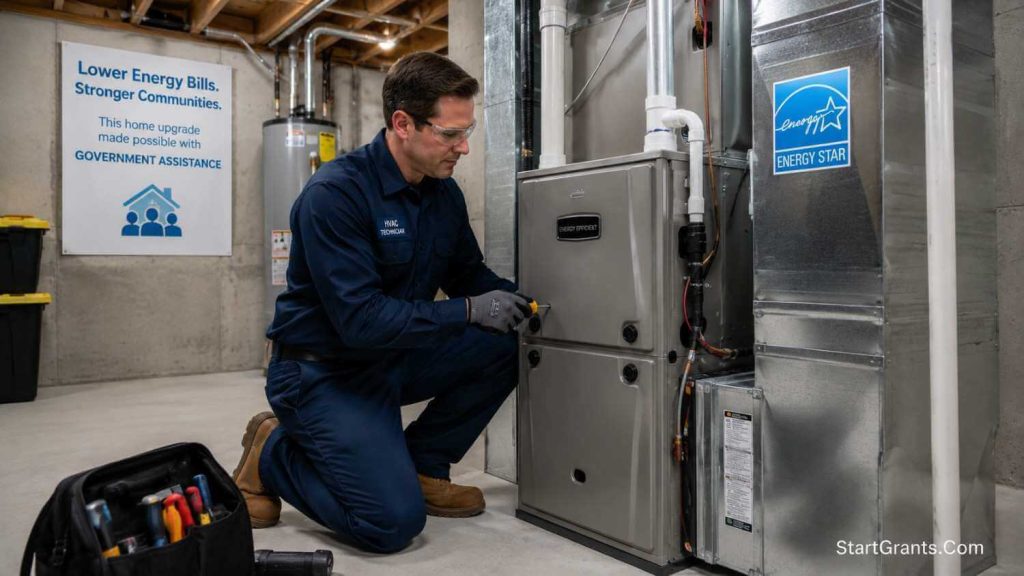
Is There Really a Free Furnace Program?
“Free furnace” is a convenient search phrase, not the name of one national benefit. A qualifying household may receive a no-cost repair or replacement through a locally administered program, but income eligibility alone does not guarantee new equipment.
| Possible source | What it may provide | Important limitation |
|---|---|---|
| LIHEAP crisis assistance | Emergency intervention that may include heating-equipment repair or replacement | Benefits, crisis definitions, seasons, and payment limits vary by administrator |
| Weatherization Assistance Program | Assessment plus approved cleaning, tuning, repair, or replacement of heating systems | WAP is not an overnight emergency program or cash grant |
| Utility or state program | Income-qualified repair, replacement, rebate, financing, or efficiency service | Not every utility offers a furnace program |
| USDA Section 504 | Loan, or a grant for qualifying homeowners age 62 or older to remove hazards | Restricted to eligible rural homeowners and subject to underwriting and program rules |
| Charity or local government | Flexible emergency payment, repair fund, referral, or temporary heating support | Funding and services can change without notice |
First: Treat a No-Heat Situation as a Safety Problem
If you smell gas, hear a carbon-monoxide alarm, see soot or flame outside the proper burner area, or anyone develops headache, dizziness, weakness, nausea, chest pain, or confusion, leave the building and call 911 or the utility’s emergency number from a safe location. Do not re-enter until emergency personnel say it is safe.
The CDC warns never to heat a home with a gas oven. It also says generators must operate outdoors, more than 20 feet from windows, doors, and vents. The Consumer Product Safety Commission recommends working smoke and carbon-monoxide alarms and keeping portable heaters at least three feet from bedding, curtains, furniture, and other combustible materials. Plug an electric space heater directly into a wall outlet—not an extension cord or power strip—and do not leave it operating while you sleep.
A homeowner can check the thermostat setting, replace thermostat batteries, and inspect a filter if the manufacturer’s instructions allow it. Combustion, electrical, gas-line, venting, and heat-exchanger work should be handled by a qualified technician. Do not continue operating equipment that a technician or utility has tagged as unsafe.
1. LIHEAP Crisis Assistance
LIHEAP is federally funded but administered by states, tribes, and territories. According to the official LIHEAP Clearinghouse, allowable assistance can include energy bills, energy crises, weatherization, minor energy-related home repairs, and replacement of heating equipment. The local plan determines which services are actually offered.
What the 18-hour and 48-hour rules mean
Federal LIHEAP law requires an administering agency to provide some form of intervention that will resolve an eligible energy crisis no later than 48 hours after a household applies, or 18 hours when the situation is life-threatening. The current LIHEAP crisis-policy table explains that administrators generally measure this period after a complete application and required documentation have been received and verified.
This deadline does not mean every applicant receives a new furnace within 18 or 48 hours. An intervention could be a fuel delivery, utility reconnection, repair authorization, temporary heating arrangement, referral, or another action permitted by the local plan. A full replacement may take longer and may not be covered.
Eligibility and benefit amounts are local
LIHEAP administrators set their own income limits within federal parameters. The maximum cannot exceed the greater of 150% of the federal poverty guidelines or 60% of state median income, although administrators may choose a lower limit subject to federal restrictions. Asset tests, crisis definitions, priority groups, application periods, and maximum payments also vary.
Use the official LIHEAP contact finder or call the National Energy Assistance Referral line at 1-866-674-6327. During a dangerous outage, contact the local agency and utility directly rather than waiting for a national referral line.
2. Weatherization Assistance Program
WAP is the strongest nationwide framework for long-term, income-qualified energy improvements. It is a service program administered at the state and local level, not a check paid to the household. The Department of Energy lists cleaning, tuning, repairing, or replacing heating and cooling systems among possible whole-house weatherization measures.
Furnace replacement is still not automatic. After confirming eligibility, the provider assesses the home and selects measures that meet its audit or approved-priority-list methodology, state plan, health-and-safety rules, cost-effectiveness standards, and available budget. A repair, tune-up, vent correction, air sealing, insulation, or another measure may be approved instead.
Who may qualify for WAP?
DOE states that households at or below 200% of the poverty income guidelines are income-eligible under the general federal framework. A state or territory may instead elect to use qualifying LIHEAP criteria based on 60% of state median income. Supplemental Security Income recipients may qualify through a categorical pathway, and local administrators must make the official determination.
WAP gives priority to groups identified in federal guidance, including older adults, households with a person with a disability, families with children, high-energy users, and households with high energy burdens. Being in a priority group can affect scheduling; it does not guarantee furnace replacement.
Both homeowners and renters may apply. For rental housing, the provider works with the landlord to obtain permission before work begins. Do not assume one nationwide rent-freeze agreement or landlord contribution rule; protections and owner requirements depend on federal rules, the state plan, building type, and local law.
Find your administrator through DOE’s WAP application directory. Because WAP uses a whole-house approach, an audit may combine heating work with air sealing or insulation. Our related guides explain home-insulation assistance and the broader options to install or replace central heating.
3. Utility, Community Action, and Local Programs

Some regulated utilities and state energy offices offer income-qualified HVAC services, safety checks, rebates, or contractor programs. These offerings are not mandated in the same form nationwide. Start with the utility named on the household’s bill and the ENERGY STAR Rebate Finder, then verify the current offer on the program administrator’s official website.
Ask these questions before accepting an offer:
- Is it a no-cost service, rebate, reimbursement, loan, on-bill financing arrangement, or lease?
- Must the household be the utility account holder?
- Is an energy audit or combustion-safety test required?
- Does the program decide between repair and replacement?
- Must the household use an approved contractor and equipment list?
- Are permits, ductwork, electrical work, venting, thermostat, disposal, and warranty included?
- Can utility assistance be combined with LIHEAP, WAP, or a local fund?
A Community Action Agency may administer LIHEAP or WAP and may know about county, city, foundation, or charitable emergency funds. Call 211 and use the Office of Community Services Community Action resource to identify the appropriate local organization. Assistance should not be assumed until the agency confirms current funding and eligibility.
4. USDA Section 504 for Eligible Rural Homeowners
The USDA Single Family Housing Repair Loans and Grants program—often called Section 504—can help very-low-income homeowners repair, improve, or modernize an eligible rural home. Grants are limited to qualifying homeowners age 62 or older who cannot repay a repair loan and must be used to remove health and safety hazards.
The current USDA Section 504 fact sheet lists a maximum loan of $40,000 and a maximum lifetime grant of $10,000 under ordinary program limits. Loans have a fixed 1% interest rate and can run for 20 years. Grants generally must be repaid if the property is sold in less than three years.
A dangerous failed heating system may fit the health-and-safety purpose, but USDA must approve the proposed work. The applicant must own and occupy the home, meet very-low-income rules, live in an eligible rural area, and be unable to obtain affordable credit elsewhere. A household should not order a furnace before the local Rural Development office completes its review.
5. Home Energy Rebates and 2026 Tax-Credit Limits
HOMES may support a larger energy-saving project
The Home Owner Managing Energy Savings program provides rebates for qualifying whole-home projects that achieve required energy savings. DOE describes possible rebates of up to $8,000, but the amount depends on household income, project cost, measured or modeled savings, and the administrator’s program design. Non-heat-pump heating equipment may be considered within an approved project; HOMES is not a nationwide stand-alone free-furnace voucher.
Do not assume the $8,000 electric rebate replaces a gas furnace
The separate High-Efficiency Electric Home Rebate program can provide up to $8,000 for an eligible heat pump, subject to income and local rules. However, DOE Program Notice 26-2, effective May 29, 2026, removed the general fuel-switching pathway for existing homes. Under that updated design, HVAC and appliance rebates generally support upgrades from existing electric equipment to more-efficient electric equipment, while participating homes may retain existing fossil-fuel heating. State, territory, and tribal implementation can change as plans are revised, so check the official Home Energy Rebates status page before selecting equipment.
Whole-home projects can also address heat loss rather than only the furnace. Our green-home assistance guide covers related efficiency measures. If the same heat pump would provide cooling, compare it with available air-conditioning assistance before committing to a system.
No federal Energy Efficient Home Improvement Credit for a 2026 furnace
The federal Energy Efficient Home Improvement Credit previously covered certain qualifying furnaces and heat pumps, but the IRS states that qualifying improvements had to be made by December 31, 2025. A furnace placed in service in 2026 does not qualify for that credit. State or utility incentives may still exist.
6. Special Guidance for Renters
Responsibility for a failed furnace depends on the lease, housing program, and state or local habitability law. A renter generally should not hire a contractor, dispose of equipment, or authorize permanent work without the owner’s written permission.
- Report the no-heat condition to the landlord or property manager in writing and keep a copy.
- Record the indoor temperature, thermostat display, outage times, and any technician or utility notice.
- Apply for LIHEAP crisis help and ask whether the administrator works directly with landlords.
- Ask the local WAP provider about rental-property eligibility and owner authorization.
- Contact local code enforcement, tenant assistance, or legal aid if the owner does not restore required heat.
- Do not withhold rent, deduct repair costs, or break the lease without state-specific legal advice.
How to Apply Without Losing Time
- Call the utility first in a dangerous outage. Report loss of heat, shutoff, gas odor, or suspected carbon monoxide through the correct emergency channel.
- Apply to LIHEAP and WAP separately. One crisis application does not automatically place the household on a weatherization waiting list.
- Describe the facts. State whether the primary heating system is not operating, has been tagged unsafe, or lacks fuel. Avoid exaggeration; the program will verify the situation.
- Gather requested records. Common examples include identification, proof of household income, utility or fuel bills, proof of address, lease or ownership documents, and a shutoff or repair notice. The exact list is local.
- Request a written HVAC diagnosis when safe and affordable. It should identify the fault, whether repair is possible, and why the equipment is unsafe. Do not pay for a diagnosis if the program requires its own contractor.
- Explain household vulnerability. Tell the agency about older adults, infants, disabilities, or documented health conditions. A medical note may support priority where the local plan permits it, but it does not guarantee approval.
- Ask about preauthorization. Many programs will not reimburse equipment purchased or work started before approval.
- Confirm the complete scope. A furnace quote may exclude duct repair, permits, electrical or gas-line work, chimney liner, condensate drain, thermostat, asbestos handling, disposal, or code upgrades.
- Keep the application number. Ask when the file became complete, what the next action will be, and how to appeal or correct a denial.
Muslim Perspective: Safe Heat, Honest Applications, and Financing
Protecting family health during dangerous cold is a genuine necessity. Muslim households can pursue public benefits and charitable assistance without assuming that every program is identical or that every financing contract has the same religious ruling.
Separate assistance from borrowing
WAP services, a LIHEAP payment, an approved utility benefit, or a charitable repair is not automatically an interest-bearing loan. Still, read the award notice. Confirm whether the assistance is a grant, reimbursement, rebate, forgivable loan, lien, on-bill charge, or conventional loan, and whether repayment can arise after a sale, move, inaccurate application, or violation of program conditions.
Review emergency financing carefully
“Zero down,” “no interest if paid in full,” rent-to-own, and home-improvement financing can differ substantially. Check the APR, deferred-interest clause, late fees, total of payments, prepayment rules, security interest or lien, repossession terms, warranty, and consequences of missing a deadline. A promotional label alone does not determine whether a contract meets a family’s religious requirements. For contract-specific guidance, provide the complete agreement to a trusted scholar or qualified Islamic-finance adviser.
Ask locally about zakat, sadaqah, and qard hasan
A mosque, zakat committee, Islamic community center, refugee-support group, or local mutual-aid network may help with an HVAC diagnosis, temporary lodging, utility bill, repair, safe space heater, or part of a replacement cost. Availability and zakat eligibility vary, so do not rely on assistance until the organization confirms it. A written diagnosis, contractor estimate, proof of household need, and documentation of other applications can make a local review easier.
Accuracy is part of responsible assistance
Report household members, income, ownership, utility responsibility, and the condition of the furnace truthfully. If a household receives duplicate benefits for the same cost, ask both administrators how coordination should work before accepting or spending the funds. This protects limited community resources and reduces the risk of an overpayment or disqualification.
Save This Furnace Assistance Checklist
- [ ] Report a no-heat emergency to the utility and local LIHEAP office.
- [ ] Apply separately to LIHEAP crisis assistance and the local WAP provider.
- [ ] Record the furnace model, serial number, failure symptoms, red tags, and written diagnosis when safe.
- [ ] Confirm whether the program—not the household—must select the contractor.
- [ ] Ask whether repair, replacement, venting, permits, ductwork, disposal, and code upgrades are covered.
- [ ] Obtain written preapproval before purchasing equipment or authorizing work.
- [ ] Keep the application number, approval, itemized invoice, inspection record, and warranty.
Avoid Furnace-Grant Scams
- No federal agency charges a fee to release a “free furnace grant.”
- Do not pay someone for a secret LIHEAP or WAP application.
- Reject demands for gift cards, cryptocurrency, bank-login credentials, or remote access to your phone or computer.
- Verify a contractor through the program administrator before signing or allowing work.
- Do not sign a blank completion certificate or say work is finished before inspecting it.
- Get equipment model numbers, labor scope, warranty, permits, and remaining household cost in writing.
Final Takeaway
The most useful first step depends on the problem: contact LIHEAP and the utility for a no-heat crisis, apply separately to WAP for an audited whole-home project, and use USDA Section 504 only when the rural-homeownership, income, age, repayment, and hazard-removal rules fit. A furnace may be repaired instead of replaced, and a rebate or loan should not be described as a free furnace. Obtain written approval before buying equipment or allowing work to begin.
Frequently Asked Questions
Will the government pay the full cost of a new furnace?
Sometimes an approved program pays the full authorized cost, but there is no universal guarantee. LIHEAP, WAP, utilities, and local agencies decide whether to repair or replace equipment and what expenses their rules and funding cover.
Does LIHEAP have to replace my furnace within 18 or 48 hours?
No. The federal timeframes concern an intervention that resolves an eligible crisis after a complete application—18 hours for a life-threatening crisis and 48 hours for other crises. The intervention is not necessarily a new furnace.
Can WAP replace an old but working furnace?
Possibly, but age alone does not establish eligibility for replacement. The local provider evaluates the home and approves measures under its technical, safety, cost-effectiveness, state-plan, and funding rules.
What is the WAP income limit?
DOE’s general framework uses income at or below 200% of the federal poverty guidelines. A state or territory may elect qualifying LIHEAP criteria based on 60% of state median income, and categorical pathways may also apply. The local administrator makes the final decision.
Can a renter receive furnace assistance?
Renters can apply for LIHEAP and WAP, but permanent work normally involves the property owner. Lease responsibility, owner permission, building eligibility, and tenant protections depend on the program and local law.
Can USDA Section 504 pay for furnace replacement?
A failed heating system may qualify as an approved repair or health-and-safety hazard, but assistance is limited to eligible very-low-income rural homeowners. Grants are restricted to qualifying homeowners age 62 or older who cannot repay a loan.
Does the $8,000 electric-home rebate cover a furnace?
It is not a universal furnace benefit. The maximum applies to eligible heat pumps under the locally administered electric rebate program. Updated 2026 federal guidance generally limits existing-home HVAC rebates to upgrades from electric equipment to more-efficient electric equipment.
Is there a federal furnace tax credit in 2026?
No. The Energy Efficient Home Improvement Credit required qualifying improvements to be made by December 31, 2025. State and utility incentives may still be available.
Can a Muslim household accept furnace assistance?
A public benefit or charitable repair is not automatically an interest-bearing loan. Verify the award conditions and review any financing, deferred-interest, lien, or repayment terms separately with a trusted adviser when needed.
Important disclaimer: StartGrants.com is an independent information portal. It is not a government agency, utility, program administrator, grantmaker, Community Action Agency, HVAC contractor, lender, charity, law firm, tax adviser, or religious authority. StartGrants.com does not issue grants, rebates, loans, benefits, equipment, legal advice, tax advice, financial advice, or fatwas. Eligibility, funding, crisis rules, income limits, covered equipment, benefit amounts, contractor requirements, waiting lists, application periods, and repayment or clawback terms can change. Verify current information with the responsible organization before applying, purchasing equipment, sharing personal information, or signing a contract. Approval, funding, repair, and furnace replacement are not guaranteed.