
Last Updated: July 2026 | Author: Munir Ardi
Anthropology is the systematic study of humanity, encompassing everything from ancient human evolution to the complex socio-cultural dynamics of modern globalization. Unlike laboratory-based sciences where experiments are conducted in a controlled room, anthropologists must step into the world. Ethnographic fieldwork requires embedding oneself in distant communities, learning new dialects, and navigating international logistics.
This pursuit of knowledge is vital to human progress, but it is astronomically expensive. Funding international flights, hiring local translators, purchasing secure data-storage equipment, and covering living expenses in a foreign country for a year can easily cost between $25,000 and $50,000. Because standard university stipends rarely cover these costs, learning how to get anthropology research grants is the ultimate survival skill for Ph.D. candidates and professional social scientists.
Before you draft a specific fieldwork proposal, you must understand the bureaucratic architecture of how federal and private money flows into academic institutions. Ensure your foundational strategy is secure by reviewing our Master Pillar: Government Grants for Nonprofit Organizations & 501(c)(3) Opportunities.
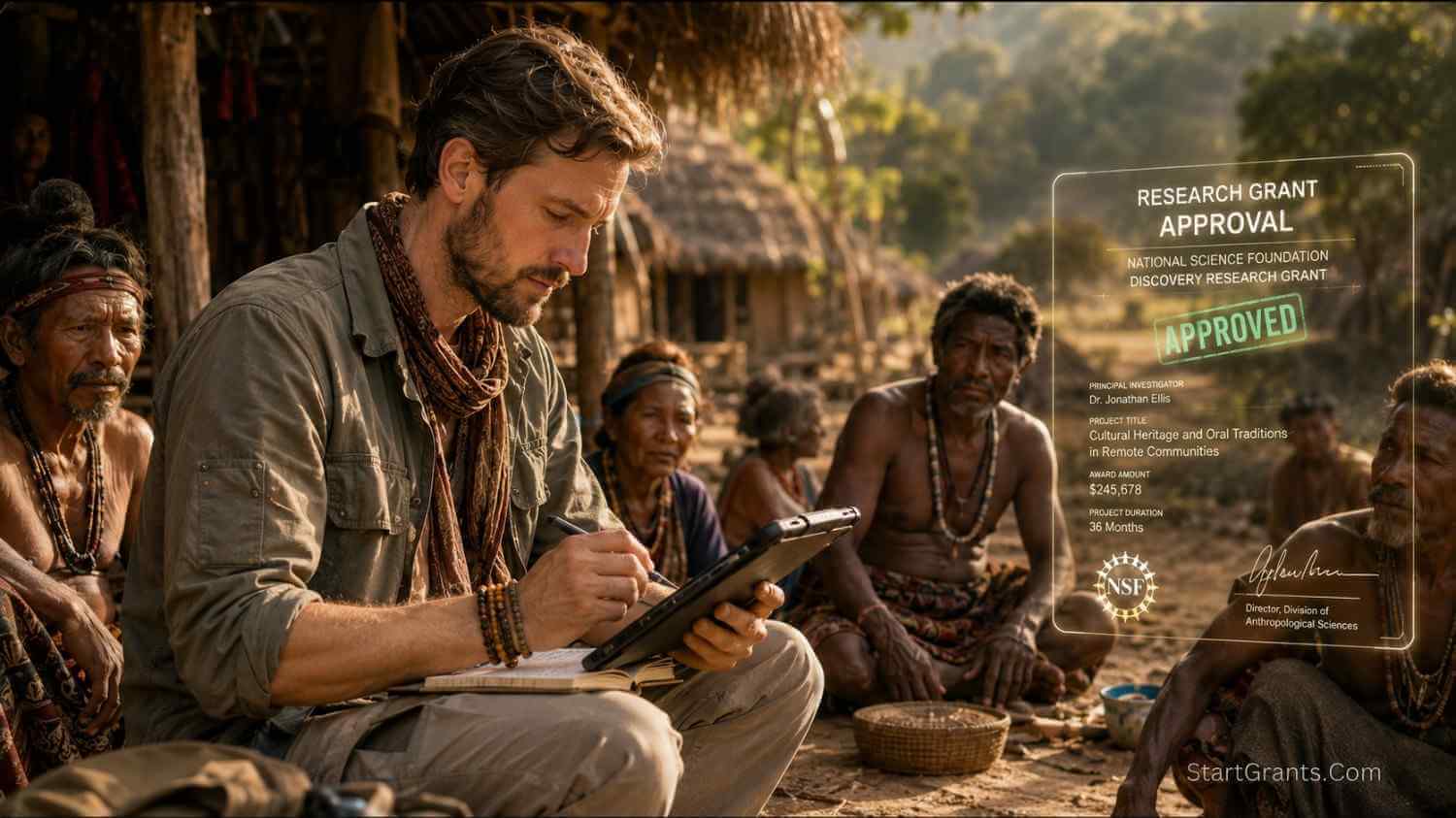
Ethnographic fieldwork requires massive capital for international travel, local translators, and secure data equipment. Securing anthropology research grants allows scientists to embed themselves in diverse cultures without incurring crippling personal debt.
Phase 1: The Federal Ecosystem (NSF & NEH)
Because anthropology sits uniquely at the intersection of hard science and the humanities, researchers have the distinct advantage of tapping into two entirely separate federal funding pipelines.
1. National Science Foundation (NSF)
The National Science Foundation (NSF) operates the Cultural Anthropology Program, which is the gold standard for social scientists in the U.S. They offer both Senior Research Awards (for established professors) and the highly coveted Doctoral Dissertation Research Improvement Grants (DDRIGs) for Ph.D. students. The NSF is strictly focused on empirical science. To win this grant, your proposal cannot just be a descriptive story about a culture; it must test a specific hypothesis and contribute to broader anthropological theory.
2. National Endowment for the Humanities (NEH)
If your anthropological research leans more toward history, linguistics, or cultural preservation rather than empirical data modeling, the National Endowment for the Humanities (NEH) is your target. They offer highly lucrative Fellowships intended to give researchers the uninterrupted time needed to write and publish major ethnographic books.
Phase 2: Private Endowments & Specialized Foundations
Federal grants are powerful but highly bureaucratic. The most agile and prestigious funding in the anthropological community comes from legacy private foundations dedicated exclusively to the study of humanity.
- The Wenner-Gren Foundation: This is arguably the most famous private foundation in the discipline. They offer Dissertation Fieldwork Grants and Post-Ph.D. Research Grants. Wenner-Gren explicitly looks to fund research that demonstrates a clear link to anthropological theory and debates.
- The Leakey Foundation: If you are a biological anthropologist, primatologist, or paleoanthropologist studying human origins, The Leakey Foundation is your primary target. They exclusively fund research related to human evolution.
- National Geographic Society: For cultural anthropologists who possess a strong element of visual storytelling and exploration, National Geographic offers grants for projects that illuminate and protect the wonder of the human world.
Pro-Tip: Inside the Wenner-Gren Foundation
Securing a grant from a prestigious private endowment requires understanding the specific philosophy of the organization. To see exactly how global anthropology grants are distributed, what types of fieldwork they prioritize, and the profound impact this capital has on researchers worldwide, watch this official breakdown: The Wenner-Gren Foundation – Supporting Worldwide Research in all Branches of Anthropology:
Phase 3: The Bureaucratic Shield (IRB & Methodology)
Understanding how to get anthropology research grants requires mastering the ethics of human research. Federal agencies will not release a single dollar of funding until your project has been officially cleared by an Institutional Review Board (IRB).
Because cultural anthropology involves interviewing living human beings, you must prove to the government that your fieldwork will not cause psychological, social, or political harm to your subjects. Your grant proposal must include a flawless methodology section detailing how you will obtain informed consent, how you will anonymize sensitive interview data, and how you will safely store audio recordings while traveling internationally.
Mastering this rigorous scientific narrative requires specific writing tactics. Ensure your proposal survives the grueling peer-review process by studying our specialized guide: Applying for Research Grants: The Ultimate Tips.
Phase 4: Budgeting for the Field
A brilliant ethnographic hypothesis will be rejected if the budget is deemed unrealistic. Reviewers scrutinize your budget to see if you actually understand the logistics of the country you are visiting.
When drafting your grant budget, you must be hyper-specific:
- Translator and Guide Fees: Do not just list “local assistance.” You must quote the actual daily wage of a local research assistant in the host country’s currency (converted to USD).
- Visa and Research Permits: Many countries charge exorbitant fees for official academic research visas. This must be a prominent line item.
- Data Security: Budget for rugged, encrypted hard drives and secure cloud storage subscriptions to ensure your fieldwork data survives harsh environments.
Phase 5: The Muslim Perspective (Lita’arafu, Ibn Khaldun, Riba & Amanah)
For Muslim academics, researchers, and students in the United States, the pursuit of anthropology is not a secular deviation; it is a profound fulfillment of a divine mandate. However, conducting international fieldwork requires navigating a Western academic financial system that is often riddled with spiritual traps. The Muslim anthropologist must operate with strict adherence to Islamic ethics and financial jurisprudence (Shariah).
The Command of Lita’arafu and Ibn Khaldun
Anthropology is deeply embedded in the Islamic tradition. Allah (SWT) states in the Qur’an (Surah Al-Hujurat 49:13): “O humanity, indeed We have created you from male and female and made you peoples and tribes that you may know one another [Lita’arafu].” The study of diverse human cultures is a direct response to this divine command.
Furthermore, Muslim researchers carry the intellectual legacy of Ibn Khaldun, the 14th-century Islamic scholar whose monumental work, the Muqaddimah, is widely recognized as the foundation of modern sociology, historiography, and cultural anthropology. Securing grants to continue this legacy is a matter of profound civilizational pride and academic duty.
The Trap of Riba in Fieldwork Logistics
Here is the hidden financial danger of academia: Grants are highly competitive, and university stipends are notoriously low. When a Ph.D. student needs to purchase a $2,000 international flight to their field site or pay for a month of lodging before their grant money clears, the default Western advice is to use a high-limit personal credit card.
If that balance is not paid off immediately, the bank applies compounding interest. In Islam, intentionally taking on debt that stipulates the payment of interest is explicitly Riba, which is strictly Haram (forbidden) and entirely eradicates the spiritual Barakah (blessing) from the academic endeavor. A Muslim researcher must adamantly refuse these predatory financial traps.
This elevates the pursuit of Research Grants (Hibah) into a religious necessity. Because true grants require no repayment, they are 100% Halal capital. If grant disbursements are delayed, a Muslim researcher must engineer Halal liquidity by utilizing internal savings, seeking Qard Hasan (zero-interest benevolent loans) from their community or university endowments, and fiercely avoiding Riba.

For the Muslim anthropologist, studying diverse cultures fulfills the Quranic mandate of ‘Lita’arafu’ (to know one another). By securing Halal research grants (Hibah) instead of relying on Riba-bearing credit cards for travel, the researcher honors the legacy of Ibn Khaldun with pure Barakah.
The Ethics of Ethnography (Amanah)
In Islam, interacting with people and recording their stories is an Amanah (a sacred trust). The history of Western anthropology is unfortunately stained with instances of colonial exploitation, where indigenous communities were studied, their artifacts taken, and their dignity ignored for the sake of a researcher’s career.
A Muslim anthropologist is bound by the strict ethical mandate of Adl (justice) and Ihsan (excellence in compassion). You must ensure that your grant-funded research directly benefits the host community. You cannot treat human beings merely as “data points.” Your methodology, approved by the IRB, must also align with Islamic ethics, ensuring that the honor, privacy, and cultural dignity of your subjects are protected at all costs.
Conclusion
Securing anthropology research grants requires transitioning your mindset from a passionate storyteller to a meticulous, data-driven scientist. By mastering the strict methodological requirements of the NSF, targeting specialized endowments like the Wenner-Gren Foundation, and drafting a flawless, IRB-compliant fieldwork budget, you can unlock the massive capital required to immerse yourself in the human experience globally.
For the Muslim academic, this intellectual journey is an extension of faith. By embracing the divine mandate of Lita’arafu, fiercely rejecting the spiritual trap of Riba-laced travel debt in favor of Halal Hibah, and upholding the sacred Amanah of ethical fieldwork, your anthropological research becomes a profound engine of global understanding and absolute spiritual purity.
Frequently Asked Questions (FAQs)
Q1: Does the NSF fund cultural anthropology projects?
A: Yes. The National Science Foundation (NSF) has a dedicated Cultural Anthropology Program. It provides substantial funding for basic scientific research that explores human social and cultural behavior. However, the proposal must be heavily grounded in empirical methodology and theoretical contribution, not just descriptive ethnography.
Q2: What is the Wenner-Gren Foundation?
A: The Wenner-Gren Foundation is a prestigious private endowment dedicated specifically to advancing anthropology globally. They offer highly competitive grants for doctoral dissertation fieldwork, post-Ph.D. research, and international symposiums across all branches of the discipline.
Q3: Can an independent researcher without a university affiliation get an anthropology grant?
A: It is exceptionally difficult. The vast majority of federal and private research grants require the applicant to be affiliated with a recognized 501(c)(3) nonprofit, an accredited university, or a museum. The institution acts as a financial sponsor and provides the necessary Institutional Review Board (IRB) oversight.
Q4: Why is it Haram for a Muslim researcher to use a credit card to pay for a fieldwork flight?
A: If the researcher uses a credit card to pay for expensive international flights or lodging and fails to pay the balance in full by the due date, the credit card company charges compounding interest on the remaining balance. In Islamic finance, intentionally paying interest is classified as Riba, which is strictly forbidden (Haram). Researchers must seek Halal alternatives like Hibah (grants) or Qard Hasan (interest-free loans).
Q5: Is anthropology considered a permissible field of study in Islam?
A: Yes, it is highly encouraged. The Qur’an (Surah Al-Hujurat 49:13) explicitly commands humanity to “know one another” (Lita’arafu). Studying diverse cultures, languages, and human societies fulfills this divine mandate. Furthermore, Muslim scholars like Ibn Khaldun laid the historical foundations for modern sociology and anthropology.
Disclaimer: The information provided in this article is for educational and informational purposes only. We are not a federal agency, a university grant office, or a religious fatwa council. NSF regulations, Wenner-Gren funding rules, and IRB compliance mandates are subject to constant changes. Always consult with your university’s Office of Sponsored Research, an academic advisor, and a qualified Islamic finance scholar regarding Halal research funding, Riba avoidance, and ethical ethnographic methodologies.