Last Updated: | Author: Munir Ardi
The best car donation program is not necessarily the charity with the loudest advertisement. It is a program that names the benefiting nonprofit, explains who processes and sells the vehicle, follows your state’s title-transfer rules, and supplies the records required for any federal tax deduction you claim.
This article compares five established donation routes with current official intake information: local Goodwill organizations, The Salvation Army, participating Make-A-Wish chapters, the Purple Heart Foundation, and KQED. Availability and vehicle acceptance vary, so treat this as a verification guide—not a ranking or a promise that every vehicle will be accepted. For the broader relationship between charitable gifts and fundraising, see our guide to donations and fundraising.
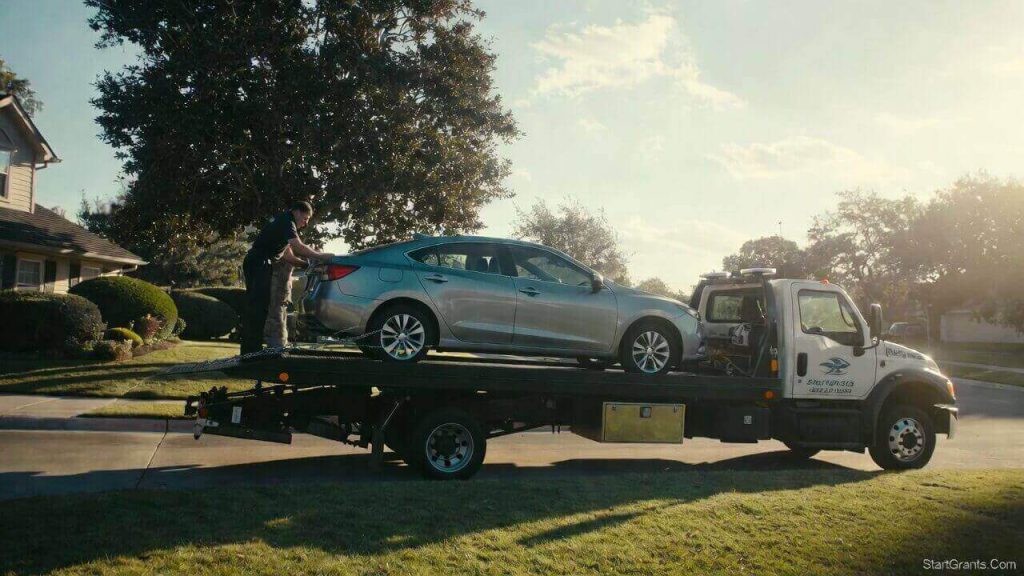
Vehicle pickup is commonly arranged after a donation is accepted, but towing availability, title requirements, and vehicle eligibility depend on the program and location.
What “Best” Should Mean for a Car Donation
There is no official federal ranking of car donation charities. A useful comparison should answer six questions:
- Who is the legal recipient? Confirm the exact nonprofit name and, when available, its EIN.
- Is a tax deduction potentially available? Check whether the recipient is eligible to receive tax-deductible contributions using the IRS Tax Exempt Organization Search.
- Who handles the vehicle? A charity may use a separate processor, tow operator, auction, or remarketing company. That arrangement is not automatically improper, but it should be disclosed.
- How does the charity benefit? Ask whether it receives net proceeds, a percentage, a fixed amount, or the vehicle itself.
- Can the program accept this vehicle in this ZIP code? Title rules, towing coverage, and accepted vehicle types vary.
- What paperwork will you receive? A pickup receipt alone may not be enough to support a federal deduction.
The California Attorney General advises donors to verify charity and fundraiser registration, review financial information, and ask how much of a donation will benefit the charitable program. Those are sensible questions in every state, even though registration systems differ.
Car Donation Programs Worth Comparing
The table below reports what each organization currently says on its official website. “Current” means that an official program or intake page was available when this article was updated; it does not guarantee acceptance or establish that one option is financially better than another.
| Donation route | Current official information | What to verify before donating |
|---|---|---|
| Local Goodwill organization | Goodwill Industries International describes a network of 150 local Goodwill organizations. Vehicle-donation availability and intake routes are local rather than uniform nationwide. | Use the official Goodwill locator, confirm the benefiting local organization, and ask which entity will issue the tax acknowledgment. |
| The Salvation Army | The official SATRUCK site accepts vehicle inquiries. It says vehicle acceptance varies by location and online vehicle scheduling is available only in some areas. | Use the official SATRUCK vehicle form or contact the program, confirm acceptance, and ask how the vehicle will support the local Adult Rehabilitation Center or other named program. |
| Participating Make-A-Wish chapter | Make-A-Wish says many—but not all—chapters offer car donation. Participating chapters may work with ARS Car Donation Services, Car Donation Foundation doing business as Wheels For Wishes, or Charitable Auto Resources (CARS). | Start with the official Make-A-Wish chapter list, then confirm the processor, benefiting chapter, and documentation. |
| Purple Heart Foundation | The Foundation’s official vehicle program considers running and non-running vehicles and advertises no-cost pickup, subject to acceptance and towability. | Use the official Purple Heart Foundation intake; confirm vehicle eligibility, title requirements, state notice duties, and the entity shown on the acknowledgment. |
| KQED vehicle donation | KQED lists a vehicle donation program on its official support page. Its help center identifies CARS as the partner that provides vehicle-donation receipts. | Begin on KQED’s official support page, verify current intake terms, and retain both pickup and tax documents. |
Goodwill: verify the local organization
Goodwill is decentralized. That matters because one local organization may accept vehicles while another may use a different processor or decline a vehicle whose acquisition cost would exceed its likely value. Our Goodwill car donation guide explains the questions to ask, but the local Goodwill and its official intake page should control your decision.
The Salvation Army: acceptance is location-specific
The Salvation Army’s official site says automobiles are commonly accepted, but not every vehicle type is accepted everywhere. Read our Salvation Army car donation overview, then verify your ZIP code and vehicle directly with SATRUCK before signing the title.
Make-A-Wish: the chapter and processor both matter
Make-A-Wish does not present one universal national processor. The official page directs donors to participating chapters and identifies three possible service partners. Our Make-A-Wish car donation explainer can help you prepare, but confirm which local chapter benefits and which organization appears on the receipt.
Purple Heart Foundation: confirm the exact beneficiary
Names involving “Purple Heart” can refer to different organizations. Use the Purple Heart Foundation’s own website and compare its current documents with our Purple Heart car donation review. Do not assume a similarly named advertisement belongs to the same legal entity.
KQED: a public-media option
KQED’s official support page confirms that vehicle donations fund its programming, while its help center says CARS provides receipts. Donors interested in this route can use our KQED car donation guide alongside KQED’s current instructions.
How Car Donation Usually Works
- You choose and verify the benefiting charity. Begin from the charity’s official site, not a look-alike advertisement or unsolicited call.
- You submit vehicle and ownership details. Intake commonly asks for the VIN, year, make, model, location, running condition, title status, and contact information.
- The program decides whether it can accept the vehicle. Acceptance may depend on title law, accessibility, towing cost, condition, and likely sale value.
- A charity or processor arranges transfer and pickup. Ask who will take title and what name should be entered as buyer or transferee. Never leave required transferee fields blank merely because a driver asks you to.
- The vehicle is used, transferred, or sold. Many donated vehicles are sold, but some charities may use, improve, or transfer a vehicle in furtherance of a charitable purpose.
- You receive records. Keep the intake confirmation, signed title copies, pickup receipt, state transfer notice, photographs, and any later tax acknowledgment.
A processor can provide useful towing and remarketing services. The key question is not whether a processor exists, but whether the beneficiary, financial arrangement, privacy practices, and paperwork are sufficiently clear for you to make an informed gift.
Federal Tax Rules for a Donated Vehicle
A vehicle donation is a noncash charitable contribution, not a tax credit and not a guaranteed refund. A federal deduction generally requires an eligible recipient and an itemized deduction on Schedule A. Your actual tax benefit depends on your return, applicable limits, and whether itemizing is advantageous.
| Situation | General federal rule | Records to review |
|---|---|---|
| Charity sells the vehicle for more than $500 | The deduction is generally limited to the smaller of the vehicle’s fair market value on the donation date or the charity’s gross sale proceeds. | A timely contemporaneous written acknowledgment, often Copy B of Form 1098-C, and Form 8283. |
| Charity sells the vehicle for $500 or less | The deduction may be the lesser of fair market value or $500, subject to acknowledgment and other tax rules. | Written acknowledgment and records supporting the vehicle’s actual condition and fair market value. |
| Charity materially improves or significantly uses the vehicle | The gross-proceeds limit may not apply; fair market value rules and the charity’s certification become important. | Acknowledgment describing the intended use or material improvement and its expected duration, plus valuation records. |
| Charity gives or sells the vehicle well below fair market value to a needy person | An exception may apply only when the transfer directly furthers the charity’s purpose of helping a poor, distressed, or underprivileged person who needs transportation. | The charity’s specific certification; merely spending sale proceeds on assistance does not create this exception. |
Form 1098-C and the 30-day rule
For a claimed value over $500, the organization must provide a contemporaneous written acknowledgment containing required details. When the charity sells the vehicle, the acknowledgment is generally due within 30 days after the sale; when a qualifying exception applies, it is generally due within 30 days after the contribution. The organization may use Form 1098-C.
Form 8283 and appraisals
The IRS generally requires Form 8283 when a noncash deduction exceeds $500. Section A generally applies above $500 through $5,000; Section B generally applies above $5,000. A qualified appraisal is generally required for a vehicle deduction over $5,000 when the deduction is not limited to gross sale proceeds. Review current IRS instructions or consult a tax professional before filing.
For the full rules, read the IRS Donor’s Guide to Vehicle Donation and Topic No. 506. A pricing guide is evidence, not an automatic deduction amount; fair market value must reflect the vehicle’s actual condition and comparable private-party market.
Title Transfer, Plates, Insurance, and Liability
State law controls the title-transfer process. Do not use a nationwide checklist as a substitute for your motor vehicle agency’s instructions.
- Ask for the transferee’s exact legal name. Complete the title as your state requires and keep a copy.
- Resolve ownership problems first. A missing title, deceased owner, co-owner, active lien, salvage designation, or name mismatch may require extra documents. Some programs can assist in some states, but rules are not uniform.
- File the seller or donor notice yourself when required. Keep the confirmation. Do not assume a tow driver or processor will complete your state notice.
- Follow state rules for plates. The IRS donor guide recommends removing plates unless state law requires otherwise; the correct action depends on your state.
- Ask your insurer when to cancel coverage. Coordinate cancellation with the completed transfer and applicable state requirements.

License-plate and transfer-notice rules vary by state. Follow your state motor vehicle agency’s instructions and keep proof of submission.
California illustrates why state-specific research matters: its DMV says a donor must submit a Notice of Transfer and Release of Liability within five days after donating the vehicle. California residents can review our California car donation guide and then complete the current process on the official California DMV title-transfer page.
How to Avoid Vehicle-Donation Scams and Poor-Value Arrangements
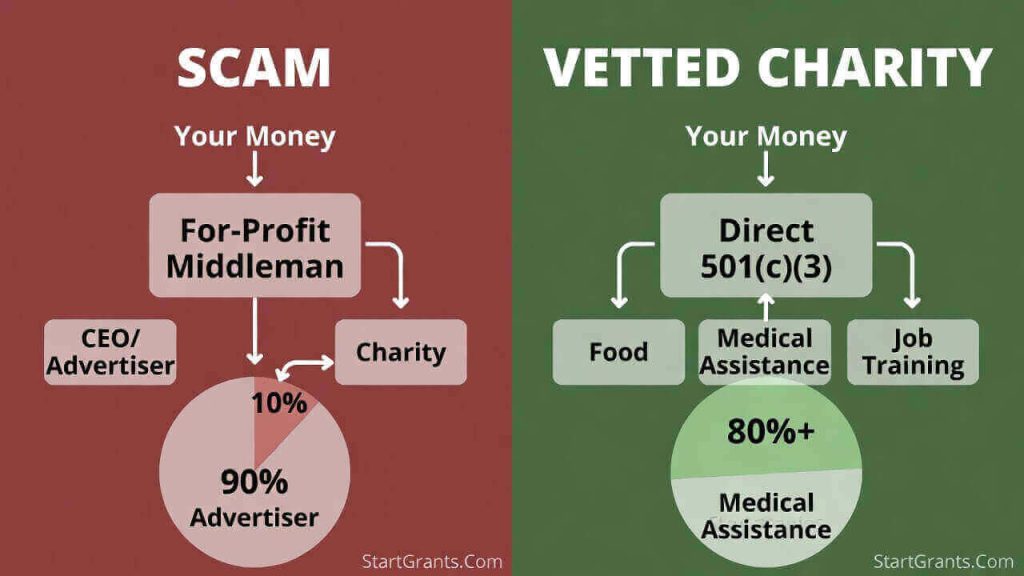
Verify the legal charity, processor, and method used to calculate the charity’s proceeds before transferring a vehicle.
A third-party processor is not automatically a scam. However, the FTC and state regulators have pursued deceptive fundraising operations, including a 2025 vehicle-donation case involving alleged false claims about how donated-car proceeds were used. Protect yourself with verifiable questions rather than assumed percentages.
- Start from the charity’s official website and independently confirm the phone number or intake link.
- Check the legal recipient’s eligibility in IRS Tax Exempt Organization Search. A brand name and legal name may differ.
- Ask who pays towing, auction, storage, title, advertising, and processing costs.
- Ask whether the charity receives gross proceeds, net proceeds, a percentage, or a fixed payment.
- Read the privacy notice before submitting a Social Security number or taxpayer identification number. Form 1098-C reporting may require a taxpayer identification number when the claimed vehicle value exceeds $500, but use only the verified program’s secure process.
- Reject pressure to sign incomplete title documents or misstate the donation date, condition, sale price, or intended use.
- Keep screenshots or copies of the program terms that applied when you donated.
Save This Car Donation Checklist
- [ ] I found the donation page through the charity’s official website.
- [ ] I confirmed the legal recipient and its eligibility to receive deductible contributions.
- [ ] I identified the processor, tow operator, and expected method for calculating proceeds.
- [ ] I confirmed that my vehicle, title status, and ZIP code are eligible.
- [ ] I checked my state’s title, plate, transfer-notice, and insurance requirements.
- [ ] I copied the signed title and photographed the VIN, odometer, and vehicle condition.
- [ ] I removed personal documents, toll tags, garage codes, and stored infotainment data.
- [ ] I saved the pickup receipt and state transfer confirmation.
- [ ] I will wait for the required acknowledgment before claiming a deduction and will obtain tax advice if needed.
Donating a Non-Running Car
Some programs accept non-running vehicles, but “any car in any condition” should not be treated as a universal rule. The vehicle may need to be complete, accessible to a tow truck, and economical to collect. Title requirements can also differ by state. Disclose the condition accurately and ask the program to confirm acceptance before arranging pickup.
If your priority is helping someone obtain transportation rather than converting the car into unrestricted charity revenue, first ask whether the organization sells donated vehicles or transfers them through a transportation program. Our guide to charities that assist with car repairs or donated vehicles covers a different search intent and should not be confused with a standard auction-based donation program.
Need Transportation Help Instead of Donating a Car?
A car donation program receives vehicles; it does not normally accept applications from people who need a free car. If you are seeking transportation assistance, use resources designed for applicants:
- Free and low-cost car resources for low-income families explains how nonprofit vehicle-placement programs may work and why availability is local.
- What “free car from the government” claims really mean separates direct government benefits from nonprofit or local transportation help.
- Gas-card assistance for low-income households focuses on fuel help rather than vehicle ownership.
Keeping these intents separate protects readers from assuming that donating to a charity creates a waiting-list right to receive a vehicle, or that a vehicle-donation processor administers a government benefit.
A Muslim Perspective: Donating a Vehicle Responsibly
A vehicle donation may be intended as voluntary charity (sadaqah), but its religious treatment depends on ownership, donor intent, the recipient, and the actual transaction. Do not assume that every tax-exempt vehicle donation automatically qualifies as zakat or that every processor is itself an eligible charitable recipient.
- Ownership and liens: An active lien means another party has a legal interest in the vehicle. Donating the car does not erase the debt or the lender’s rights. Obtain an accurate payoff and title release before transfer, and seek advice if the financing arrangement raises riba concerns.
- Transparency: Ask which charity benefits and how fees reduce the proceeds. This helps limit avoidable uncertainty and supports an informed charitable intention.
- Use of funds: Review the recipient’s mission and the program funded by the sale. A nonprofit tax classification alone does not answer every Islamic-law question about the use of a gift.
- Tax deductions: A charitable deduction reduces taxable income under tax law; it is not itself a loan or interest payment. Whether claiming it affects a donor’s religious intention is a personal jurisprudential question, not something this article can decide.
- Zakat versus sadaqah: If you intend the vehicle or proceeds as zakat, verify recipient eligibility, agency arrangements, valuation, and transfer with a qualified Islamic finance scholar. A general car-donation sale may be better treated as voluntary charity unless competent guidance supports otherwise.
Review the actual title, lien, processor, and donation terms. For legal, tax, and religious questions, consult the appropriate attorney, tax professional, and qualified Islamic finance scholar rather than relying on a general web article as a ruling.
Conclusion
The strongest car donation choice is the one you can verify from end to end. Confirm the legal charity, identify any processor, ask how the beneficiary is paid, follow state title rules, and keep the documents needed for your tax return. Goodwill, The Salvation Army, participating Make-A-Wish chapters, the Purple Heart Foundation, and KQED all maintain official donation information, but their coverage, acceptance rules, and processing arrangements are not identical.
Compare donating with selling or trading the vehicle and then donating cash. A direct sale may produce more money for the cause, while a vehicle program may be more convenient. The better route depends on the vehicle, the costs, your tax situation, and how much value ultimately reaches the mission you want to support.
Frequently Asked Questions
What is the best charity to donate a car to?
There is no official best charity for every donor. Choose a qualified organization whose mission you support, verify any vehicle processor, ask how the charity is paid, and confirm that the program accepts your vehicle and location.
Is a car donation the same as giving a car to a family?
No. Many vehicle donation programs sell donated cars and use the proceeds for the charity’s work. A direct vehicle-placement program is different and should expressly state that it gives or sells vehicles below market value to eligible recipients.
Can I deduct the full market value of my donated car?
Not automatically. If the charity sells a vehicle valued above $500, the deduction is generally limited to the smaller of its fair market value or the gross sale proceeds unless a qualifying IRS exception applies.
Do I need to itemize to deduct a donated vehicle?
Generally, yes. A donated vehicle is a noncash charitable contribution, and an individual generally claims it as an itemized deduction on Schedule A, subject to eligibility, substantiation, and deduction limits.
When should I receive Form 1098-C?
For a claimed vehicle value over $500, a charity may use Form 1098-C as the required acknowledgment. It is generally due within 30 days after a sale or within 30 days after the contribution when a qualifying use or transfer exception applies.
Can I donate a car without a title?
Possibly, but the answer depends on state law and the program. Contact the verified charity before pickup and ask your state motor vehicle agency what replacement-title or ownership documents are required.
Can I donate a non-running car?
Some programs accept non-running vehicles if they are complete, accessible, towable, and economical to collect. Acceptance is not guaranteed, so disclose the condition and obtain confirmation before transferring the title.
Is towing always free?
No universal rule guarantees free towing. Several established programs advertise no-cost pickup for accepted vehicles, but coverage and acceptance can depend on location, condition, access, and expected vehicle value.
Should I remove the license plates before pickup?
Follow your state’s motor vehicle rules. The IRS donor guide recommends removing plates unless state law requires otherwise, so do not rely on a one-size-fits-all instruction.
How can I tell whether a car donation request is legitimate?
Start from the charity’s official website, verify the legal recipient in IRS records, identify the processor, ask how proceeds are calculated, read the privacy terms, and refuse pressure to sign an incomplete title or provide false information.
Important disclaimer: StartGrants.com is an independent information portal. It is not a government agency, charity, vehicle-donation processor, towing company, application administrator, lender, law firm, tax adviser, motor vehicle agency, or religious authority. StartGrants.com does not accept vehicles, arrange towing, issue tax acknowledgments, provide transportation benefits, or offer legal advice, tax advice, or fatwas. Charity status, vehicle acceptance, service areas, processor relationships, tax rules, and title requirements can change. Verify every donation with the named charity, the IRS, and your state motor vehicle agency, and seek qualified professional guidance for your circumstances.