
Last Updated: | Author: Munir Ardi
Help paying for a doula or midwife usually comes through health coverage, a community program, a sliding-fee arrangement, or charitable assistance—not a cash grant paid directly to the family. Medicaid includes nurse-midwife services as a mandatory benefit, while doula coverage depends on the state, health plan, provider enrollment, and service rules. A grant-funded organization may provide the service free or at reduced cost without giving the client unrestricted grant money.
Before choosing a provider, confirm in writing whether the service is covered, whether both the provider and planned birth facility are in network, what visits are included, and whether a referral or prior authorization is required. For assistance with infant supplies and broader family benefits, use our free baby stuff for low-income families guide.
Doula vs. Midwife: Why the Difference Matters for Payment
| Provider | Usual role | How payment may work | What to verify |
|---|---|---|---|
| Certified Nurse-Midwife (CNM) | Provides clinical reproductive, pregnancy, birth, postpartum, and other authorized care within state law. | Nurse-midwife services are a mandatory Medicaid benefit. Private-plan coverage depends on plan terms. | License, certification, network, facility, referral, authorization, and cost sharing. |
| Certified Midwife (CM) | Has graduate-level midwifery education and national certification but is not a registered nurse. | Recognition, licensure, Medicaid enrollment, and private coverage are limited by state and plan rules. | Whether the state licenses CMs and whether the exact plan covers the provider. |
| Certified Professional Midwife (CPM) | Commonly provides care in community birth settings, subject to state law and individual qualifications. | Coverage is not the same as the federal nurse-midwife benefit and varies substantially. | State license, Medicaid or insurer enrollment, birth setting, supplies, and transfer-related costs. |
| Birth doula | Offers nonclinical support during pregnancy, labor, and the immediate birth period. | A state Medicaid program, managed-care plan, employer benefit, community program, sliding fee, or self-payment may apply. | Covered visits, provider directory, hospital access, backup, and reimbursement process. |
| Postpartum doula | Provides nonclinical support with adjustment, routines, feeding support, and infant-care education after birth. | Coverage is less uniform and may be limited to a defined postpartum period or number of visits. | Scope, covered dates, hours, overnight care, cancellation rules, and services excluded. |
Credentials do not create identical practice rights nationwide. Verify the provider through the applicable state licensing agency and confirm coverage with the health plan before paying a deposit.
The American College of Nurse-Midwives explains that CNMs and CMs complete graduate-level accredited midwifery education and pass a national certification examination. The American Midwifery Certification Board consumer directory can verify current CNM or CM certification. Certification and state licensure are separate; state licensure provides the legal authority to practice.
Does Medicaid Pay for a Midwife?
Federal Medicaid rules list nurse-midwife services as a mandatory Medicaid benefit. Freestanding birth center services are also mandatory when the center is licensed or otherwise recognized by the state. The official CMS mandatory and optional Medicaid benefits page identifies both categories.
This does not mean Medicaid will automatically pay every midwife, every service, or every planned birth setting. The provider may need an active state license, Medicaid enrollment, and a contract with the member’s managed-care plan. A state may not license or recognize the proposed facility or provider credential. Network, medical-necessity, referral, authorization, and billing rules may still apply.
Call the member-services number on the Medicaid card and ask:
- Is this specific midwife enrolled with Medicaid and in my managed-care network?
- Is the planned hospital, freestanding birth center, or home-birth setting covered?
- Which prenatal, delivery, postpartum, laboratory, imaging, and newborn services are included?
- Do I need a referral or prior authorization?
- Will the practitioner and facility submit separate claims?
- What costs could arise if clinical needs require transfer to a hospital or another practitioner?
If you need state contact information, use the official Medicaid and CHIP contact directory. Ask for a written benefit explanation or a link to the current member handbook.
A midwife’s professional fee may be only one part of the total bill. Facility, laboratory, imaging, anesthesia, pharmacy, newborn, ambulance, and consulting-clinician charges can be separate. If a balance remains, follow the steps in our guide to help paying hospital bills after childbirth.

Does Medicaid Pay for a Doula?
There is no single nationwide Medicaid doula benefit. CMS recognizes that states may choose to cover doula services, but states are not uniformly required to do so. Coverage can be added through different legal and payment pathways, and state programs continue to change. Some use fee-for-service Medicaid, managed-care plans, or both.
Even where a doula benefit exists, the doula may have to complete state-approved training, meet credential or background-check requirements, enroll as a Medicaid provider, or contract with the member’s plan. The benefit may specify a limited number of prenatal and postpartum visits, one labor-and-delivery episode, reimbursement rates, documentation, and the period when services must occur.
The NASHP Medicaid doula policy tracker is a useful starting point, but the state Medicaid agency and the member’s health plan remain the controlling sources for current coverage.
What to Ask the Medicaid Plan
- Is birth doula care, postpartum doula care, or both covered under my exact plan?
- How many prenatal, labor, and postpartum visits or hours are included?
- Must I choose from a provider directory, and can you send the current list?
- Does the doula bill the plan directly, or can the member request reimbursement?
- Is a referral, authorization, or risk assessment required?
- Does coverage change if I change plans, move, deliver early, or use a different facility?
Record the representative’s name, date, and call-reference number. Then ask the doula to confirm participation with the exact managed-care plan—not merely “Medicaid.”
Where to Find Free or Reduced-Cost Doula Services
Organizations may receive grants to operate doula programs, train doulas, or serve a particular community. That funding usually pays for services rather than creating cash awards for individual applicants. Enrollment can be limited by service area, pregnancy stage, program capacity, health plan, income, age, clinical or social risk, or the requirements of the funding source.
| Starting point | What it may provide | What to confirm |
|---|---|---|
| State Medicaid agency or managed-care plan | Covered doula visits or enrolled nurse-midwife care | Provider directory, authorization, visits, dates, setting, and billing |
| Healthy Start project | Care coordination and locally available pregnancy or postpartum support, which may include doulas | Service area, enrollment, pregnancy stage, and current doula capacity |
| HRSA-funded health center | Prenatal care, midwifery at some sites, sliding-fee discounts, or referrals | Services at the specific site, income documents, insurance, and referral process |
| Hospital or birth center | Volunteer birth companion, staff doula, financial assistance, or payment plan | Availability, support-person rules, provider privileges, and separate charges |
| Community doula organization | Free, grant-funded, culturally responsive, or reduced-fee support | ZIP code, funding status, enrollment deadline, facility access, and backup |
| Independent provider or trainee | Sliding fees, installments, limited pro bono slots, or lower trainee rates | Training, supervision, experience, total price, refund terms, and scope |
Local programs and available spaces can change quickly. Contact the provider before submitting documents or traveling.
Healthy Start Projects
HRSA funds local Healthy Start projects to improve health outcomes before, during, and after pregnancy in communities experiencing high rates of infant death and related disparities. Services are locally designed. Some projects provide or coordinate community-based doula care, but this is not a promise that every Healthy Start participant receives a doula. Use the official HRSA Healthy Start page to identify a nearby project and ask about current enrollment and doula availability.
HRSA-Funded Health Centers
Health centers offer services regardless of ability to pay and maintain sliding-fee discount programs based primarily on income and family size. Not every location provides obstetric care, midwifery, or doulas. Search the official Find a Health Center directory, then call the specific site to confirm prenatal services, providers, fees, documents, and referral arrangements.
Community Programs, Hospitals, and Training Organizations
Search for “community doula program” with your city, county, or state. Ask the local health department, prenatal clinic, hospital social worker, Medicaid plan, and maternal-health coalition for current referrals. Hospitals may offer volunteer doulas, staff doulas, community-benefit assistance, or referral lists, but these are local services rather than universal hospital benefits.
Some independent doulas offer a sliding fee or installments. Trainees may charge less while gaining experience, but training programs do not universally require free births. Ask what supervision, backup, travel, cancellation, privacy, and refund terms apply.
What About Postpartum Doula Care?
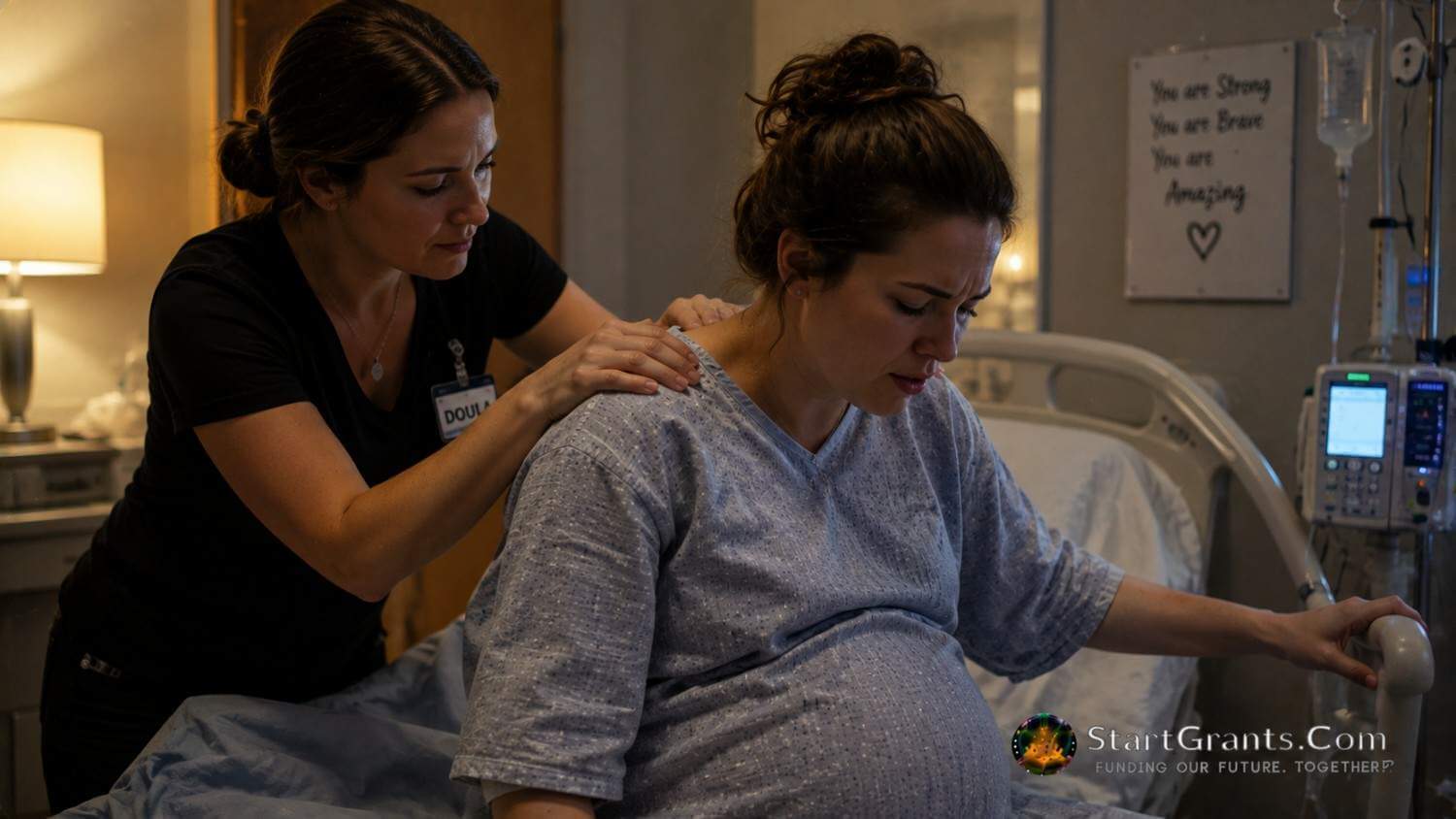
A postpartum doula may provide nonclinical support with household adjustment, infant-care education, feeding routines, and recovery planning. The doula does not replace a nurse, certified lactation professional, mental-health clinician, pediatrician, or emergency care.
Some Medicaid doula benefits include postpartum visits, but the number of visits and covered period vary. Ask whether postpartum support is part of the benefit, whether prenatal and postpartum visits are separately limited, and whether the same enrolled doula must provide them. For other recovery needs, see our postpartum care financial assistance guide. Medicaid members who need feeding equipment can also review how to request a breast pump through Medicaid.
Seek urgent medical care for heavy bleeding, chest pain, trouble breathing, seizures, loss of consciousness, thoughts of harming yourself or the baby, or another emergency symptom. A doula should not evaluate or manage a medical emergency.
Before You Sign a Doula or Midwife Contract
- Verify credentials and legal authority: Check the state licensing agency for a midwife. For a doula, verify training or certification claims, experience, references, and any Medicaid enrollment required for coverage.
- Confirm the birth setting: Ask whether the provider has privileges, contractual access, or permission to work at the planned hospital or birth center.
- Get the entire price: Identify deposits, visit fees, travel, supplies, on-call time, facility charges, laboratory services, and expenses that are billed separately.
- Understand insurance billing: Determine who submits claims, whether balance billing is possible, and what happens if coverage is denied.
- Discuss backup: The agreement should explain who responds if the provider is ill, unavailable, or attending another birth.
- Plan for changes: Ask how the contract handles early delivery, induction, cesarean birth, pregnancy loss, relocation, changed medical needs, or hospital transfer.
- Review cancellation and refund terms: Do not rely on verbal assurances about a nonrefundable retainer or unused visits.
- Protect privacy: Ask before agreeing to photographs, testimonials, social-media posts, trainee observation, or sharing information with another organization.
Paying Safely When Insurance Does Not Cover the Service
Ask first about sliding fees, charity care, grant-funded slots, installments paid directly to the provider, or a written no-interest plan. A medical credit card or general financing product may include interest, deferred-interest provisions, fees, or collection consequences. Read the complete agreement rather than relying on a promotional description.
Do not assume a doula fee is automatically reimbursable from an HSA or FSA. Those accounts generally reimburse qualified medical expenses under federal tax rules, while a doula contract may combine medical-care-related and general support services. Ask the plan administrator for a written determination before paying and keep an itemized contract and receipt. IRS Publication 969 explains the general HSA and FSA rules.
Save This Doula and Midwife Assistance Checklist
[ ] Identify the exact provider credential and check state licensure when applicable.
[ ] Call the health plan and request the current benefit and provider directory.
[ ] Verify both the provider and planned facility or setting.
[ ] Ask about referrals, authorizations, covered visits, and billing procedures.
[ ] Contact Healthy Start, a health center, the local health department, and community doula programs.
[ ] Compare at least two written contracts when possible.
[ ] Confirm backup, transfer, cancellation, privacy, and refund terms.
[ ] Ask for sliding fees, grant-funded openings, or a written no-interest plan before using credit.
[ ] Keep call-reference numbers, benefit documents, contracts, receipts, and denial notices.
A Muslim Perspective
Muslim families may value privacy, modesty, a female care team, language support, and the presence of a spouse or trusted relative. Discuss these preferences early with the midwife, doula, hospital, and insurer. A doula can communicate preferences and support informed questions, but cannot guarantee the sex of emergency staff, override clinical rules, or replace the licensed practitioner responsible for care.
A grant-funded service, charitable discount, zakat or sadaqah payment, or genuine gift normally differs from an interest-bearing loan because the recipient is not borrowing money with an obligation to repay interest. However, a medical credit card or financing contract may contain interest, deferred interest, late fees, or other terms that require careful review. Families who want to avoid riba can first ask for a discount, charitable assistance, an installment arrangement with no interest, or a qard hasan option from a trusted community organization.
A household facing genuine financial hardship may ask a mosque or Muslim charity about zakat, sadaqah, or a general benevolence fund. Eligibility is not automatic, and each organization may require documentation or restrict how funds are used. Describe insurance coverage and other assistance honestly, protect medical privacy, and use restricted funds as an amanah for their stated purpose. StartGrants.com does not issue fatwas; consult a qualified scholar about a specific financing agreement or zakat question.
Frequently Asked Questions
Can a doula deliver my baby?
No. A doula is a nonclinical support professional. A doula does not perform medical examinations, diagnose conditions, prescribe medication, interpret fetal monitoring, or serve as the clinical provider responsible for delivering the baby.
Will my hospital allow a doula?
Many hospitals allow doulas, but support-person limits, check-in procedures, infection-control rules, and credential requirements can vary. Confirm the current labor-and-delivery policy directly with the hospital and ask whether a doula counts toward the patient’s visitor or support-person limit.
Are midwives doctors?
Midwives are not physicians unless they separately hold a medical degree. CNMs are registered nurses with graduate-level midwifery education and national certification. CMs have graduate-level midwifery education and national certification but are not nurses. Other credentials follow different education, certification, and state-licensing pathways.
Does WIC pay for a doula or midwife?
No. WIC provides supplemental foods, nutrition education, breastfeeding support, and referrals; it is not a cash grant for hiring a doula or midwife. A local WIC clinic may refer families to maternal-health services, but availability varies.
What does a sliding-scale fee mean?
A sliding-scale fee means the provider adjusts charges using stated criteria, commonly household income and family size. There is no universal discount. Ask for the written fee schedule, required documents, total amount due, and whether reduced-fee spaces are currently available.
Can I use an HSA or FSA to pay for a doula?
Do not assume the full doula fee qualifies. Reimbursement depends on federal qualified-medical-expense rules, the services documented in the contract, and the plan administrator’s requirements. Request a written determination before paying and keep an itemized contract and receipt.
Can I get a trainee doula for free?
Possibly, but free service is not guaranteed. Training and certification requirements differ, and a trainee may charge a reduced fee, travel expenses, or a regular fee. Ask the training organization about current availability, supervision, backup, scope, and written terms.
What if no doula program has an opening before my due date?
Ask to join cancellation lists, contact additional community programs, and ask the hospital about staff doulas, volunteer birth companions, or virtual prenatal support. Build a support plan with a trusted person and the clinical care team, and do not delay prenatal care while waiting for a doula opening.
Does Medicaid cover a home birth with any midwife?
No. Coverage depends on the state, the provider’s credential and Medicaid enrollment, the member’s plan, the birth setting, and applicable authorization or billing rules. Confirm the exact midwife and setting with the Medicaid plan before relying on coverage.
Bottom Line
Start with the exact service you need rather than searching only for a “grant.” For clinical midwifery care, verify the credential, state license, health-plan network, facility, and authorization rules. For doula care, check the state’s Medicaid benefit and provider directory, then contact Healthy Start, health centers, hospitals, community programs, and independent providers about current free or reduced-fee openings. Get all coverage decisions, prices, and contract terms in writing.
Important Disclaimer: StartGrants.com is an independent information portal. It is not a government agency, health plan, healthcare provider, licensing board, grantmaker, doula or midwifery organization, tax adviser, or religious authority, and it does not award assistance or arrange maternity care. Coverage, licensure, program funding, provider availability, and fees can change. Confirm current information directly with the state agency, health plan, facility, provider, or program. This article provides general information and does not replace individualized medical, insurance, tax, legal, or religious advice.