
Last Updated: | Author: Munir Ardi
There is no single federal grant that automatically pays every applicant to become a solar panel installer. Real funding may be available through the Workforce Innovation and Opportunity Act (WIOA), a paid Registered Apprenticeship, federal student aid at an eligible school and program, an employer, or a local nonprofit training cohort. Each route has its own eligibility rules, covered costs, and approval process.
If you are comparing several occupations, begin with our overview of grants for career training and certifications. It explains why a training program can be eligible for public funding without guaranteeing that a particular student will receive an award.
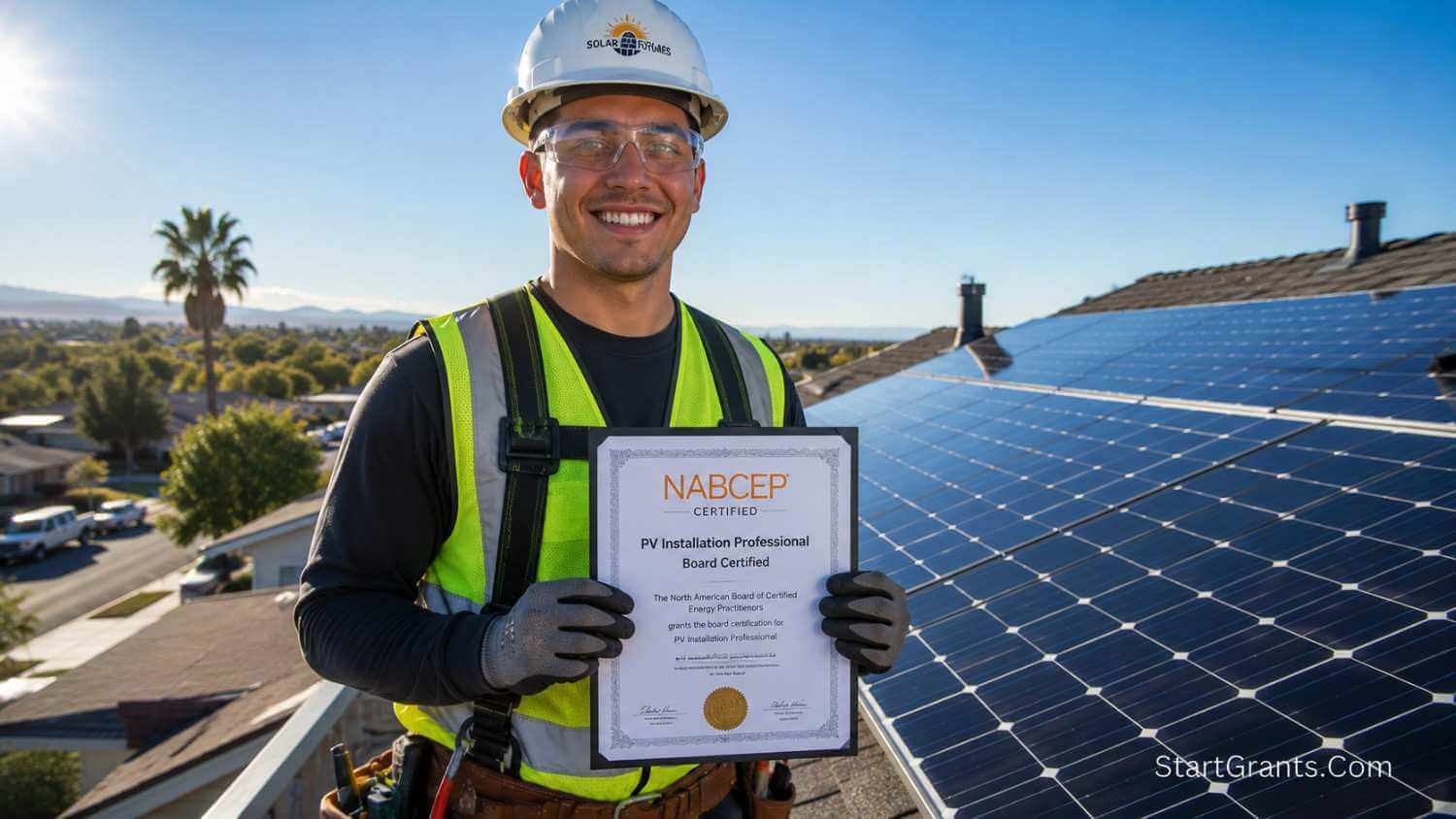
Solar installation training may combine classroom instruction, hands-on practice, safety education, and supervised work. Funding and admission are separate decisions.
What Solar Installation Training Funding Really Means
A solar training advertisement may use the word “grant” loosely. Before applying, identify who receives the money and what the award actually does. WIOA may authorize payment to an approved training provider for an eligible participant. A Registered Apprenticeship is paid employment with structured instruction, not a scholarship. A Pell Grant is student aid for an eligible student attending an eligible institution and program. Employer reimbursement, nonprofit training, and loans operate differently again.
The career itself has several entry routes. The U.S. Bureau of Labor Statistics (BLS) says solar photovoltaic installers typically need a high school diploma or equivalent and receive moderate-term on-the-job training; some take courses at a technical school or community college. The occupation’s national median annual wage was $53,140 in May 2025, and BLS projects employment growth of 37% from 2025 through 2035. Those are national statistics, not a promise of local openings or starting pay. Review the current BLS occupational profile for solar photovoltaic installers and compare it with local job postings.
| Funding route | What it may provide | Important limitation |
|---|---|---|
| WIOA training services | Approved occupational training and, under local policy, possibly necessary supportive services | The applicant, occupation, provider, exact program, and requested costs must satisfy state and local rules; ETPL listing is not an award |
| Registered Apprenticeship | Paid work experience, mentorship, related instruction, and progressive wage increases | Openings are employer- and location-specific, admission is competitive, and not every apprenticeship is solar-only |
| Federal Pell Grant | Need-based federal aid for an eligible undergraduate at an eligible institution and program | A short private course is not automatically eligible; FAFSA completion does not guarantee the maximum award or full cost |
| Employer-funded training | On-the-job instruction, reimbursement, tools, or credential support, depending on the employer | A work commitment, repayment clause, payroll deduction, or continued-employment condition may apply |
| Nonprofit or community training | A cohort, hands-on practice, career preparation, or referral to employers | Service areas, target populations, schedules, capacity, and participant costs vary |
| Loan or payment plan | Borrowed or deferred payment for training costs | This is debt, not a grant; review interest, fees, cancellation terms, and total repayment |
Four Verified Routes to Explore
1. WIOA Adult and Dislocated Worker Training
The U.S. Department of Labor describes WIOA as a system that helps eligible job seekers access employment, education, training, and support services. Decisions are made through state and local workforce systems. Training for eligible adults and dislocated workers is commonly purchased through an Individual Training Account, and states maintain Eligible Training Provider Lists (ETPLs).
Use the official American Job Center Finder to locate the office serving your area. You can also find your state’s directory through CareerOneStop’s WIOA-Eligible Training Program Finder.
An ETPL listing means a program is eligible to be considered for WIOA funding. It does not mean that funding is reserved for you. A local career planner may assess your program eligibility, employment goal, local labor-market demand, other available aid, and whether the requested training is appropriate. Funding limits and supportive-service policies vary by local workforce area.
2. Paid Registered Apprenticeship
A Registered Apprenticeship combines paid on-the-job learning with structured education. Apprenticeship.gov lists electrician among high-demand energy apprenticeship occupations, and electrical apprenticeship can be a route into photovoltaic work. Search the official Apprenticeship Job Finder for current openings and apply to the employer or program sponsor. Confirm whether the work actually includes solar installation, what classroom costs are covered, and which licenses or credentials the program supports.
3. Federal Student Aid at an Eligible School and Program
A student enrolled in an eligible undergraduate certificate or degree program at a participating school may qualify for a Federal Pell Grant after submitting the FAFSA. For the 2026-27 award year, the maximum Pell Grant is $7,395, but an individual’s award depends on eligibility and the school’s calculation. The school and the exact solar, electrical, construction, or renewable-energy program must participate; the school’s general accreditation or a course’s solar theme is not enough. Start with Federal Student Aid’s Pell Grant guidance and ask the financial-aid office to confirm the program’s federal school code and aid eligibility in writing.
4. Nonprofit and Community-Based Training
GRID Alternatives currently describes Installation Basics Training (IBT) as a competency-based program for entry-level solar installation and related construction work. Its curriculum includes safety, construction and electricity basics, array installation, commissioning, operations and maintenance, and employment readiness. GRID also states that it operates several workforce initiatives. Availability is not nationwide at all times, however, so use the organization’s workforce-development page and location finder to check the office, cohort dates, eligibility, attendance requirements, and any participant costs that apply where you live.
Credentials, Safety Cards, and Licenses Are Not Interchangeable
Before paying for a course, identify the credential your target employers actually request and the legal rules in the state where you plan to work.
| Item | What it shows | What it does not prove |
|---|---|---|
| NABCEP PV Associate credential | Fundamental knowledge demonstrated through an approved pathway and examination | It is not a state electrical license or automatic authorization to work independently |
| NABCEP Board Certification | Advanced competence under the specific certification’s experience, training, and examination requirements | It does not replace permits, state or local licensing, or employer requirements |
| OSHA 10- or 30-hour card | Completion of voluntary OSHA Outreach hazard-awareness training | OSHA says Outreach training does not satisfy an employer’s duty to provide training required by specific OSHA standards |
| State or local trade license | Legal authorization defined by the responsible licensing authority | One state’s license does not automatically establish authority in another jurisdiction |
| School certificate of completion | Completion of that provider’s curriculum | It does not guarantee a job, public funding, licensure, or a third-party credential |
NABCEP’s current Associate Program says the PV Associate credential can be earned through an education pathway, an experience pathway, or an older Entry Level conversion pathway, followed by the applicable exam. The April 7, 2026 PV Associate exam update changed content domains. Review the current NABCEP Associate requirements, handbook, and fee schedule before selecting a course.
OSHA states that its Outreach Training Program is voluntary at the federal level, although some states, localities, employers, unions, and other organizations require it. Read the official OSHA Outreach Training Program guidance. For a fuller explanation of cards, course selection, and funding claims, see our article on OSHA 30 training grants and limitations.
BLS notes that PV installers may connect panels to the electrical grid depending on the job and state law, while electricians sometimes perform that work. Ask the state electrical or contractor licensing board and the local permitting authority which tasks require a licensed electrician, apprentice registration, contractor license, supervision, or permit. Do not rely solely on a school’s sales representative.
How to Request WIOA Funding Without Enrolling Too Early
- Contact the correct American Job Center. Ask which office serves your home address and which WIOA Adult, Dislocated Worker, or Youth services may apply.
- Complete the local intake process. Be ready to document identity, authorization to work if requested, employment history, income or dislocation circumstances, and any barriers the program is permitted to consider. Required documents and priority rules differ.
- Define the employment goal. Bring several current solar installer or electrical-helper job postings from commuting distance. Note the licenses, driver’s license, safety training, travel, background screening, and experience employers request.
- Find the exact program on the ETPL. Match the provider, campus, program title, delivery format, and credential. A school may have some eligible programs and other programs that are not eligible.
- Request a complete cost review. Ask whether the proposed award covers tuition, books, personal protective equipment, tools, transportation, childcare, testing, or license fees. Never assume supportive services are automatic.
- Get authorization before committing. Do not pay a nonrefundable deposit or begin classes until the workforce office and school confirm the approval, payment arrangement, start date, and your remaining balance in writing.
If your local solar options are limited, compare another WIOA-eligible occupation before borrowing. Our guides to WIOA funding for CDL training and IT certification funding for unemployed workers explain how the same workforce system can apply different local priorities and provider rules to other career paths.
How to Compare Solar Training Programs
A strong program should help you build employable skills, not merely sell an exam-preparation package. Request written answers to these questions:
- How many hours are live, hands-on instruction rather than recorded video?
- Will students practice fall protection, ladder safety, roof layout, racking, module installation, grounding, wiring concepts, commissioning, and basic troubleshooting?
- Is the course aligned with a named NABCEP pathway, and is the provider listed in the appropriate NABCEP directory?
- Which examination, card, school certificate, or college credit is included?
- Which costs remain: registration, books, tools, personal protective equipment, travel, exams, retests, or renewal?
- Does the program publish completion and employment outcomes for the exact campus and course?
- Which employers hired recent graduates, and what were their actual entry-level job titles?
- What are the refund, withdrawal, attendance, and satisfactory-progress rules?
Save This Solar Training Funding Checklist
- [ ] I found the licensing authority for the state and locality where I plan to work.
- [ ] I collected local job postings and confirmed the credential employers actually request.
- [ ] I verified the exact school, campus, and program on the applicable eligibility list.
- [ ] I obtained a written total-cost breakdown, including tools, safety gear, exams, travel, and retests.
- [ ] I asked whether funding is a grant, direct program payment, reimbursement, wage, scholarship, or loan.
- [ ] I reviewed attendance, withdrawal, repayment, and employer-commitment terms.
- [ ] I did not enroll or pay a nonrefundable deposit before written funding approval.
- [ ] I saved copies of the award notice, school agreement, receipts, and credential requirements.
A Muslim Perspective: Paying for Solar Training Without Riba
For a Muslim applicant, the first step is to classify the funding accurately. A WIOA payment to an approved provider, a scholarship, paid apprenticeship wages, employer-paid instruction, and an interest-bearing student loan are not the same transaction. Nonrepayable assistance may help a student avoid interest-based debt, but no grant should be declared automatically permissible without reading its actual conditions.
Review restrictions on use, attendance and service obligations, reimbursement, tax treatment, publicity, repayment, and clawback. Employer-sponsored training can be useful, but a repayment clause triggered by early departure deserves careful review. A payment plan may also contain interest, late fees, or other terms that raise riba or gharar concerns. Alternatives may include savings, a documented qard hasan from family or community members, an employer-paid apprenticeship, eligible charitable assistance, or a scholarship whose terms are clear.
Solar installation is a form of skilled work, but the permissibility of a person’s income can depend on the actual duties and contracts involved. Sales or finance roles may require separate review if they involve arranging interest-bearing consumer financing. This article does not provide a fatwa. Take the real agreement to a qualified Islamic finance scholar and, where appropriate, an attorney or tax professional who can evaluate your circumstances.
Red Flags and Costly Mistakes
- Guaranteed funding: An ETPL listing, FAFSA submission, or workforce appointment does not guarantee an award.
- Guaranteed employment: Ask for documented outcomes; no legitimate school can promise that every graduate will be hired.
- Credential confusion: A school certificate, OSHA card, NABCEP credential, and state license serve different purposes.
- Paying before approval: WIOA offices may not reimburse costs incurred before authorization.
- Online-only preparation sold as field readiness: Rooftop and electrical work require supervised practical training and employer-specific safety instruction.
- Unclear financing: A deferred-payment agreement, income-share arrangement, or employer training contract is not a grant merely because no payment is due on day one.
- Ignoring physical and travel demands: BLS identifies outdoor work, rooftops, attics, crawl spaces, travel, fall hazards, electrical shock, and hot equipment among the realities of the occupation.
Frequently Asked Questions
Is there a federal grant specifically for every aspiring solar installer?
No. There is no universal federal grant that automatically pays every applicant. WIOA training services, federal student aid, apprenticeships, employer programs, and nonprofit cohorts have separate eligibility and approval rules.
Can WIOA pay for solar panel installation training?
It may. A local workforce agency can approve training for an eligible participant when the occupation, provider, exact program, and proposed costs satisfy its rules and funds are available. Contact the American Job Center serving your address before enrolling.
Does an ETPL listing guarantee that WIOA will pay my tuition?
No. ETPL status makes a program eligible for consideration, but it does not guarantee participant eligibility, local approval, available funds, or payment of every cost.
Do I need a NABCEP credential to begin working as a solar installer?
Not necessarily. Employer expectations and state or local rules vary. The NABCEP PV Associate credential demonstrates foundational knowledge, but it is not a substitute for a legally required electrical or contractor license.
Is OSHA 10 or OSHA 30 a federal license for solar work?
No. OSHA describes Outreach training as voluntary hazard-awareness education, not a license, and says it does not replace training required by specific OSHA standards. A state, locality, employer, union, or project may still require an Outreach card.
Can a Registered Apprenticeship pay me while I train?
Yes. Registered Apprenticeship combines paid work experience, mentorship, related instruction, and progressive wage increases. Openings and entry requirements depend on the employer or program sponsor.
Can a Pell Grant pay for solar installation training?
Possibly, if you are an eligible undergraduate enrolled in an eligible program at a participating institution. A private short course is not automatically eligible, and the financial-aid office must determine your award.
Will training funding cover tools, safety gear, and exam fees?
Sometimes, but never assume it will. Ask for a written cost decision covering tuition, books, tools, personal protective equipment, transportation, childcare, examinations, retests, and license fees before enrolling.
Can someone who is unemployed apply for solar training assistance?
Yes, an unemployed person may seek WIOA or other workforce services, but unemployment alone does not guarantee eligibility or an award. The local workforce agency applies its program rules, priorities, assessments, and funding limits.
Should I enroll in a solar course before WIOA approves it?
No. Ask the workforce office and school for written authorization, covered costs, payment arrangements, and your remaining balance before paying a nonrefundable deposit or starting classes.
Bottom Line
The strongest search strategy is local and document-driven. Start with your American Job Center, your state’s ETPL, current apprenticeship openings, and the financial-aid office of any eligible college or career school. Compare those routes with verified nonprofit cohorts and employer-paid training. Confirm licensing, practical instruction, total costs, and the exact credential before committing. The goal is not simply to find a course labeled “solar,” but to choose an approved, affordable pathway that matches real jobs in your area.
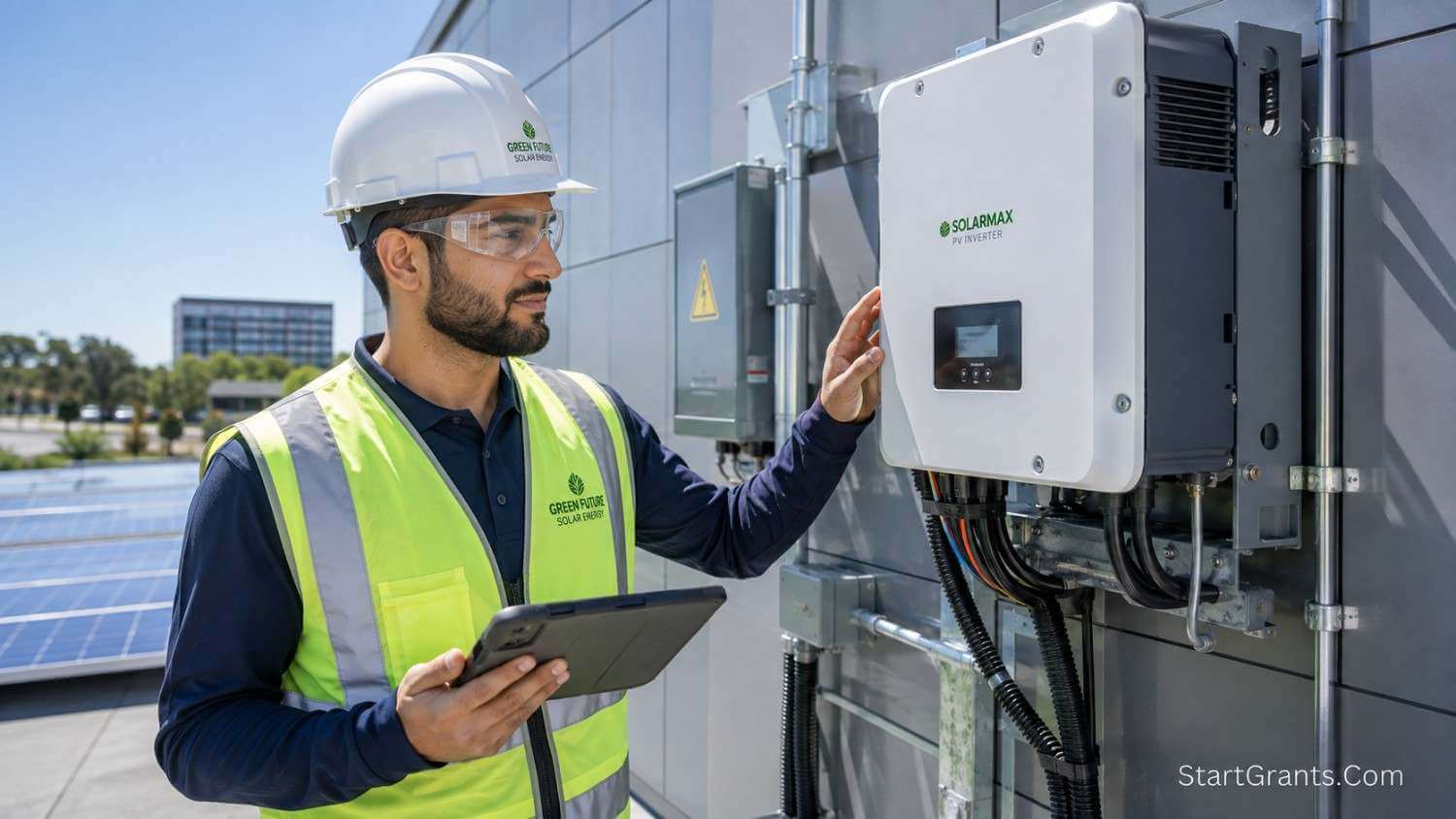
Review the actual duties, safety requirements, training agreement, and financing terms before choosing a solar career pathway.
Important disclaimer: StartGrants.com is an independent information portal. It is not a government agency, grantmaker, application administrator, school, credentialing body, licensing authority, employer, lender, law firm, tax adviser, or religious authority. StartGrants.com does not issue grants, scholarships, student aid, credentials, licenses, jobs, loans, legal advice, tax advice, or fatwas. Program availability, eligibility, funding limits, covered expenses, fees, licensing rules, and terms can change. Verify each opportunity with the responsible workforce agency, school, employer, licensing authority, or sponsor and seek qualified professional guidance for your circumstances.