
Last Updated: August 2026 | Author: Munir Ardi
The digital revolution has created unprecedented opportunities for independence, but for individuals who are blind or visually impaired, this revolution comes with an astronomical price tag. The tools required to navigate modern life, education, and employment—collectively known as assistive technology for the blind—are staggeringly expensive. A standard refreshable Braille display can easily cost $3,000, while AI-powered wearable smart glasses (like the OrCam) can exceed $4,000.
The most shocking reality for families facing a sudden loss of vision is that traditional health insurance (including Medicare) frequently refuses to cover these items, classifying them as “convenience” tools rather than “medical necessities.” When insurance abandons you, you must pivot immediately to the philanthropic and federal grant ecosystem.
Before diving into the highly specific technological pipelines available for the visually impaired, you must understand the broader legal framework of disability funding. Establish your foundational strategy by reviewing our Master Pillar: Disability and Mental Health Grants.

High-end assistive technology, such as refreshable Braille displays and AI smart glasses, can cost thousands of dollars. By navigating federal Vocational Rehabilitation programs, visually impaired individuals can secure these critical tools entirely debt-free.
Phase 1: The Federal Pipeline (AT Act Programs)
If you cannot afford a screen reader or a specialized braille note-taker, your first stop must be the federal government. The Administration for Community Living (ACL) oversees the Assistive Technology (AT) Act. This federal law mandates and funds a specific AT program in all 50 states.
State AT programs operate massive equipment demonstration centers and short-term loan libraries. More importantly, they offer State Financing Activities. While they rarely hand out cash directly, they offer massive subsidies, matched savings programs, and sometimes direct technology grants to ensure low-income individuals can acquire the hardware they need to live independently.
Phase 2: Vocational Rehabilitation (The Employment Hack)
The absolute most powerful mechanism for securing free, high-end assistive technology for the blind is tying the equipment to Employment. The federal government operates the Vocational Rehabilitation (VR) program through state-level Departments of Blind Services.
The mandate of the VR program is to help disabled individuals find, secure, and maintain employment. If you can prove to a state VR counselor that you need a $3,500 BrailleSense device to perform the duties of a new job, or to complete the college degree required for that job, the VR agency will buy the device for you. It is a 100% free grant. You must build a compelling employment plan to unlock this capital. Broaden your understanding of these adult career safety nets by reading: Financial Help for Disabled Adults.
Phase 3: Educational Tech & IEPs (For Children)
If the person requiring assistive technology for the blind is a child, you bypass the employment argument and utilize federal education law. Under the Individuals with Disabilities Education Act (IDEA), public schools are legally mandated to provide a “Free Appropriate Public Education” (FAPE).
If your visually impaired child requires a specialized screen reader (like JAWS) or an iPad with adaptive software to access the curriculum, you must mandate it in their Individualized Education Program (IEP). Once it is written into the IEP, the school district is legally required to purchase the technology for your child using federal and state education grants. Explore more strategies for navigating the pediatric disability ecosystem in our guide: How to Get Government Grants for Disabled Children.
Pro-Tip: Funding the Right Technology
Before you submit a formal request to Vocational Rehabilitation or a private foundation, you must know exactly which devices are actually worth the investment. Submitting a grant request for outdated or ineffective technology will result in an instant denial. To understand the current technological landscape and see a comprehensive ranking of modern devices—from essential screen readers to high-end wearables—watch this expert breakdown: Assistive Technology for the Blind and Visually Impaired | Tier List:
Phase 4: Non-Profit Foundations & Synergy
Because government agencies (like VR programs) can take months to process hardware requests, many individuals turn to agile private foundations.
- The National Federation of the Blind (NFB): The NFB frequently operates programs that distribute free white canes and deeply subsidized technology, such as heavily discounted KNFB Readers or Braille displays, to their members.
- The Lions Club International: Famous for their dedication to sight preservation, local Lions Club chapters operate robust, localized grant funds. If you write a compelling hardship letter to your local chapter president, they frequently cut checks directly to vendors to purchase smart glasses or specialized software for community members in need.
- Sensory Synergy: Many individuals face dual sensory loss (deaf-blindness). Foundations that support the blind often overlap with those supporting the deaf. If you require dual adaptive tech, master the grant landscape of the hearing impaired as well in our guide: Financial Assistance for Hearing Aids.
Phase 5: The Muslim Perspective (Ihsan, MUHSEN, Riba & Zakat)
For a Muslim navigating profound vision loss in the United States, acquiring assistive technology is not just about physical independence; it is about maintaining a deep connection to the community, the Qur’an, and spiritual dignity. Islamic jurisprudence (Shariah) offers a profound safety net, while strictly prohibiting the predatory financial traps common in the Western medical system.
The Standard of Ihsan (Excellence in Inclusion)
In Islam, individuals with disabilities hold a position of immense honor. The Prophet Muhammad (?) famously left the administration of Medina in the hands of Abdullah ibn Umm Maktum, a revered companion who was completely blind, explicitly demonstrating that visual impairment does not diminish a person’s capability or leadership. Ensuring that visually impaired Muslims have the tools (assistive tech) to access education, employment, and the Mosque is a communal obligation of Ihsan (excellence).
The Trap of Riba in Tech Financing
Because items like the OrCam or Braille note-takers cost thousands of dollars, medical supply companies aggressively push “CareCredit” or standard high-interest credit cards to finance the devices. If the balance is not paid off immediately, compounding interest triggers.
In Islamic finance, any transaction that mandates the payment of interest is explicitly Riba, which is strictly Haram (forbidden) and eradicates the spiritual Barakah (blessing) from the household’s wealth. A Muslim family must adamantly refuse to finance assistive technology through Riba. This elevates the pursuit of federal and private Grants (Hibah)—which require no repayment—into a religious imperative.
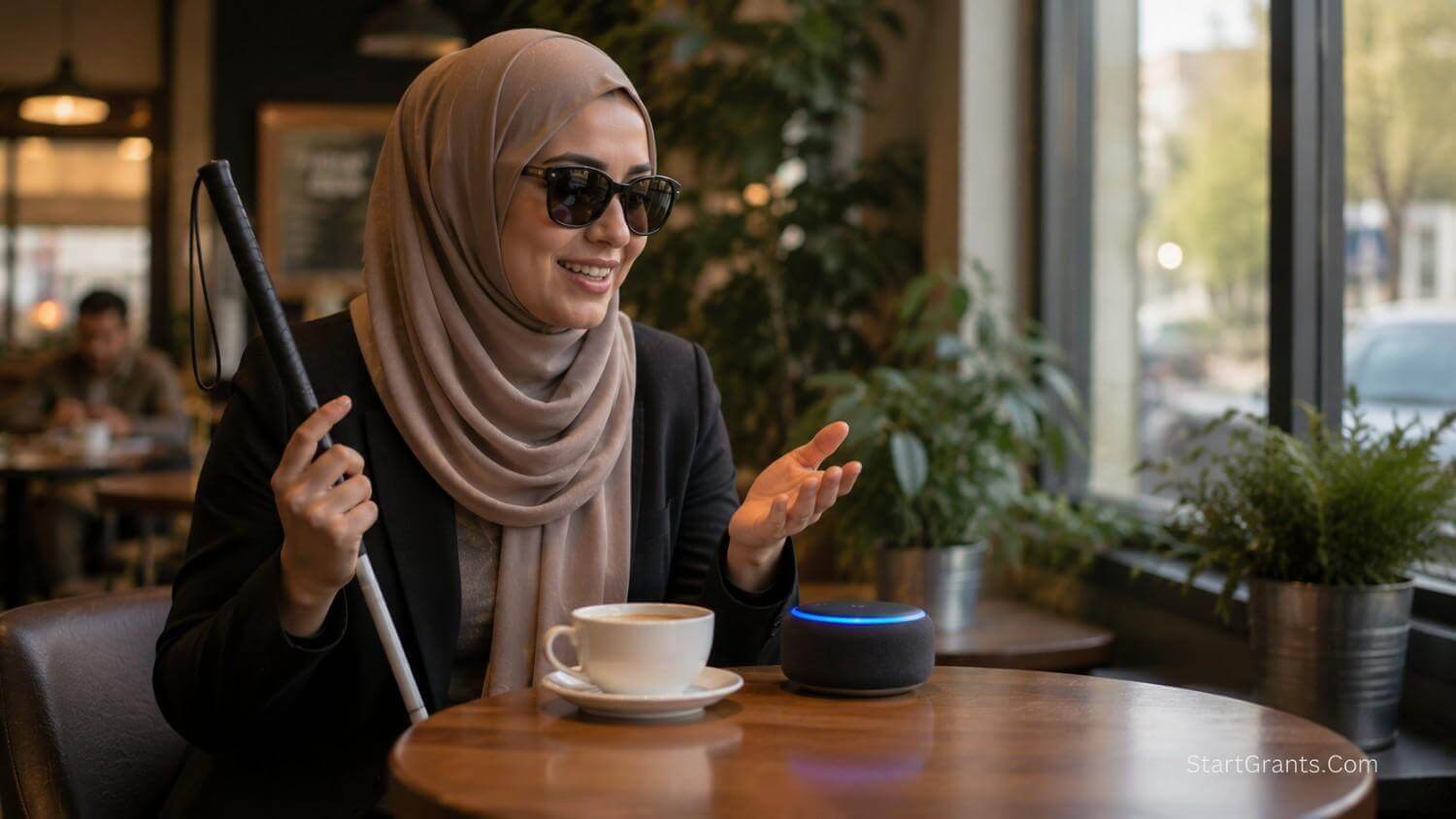
In Islamic tradition, empowering individuals with disabilities is an act of profound Ihsan (excellence). By utilizing Halal grants and Zakat from organizations like MUHSEN, Muslim individuals can acquire necessary assistive technology without resorting to Riba-laced medical credit cards.
MUHSEN: The Islamic Support Network
Historically, the American Muslim community lacked structured support for special needs. Today, organizations like MUHSEN (Muslims Understanding and Helping Special Education Needs) are revolutionizing this space. MUHSEN advocates for accessibility within Masjids, provides targeted grants for special needs equipment, and ensures that visually impaired Muslims are not spiritually isolated. If you are a Muslim struggling to fund adaptive technology, connecting with MUHSEN is a vital strategic and communal step.
Zakat for Assistive Technology
Can obligatory alms (Zakat) be used to buy a $4,000 smart glass device? Yes. If an individual is visually impaired, cannot afford the assistive technology required for their basic daily functioning or employment, and their insurance denies coverage, they fall into the category of Al-Masakin (the needy) or Al-Fuqara (the poor).
It is entirely Halal and highly encouraged for the local Muslim community or Masjid to allocate Zakat funds to purchase these specific technological devices, restoring the individual’s independence without subjecting them to the spiritual ruin of Riba-based commercial debt.
Conclusion
Securing assistive technology for the blind requires outmaneuvering a healthcare system that views essential independence tools as optional conveniences. By leveraging the legal mandates of the State Vocational Rehabilitation programs for employment and the IEP framework for education, visually impaired individuals can force government agencies to absorb the massive hardware costs.
For the Muslim community, funding this technology is the modern manifestation of prophetic inclusion. By fiercely rejecting the predatory trap of Riba-laced medical credit cards, utilizing the power of communal Zakat, and partnering with pioneering organizations like MUHSEN, visually impaired Muslims can secure the tools they need to thrive both economically and spiritually, wrapped in the protective dignity of Islam.
Frequently Asked Questions (FAQs)
Q1: Does Medicare pay for Braille displays or smart glasses?
A: Generally, no. Medicare strictly limits funding to “Durable Medical Equipment” (DME) that is primarily used for a medical purpose. They frequently classify advanced assistive technologies (like screen readers, smart glasses, or Braille note-takers) as “convenience items” or educational tools, and will outright deny coverage, making government and private grants absolutely necessary.
Q2: What is an Assistive Technology (AT) Act Program?
A: Authorized by federal law, every state has an AT Act Program designed to improve access to assistive technology for individuals with disabilities. These programs provide device demonstrations, short-term device loans, and state financing activities (like low-interest loans or matched savings grants) to help you acquire expensive hardware.
Q3: How does Vocational Rehabilitation (VR) pay for blind technology?
A: If you are legally blind and working with a state VR counselor to secure or maintain employment, the VR agency can authorize the purchase of assistive technology (like a JAWS software license or a Braille display) as part of your Individualized Plan for Employment (IPE). It is considered an investment to keep you in the workforce and does not have to be repaid.
Q4: Why is it Haram to use a medical credit card like CareCredit to buy assistive tech?
A: Medical credit cards offer promotional periods, but if the balance is not paid off completely in time, they retroactively apply massive compounding interest. In Islamic jurisprudence, signing any contract that includes a clause for paying interest is classified as Riba, which is strictly forbidden (Haram). Muslim families must seek Halal alternatives like Hibah (grants) or Zakat.
Q5: Can Zakat be used to buy technology for a disabled person?
A: Yes. If a visually impaired person lacks the financial means to purchase the assistive technology required for their basic independence, education, or employment, they meet the Fiqh criteria of the needy (Al-Masakin). The community is legally permitted and encouraged to use Zakat funds to purchase these life-changing devices on their behalf.
Disclaimer: The information provided in this article is for educational and informational purposes only. We are not a medical billing agency, a federal Vocational Rehabilitation office, or a religious fatwa council. Medicare policies, IDEA education laws, and VR grant availability are subject to constant legislative changes. Always consult with your state’s Department of Blind Services for VR eligibility, a special education advocate for IEP requests, and a qualified Islamic finance scholar regarding Halal medical financing, Riba avoidance, and specific Zakat disbursements for medical technology.