
Last Updated: July 2026 | Author: Munir Ardi
The Muslim philanthropic sector in the United States faces a fascinating and deeply frustrating paradox. During the month of Ramadan, an American Mosque or Islamic charity can easily raise hundreds of thousands of dollars in a single night to feed refugees or build water wells overseas. Yet, that exact same organization will struggle for months to raise a mere $10,000 to pay a professional youth director’s salary, upgrade their vulnerable cybersecurity software, or fix a leaking roof.
This happens because the vast majority of Muslim giving is restricted by theological law (Zakat) to direct poverty relief. Donors want to buy food, not fund administrative overhead. This leaves Muslim community centers and allied nonprofits starving for operational capital, leading to high staff burnout and disorganized leadership.
This critical gap is exactly where private endowments step in. If you are running a community organization, here is how El-Hibri Foundation is great for grant seekers: they do not fund the food pantry; they fund the leaders who run the food pantry. They provide the highly elusive, unrestricted operational capital required to scale your mission.
Before diving into the specific application pipelines of private endowments, you must understand the broader ecosystem of religious and faith-based philanthropy. Anchor your organization’s strategy by reviewing our master pillar: Faith-Based and Religious Donations.
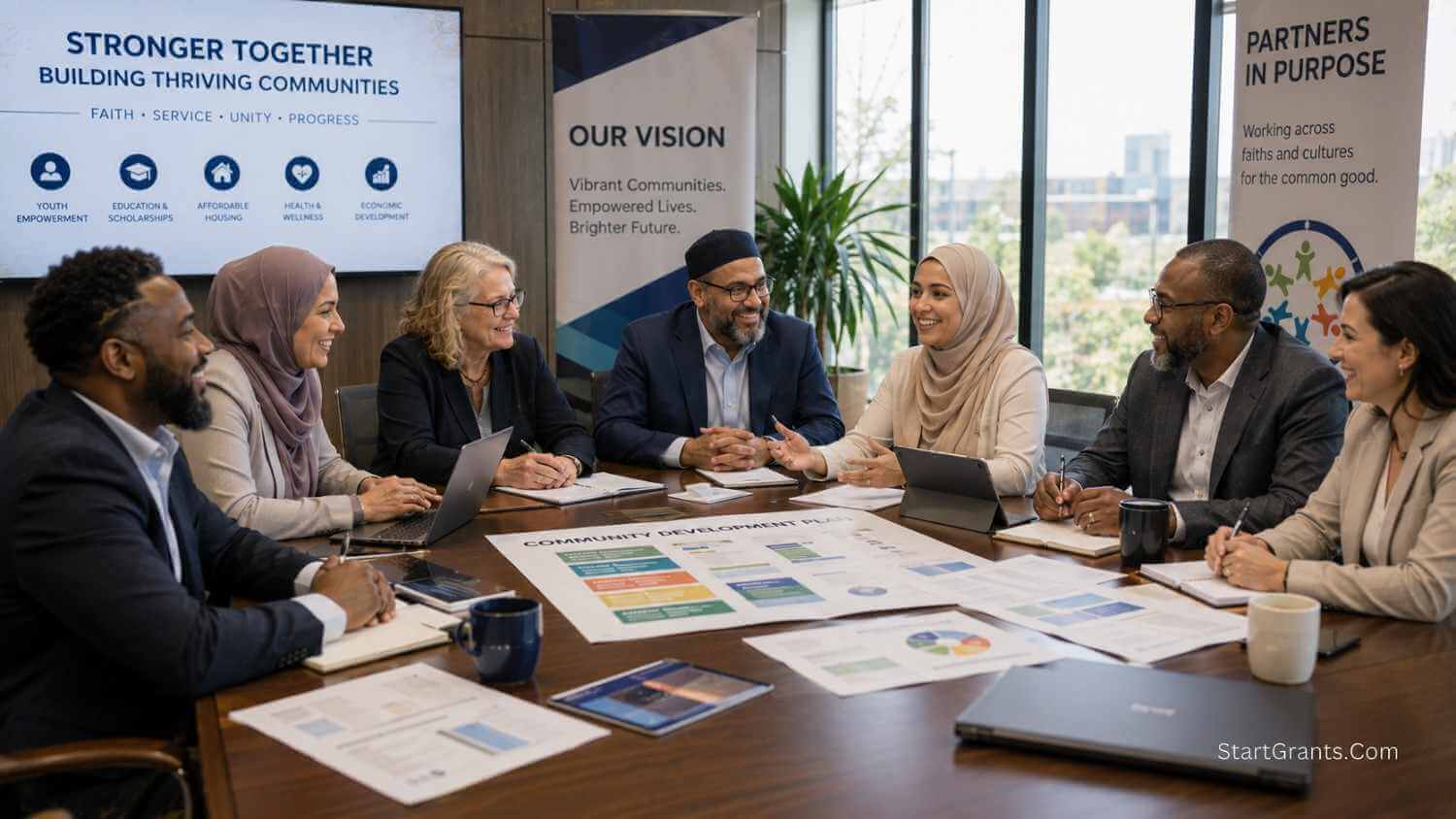
Unlike disaster relief funds, the El-Hibri Foundation focuses on “Capacity Building” and “Advancing Inclusion.” They provide the crucial financial capital needed to train Muslim leaders, modernize organizational infrastructure, and foster interfaith alliances.
Phase 1: What is the El-Hibri Foundation?
The El-Hibri Foundation (EHF) is a private philanthropic endowment based in Washington, D.C. Founded in 2001 by Ibrahim El-Hibri, its mission is fundamentally different from traditional relief NGOs. Their core mandate is to empower Muslim leaders and their allies to build inclusive, socially just, and highly organized communities across the United States.
They operate on the philosophy that a community cannot thrive if its institutions are weak. By issuing highly targeted grants, providing leadership incubators, and recognizing outstanding community service through annual awards, EHF acts as the administrative backbone for the American Muslim nonprofit sector.
Phase 2: The Core Grant Pipelines
To understand why the El-Hibri Foundation is a premier target for grant seekers, you must look at the specific types of funding they offer. They primarily deploy capital through two distinct, highly strategic pipelines:
1. Advancing Inclusion Grants
Islamophobia and bigotry cannot be defeated in isolation. The EHF provides substantial grants to organizations—both Muslim and non-Muslim—that actively foster interfaith collaboration, build alliances across different marginalized communities, and execute campaigns that combat hate and promote social justice. If your community center hosts interfaith dialogues, civic engagement training, or anti-bullying workshops in local schools, this is your primary funding source.
2. Capacity Building Grants (The Holy Grail)
In the nonprofit world, “Capacity Building” is the holy grail of funding. It is money given specifically to improve an organization’s internal operations. EHF awards these grants so your Muslim nonprofit can hire strategic consultants, purchase professional donor-tracking software (CRM), train your board of directors in federal compliance, or send your executive team to leadership retreats. It is the money that transforms a chaotic, volunteer-run charity into a formidable, professional institution.
Pro-Tip: The Philosophy of Funding Leaders
To truly understand why the El-Hibri Foundation is great for grant seekers, you must understand their core philosophy: they invest in human capital. To see how they publicly recognize and fund community organizers who are advancing inclusion, watch this brief video highlighting their commitment to empowering Muslim leadership: Announcing the El-Hibri Foundation Peace Awards:
Phase 3: Synergizing Your NGO’s Portfolio
Elite nonprofit directors never rely on a single source of funding. Here is how the El-Hibri Foundation is great for grant seekers who know how to synergize their capital: you use EHF grants to build your infrastructure, which then allows you to win massive federal and international grants.
- The Relief Synergy: You use an EHF Capacity Building grant to hire a professional, full-time grant writer and upgrade your accounting software. With that new professional infrastructure, your organization is now qualified to handle massive, multi-million dollar food distribution sub-awards. Learn how to secure those specific relief funds in our guide: How to Apply for Grants for Partnership Programs with Islamic Relief USA.
- The Security Synergy: You use EHF Advancing Inclusion grants to build community trust and interfaith programs. Simultaneously, to protect those very community members from hate crimes while they are inside your building, you must target federal infrastructure funds. Master the acquisition of physical security capital by reading: Do Churches Get Government Grants? (FEMA NSGP Guide).
Phase 4: The Bureaucratic Application Process
Private foundations are highly protective of their endowments. EHF will not fund unorganized entities or informal groups of activists. To access their capital, you must pass their bureaucratic shield.
- The 501(c)(3) Mandate: EHF, by law, can only issue grants to organizations that are officially recognized by the IRS as tax-exempt 501(c)(3) public charities (or those operating under a verified fiscal sponsor). If your Mosque or youth group does not have an official IRS Determination Letter, your application will be instantly discarded.
- The Letter of Inquiry (LOI): You do not submit a 50-page proposal on day one. EHF typically utilizes a two-step process. First, you submit a brief Letter of Inquiry (LOI) outlining your mission and what you intend to do with the money. If the foundation’s board finds your LOI compelling and aligned with their strategic goals, they will invite you to submit a full, comprehensive grant proposal.
Phase 5: The Muslim Perspective (Zakat Mismanagement, Riba, & Gharar)
For Muslim community leaders, understanding the strategic value of the El-Hibri Foundation is intrinsically linked to understanding Islamic financial jurisprudence (Shariah). Operating an Islamic Center or a Muslim NGO in the United States requires navigating complex theological boundaries regarding how money is collected and spent.
The Crisis of Zakat Mismanagement
As mentioned in the introduction, the greatest theological crisis facing American Muslim nonprofits is the misuse of Zakat. The Qur’an (9:60) explicitly restricts the distribution of Zakat to eight specific categories (the Asnaf), primarily the destitute, the poor, and refugees.
It is strictly Haram (forbidden) to use Zakat funds to pay the Mosque’s electricity bill, hire a marketing director, buy new laptops for staff, or host an interfaith dinner. If a nonprofit board uses collected Zakat for administrative overhead, they are committing a severe sin and violating a divine Amanah (trust).
Therefore, securing “Capacity Building” grants from private endowments like EHF is a religious necessity. These grants are classified as Sadaqah Jariyah (continuous charity) or general Hibah (gifts). They provide the Halal, unrestricted capital required to run the organization’s administration, ensuring that the community’s Zakat can be deployed 100% to the poor without administrative deductions.
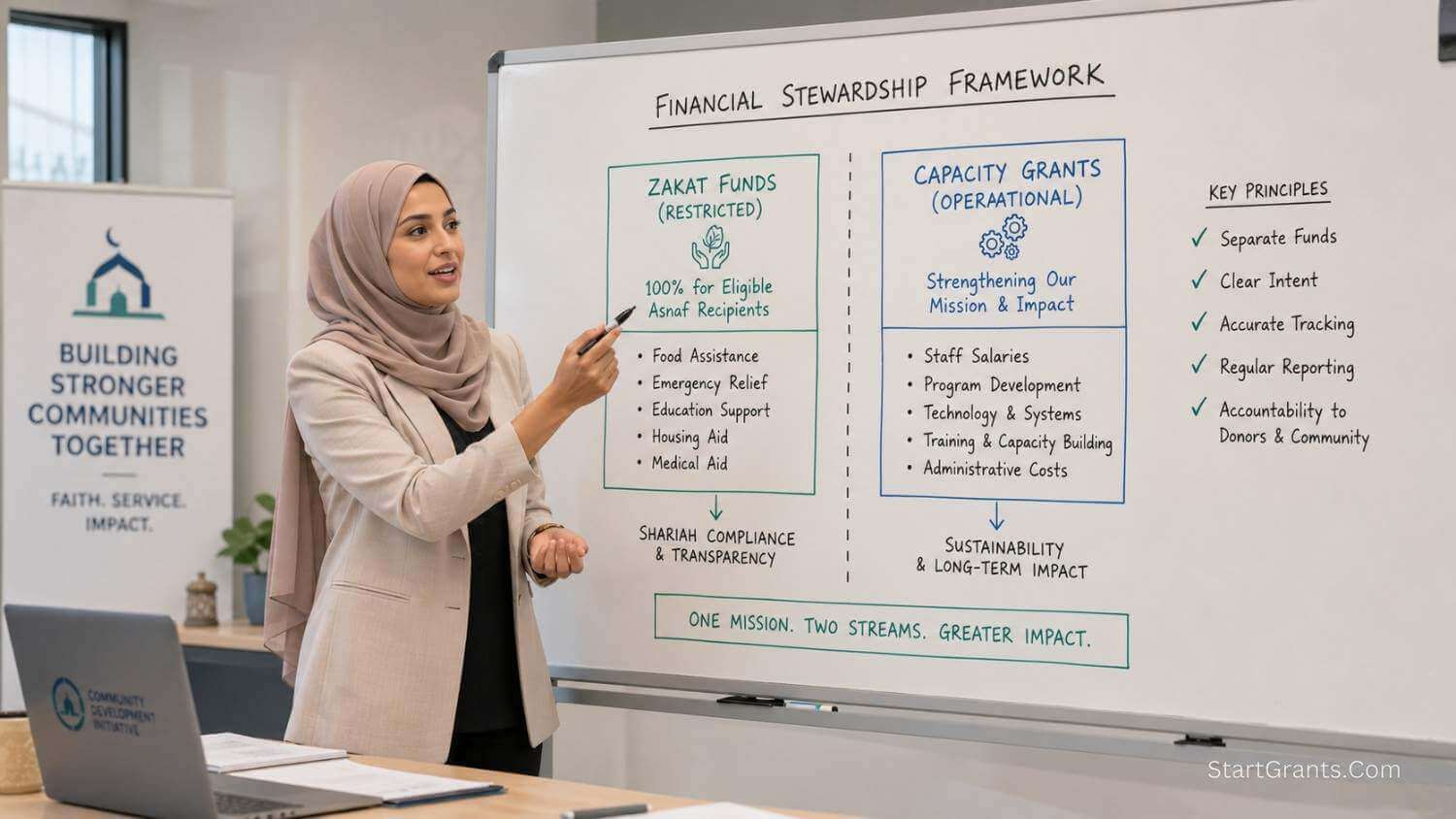
Understanding Islamic finance is critical for Muslim NGOs. Because Zakat funds are strictly restricted to the needy, organizations must secure capacity-building grants (like those from El-Hibri) to legally and ethically fund their operational overhead, staff salaries, and infrastructure without committing a spiritual violation.
Avoiding Riba in Nonprofit Scaling
When an organization scales rapidly and cash flow becomes tight, secular nonprofits often take out “bridge loans” or use corporate credit cards to cover payroll and administrative costs, paying compounding interest in the process.
In Islam, any loan that stipulates the payment of interest is explicitly Riba, which destroys the Barakah (blessing) of the organization. A Muslim nonprofit must absolutely reject interest-bearing debt. By securing a $50,000 capacity-building grant from EHF, the organization injects debt-free, Riba-free capital into its operations, allowing it to hire staff and upgrade infrastructure ethically.
Gharar and D&O Liability Insurance
To win major grants from institutional foundations, your nonprofit must demonstrate elite corporate governance. Often, foundations require the receiving organization to carry Directors and Officers (D&O) Liability Insurance to protect board members from lawsuits regarding mismanagement.
Traditional commercial insurance contains Gharar (excessive uncertainty) and elements of gambling. Ideally, Muslim nonprofits should utilize Takaful (Islamic cooperative insurance). However, because authentic B2B Takaful for executive liability is practically non-existent in the U.S. market, contemporary Islamic scholars widely apply the principle of Dharurah (legal and operational necessity). This permits the Muslim board of directors to purchase the required commercial policy to protect the institution, satisfy grant compliance, and ensure the survival of the community center, provided the intent is purely protection, not speculative profit.
Conclusion
Realizing exactly why and here is how El-Hibri Foundation is great for grant seekers requires a shift in philanthropic mindset. You must stop looking solely for funds to buy food, and start looking for funds to empower your leaders. By securing Advancing Inclusion and Capacity Building grants, your nonprofit can exit the exhausting cycle of “survival mode” and build a professional, highly structured institution capable of executing massive social change.
For the Muslim community leader, securing these private endowments is the ultimate solution to ethical governance. By utilizing EHF’s Halal grants (Hibah) to fund your operational overhead and interfaith initiatives, you fiercely protect the community’s Zakat from administrative misuse, completely avoid the trap of Riba-laced commercial loans, and ensure that your organization scales with absolute spiritual integrity and divine Barakah.
Frequently Asked Questions (FAQs)
Q1: Does the El-Hibri Foundation fund international relief projects?
A: Generally, no. The El-Hibri Foundation primarily focuses its grantmaking on domestically based organizations within the United States. Their core mission is advancing inclusion and building the capacity of American Muslim leaders and their allies, rather than funding international disaster relief or overseas development.
Q2: What is a “Capacity Building” grant?
A: A capacity-building grant is funding specifically designed to improve an organization’s internal operations and long-term sustainability. Instead of funding a specific outward-facing charity event, it pays for things like strategic planning consultants, leadership training for staff, upgrading accounting software, or hiring a new executive director.
Q3: Can individuals apply for grants from the El-Hibri Foundation?
A: No. The El-Hibri Foundation only awards grants to organizations that are officially recognized as tax-exempt 501(c)(3) public charities by the IRS, or organizations that have a formal agreement with a recognized 501(c)(3) fiscal sponsor. They do not give grants to individuals for personal use.
Q4: Why is it Haram for an Islamic Center to use Zakat to pay the Imam’s salary?
A: In Islamic jurisprudence, Zakat is a specific, obligatory tax that is strictly restricted by the Qur’an to eight specific categories (Asnaf), which primarily includes the absolute poor, the destitute, and refugees. An Imam’s salary, marketing expenses, or building maintenance do not fall into these categories. Using Zakat for operational overhead is a severe theological violation. Those expenses must be paid using Sadaqah (voluntary charity) or operational grants.
Q5: Why must a Muslim nonprofit avoid taking a bank loan to cover administrative costs?
A: Commercial bank loans require the borrower to pay back the principal amount plus compounding interest. In Islamic finance, intentionally engaging in a contract that stipulates the payment of interest is classified as Riba, which is strictly forbidden (Haram). Muslim nonprofits must rely on Halal alternatives like government or foundation grants (Hibah) or interest-free loans (Qard Hasan) to avoid spiritual corruption.
Disclaimer: The information provided in this article is for educational and informational purposes only. We are not a representative of the El-Hibri Foundation, a legal firm, or a religious fatwa council. The El-Hibri Foundation’s grant cycles, LOI requirements, and strategic funding priorities are subject to change. Always consult directly with the foundation’s official guidelines before applying, a certified CPA regarding nonprofit tax compliance, and a qualified Islamic finance scholar regarding the strict separation of Zakat funds, avoiding Riba in organizational debt, and D&O insurance mandates via Dharurah.