
Last Updated: July 2026 | Author: Munir Ardi
The philanthropic landscape in the United States is vast, but the distribution of capital is heavily centralized. Massive national non-governmental organizations (NGOs) control tens of millions of dollars in annual budgets. However, these national titans face a critical logistical bottleneck: they have the capital, but they lack the localized, grassroots infrastructure to distribute aid directly into every single neighborhood.
For a local Muslim community center, a small domestic violence shelter, or a neighborhood free clinic, this dynamic presents an incredible financial opportunity. You do not have to raise all your funds from scratch. By learning how to apply for grants for partnership programs with Islamic Relief USA (IRUSA), your grassroots organization can act as the “last mile” distributor for one of the most powerful Islamic charities in the world.
Before diving into the hyper-specific bureaucracy of partnering with national Muslim NGOs, you must understand the foundational legal and structural requirements of faith-based funding. Anchor your organizational strategy by reviewing our master pillar: Faith-Based and Religious Donations.

Islamic Relief USA (IRUSA) relies on partnerships with local grassroots organizations to execute its domestic missions. By securing a partnership grant, local Masjids and clinics can tap into massive national funding.
Phase 1: The Power of Coalition Funding (Sub-Awarding)
To secure partnership funding, you must first understand the strategy of “Sub-Awarding.” Islamic Relief USA operates programs in over 40 countries, but their U.S. Programs Division is uniquely focused on domestic poverty, disaster response, and refugee assistance.
IRUSA does not build brand new food banks in every city. Instead, they identify a high-performing local 501(c)(3) organization (like your local Masjid’s food pantry) and provide them with a Partnership Grant (a sub-award). IRUSA provides the massive cash injection or truckloads of physical food, and your local organization provides the volunteers and the facility to distribute it to the end beneficiaries.
Phase 2: Aligning with IRUSA’s Core Domestic Initiatives
You cannot simply email IRUSA asking for money to fix your mosque’s roof. Their partnership grants are strictly designated for specific, programmatic interventions that align with their national goals. You must tailor your grant proposal to fit one of these three primary silos:
1. Food Insecurity (The Ramadan & Qurbani Peaks)
The largest volume of domestic partnership grants occurs around peak Islamic seasons. IRUSA partners with local organizations to distribute Ramadan food boxes and Udhiyah/Qurbani meat to low-income families across the United States. If your organization wants to execute a massive food drive, you must leverage this seasonal funding. To master the broader strategy of peak-season funding, read our guide on Ramadan Donations USA: Maximizing Community Impact.
2. Refugee Resettlement & Integration
When refugees arrive in the U.S., the federal government provides limited initial support. IRUSA offers grants to local Muslim organizations that provide long-term integration services, such as ESL (English as a Second Language) classes, job placement training, and mental health counseling for traumatized families.
3. Domestic Disaster Response
When hurricanes or tornadoes strike U.S. soil, IRUSA’s Disaster Response Team deploys rapidly. They often issue emergency grants to local Masjids to act as temporary staging grounds or emergency shelters for displaced residents.
Pro-Tip: Understanding IRUSA’s Humanitarian Magnitude
Before drafting your partnership proposal, you must understand the sheer operational scale and philanthropic philosophy of Islamic Relief. They are a global powerhouse that frequently collaborates with massive professional networks, such as APPNA, to execute health and relief missions. To grasp the magnitude of the organization you are pitching to and see their collaborative mission in action, watch this insightful broadcast: Islamic Relief’s | Global Mission To Help Needy Muslims | APPNA | TV One USA:
Phase 3: Synergizing Your Proposal
While an IRUSA grant is incredibly powerful, relying on a single national organization for your local charity’s survival is statistically dangerous. To ensure long-term stability and prove to IRUSA that you are a competent, proactive partner, you must demonstrate “Fundraising Synergy.”
You should actively combine faith-based operational grants with private endowments designed for leadership and diversity. If your organization is promoting youth leadership or interfaith community building alongside your relief work, you must aggressively target alternative Muslim endowments. Expand your funding portfolio by exploring: Here is How El-Hibri Foundation is Great for Grant Seekers.
Phase 4: The Bureaucratic Firewall (501c3 & MOU)
A multi-million dollar NGO like IRUSA is subject to grueling financial audits by the IRS and independent charity watchdogs (like Charity Navigator). They will not risk their impeccable rating by partnering with an unorganized, legally ambiguous local group.
To pass their initial vetting process and receive a grant, your local organization must possess an absolute bureaucratic shield:
- Verified 501(c)(3) Status: You must have an official IRS Determination Letter. Operating informally under the umbrella of a local business will result in immediate disqualification.
- Financial Transparency: You must be prepared to hand over your organization’s recent Form 990s and internal financial statements to prove you are not currently bankrupt or mismanaging funds.
- The Memorandum of Understanding (MOU): If selected, you will be required to sign a strict legal contract (MOU). This document dictates exactly how the grant money can be spent, the mandatory reporting deadlines, and the specific metrics you must track (e.g., exactly how many individuals received a hot meal).
Phase 5: The Muslim Perspective (Amanah, Riba, Gharar, & Zakat Isolation)
For a local Muslim community center or clinic, securing a partnership grant with IRUSA is a moment of triumph. However, executing the terms of the grant introduces severe ethical and spiritual stress tests. Managing hundreds of thousands of dollars in donor funds is a sacred Amanah (trust). The local partner must navigate the execution phase with uncompromising adherence to Islamic financial jurisprudence (Shariah).
The Absolute Separation of Zakat
This is the most critical theological rule of partnership grants. When IRUSA provides a sub-award to your local organization, those funds are strictly categorized. If the grant consists of Zakat funds, your local organization is now acting as an agent (Amil) for that Zakat.
The Qur’an (9:60) mandates that Zakat can only be distributed to eight specific categories (the Asnaf), primarily the extreme poor and destitute. It is strictly Haram to use Zakat-restricted grant money to pay your local organization’s administrative overhead, fix the Masjid’s plumbing, or buy marketing materials. Every single penny of a Zakat grant must go directly to the end beneficiary. Your accounting ledgers must flawlessly isolate Zakat funds from general Sadaqah (voluntary charity) or operational funds. Commingling these accounts is a betrayal of the Amanah.
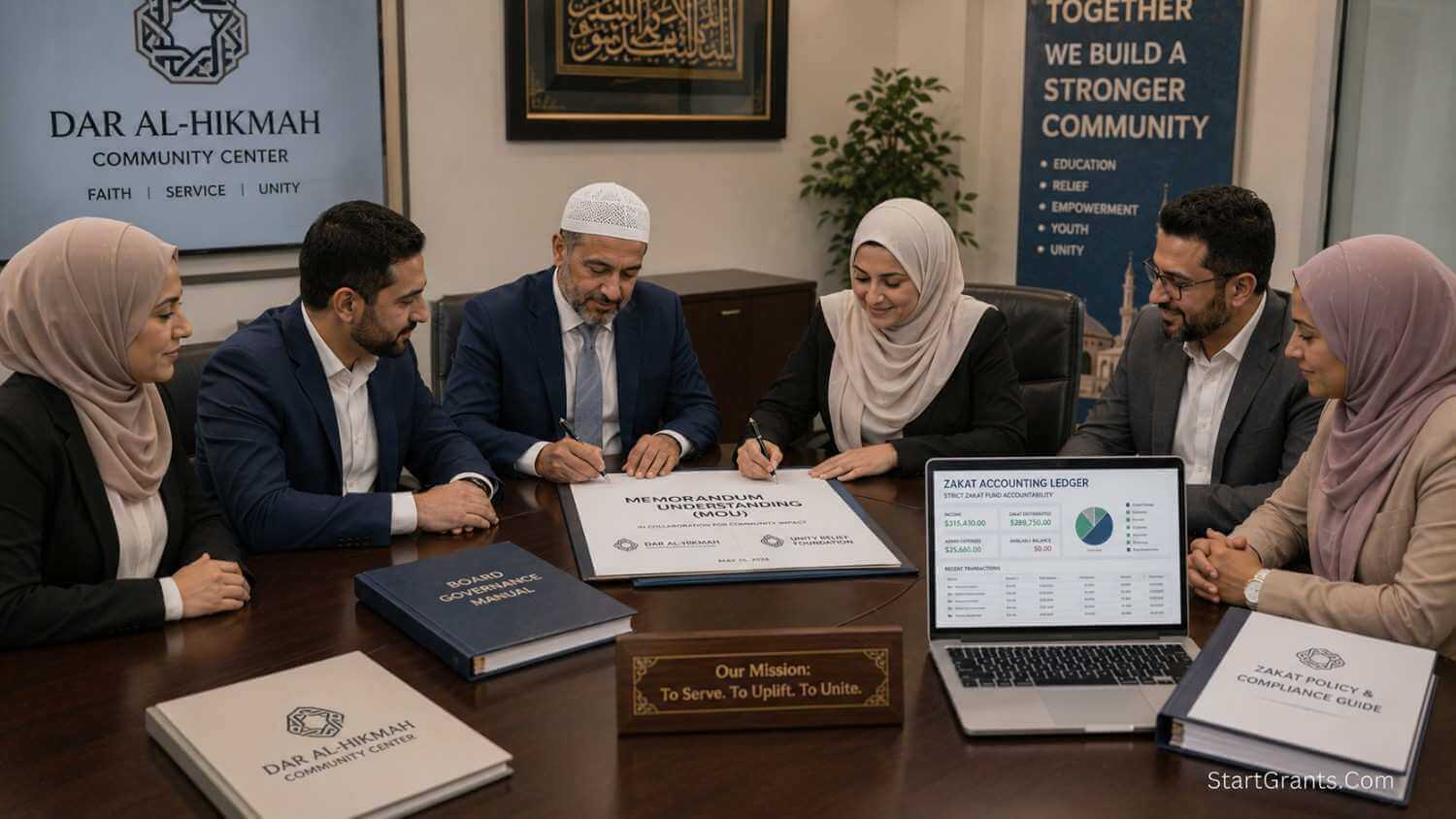
Partnering with a titan like IRUSA requires impeccable Islamic financial ethics. Local partners must meticulously isolate Zakat-restricted grants from general operating funds and avoid Riba-laced logistics debt to maintain absolute spiritual purity.
Avoiding Riba in Logistics and Execution
Running a massive community distribution takes upfront capital. For example, if you partner with IRUSA to distribute 5,000 Ramadan food boxes, your local organization might need to rent forklifts, hire security, or secure a temporary warehouse before the final grant check clears the bank.
To survive this cash-flow gap, secular charities often use high-limit corporate credit cards or commercial bridge loans. In Islam, intentionally taking on debt that stipulates compounding interest is explicitly Riba, which is strictly forbidden and destroys the Barakah of the charity event. A Muslim organization must adamantly refuse these loans. You must float operational costs using internal cash reserves or secure Qard Hasan (zero-interest benevolent loans) from trusted community board members.
Gharar and Commercial General Liability Insurance
To protect their national brand from catastrophic lawsuits, IRUSA (and virtually all major national NGOs) will legally mandate in the MOU that your local organization carries extensive Commercial General Liability Insurance. If someone gets food poisoning at your food pantry, or a volunteer is injured unloading a truck, the insurance protects both entities.
Traditional commercial insurance contains Gharar (excessive uncertainty) and elements of gambling. Ideally, Islamic charities should utilize Takaful (Islamic cooperative B2B insurance). Because genuine commercial Takaful is practically non-existent in the U.S. nonprofit sector, contemporary Islamic scholars universally apply the principle of Dharurah (legal and operational necessity). This permits the local Masjid or clinic to purchase the required commercial policy to satisfy the MOU and protect the community from ruinous lawsuits, provided the intent is strictly legal compliance and protection, not speculative profit.
Conclusion
Learning how to apply for grants for partnership programs with Islamic Relief USA requires a shift from a solitary mindset to a coalition strategy. By proving your local organization possesses a pristine 501(c)(3) legal structure, a transparent accounting system, and the grassroots volunteer force necessary to execute the mission, you become an invaluable asset to national NGOs seeking local distribution.
For the Muslim community leader, executing this partnership is the ultimate test of administrative and spiritual discipline. By fiercely isolating Zakat funds to protect their theological validity, rejecting Riba-laced bridge loans during the logistics phase, and navigating insurance mandates through Dharurah, your local organization ensures that the massive influx of national capital translates into pure, uncompromised blessings for your community.
Frequently Asked Questions (FAQs)
Q1: Does Islamic Relief USA give grants to individuals?
A: Generally, no. IRUSA primarily provides grants (sub-awards) to registered 501(c)(3) nonprofit organizations, Masjids, and established community clinics that have the infrastructure to distribute aid to a large number of individuals. If an individual needs personal emergency help, they are usually directed to contact one of IRUSA’s local partner organizations.
Q2: What is an MOU in a partnership grant?
A: A Memorandum of Understanding (MOU) is a formal, legally binding document between the national NGO (like IRUSA) and the local partner. It outlines the exact terms of the partnership, including how much money will be provided, the specific demographic that must be served, and the strict reporting deadlines the local partner must meet to prove the funds were used correctly.
Q3: Why must Zakat grant funds be isolated in a nonprofit’s accounting?
A: In Islamic jurisprudence, Zakat is a divine obligation restricted solely to eight specific categories (Asnaf), primarily the poor and needy. It cannot be used for general operations, building repairs, or marketing. If a local charity receives a Zakat-restricted grant, they must isolate the funds in their accounting to guarantee 100% of that money reaches the eligible beneficiaries, fulfilling the theological Amanah (trust).
Q4: Can a local Masjid use a credit card to pay for the logistics of a grant distribution?
A: A Masjid can use a corporate credit card only if the balance is paid off in full by the due date, incurring zero interest. If the balance carries over and accumulates compounding interest, the organization is engaging in Riba, which is strictly Haram (forbidden) in Islam. Organizations must avoid interest-bearing debt at all costs.
Q5: Is it Halal for an Islamic charity to buy Commercial Liability Insurance to satisfy a grant contract?
A: Traditional insurance contains Gharar (uncertainty) and is generally problematic in Shariah. However, because failing to have liability insurance exposes the charity to ruinous lawsuits and breaches the mandatory terms of national partnership grants, Islamic scholars generally permit purchasing the required commercial policy under the principle of Dharurah (legal necessity), due to the lack of available Takaful alternatives in the U.S.
Disclaimer: The information provided in this article is for educational and informational purposes only. We are not a representative of Islamic Relief USA, a legal firm, or a religious fatwa council. IRUSA’s grant application procedures, MOU requirements, and funding priorities are subject to change. Always consult directly with the IRUSA U.S. Programs division for official partnership guidelines, a certified CPA regarding nonprofit grant accounting, and a qualified Islamic finance scholar regarding Zakat distribution laws, avoiding Riba, and compliance with Dharurah.