
Last Updated: | Author: Munir Ardi
Returning to school while raising children alone is not just a tuition decision. You may also need to cover child care, food, housing, transportation, internet, books, and the work hours you lose while attending class. The encouraging news is that several legitimate aid programs can be combined. The important reality is that most are based on financial need, enrollment, location, or another eligibility rule—not simply on being a single mother.
There is no universal federal grant labeled “single mother grant.” Start with the Free Application for Federal Student Aid (FAFSA), then build a package from federal and state aid, school grants, child-care assistance, private scholarships, employer benefits, and workforce programs. Our grants for adults returning to school guide provides a broader overview for adult learners.

Start Here: A Practical Funding Order
- Choose an eligible credential. Compare a community-college certificate, trade program, associate degree, or bachelor’s degree based on the job it leads to.
- Submit the FAFSA. This is the gateway to federal aid and is also used by many states and colleges.
- Request the school’s complete aid offer. Separate grants and scholarships from loans and work-study.
- Build a child-care plan. Check CCAMPIS, state child-care subsidies, Head Start or Early Head Start, and campus programs.
- Ask for a professional-judgment review. Do this if FAFSA income no longer reflects a job loss, reduced work, divorce, high medical costs, or another documented change.
- Apply for outside awards and employer benefits. Verify current deadlines and disclose outside aid to the financial-aid office.
- Compare net price and schedule. Include child care, commuting, technology, clinical placements, and time away from work.
Do not enroll because a recruiter promises that “single mothers go free.” Require a written cost breakdown and aid offer for the exact program and term.
Federal Pell Grants: The Main Starting Point
The Federal Pell Grant is generally available to eligible undergraduate students with financial need. It is not reserved for parents or women. For the 2026–27 award year, the maximum Pell Grant is $7,395. Your actual amount can be lower and depends on the federal calculation, cost of attendance, enrollment intensity, and remaining lifetime eligibility.
Being a single parent can affect the Pell formula, but it does not automatically guarantee the maximum award. Complete the official FAFSA form and wait for the school to determine the final amount. The FAFSA Submission Summary contains an estimate, not the college’s final aid offer.
Can a part-time mother receive Pell?
Yes, an eligible student may receive Pell while attending part time. The amount is adjusted using enrollment intensity. It is unsafe to assume that “half time always equals exactly half the grant.” For example, when 12 credits is full time, seven credits represents 58% enrollment intensity under the federal calculation—not a generic 50% category. Other aid programs may have separate minimum-credit rules.
When might Pell need to be repaid?
Pell is normally gift aid, but repayment can be required in certain circumstances—for example, if the student withdraws, never begins attendance, receives an enrollment adjustment, or receives other assistance that changes eligibility. Ask the financial-aid office how dropping a class would affect aid before making the change.
Federal Student Aid’s Pell Grant page lists the current maximum and core requirements.
FAFSA Dependency Status for a Single Mother
A student is not automatically independent merely because she is a mother, unmarried, or living away from her own parents. For the 2026–27 FAFSA, a student who has children can generally be treated as independent when those children live with her and she will provide more than half of their support between July 1, 2026, and June 30, 2027.
This support test matters. If the student lives with her parents and they pay most household and child expenses, she may not satisfy the legal-dependent question even if she handles day-to-day parenting. Answer based on the actual support arrangement and keep records such as housing costs, food, child care, medical expenses, and benefit statements if the school requests documentation.
How child support is treated
For the 2026–27 FAFSA calculation, annual child support received is reported as an asset of the recipient. Report the amount requested by the form rather than adding it to taxable income or estimating future payments. A child-support amount can influence the Student Aid Index, but it does not create a universal reduction or automatically disqualify the student from Pell.
Ask for More Aid When Your Finances Have Changed
FAFSA uses tax information from an earlier year, so it may not reflect a recent separation, layoff, reduction in work hours, loss of child support, death in the family, or large unreimbursed medical expense. Submit the FAFSA first, then ask each school’s financial-aid office for a special-circumstances or professional-judgment review.
The administrator can consider a case-by-case adjustment with adequate documentation. Approval is not automatic, and one college’s decision does not bind another college. Helpful records may include:
- recent pay stubs or an employer separation notice;
- unemployment benefit information;
- a divorce, separation, or child-support order;
- documentation showing support that stopped;
- medical or dental bills not covered by insurance; and
- a signed explanation and the school’s requested form.
Federal Student Aid advises students whose current finances are not reflected on FAFSA to contact the financial-aid office. Do not change tax figures on FAFSA merely to make them resemble current income.
Other Federal, State, and College Grants
Federal Supplemental Educational Opportunity Grant
FSEOG is for undergraduates with exceptional financial need at participating schools. The institution receives a limited allocation, so money may run out and not every college participates. Filing FAFSA early can help, but it does not guarantee an award.
State grants
State aid may be based on residence, income, enrollment, school type, high-school completion, field of study, or workforce needs. Some states use FAFSA; others require an additional state application. A state deadline may arrive long before the federal FAFSA deadline. Confirm whether the exact online, out-of-state, part-time, or certificate program qualifies.
Institutional grants and emergency aid
Colleges may offer need-based grants, adult-learner scholarships, completion grants, emergency funds, food pantries, transportation help, laptop loans, or student-parent support. These programs often have limited budgets. Ask the financial-aid office, student-parent center, basic-needs office, and college foundation rather than relying on the admissions recruiter alone.
If unemployment is part of the transition, review our back-to-school grants for unemployed adults guide. Unemployment benefits, WIOA training approval, and college financial aid are separate decisions.
Child-Care Help While You Attend School
Child care can determine whether an otherwise affordable program is actually possible. Build this part of the plan before accepting admission.
CCAMPIS
Child Care Access Means Parents in School (CCAMPIS) is a federal program that makes competitive grants to colleges—not directly to every parent. Participating institutions use the funds to support low-income student parents, commonly through campus care, subsidies, partnerships, or sliding fees.
CCAMPIS is not exclusively for single mothers, not available at every college, and does not universally pay 100% of daycare. Availability, child ages, eligible providers, waitlists, student contribution, credit load, and application procedures are determined by the institution’s program. Ask:
- Does the college currently have an active CCAMPIS program?
- Who is eligible, and is Pell eligibility required locally?
- Are online and part-time students included?
- Is care on campus, off campus, or either?
- What copayment, hours, waitlist, and reapplication rules apply?
The Department of Education’s CCAMPIS program page confirms that grants go to institutions and may support sliding-fee child-care services for low-income student parents.
State child-care subsidies and campus discounts
States and territories operate child-care financial-assistance programs under their own rules. Education or training may count as an approved activity, but income limits, copayments, child ages, provider requirements, waitlists, and student-hour rules differ. Use ChildCare.gov’s state resources and apply through the agency serving your location.
Also ask about Head Start, Early Head Start, campus child care, local scholarships, employer dependent-care benefits, and provider discounts. Eligibility never guarantees that a space is available.
Dependent-care allowance in the school budget
For a student with dependents, the federal cost-of-attendance budget can include reasonable actual dependent-care costs during class, study, fieldwork, internships, and commuting. This allowance can increase recognized financial need or borrowing room, but it is not a separate cash grant. Ask what documentation the school requires and remember that additional loan eligibility still creates debt.
Private Scholarships With Current 2026 Status
Private awards can help with costs that a tuition grant does not fully cover. Apply only through the provider’s official website and verify the cycle every year.
Soroptimist Live Your Dream Awards: applications currently open
As of September 1, 2026, applications are accepted from August 1 through November 15. The program is for eligible women who provide the primary financial support for themselves and dependents, demonstrate financial need, and are enrolled in or accepted to vocational training or an undergraduate degree program. It uses multiple judging levels; an eligible applicant is not guaranteed an award. Recipients have the potential to receive $1,000–$16,000 across the competition levels and may use funds for education-related needs such as tuition, books, transportation, and child care.
Apply through the official Live Your Dream Awards page. The provider requires applicants to write their personal story in their own words; AI may help with grammar or organization but should not fabricate or replace lived experience.
Patsy Takemoto Mink Education Support Awards: current cycle closed
The Foundation’s 2026–27 cycle closed on August 1, 2026. It planned five awards of up to $5,000 for eligible low-income women with minor children. The official page says information for the 2027–28 cycle is expected in May 2027. Do not send money or personal information to a third party claiming it can reopen the closed application.
Monitor the official Patsy Mink application page for the next cycle.
Local and school-based awards
Community foundations, hospitals, unions, professional associations, women’s organizations, and college foundations may offer smaller awards with fewer applicants. Search by credential, county, occupation, employer, and college—not only by the phrase “single mother scholarship.” Never pay an application fee for an award that claims to be a federal grant.
Employer Benefits and Flexible Programs
An employer may offer direct tuition payment, reimbursement, an approved college network, apprenticeships, or scholarships. Direct payment reduces upfront cost; reimbursement may require you to pay first and earn a minimum grade. The employer may also require continued service after payment.
For 2026, up to $5,250 of qualifying benefits under an employer’s written Section 127 educational-assistance program can generally be excluded from federal taxable income. The employer chooses whether and how to offer the benefit; the IRS Section 127 update explains the 2026 tax treatment. Our guide to companies that pay for college upfront explains the difference between direct payment and reimbursement.
Online education can reduce commuting and schedule pressure, but it does not guarantee federal aid or eliminate clinical, lab, or proctored-exam requirements. Use our government funding for online courses guide to verify the institution and exact program.
If your goal is exploration rather than a credential, our guide to universities offering free online courses explains why free audit access is different from college admission, transferable credit, or a funded degree.
If You Need a High School Credential First
Federal student aid generally requires a high school diploma, recognized equivalent, qualifying homeschool completion, or an eligible Ability-to-Benefit pathway. Pell generally does not pay tuition for online high school.
Compare our guides to assistance for an online high school diploma and free online GED preparation for adults. A free GED class is preparation, not the official test, and an unrecognized online diploma may be rejected by colleges or employers.
Compare the Whole Cost Before Enrolling
| Cost or risk | Question to ask |
|---|---|
| Tuition and mandatory fees | What remains after grants and scholarships, without loans? |
| Child care | Is a place available for the child’s age, hours, and semester dates? |
| Books and technology | Are a laptop, software, internet, lab kit, or proctoring service required? |
| Clinical or internship | Is it unpaid, in person, far from home, or scheduled outside normal child-care hours? |
| Time to completion | Will part-time study delay the credential or cause aid to expire? |
| Transfer and licensing | Will credits transfer, and does the program meet state licensing requirements? |
| Withdrawal risk | What balance could be owed after dropping or withdrawing? |
Use College Scorecard, the Department of Education’s accreditation database, the school catalog, and the applicable licensing board. Do not choose solely by the size of the advertised aid package; loans make a package look larger without reducing net price.
Muslim Perspective: Education Funding Without Universal Fatwas
Muslim single mothers may be balancing education, child care, work, prayer, modesty, family expectations, and concerns about education debt. A useful plan begins with verified costs and contracts. StartGrants does not issue fatwas and cannot declare every government benefit, loan, payment plan, or scholarship permissible or impermissible for every person.
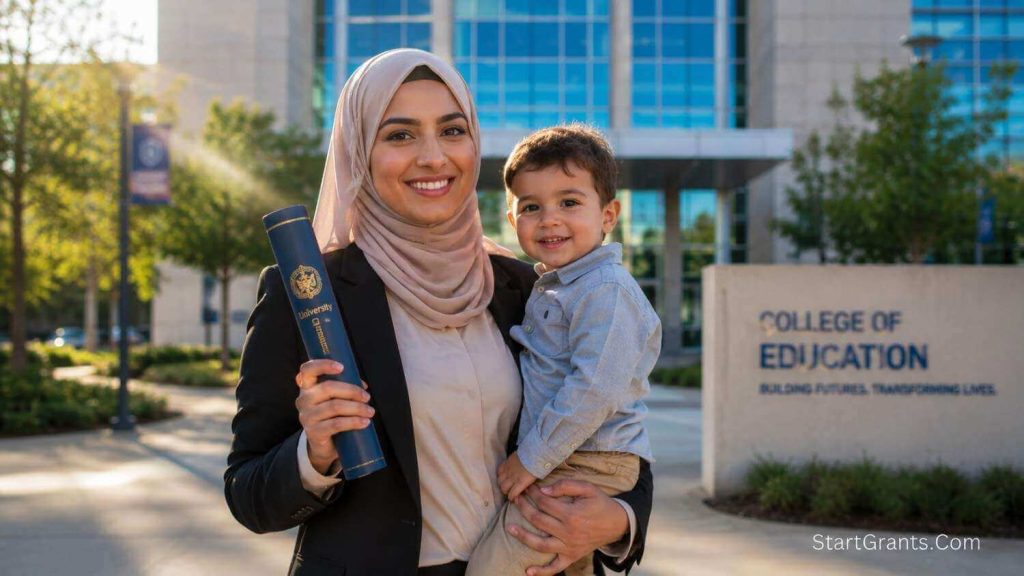
A cautious sequence for funding
- Start with aid that does not normally create repayment: Pell, state and school grants, scholarships, employer benefits, and workforce assistance for which you qualify.
- Ask about community support: a mosque, zakat committee, sadaqah fund, waqf, or Muslim professional organization may help locally, but funding and religious eligibility are never guaranteed.
- Distinguish a scholarship from financing: qard hasan is still a repayable obligation even if no interest is charged. Review fees, guarantors, repayment dates, hardship terms, default, and withdrawal consequences.
- Seek appropriate advice: ask a qualified scholar familiar with U.S. education finance about personal religious concerns, and ask a financial-aid or legal professional about the actual contract.
A government grant is not automatically the same legal arrangement as a conventional loan, and a product marketed as “interest-free” is not automatically free of fees or risk. Avoid claims that every single mother qualifies for zakat, that a mosque must fund college, or that accepting a specific benefit is universally required or forbidden.
Questions about campus and online study
- Who handles religious-accommodation requests?
- Can required sessions be moved around Friday prayer or Eid when academically feasible?
- What are the camera, room-scan, identity-verification, and remote-proctoring rules?
- Are Ramadan exam or deadline adjustments considered through the normal accommodation process?
- Do labs, clinicals, uniforms, personal care, or physical-contact requirements create concerns that should be discussed before enrollment?
- Does campus child care accommodate halal food, modest personal care, prayer, and Eid absences where reasonably possible?
Request accommodations early and in writing. A school can still enforce essential academic, safety, integrity, and professional-licensing requirements.
Avoid Scholarship and “Single Mom Grant” Scams
- FAFSA is free. Do not pay someone to unlock Pell.
- No legitimate provider can guarantee a scholarship before reviewing eligibility and the application.
- Never share your StudentAid.gov password or one-time security code.
- Check the sender’s domain and navigate to the provider’s official site yourself.
- Do not pay a processing fee, tax, gift card, or cryptocurrency charge to release an award.
- Reject pressure to enroll before receiving the full cost, refund policy, accreditation, and licensing disclosures.
- Do not let anyone fabricate hardship, income, dependency, or essay information.
Your 30-Day Action Plan
- Days 1–3: Choose a career outcome and shortlist three eligible programs.
- Days 4–7: Submit FAFSA and save the confirmation.
- Week 2: Ask each school about CCAMPIS, dependent-care allowances, emergency aid, student-parent services, and professional judgment.
- Week 3: Apply for the state child-care subsidy and scholarships that are currently open.
- Week 4: Compare written net prices, schedules, child-care availability, completion rates, and licensing outcomes.
- Before enrollment: Choose the option that is sustainable without depending on an unconfirmed award or refund.
Frequently Asked Questions
Are there federal grants specifically for single mothers?
There is no universal federal education grant reserved only for single mothers. Pell, FSEOG, state aid, CCAMPIS-supported services, and other programs use financial need, enrollment, institution, family, or location requirements.
Does being a single mother automatically make me an independent FAFSA student?
No. For 2026–27, a student with children generally must provide more than half of their support for the relevant period and satisfy the FAFSA family-size rules. The form determines dependency status from the student’s answers.
What is the maximum Pell Grant for 2026–27?
The maximum is $7,395, but the actual amount depends on eligibility, cost of attendance, enrollment intensity, and remaining lifetime eligibility. Single-parent status does not guarantee the maximum.
Will CCAMPIS pay all of my child-care costs?
Not necessarily. CCAMPIS funds participating colleges, which set local eligibility, subsidies, sliding fees, providers, hours, and waitlists. Some families may still have a copayment or uncovered hours.
Can I receive Pell while attending part time?
Yes, an eligible student may receive Pell part time, but payment is adjusted by enrollment intensity and other rules. Half-time enrollment does not always produce exactly half of a full-time award.
Does child support count on the 2026–27 FAFSA?
Yes. Annual child support received is reported as an asset of the recipient under the 2026–27 calculation. Enter the amount requested by the FAFSA form; it does not automatically eliminate Pell eligibility.
Can I receive grants if my credit is poor?
Federal Pell Grants do not use a consumer credit score. Other eligibility rules still apply. Credit history can matter for private loans and is considered under the separate adverse-credit rules for federal Direct PLUS Loans.
Can I receive new federal aid while my student loan is in default?
A defaulted federal loan can block new federal grants, work-study, and loans. Fresh Start is no longer available; contact the Default Resolution Group about rehabilitation, consolidation, or repayment and confirm that eligibility has been restored before enrolling.
Important disclaimer: StartGrants.com is an independent information portal. It is not a government agency, college, scholarship provider, financial-aid administrator, child-care agency, lender, tax adviser, legal adviser, or religious authority. Eligibility, award amounts, deadlines, program availability, child-care spaces, and religious considerations vary and can change. Verify details directly with the responsible agency, school, provider, employer, and qualified adviser before applying, enrolling, paying, or borrowing.