
Last Updated: August 2026 | Author: Munir Ardi
The celebration of graduating from dental school is often immediately overshadowed by a crippling financial reality. In 2026, the average dental student graduates with a staggering $300,000 to $400,000 in federal and private student loans. At a standard 7% interest rate, the compounding interest alone can cost thousands of dollars every single month.
If you attempt to pay this off on a standard 10-year plan, your monthly payment could easily exceed $4,000—a nearly impossible burden for a new associate dentist trying to start a life, buy a home, or open a practice.
Fortunately, you do not have to be trapped in debt for the next three decades. Because there is a severe shortage of healthcare providers in underserved areas, the federal government and state agencies have created massive financial escape hatches. If you are searching for “dental school loan forgiveness programs,” this comprehensive guide will show you exactly how to get the government to wipe out your debt entirely.
Before diving into post-graduate debt relief, you should also understand how future students can avoid this debt in the first place by reviewing our master directory of dental school grants and scholarships.

The average dental student graduates with over $300,000 in federal debt. Fortunately, through government-sponsored Public Service Loan Forgiveness (PSLF) and NHSC programs, dentists can wipe out their remaining balances completely tax-free.
Phase 1: Public Service Loan Forgiveness (PSLF)
The Public Service Loan Forgiveness (PSLF) program is the holy grail of dental debt relief. It is a federal program designed to encourage highly skilled professionals to work in the public non-profit sector.
How PSLF Works for Dentists
If you work full-time (at least 30 hours per week) for a qualifying employer and make 120 qualifying monthly payments under an Income-Driven Repayment (IDR) plan, the Department of Education will forgive the entire remaining balance of your Direct Loans.
- The Math: Over 10 years, you make payments based solely on your income, not your loan balance. Because non-profit salaries are generally lower, your monthly payment remains low. After 120 payments, if you still owe $400,000, that entire amount is wiped out completely tax-free.
- Qualifying Employers: You cannot work in a private corporate practice. You must work for a 501(c)(3) non-profit organization, a government agency, a public university (as a dental school professor), or a Federally Qualified Health Center (FQHC).
- Action Step: You must submit an Employment Certification Form (ECF) annually through the official Federal Student Aid PSLF Portal to track your progress.
Pro-Tip: The Math Behind Forgiveness
The biggest mistake young dentists make is applying for PSLF while enrolled in the wrong repayment plan, resulting in years of payments not counting toward the 120-payment requirement.Watch this essential financial breakdown from wealth strategist Justin Maxwell. He compares the exact, side-by-side mathematics of aggressive paydowns versus utilizing Income-Driven Repayment (IDR) and PSLF. Understanding these numbers is the key to ensuring you maximize your federal forgiveness while building your own nest egg:
Phase 2: National Health Service Corps (NHSC) Loan Repayment
If 10 years sounds like too long of a commitment, the National Health Service Corps (NHSC) Loan Repayment Program offers massive, short-term cash injections directly to your loan servicer.
Administered by the Health Resources and Services Administration (HRSA), this program is designed to bring dentists into Health Professional Shortage Areas (HPSAs).
- The Benefit: You can receive up to $50,000 tax-free for just two years of full-time clinical practice at an NHSC-approved site (or $25,000 for half-time).
- Continuation: The best part? After your initial two years, you can apply for continuation contracts. Many dentists have successfully used consecutive NHSC contracts to pay off $150,000+ of debt in just five or six years.
- Dual Benefit: Any payments made using NHSC funds while you are working at an FQHC also count toward your 10-year PSLF track. This allows you to stack the benefits.
Phase 3: State-Level Loan Repayment Programs (SLRP)
You do not have to rely solely on the federal government. Almost every state operates its own State Loan Repayment Program (SLRP). These are cost-sharing grants funded partially by the federal government and partially by the state.
- States like California (CalHealthCares), New York, and Texas offer massive grants (sometimes up to $300,000 over five years) to dentists who agree to treat a high volume of Medicaid/CHIP patients.
- Action Step: You must research your specific state’s Department of Public Health website, as application windows are notoriously short (often opening for just 30 days a year).
Phase 4: Strategic Integration (Exploring Alternatives)
Loan forgiveness requires you to work in specific geographic areas or non-profit settings. If you prefer to open a private practice or take a different route, you must explore these alternative funding strategies:
- Join the Military: If you are tired of debt, the military can wipe it out. The Army and Navy offer the Financial Assistance Program (FAP) and active-duty loan repayment bonuses. Learn more in our guide to military dental school scholarships.
- Work in the Countryside: Private foundations and rural hospital networks often offer their own sign-on bonuses to pay off student loans for dentists willing to relocate. Explore dental scholarships for rural practice.
- Were You a Minority Applicant? If you are still in school and want to avoid these loans altogether, ensure you are maximizing demographic-specific endowments. Review our guide to scholarships for minority dental students.
Phase 5: The Islamic Perspective (Escaping the Riba Trap)
For Muslim dentists, graduating with $300,000 in federal student loans is not just a financial burden; it represents a profound spiritual crisis. Under Islamic law (Fiqh al-Mu’amalat), any contract that mandates the payment of interest on a loan is classified as Riba (usury). Engaging in Riba is explicitly condemned in the Quran and strips the spiritual blessings (Barakah) from your income.
Many Muslim students take out these loans out of perceived necessity (Darurah) or due to a lack of Halal alternatives during their education. If you have already graduated and are trapped in these loans, what is the Islamic course of action?
1. Tawbah (Repentance) and Urgent Relief
The primary Islamic obligation is to escape the Riba contract as quickly as humanly possible. Treating the debt casually and paying only the minimum on a standard 20-year repayment plan means you are willfully prolonging your engagement with Riba. You must make a firm intention (Niyyah) to eliminate this debt.
2. PSLF & NHSC as a Halal Exit Strategy
Participating in federal loan forgiveness programs (like PSLF or NHSC) is actually one of the most brilliant and highly recommended Halal exit strategies available to Muslim doctors.
- Canceling the Riba: When you complete your 120 payments for PSLF, the government cancels the remaining balance—which is almost entirely composed of compounding Riba. By utilizing this program, you are legally forcing the lender to erase the usurious interest you would have otherwise been forced to pay.
- Service Over Profit: Working at an FQHC or non-profit clinic to qualify for PSLF aligns perfectly with the Islamic ethos of serving the poor, the marginalized, and the oppressed (Sadaqah and Zakat principles). You are healing the needy while simultaneously rescuing your own soul from the grip of Riba.
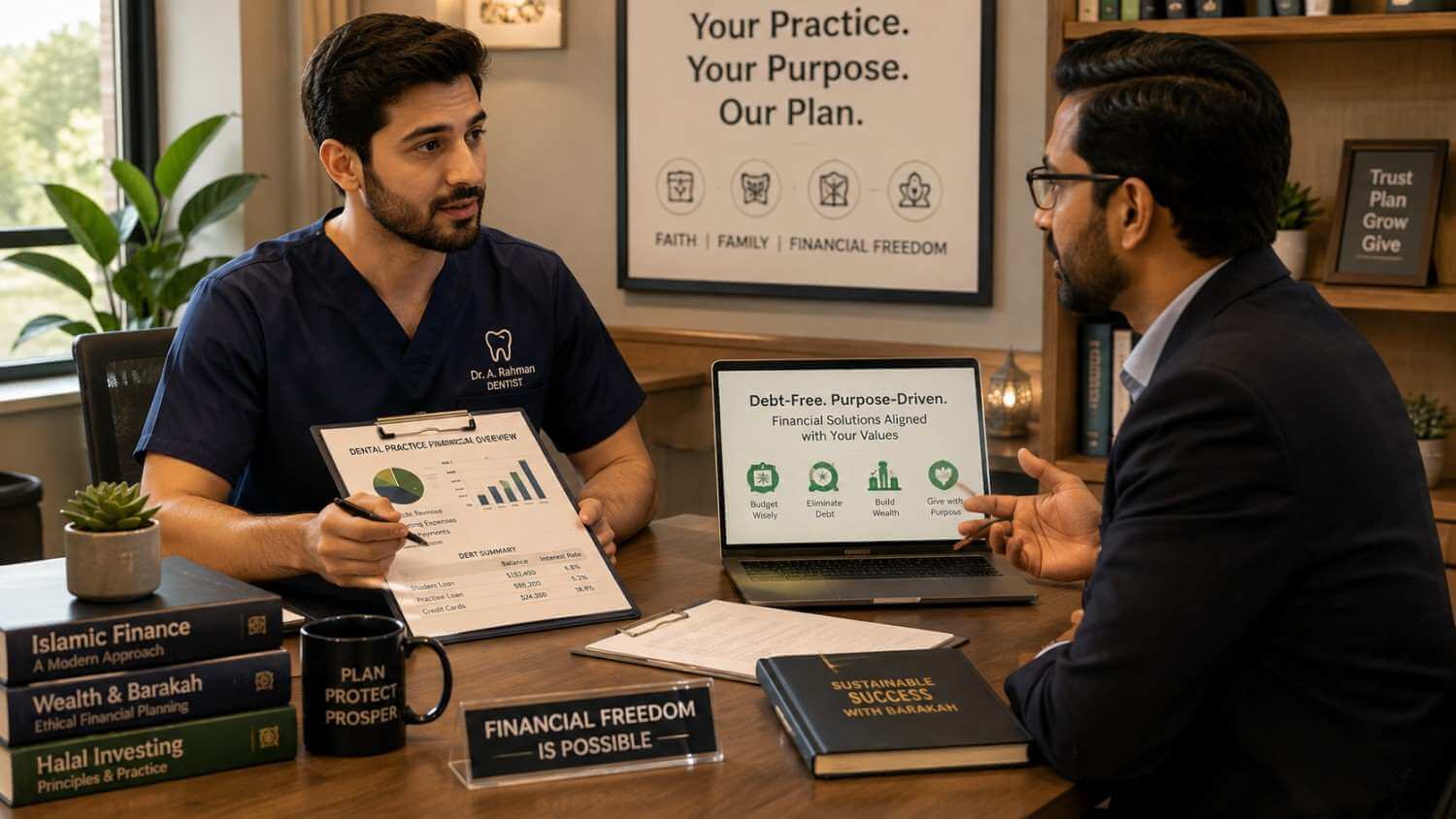
For Muslim dentists who unknowingly fell into Riba-based student loans, participating in federal forgiveness programs is a highly recommended Halal exit strategy. It legally cancels the compounding interest and frees the individual from oppressive debt.
Conclusion: Your Debt-Elimination Action Plan
You do not have to live with a $4,000-a-month student loan bill hanging over your head. Utilizing “dental school loan forgiveness programs” requires meticulous record-keeping and strategic career choices.
Execute this debt-relief checklist immediately:
- Consolidate Your Loans: If you have older FFEL or Perkins loans, consolidate them immediately into a Federal Direct Consolidation Loan, as only Direct Loans qualify for PSLF.
- Choose an IDR Plan: Apply for the most beneficial Income-Driven Repayment plan (such as the SAVE or PAYE plan) based on your current tax filing status. Never choose the Standard 10-Year plan if you are aiming for PSLF.
- Find a Non-Profit Employer: Secure an associate position at an FQHC, a community health clinic, or a university dental school. Private practices do not qualify.
- Submit Your ECF Annually: Do not wait 10 years to see if you qualify. Submit the Employment Certification Form to your loan servicer every single year to officially lock in your qualifying payment counts.
- Stack the NHSC: If your clinic is in an HPSA, apply for the NHSC Loan Repayment Program to receive $50,000 in immediate cash relief while simultaneously banking your PSLF time.
The path to a $0 balance is real. Commit to public service, utilize the federal safety nets, and reclaim your financial and spiritual freedom.
Comprehensive Frequently Asked Questions (FAQs)
Q1: Do private student loans (like Sallie Mae) qualify for PSLF?
A: No. Only federal Direct Loans (such as Direct Unsubsidized Loans and Direct Grad PLUS Loans) qualify for the Public Service Loan Forgiveness program. Private student loans cannot be forgiven by the federal government under any circumstances.
Q2: What happens if I change jobs before reaching 10 years for PSLF?
A: Your 120 qualifying payments do not need to be consecutive. If you leave a non-profit clinic to work in private practice for two years, your PSLF counter simply pauses. If you return to a qualifying non-profit employer later, your counter will pick up exactly where you left off.
Q3: Is the amount forgiven under PSLF taxable?
A: No. Unlike standard 20-year Income-Driven Repayment forgiveness, the balance forgiven under the Public Service Loan Forgiveness (PSLF) program is completely tax-free at the federal level.
Q4: Can I participate in both NHSC Loan Repayment and PSLF at the same time?
A: Yes, this is a highly recommended strategy. If you use your NHSC grant funds to make your required monthly IDR payments, those payments will count toward your 120 PSLF payments, allowing you to double-dip the benefits while working at the same qualifying FQHC.
Q5: What is a Health Professional Shortage Area (HPSA) score?
A: A HPSA score is a metric generated by the federal government (ranging from 0 to 25 for dental care) that indicates how severe the shortage of dentists is in a specific geographic area. The higher the score, the more likely you are to be awarded NHSC funds, as the government prioritizes the most desperate communities first.
Q6: Can I own a private practice and still get state loan repayment?
A: It depends on the state. While federal PSLF strictly forbids private practice, some State Loan Repayment Programs (SLRPs) will allow you to own a private practice if you legally commit to accepting a specific, high percentage of Medicaid or CHIP patients in your area.
Q7: What if my loans were placed in forbearance during my residency?
A: Generally, months spent in administrative forbearance do not count toward PSLF. It is usually much better to waive forbearance and make $0 or low-dollar IDR payments during your residency so that those years count toward your 120 required payments.
Q8: I am a Muslim dentist trapped in Riba loans. Is it Halal to declare bankruptcy to escape it?
A: Islam requires the fulfillment of contracts and the payment of debts. Willfully defaulting or declaring bankruptcy without extreme, life-threatening justification is generally frowned upon or considered sinful if you have the means to pay the principal. The correct Halal approach is to utilize legal government programs like PSLF and NHSC to aggressively eliminate the debt and force the cancellation of the Riba, while seeking Allah’s forgiveness for entering the contract.
Important Disclaimer: StartGrants.com is an independent educational portal. We are not financial advisors, CPA tax professionals, or a government agency. Federal student loan laws and Income-Driven Repayment plans change frequently. Always verify your eligibility directly through StudentAid.gov.