Last Updated: | Author: Munir Ardi

Beauty school grants can help pay for cosmetology, barbering, esthetics, nail technology, makeup, or massage training—but there is no universal “beauty grant” that automatically pays every student’s tuition. The legitimate options are a mix of federal and state aid, workforce funding, school-based assistance, and competitive private scholarships.
The word grant is also used loosely online. Some opportunities are scholarships, some are tuition discounts, some are prizes for licensed professionals, and others are loans that must be repaid. This guide separates those categories and identifies opportunities that could be verified as of September 3, 2026.
Beauty School Grants Versus Scholarships
| Type of help | What it means | What to verify |
|---|---|---|
| Federal or state grant | Need-based public aid, such as an eligible student’s Pell Grant. | Student eligibility, school participation, exact program eligibility, deadlines, and enrollment level. |
| Private scholarship | A competitive award from a nonprofit, association, company, school, or donor. | Discipline, age, residency, school status, judging rules, permitted expenses, and payment method. |
| Tuition discount | A reduction in the school’s published price. | Whether the original price is competitive and whether the discount can be combined with other aid. |
| Workforce assistance | Training or supportive-service funding approved through a local workforce system. | Applicant eligibility, local demand, approved provider status, funding limits, and approval before enrollment. |
| Loan or financed payment plan | Borrowed or deferred payment that must be repaid. | Interest, fees, total repayment, late charges, cancellation rights, and consequences of withdrawal. |
For the full federal-aid and program-verification process, read cosmetology school grants and FAFSA funding. The broader vocational and trade school grants guide explains options that also apply outside the beauty industry.
Current Beauty Scholarships by Discipline

The opportunities below were checked against provider pages on September 3, 2026. “Open” means the provider displayed a current application period; it does not mean every reader qualifies. Deadlines, award counts, and terms can change, so open the official application and read its complete rules before preparing materials.
| Opportunity | Verified 2026 details | Status on September 3 |
|---|---|---|
| Jerry Alexander Gorman Foundation “Passion to Succeed” | Two cosmetology/barbering scholarships of up to $6,500; separate esthetics/nail opportunity lists two scholarships of up to $3,500. | Open September 1–October 31, 2026 through Beauty Changes Lives. |
| L’Oréal PPD “Inspiration Through Education” | Four cosmetology scholarships of up to $5,000. | Open September 1–October 31, 2026 through Beauty Changes Lives. |
| Leo Passage “Dare to Lead” | Two awards of up to $7,500 for eligible cosmetology, barbering, or equivalent hair-focused programs. One award is restricted to a Pivot Point partner school. | Open September 1–October 31, 2026 through Beauty Changes Lives. |
| Dermalogica Future Industry Professionals | One esthetics scholarship of up to $5,000. Check the current application for partner-school and other requirements. | Listed for September 1–October 31, 2026. |
| Circadia “Timing Is Everything” | Three esthetics scholarships of up to $5,000. | Open September 1–October 31, 2026 through Beauty Changes Lives. |
| Borboleta “Pro Path” | Two esthetics scholarships of up to $1,500. | Open September 1–October 31, 2026 through Beauty Changes Lives. |
| Hand & Stone x Massage Warehouse | One massage-therapy scholarship of up to $2,500. | Open September 1–October 31, 2026 through Beauty Changes Lives. |
Confirm these and other seasonal awards on the official Beauty Changes Lives scholarship page. Its FAQ says student applicants generally need proof of acceptance or enrollment and that requirements differ by scholarship.
Professional Beauty Association Scholarships
The Professional Beauty Association scholarship page listed several active opportunities on September 3, 2026:
- Joseph L. Weir Memorial Scholarship: Five $500 awards for current PBA student or licensed-professional members, with a September 30, 2026 deadline.
- PBA Minerva Beauty Scholarship: One $2,000 student scholarship for eligible students in cosmetology, nail technology, barbering, esthetics, or massage, plus two $500 continuing-education awards for eligible licensed professionals. The deadline is October 15, 2026.
- Schwarzkopf Professional Shaping Futures: Five $2,000 scholarships for eligible students enrolled in accredited cosmetology or hairstyling programs leading to licensure. The listed deadline is October 31, 2026, and citizenship or permanent-resident and age requirements apply.
- Moroccanoil Scholarship: Five $2,500 awards with a November 30, 2026 deadline. The page restricts this opportunity to qualifying U.S. citizens age 18 or older attending independent cosmetology schools not affiliated with a product brand.
Do not treat a scholarship name as sufficient proof of eligibility. Membership, citizenship, age, school ownership, enrollment status, discipline, and permitted expenses can all matter.
Great Clips and Other Specialized Opportunities

Great Clips Great Scholarship Program
Great Clips states that it awards more than $100,000 in cosmetology and barbering scholarships each year, with individual awards valued at up to $5,000. Its current scholarship application page lists the spring application period as September 2 through March 1 and the fall period as March 2 through September 1.
Submitting the form may also add the applicant to a talent community or authorize communications, depending on the selected consent fields. Read the current terms and privacy notice instead of assuming an award requires or guarantees employment.
VFW–Sport Clips Help A Hero Scholarship
This is a veterans’ education scholarship, not a cosmetology-only award. The VFW lists awards of up to $5,000 for qualifying service members and veterans. The spring 2027 application period runs from August 1 through November 15, 2026. Awards are restricted to tuition and fees and are paid to the school. Review the complete military-service, rank, citizenship, financial-need, and FAFSA requirements on the VFW student-veteran support page.
mikeroweWORKS Work Ethic Scholarship
The official 2026 program includes cosmetology among its approved service and personal-care fields. Applicants must meet the program’s citizenship, school, program-length, cost-documentation, and other requirements. Award amounts vary, so do not rely on a third-party page promising a particular amount. Check the current mikeroweWORKS scholarship rules and approved programs.
Joe Francis Haircare Scholarship
The 2026 deadline was June 1, so this opportunity is closed as of this article’s update. The foundation says applications are normally accepted January 1 through June 1 each year. It covers cosmetology or barber-school applicants and students—not esthetics or nail training—and has graduation-timing rules. Recheck the official Joe Francis application page before planning for a later cycle.
Scholarships for Women Returning to School
Soroptimist Live Your Dream Awards
The Live Your Dream Awards accept eligible women who are the primary financial providers for themselves and their dependents, demonstrate financial need, and are enrolled in or accepted to vocational training or an undergraduate program. Additional residency, previous-award, family-relationship, and education rules apply. The 2026 application deadline is November 15, and award amounts vary by judging level.
This is not a “single-mother scholarship” and applicants do not have to be mothers. Dependents can include other qualifying family members. Soroptimist also says the written sections must reflect the applicant’s own experiences and goals; AI may assist with grammar or organization, but the story must remain the applicant’s own.
Jeannette Rankin Foundation
The foundation says its next application period opens in November 2026 for applicants age 35 or older who identify as women or nonbinary, demonstrate financial need, and are pursuing their first associate or bachelor’s degree. A stand-alone beauty-school certificate may therefore be outside the stated degree requirement. Verify the credential before relying on this option at the Jeannette Rankin Foundation.
Do FAFSA and Workforce Funding First
Private scholarships should usually supplement—not replace—the federal, state, school, and workforce application process.
- FAFSA: The 2026–27 maximum Federal Pell Grant is $7,395, but the actual amount varies. The student must meet federal requirements and attend a participating school in an eligible program. Submit the free application through StudentAid.gov.
- Workforce Pell: Beginning July 1, 2026, certain state-certified and U.S. Department of Education-approved short-term workforce programs can qualify for Pell. A short beauty program does not qualify automatically merely because of its length. Review the Department’s Workforce Pell approval notice.
- WIOA: A local workforce board may approve training or related support for an eligible job seeker, but local demand, Eligible Training Provider List status, funding caps, and applicant priority rules vary. Contact an American Job Center before enrolling.
- School aid: Ask every school for a written list of institutional scholarships and discounts, their renewal rules, and whether awards reduce the same published tuition for every student.
Students considering bodywork training can use the related massage therapy school funding guide. Licensing, hands-on requirements, and eligible scholarships differ from cosmetology or esthetics.
How to Build a Strong Scholarship Application

1. Answer the Actual Prompt
Do not submit one generic essay or video unchanged to every sponsor. Reuse factual background where appropriate, but answer each organization’s questions, eligibility criteria, and career focus directly. Mention the award correctly and explain how it would affect a specific, documented cost.
2. Use Concrete Evidence
Instead of saying only “I have always loved beauty,” describe what you have done: completed prerequisite hours, practiced sanitation procedures, built a portfolio, shadowed a licensed professional, served clients under supervision, or researched an underserved local need. Never invent hardship, work, clients, community impact, or awards.
3. Make the Budget Specific
State the verified remaining cost after other grants and scholarships. Separate tuition, required kit, books, examination fee, license fee, transportation, and childcare. Explain which expense the sponsor’s rules allow the award to cover.
4. Follow Video Rules Exactly
Beauty Changes Lives advises applicants to review the scholarship’s prompt, proof-of-enrollment requirement, judging rubric, time limit, and visibility settings. Some current applications require a public YouTube link and reject videos that exceed the stated maximum. Other sponsors use essays or direct uploads. The specific application controls.
5. Choose the Right Reference
Select someone who meets the sponsor’s instructions and can describe your work, reliability, or education accurately. A salon owner is not automatically better than an instructor, employer, counselor, or community leader. Give the reference enough time and never write a recommendation on someone else’s behalf unless the program expressly allows a draft and the reference independently reviews and adopts it.
6. Protect Client Privacy
Obtain permission before displaying a client, classmate, or family member in an application video or portfolio. Do not reveal health information, private circumstances, or images of minors without appropriate consent. Use a mannequin or your own work samples when the scholarship permits it.
Muslim Perspective: Scholarships, Modesty, and Riba
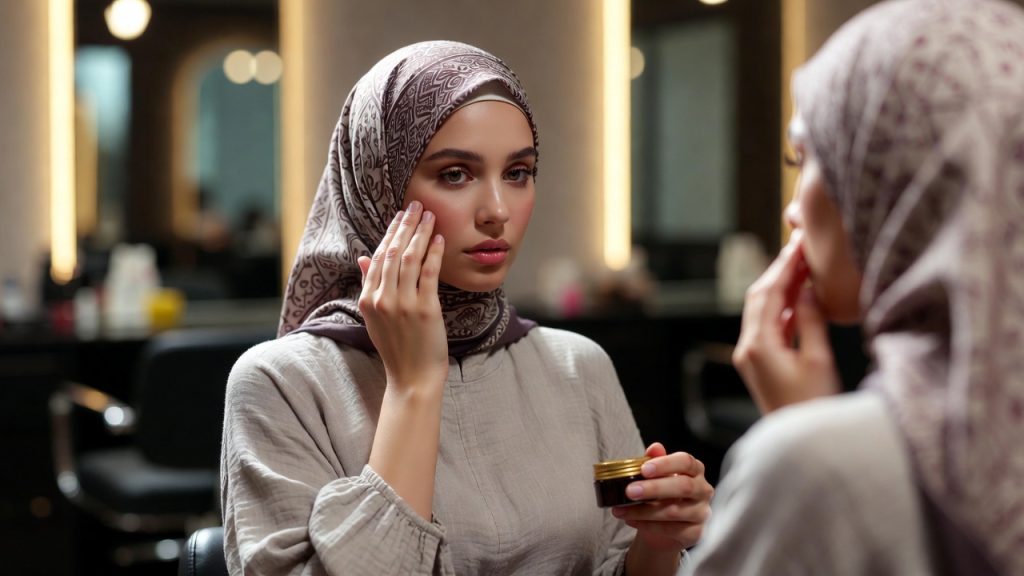
A Muslim applicant should describe her real experience, goals, and community needs—but wearing hijab or serving Muslim clients never guarantees a scholarship. Claims that corporations are actively selecting “visible Muslims” or that a religious identity is a competitive advantage cannot be promised. The best application is truthful, specific, and responsive to the published judging criteria.
Discuss Privacy and Practical Training Early
Before enrolling, ask which services must be performed on classmates or live clients, whether mixed-gender practice is required, and whether a lawful competency-equivalent arrangement is available for privacy or modesty concerns. Also ask about hijab and uniform safety, prayer breaks, product ingredients, nail-service requirements, and sanitation rules. Obtain the answer in writing and verify licensing implications with the state board; a mannequin may not substitute for every required competency.
Understand the Funding Contract
A scholarship is generally an award that does not require repayment when its conditions are satisfied, while a loan creates a repayment obligation. That practical distinction can help a student who wants to avoid riba, but this article does not issue a universal religious ruling about every grant, prize, contract, late fee, income-share arrangement, or financing product.
A debt-conscious order is:
- Compare state-approved programs and choose the lowest credible net price.
- Use eligible public grants and private scholarships after reading their conditions.
- Ask about workforce funding, employer assistance, and school discounts.
- Explore verified zakat, sadaqah, waqf-supported education aid, or qard hasan locally, understanding that availability is not guaranteed.
- Review any remaining financing with a qualified scholar and an independent financial counselor before signing.
Do not assume a plan is riba-free merely because it is advertised as “Islamic,” “zero interest,” or a fixed markup. Read the total price, origination and late fees, default provisions, required insurance, collection terms, and whether the balance increases over time.
A student whose longer-term goal includes clothing, styling, or runway work may also find the contextual guide to grants and funding for fashion designers useful. Those are creative-business or design opportunities, however, and should not be presented as substitutes for beauty-school tuition aid.
How Scholarship Payments and Taxes Work
There is no universal payment method. A sponsor may pay the school, reimburse a documented expense, provide products or tools, or send an award under its own terms. Read the rules and ask:
- Is the award restricted to tuition, or can it cover required fees, books, tools, or a kit?
- Does the sponsor pay the school or the recipient?
- What happens if the student changes schools, graduates, takes leave, or withdraws?
- Must the award be used within a specified period?
- Can it be combined with school, state, workforce, or federal aid?
Tell the school’s financial-aid office about outside awards and ask for an updated written aid offer. Do not assume that “stacking” several awards always produces a cash refund.
Tax treatment also depends on the recipient, institution, award terms, and use of funds. The IRS scholarship guidance says an award may be tax-free when the recipient is a candidate for a degree at an eligible educational institution and uses it for qualified tuition, required fees, or required course books, supplies, and equipment. Amounts used for room, board, travel, or optional equipment can be taxable. Because some beauty programs are nondegree certificate programs, do not assume every beauty scholarship is tax-free; consult a qualified tax professional about your facts.
How to Spot a Beauty Scholarship Scam

- The message says you won a contest you never entered.
- A sender guarantees an award or claims everyone qualifies.
- You must pay a processing, redemption, release, or application fee to receive the award.
- The form asks for an FSA ID, bank login, gift card, or payment by cryptocurrency.
- The deadline appears only in a social post and cannot be found on the sponsor’s current website.
- The domain imitates a known brand but contains misspellings or an unrelated address.
- The sponsor pressures you to sign a school enrollment or private financing agreement first.
The Federal Trade Commission warns consumers not to pay to apply for a scholarship and not to trust guarantees. A legitimate paid scholarship-search service may sell information, but paying it does not improve the chance of winning and it must not promise an award.
Your Seven-Step Application Plan
- Verify the credential. Confirm that the exact program satisfies your state’s licensing requirements.
- Compare schools. Request tuition, fees, kit, exam, licensing, transportation, and withdrawal costs in writing.
- Apply for core aid. Complete the FAFSA and contact the local workforce office before enrolling.
- Build a scholarship calendar. Track sponsor, discipline, amount, deadline, time zone, documents, and status.
- Prepare reusable evidence. Keep an accurate résumé, budget, proof of enrollment, portfolio, and list of achievements.
- Customize every submission. Follow the current prompt, word or time limit, file format, and visibility rules.
- Compare the final net price. Add confirmed grants and scholarships only; do not count pending applications as money received.
Frequently Asked Questions
Are beauty school grants the same as scholarships?
Not always. A public grant is generally awarded through a government aid program, while a private scholarship comes from a school, nonprofit, association, company, or donor. Both may reduce education costs, but their eligibility, permitted expenses, and payment rules differ.
Which beauty scholarships are open in September 2026?
Beauty Changes Lives lists multiple Fall 2026 cosmetology, barbering, esthetics, nail, and massage opportunities open from September 1 through October 31. PBA, Great Clips, Soroptimist, and VFW–Sport Clips also list active application periods, subject to their individual eligibility rules.
Can I apply before enrolling in beauty school?
It depends on the scholarship. Beauty Changes Lives generally requires proof of acceptance or enrollment, while other sponsors may accept students who plan to enroll. Follow the exact requirement in the current application.
Do beauty scholarships require a video?
Some do, but not all. If a video is required, follow the stated questions, time limit, format, and visibility settings. Other programs use an essay, portfolio, reference, financial information, or direct application form.
Can a beauty scholarship pay for my student kit?
Only if the scholarship terms allow it. Some awards are restricted to tuition, while others may permit required books, tools, or kit costs. Confirm the permitted expense and payment process with both the sponsor and school.
Can I combine several beauty scholarships?
Sometimes, but not automatically. Each sponsor and school can impose restrictions, and outside aid may change the student’s financial-aid package. Report awards to the financial-aid office and request an updated written calculation.
Are beauty school scholarships tax-free?
Not necessarily. Federal tax treatment depends on factors including whether the recipient is a degree candidate at an eligible institution and whether funds pay qualified education expenses. Nondegree beauty programs and money used for living or travel expenses may be treated differently.
Is there a guaranteed scholarship for Muslim beauty students?
No verified national scholarship guarantees an award because an applicant is Muslim or wears hijab. Muslim students can apply for any opportunity whose published requirements they meet and may also ask local mosques or nonprofits about limited zakat, sadaqah, or interest-free assistance.
Important disclaimer: StartGrants.com is an independent information portal. It is not a government agency, school, accreditor, licensing board, scholarship sponsor, lender, tax adviser, or religious authority. Scholarship availability, deadlines, award amounts, eligibility, and payment terms can change without notice. Confirm every opportunity with the official provider and verify school, licensing, financial-aid, tax, and contract questions with the appropriate qualified organization or professional before enrolling or paying.