
Last Updated: | Author: Munir Ardi
Agriculture grants do exist, but there is no single federal program that gives every farmer money to buy land, purchase a tractor, or cover ordinary operating costs. Most government agricultural funding is tied to a defined purpose such as conservation, research, renewable energy, value-added production, market development, or disaster recovery. Other assistance comes as a loan, cost-share contract, commodity payment, crop-insurance subsidy, or support delivered through an intermediary.
The practical first step is to identify the type of project you have, the applicant named in the official rules, and the funding instrument being offered. A program that helps agriculture is not necessarily a grant to an individual farmer.
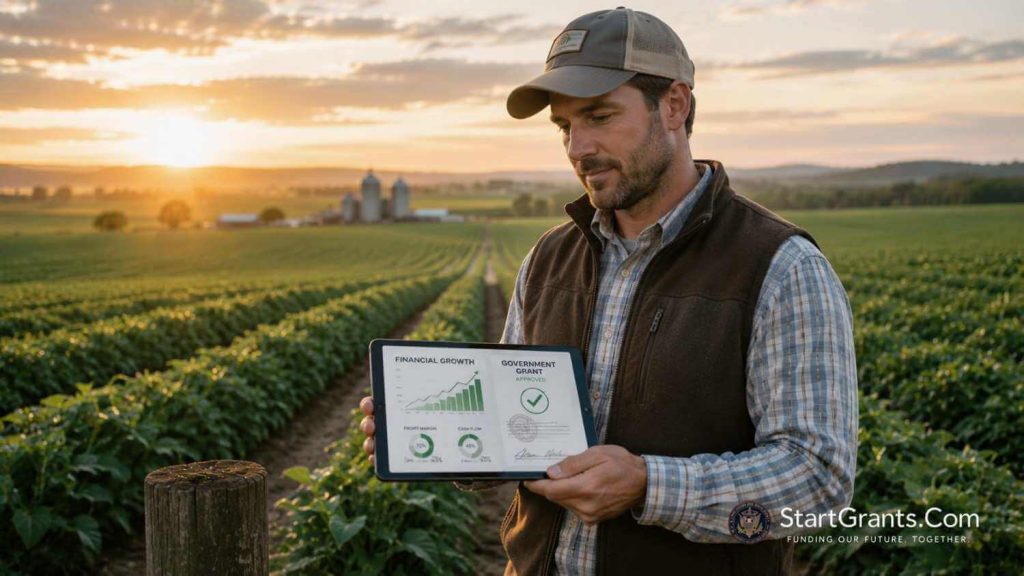
Agriculture funding can include competitive grants, conservation contracts, loans, insurance support, and other program-specific assistance.
What Agriculture Grants Can—and Cannot—Pay For
A true grant is an award governed by written terms. It normally does not require repayment when the recipient follows those terms, but it may require matching funds, documentation, performance reports, reimbursement requests, or repayment if the award conditions are violated. A grant is not automatically unrestricted cash.
USDA’s official farm-loan guidance states that the agency does not offer grants for purchasing land and that most available grants are limited in amount or purpose. Buying or expanding a farm is more commonly financed with personal capital, private financing, or a USDA Farm Service Agency loan. See the official Farmers.gov farm-loan and grant guidance before treating a financing offer as a grant.
Government support for agriculture can take several forms:
- Competitive grant: A proposal is scored against published criteria, and only selected applicants receive awards.
- Conservation financial assistance: A producer may enter a contract to implement approved practices and receive payments under that contract.
- Direct or guaranteed loan: Borrowed money must be repaid according to the promissory note. A guaranteed loan is still a loan; “guaranteed” describes government backing for the lender, not guaranteed approval for the borrower.
- Reimbursement or cost share: The recipient may have to incur eligible expenses, document them, and request payment.
- Commodity or disaster payment: Eligibility depends on the applicable statute, program rules, production history, loss, enrollment, or commodity—not merely on owning a farm.
- Crop-insurance premium support: This reduces part of an insurance cost; it is not a startup grant.
- Grant to an intermediary: A university, nonprofit, government agency, or other organization receives the federal award and delivers research, training, technical assistance, or services to producers.
Verified Agriculture Funding Snapshot for September 2026
The table below separates current status from program purpose. “Open” never means that every farmer is eligible; the controlling Notice of Funding Opportunity (NOFO), program regulation, state ranking notice, or application guide determines eligibility.
| Program or route | What it is | Status checked September 13, 2026 | Important distinction |
|---|---|---|---|
| Value-Added Producer Grants (VAPG) | Competitive grants for eligible value-added planning or working-capital activities | FY 2026 round closed April 22, 2026, at 1:00 p.m. Eastern Time | A 1:1 match applied in FY 2026; it was not a general farm operating grant |
| Rural Energy for America Program (REAP) | Renewable-energy and energy-efficiency grants and guaranteed loans | USDA says it is not accepting REAP grant applications at this time; guaranteed-loan applications may be submitted | The currently available guaranteed-loan route is repayable financing, not grant funding |
| Environmental Quality Incentives Program (EQIP) | NRCS technical and financial assistance under a conservation contract | Applications accepted throughout the year; states set ranking and funding deadlines | Funding is linked to approved conservation practices and a contract, not unrestricted cash |
| Sustainable Agriculture Research and Education (SARE) | Regional competitive grants for research, education, demonstration, and professional development | Availability and deadlines vary by region and grant type | Some calls are designed for farmers or ranchers; others require different applicants or partnerships |
| NIFA competitive funding | Grants and cooperative agreements for agricultural research, education, and Extension | Mixed: each NOFO has its own opening date and deadline | Eligibility may include institutions, organizations, agencies, partnerships, businesses, or individuals, depending on the NOFO |
| FSA farm loans | Direct and guaranteed ownership, operating, microloan, and other loan products | Applications depend on the loan product and borrower circumstances | These are repayable loans and should never be described as free grants |
Choose the Right Agriculture Funding Path
This Tier 1 guide owns the broad questions around agriculture grants, government farm funding, and farm subsidies. The guides below address narrower needs so that readers can evaluate the rules that actually apply to their project.
Research, education, and Extension projects
NIFA funds research, education, and Extension across food and agricultural sciences. Many opportunities are built for colleges, universities, research institutions, nonprofits, agencies, or multi-party projects, although eligibility is always NOFO-specific and some programs permit individual applicants. Use our USDA NIFA grants and eligibility overview to distinguish organizational funding from opportunities that may accept an individual.
Women farmers and ranchers
Being a woman farmer does not create one universal federal grant. Some programs use targeted funding, priority points, outreach, or historically underserved provisions, while the underlying program rules still control. Our guide to government farm funding resources for women explains how to check those pathways without treating every loan or training program as a grant.
Organic agriculture
Organic funding may support research, Extension, conservation, certification-related assistance, or market development. It is not automatically a cash award for converting a farm. NIFA’s three FY 2026 Organic Agriculture Research and Extension Initiative listings are shown as closed, and that program has detailed project and application requirements. Review our organic farming grants and assistance guide for the distinctions among research funding, producer assistance, and certification support.
Beekeeping and pollinator projects
There is no single USDA program that supplies free hives to every beekeeper. Depending on the project, relevant routes may involve pollinator-habitat conservation, on-farm research, value-added honey products, loans, or state and local initiatives. Start with our guide to beekeeping grants and pollinator assistance.
Farm equipment
Most federal equipment purchases are financed or tied to a qualifying project. For example, FSA operating loans can finance eligible equipment, while an EQIP payment may support an approved conservation practice. NIFA’s Equipment Grants Program, by contrast, is for shared-use research equipment at eligible institutions—not a tractor grant for individual farms. See farm equipment grants, loans, and cost-share options before choosing a financing route.
Urban, indoor, and emerging agriculture
Urban agriculture funding can support research, education, Extension, planning, or community food-system work, but applicant and project rules matter. NIFA’s FY 2026 Urban, Indoor, and Emerging Agriculture competition closed July 27, 2026; it supported defined research, education, and Extension projects rather than unrestricted startup cash. Our urban farming grants and funding guide covers city farms, indoor growing, and related programs in more detail.
Major Federal Routes Farmers Should Understand
Value-Added Producer Grants
The USDA Rural Development Value-Added Producer Grant program supports eligible producers, producer groups, cooperatives, and majority-controlled producer-based ventures undertaking qualifying value-added activities. Eligible uses may include planning work, such as feasibility studies and business plans, or working-capital activities such as processing, packaging, marketing, inventory, and eligible salaries.
The FY 2026 round is closed. It accepted applications from February 17 through April 22, 2026, at 1:00 p.m. Eastern Time. The maximum was $50,000 for planning grants and $200,000 for working-capital grants, with a 1:1 matching requirement. Those figures should not be projected onto a future round until USDA publishes a new notice.
Rural Energy for America Program
REAP can serve agricultural producers and rural small businesses pursuing eligible renewable-energy systems or energy-efficiency improvements. However, the current USDA REAP page states that the agency is not accepting REAP grant applications at this time. Guaranteed-loan applications may still be submitted. Applicants should evaluate the loan’s interest, collateral, fees, repayment schedule, guarantees, and lender conditions instead of assuming that an open page means grant money is available.
Environmental Quality Incentives Program
EQIP is administered by USDA’s Natural Resources Conservation Service. It provides technical and financial assistance to eligible agricultural producers and nonindustrial private forest managers who address approved natural-resource concerns. According to the official EQIP application page, applications are accepted throughout the year, while states establish ranking deadlines. An applicant who is selected may receive a contract covering specified conservation practices. Payment rates, documentation, schedules, and advance-payment rules are program-specific.
Sustainable Agriculture Research and Education
SARE is organized into regional programs. Its grants commonly support research, demonstrations, education, or professional development that can be shared with the agricultural community. Some regional calls accept farmer or rancher applicants, but deadlines, award limits, partnerships, and eligible costs differ. Use the official SARE grants directory to identify your region and read the current call for proposals.
NIFA funding opportunities
NIFA publishes separate NOFOs rather than one universal “NIFA farm grant.” Its portfolio primarily advances agricultural research, education, and Extension. The official NIFA funding-opportunity search shows open and closed notices, posting dates, deadlines, and program summaries. Read the eligibility section of the specific NOFO; do not infer eligibility from another NIFA program.
FSA direct and guaranteed farm loans
FSA loans can be relevant when the actual need is land, livestock, seed, equipment, or operating capital. Direct loans are made by FSA, while guaranteed loans are made by approved lenders with an FSA guarantee. Both routes involve underwriting and repayment. The USDA Loan Assistance Tool and farm-loan guidance can help a prospective borrower identify a suitable product and application process.
Farm Subsidies Are Not the Same as Farm Grants
Search results often use “farm subsidy” as a catch-all phrase, but the legal and financial forms differ. A commodity payment, marketing-assistance loan, loan-deficiency payment, crop-insurance premium subsidy, conservation contract, and disaster payment may all support agriculture without being a competitive startup grant.
This distinction affects eligibility, taxes, accounting, repayment, insurance, and compliance. Before accepting any award or payment, identify:
- the administering agency and legal program name;
- whether the assistance is a grant, loan, contract, reimbursement, insurance benefit, or payment;
- the event or expense that triggers payment;
- recordkeeping, inspection, reporting, and conservation obligations;
- whether payment can be reduced, denied, recaptured, or offset;
- the tax form and tax treatment that may apply; and
- any crop-insurance, acreage-reporting, or program-enrollment deadline.
Who Can Apply for Agriculture Grants?
There is no universal applicant profile. A NOFO may allow an individual producer, a producer group, a cooperative, a nonprofit, a business, a Tribal entity, a state or local government, a college or university, a research institution, or a partnership. Other opportunities exclude individual farms and fund an intermediary instead.
Do not form an LLC or obtain an EIN solely because a blog says every grant requires one. The correct applicant structure comes from the official notice and must match the entity that will perform the project, receive the award, keep records, and assume legal responsibility. An existing business structure also does not make an otherwise ineligible applicant eligible.
When SAM.gov, a UEI, and Grants.gov are required
Many federal organization applications require an active SAM.gov entity registration, a Unique Entity ID (UEI), and a Grants.gov profile. SAM.gov states that obtaining a UEI, registering an entity, and maintaining the registration are free. A UEI alone is not the same as a completed registration and does not necessarily permit direct federal-award applications.
The official SAM.gov entity-registration page and Grants.gov organization-registration instructions should control. Start early: validation and registration processing can take time. Some NIFA opportunities also use eRA Commons or another application system, so follow the current NOFO rather than assuming Grants.gov is the only step.
How to Find and Evaluate a Real Opportunity
- Define the project, not just the purchase. Write down the problem, public or producer benefit, activities, location, partners, budget, and measurable result.
- Contact the appropriate USDA Service Center. FSA, NRCS, and Rural Development staff can help identify relevant programs, but each agency has a different role. Use the official USDA Service Center Locator.
- Search the responsible agency’s current page. Use USDA, NIFA, Rural Development, NRCS, FSA, SARE, your state department of agriculture, and Grants.gov—not an old list of program names.
- Open the current NOFO or application guide. Confirm the assistance listing number, funding-opportunity number, posted date, deadline, time zone, and submission system.
- Run an eligibility screen. Check applicant type, geography, ownership, operating history, project type, certifications, registrations, partners, and any priority categories.
- Test the budget. Separate eligible from prohibited costs and verify match, reimbursement, pre-award-cost, procurement, and indirect-cost rules.
- Read the award terms. Look for reporting, records retention, audits, site access, environmental review, publicity, data, intellectual-property, insurance, and recapture provisions.
- Submit before the stated time zone deadline. Allow time for registration, uploads, signatures, and correction of validation errors.
Save This Agriculture Funding Checklist
- [ ] I identified whether the opportunity is a grant, loan, contract, cost share, reimbursement, insurance benefit, or other payment.
- [ ] I opened the current official NOFO, state ranking notice, or application guide.
- [ ] My applicant type, farm location, and proposed activities are explicitly eligible.
- [ ] I confirmed the deadline, time zone, submission portal, and required authorized signer.
- [ ] My SAM.gov registration, UEI, Grants.gov profile, or other required account will be active in time.
- [ ] I separated eligible costs from land purchases, normal expenses, or other prohibited costs.
- [ ] I can document the required match, cash flow, reimbursement expenses, or advance-payment use.
- [ ] I reviewed reporting, procurement, environmental, insurance, tax, and recordkeeping obligations.
- [ ] I saved the final application, attachments, confirmation number, and controlling terms.
- [ ] I will verify any future round instead of reusing old dates, award amounts, or rules.
Common Mistakes and Agriculture Grant Scams
- Paying for SAM.gov registration: SAM.gov registration and the UEI are free. A private consultant may charge for optional help, but it is not the government and should not imply that payment guarantees an award.
- Confusing a guaranteed loan with guaranteed funding: A government guarantee protects part of a lender’s risk; the borrower still must qualify and repay the debt.
- Using an old deadline: Program names may return annually while budgets, eligible applicants, match rules, priorities, and deadlines change.
- Applying to the wrong applicant category: A project may help farmers while the eligible applicant is a university, nonprofit, government agency, or cooperative.
- Budgeting an ineligible purchase: A broad program purpose does not override the current list of permitted and prohibited costs.
- Assuming selection means immediate cash: Environmental review, award execution, documentation, procurement, reimbursement, or other conditions may come first.
- Sharing sensitive information with an impostor: Verify the website domain, contact information, assistance listing, and opportunity number before providing tax, banking, identity, or farm records.
A Muslim Perspective: Reviewing Farm Funding Without Assuming Every Award Is the Same
For Muslim farmers, the label on a program is only the starting point. A competitive grant may resemble a restricted gift, but the actual agreement can include matching funds, reimbursement, reporting, permitted-use limits, insurance requirements, or clawback provisions. Review the complete award rather than assuming every grant has the same legal, tax, or religious character.
A conventional farm loan normally requires repayment under an interest-bearing contract, which raises a riba concern for many Muslims. A subsidized rate or government guarantee does not turn a loan into a grant. Before signing, examine the interest calculation, late-payment terms, collateral, guarantees, fees, refinancing provisions, and default remedies with qualified advisers. This article does not issue a fatwa on any specific contract.
Depending on the farm and available resources, alternatives worth investigating may include retained earnings, staged purchases, equipment rental, a properly documented qard hasan, community crowdfunding, preorders, or appropriately structured leasing, equity, and profit-sharing arrangements. These alternatives also require careful review for ownership, risk allocation, gharar, taxes, securities law, and the underlying halal nature of the business activity.
Crop insurance, disaster coverage, and zakat treatment are fact-specific. A legal requirement, contract condition, local market, farm structure, crop type, irrigation method, debt, and timing can affect the analysis. A farmer who needs guidance should bring the actual program notice, award agreement, loan documents, insurance policy, and financial records to a qualified Islamic finance scholar and, where appropriate, an attorney, tax professional, insurance professional, or agricultural adviser.
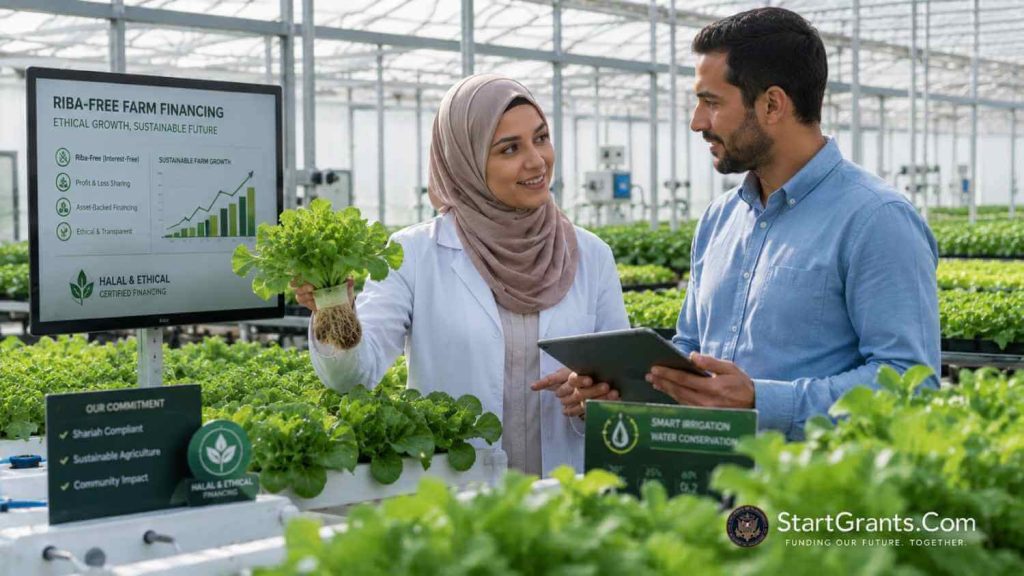
Muslim farmers can compare the substance of grant, loan, insurance, lease, and partnership documents before making a funding decision.
Frequently Asked Questions
Are there government grants to start a farm?
Some government programs fund defined agricultural projects, but there is no universal federal startup grant for anyone who wants to open a farm. Eligibility usually depends on the applicant, location, project purpose, public benefit, and current program rules.
Will USDA give me a grant to buy farmland?
No. USDA’s Farmers.gov guidance states that USDA does not offer grants for purchasing land. Eligible borrowers may instead investigate Farm Service Agency ownership loans or other financing and should review repayment, collateral, and underwriting requirements.
What is the difference between an agriculture grant and an FSA loan?
A grant is an award governed by permitted uses and other conditions and normally is not repaid when those conditions are met. An FSA loan is borrowed money that must be repaid under a loan agreement, even when the rate or terms differ from commercial credit.
Is the Value-Added Producer Grant open in 2026?
No. The FY 2026 Value-Added Producer Grant round closed on April 22, 2026, at 1:00 p.m. Eastern Time. Farmers interested in a later round should monitor the official USDA Rural Development page and should not assume the 2026 amounts, match, or deadline will repeat.
Is REAP accepting grant applications now?
No. As checked on September 13, 2026, USDA states that it is not accepting REAP grant applications at this time. The agency says guaranteed-loan applications may be submitted, but that route is repayable financing and approval is not guaranteed for every applicant.
Can an individual farmer apply for a NIFA grant?
It depends on the specific NOFO. Some NIFA opportunities permit individuals, while others limit applications to institutions, organizations, agencies, businesses, or partnerships. The eligibility section of the current notice controls.
Can an agriculture grant pay for farm equipment?
Only when the current program expressly allows the equipment and it is necessary for an eligible project. Many equipment needs are financed with loans, leases, or personal funds, while conservation programs may support approved practices under a contract.
Are there federal farm grants only for women?
There is no single universal federal grant that awards money solely because the applicant is a woman farmer. Some programs have targeted funds, priorities, outreach, or historically underserved provisions, but applicants still must meet the underlying program and project rules.
Do beekeepers qualify for USDA grants?
Some beekeeping or pollinator projects may fit conservation, research, education, value-added, or state and local opportunities. Owning bees alone does not create eligibility, and there is no universal federal program that gives every beekeeper free hives or cash.
Do I need SAM.gov registration and a UEI for every farm program?
No. Many federal grant applications from organizations require an active SAM.gov registration and UEI, but local service-center programs and individual opportunities may use different systems. Follow the current official instructions for the exact program, and remember that SAM.gov registration and the UEI are free.
Bottom Line
The best agriculture funding search begins with an eligible project, not the phrase “free farm grant.” Separate competitive grants from loans, conservation contracts, reimbursements, commodity programs, insurance support, and disaster payments. Then verify the current official notice, applicant rules, deadline, budget restrictions, match, and post-award obligations before investing time in an application.
Program status changes. Use the September 2026 snapshot in this article for orientation, then confirm every application against the responsible agency’s live page and controlling documents.
Important disclaimer: StartGrants.com is an independent information portal. It is not a government agency, grantmaker, application administrator, lender, law firm, tax adviser, insurance adviser, or religious authority. StartGrants.com does not issue grants, loans, farm-program benefits, contracts, insurance, legal advice, tax advice, financial advice, insurance advice, or fatwas. Program availability, deadlines, eligibility, award amounts, fees, payment levels, and terms can change. Verify every opportunity with the responsible agency or sponsor and seek qualified professional guidance for your circumstances.