Last Updated: | Author: Munir Ardi
There is no single federal farm grant that every woman can receive simply because she is a woman. Women farmers may qualify for competitive grants, conservation assistance, loans, training, or locally administered programs, but eligibility usually depends on the farm, project, location, income or resource status, years in operation, and the rules of a specific funding notice.
For a broader map of agricultural funding—including competitive grants, conservation assistance, farm loans, and programs administered through organizations—start with our agriculture grants and farm funding overview. The sections below then focus on which of those routes may be relevant to women farmers and which claims require extra caution.
This distinction matters because many online lists combine grants with loans, reimbursements, contracts, and programs that fund organizations rather than individual producers. For the research, education, and Extension side of federal agricultural funding, read our USDA NIFA grants and eligibility guide. NIFA generally funds defined projects through competitive programs; it should not be presented as a source of unrestricted startup money for an individual farm.
Women are a major part of U.S. agriculture. The 2022 Census of Agriculture counted approximately 1.2 million female producers, representing 36% of all U.S. producers. That fact does not create automatic grant eligibility, but it helps explain why USDA, Extension systems, nonprofits, and producer networks provide outreach and technical assistance tailored to women in agriculture.
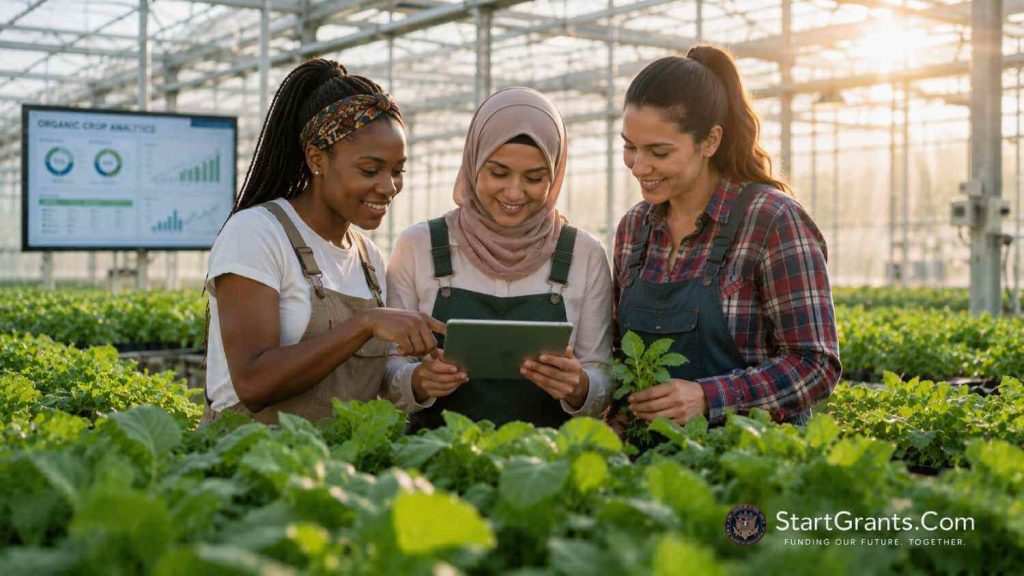
Women farmers should compare grants, conservation contracts, loans, and training programs instead of assuming that every form of USDA assistance is a grant.
The Most Important Correction: Gender Is Not a Universal USDA Priority Pass
Older articles often claim that every woman is automatically a “socially disadvantaged farmer” across USDA and therefore receives priority scoring, 90% project coverage, waived fees, or guaranteed funding. That is not a safe or accurate general rule.
Eligibility terminology differs by statute and program. For example, the current NRCS guidance defines historically underserved producers through four categories: beginning, socially disadvantaged, veteran, and limited-resource farmers or ranchers. Its socially disadvantaged category is based on membership in a group subjected to racial or ethnic prejudice. A woman may qualify for NRCS historically underserved provisions because she is a beginning farmer, limited-resource farmer, veteran farmer, or otherwise meets the applicable definition, but gender alone should not be treated as universal proof of that status.
FSA loan rules are different. FSA’s current funding page expressly states that part of its farm-loan funding is targeted to socially disadvantaged applicants and identifies women among the covered categories. Those targeted funds can improve access to a loan program, but they do not convert the loan into a grant or guarantee approval.
Government Farm Funding Routes Women Can Consider
| Program or route | Funding type | Current status on September 10, 2026 | Important limitation |
|---|---|---|---|
| NRCS Environmental Quality Incentives Program | Technical and financial assistance under a conservation contract | Applications accepted continuously; state ranking dates determine when applications compete for current funding | The producer, land, resource concern, and proposed conservation practices must qualify; an application is not an award |
| Value-Added Producer Grant | Competitive grant for planning or working capital tied to a value-added agricultural product | FY 2026 closed; deadline was April 22, 2026, at 1:00 p.m. Eastern Time | Requires an eligible producer applicant and a 1:1 match; it is not a grant for ordinary raw-commodity production or general farm purchases |
| Regional SARE farmer or rancher grants | Competitive research and education grants supporting sustainable agriculture | Varies by Northeast, North Central, Southern, or Western SARE program and grant category | The project generally needs a research, demonstration, education, or outreach purpose; rules from one region do not apply nationwide |
| Specialty Crop Block Grant Program | Federal grant to a state or territory, which may run its own project competition | Federal FY 2026 application period for state departments of agriculture closed June 8, 2026; state opportunities vary | Only state departments of agriculture apply directly to USDA AMS; a project must benefit specialty-crop competitiveness, not only one private business |
| Beginning Farmer and Rancher Development Program | NIFA grant to partnerships that provide education, mentoring, and technical assistance | FY 2026 closed; deadline was June 16, 2026, at 5:00 p.m. Eastern Time | Individual farmers cannot submit a federal BFRDP application; they may participate in services delivered by a funded organization |
| FSA farm ownership, operating, or microloan | Repayable direct or guaranteed loan | Applications generally accepted through FSA; available funds and processing conditions can vary | Women are included in FSA targeted-loan funding, but borrowers must satisfy credit and program rules and repay principal, interest, and applicable charges |
| American Farmland Trust National Farm Viability Grant | Private nonprofit grant, not a government program | 2026 round closed; applications were accepted June 8-18, 2026 | The 2026 round offered up to $10,000 and focused on eligible beginning, limited-resource, and veteran farmers; it was not a women-only grant |
Use the official USDA Service Center Locator to contact FSA or NRCS. For federal grant notices, verify the opportunity on the responsible agency’s website and Grants.gov instead of relying on an old list.
1. NRCS EQIP: Conservation Assistance, Not Unrestricted Cash
The Environmental Quality Incentives Program can help eligible producers implement approved conservation practices addressing soil, water, plant, animal, air, energy, or related natural-resource concerns. Depending on the local plan and payment schedule, eligible practices may include cover crops, irrigation improvements, high tunnels, nutrient management, fencing, or livestock-water systems.
EQIP does not simply pay whatever a producer spends. NRCS evaluates the applicant and land, develops a plan with the producer, ranks the application, and offers a contract only if the application is selected. Payment rates are established for approved practices and reviewed each fiscal year. The producer remains responsible for completing the practice according to the contract.
Historically underserved advance payments
An applicant who qualifies under one of NRCS’s historically underserved categories may be eligible for a higher payment rate and an advance-payment option. The advance provides at least 50% of the contracted payment for an approved practice before implementation. It must be used within 90 days for authorized materials or services, and unused funds must be returned. This is not the same as receiving 50% of the project’s retail cost with no conditions.
Do not assume that every woman automatically qualifies. Ask NRCS which category applies to you and retain documentation supporting any self-certification. Beginning status, limited-resource status, veteran status, and the applicable socially disadvantaged definition each have separate rules.
2. Value-Added Producer Grants
The Value-Added Producer Grant program helps eligible agricultural producers develop and market value-added products. Examples can include a feasibility study or business plan for a new product, or eligible working-capital expenses such as processing, packaging, advertising, inventory, and salaries connected to the approved value-added venture.
The FY 2026 round is closed. USDA Rural Development accepted applications from February 17 through April 22, 2026. The published maximums were $50,000 for planning grants and $200,000 for working-capital grants, with a 1:1 match. Those amounts are ceilings, not expected awards.
Eligible applicant categories include agricultural producers, producer groups, farmer or rancher cooperatives, and majority-controlled producer-based business ventures. The applicant generally must own and produce more than 50% of the raw commodity and show that the project will generate greater producer revenue from the value-added product. Gender alone does not establish eligibility or priority. Monitor the official page for a future NOFO rather than reusing FY 2026 rules.
3. SARE Grants for Producer-Led Projects
Sustainable Agriculture Research and Education supports competitive research and education projects through four regional programs. Some regional categories accept proposals led by farmers or ranchers, making SARE one of the more practical places to look for a producer-led experiment, field demonstration, or outreach project.
However, SARE is not a national operating grant. Each region establishes its own applicant rules, award limits, deadlines, technical-adviser requirements, reporting, payment schedule, and eligible expenses. Locate your region through the official SARE grants page and read the current call before beginning a proposal.
4. BFRDP Helps Farmers Through Funded Organizations
The Beginning Farmer and Rancher Development Program eligibility rules are frequently misrepresented as offering a startup check for a new farmer. The program actually funds collaborative networks or partnerships that provide education, mentoring, outreach, and technical assistance. NIFA states that applications from individuals, or from organizations without a qualifying network or partnership, are ineligible.
A woman who has operated a farm for no more than 10 years may still benefit from a local BFRDP-funded course or service. She does not submit the federal grant application herself. Our focused guide explains how the Beginning Farmer and Rancher Development Program works, including the difference between the grantee and the participating farmer.
5. State, Tribal, and Local Agricultural Programs
State departments of agriculture, conservation districts, Tribal governments, land-grant Extension programs, and local food-system organizations may administer project grants, cost-share assistance, training, or disaster programs. Some state agencies also request project proposals after receiving federal Specialty Crop Block Grant funding.
These programs may be more accessible than a national competition, but they are not automatically women-only. Verify:
- Whether an individual, farm business, nonprofit, or public entity must apply.
- Required state, county, Tribal, or service-area location.
- Farm sales, operating-history, land-control, and commodity requirements.
- Whether funds are paid upfront, reimbursed, or paid after verification.
- Matching funds, required estimates, procurement rules, and project deadlines.
- Tax reporting, publicity, inspection, recordkeeping, and repayment provisions.
Urban producers can also consult our guide to urban farming grants and USDA assistance. Producers pursuing certified-organic or transition-related projects should compare the distinct routes in organic farming grants and conservation assistance.
6. FSA Loans: Targeted Funds Do Not Mean Free Money
FSA offers direct and guaranteed farm ownership and operating loans. Its microloan program has a maximum of $50,000 for either an operating or farm-ownership microloan. FSA also reserves portions of certain loan funds for socially disadvantaged applicants, including women, and for beginning farmers.
These provisions can improve access to a loan category, but approval still depends on the applicable eligibility, feasibility, credit, security, experience, and documentation rules. The borrower must repay the debt. Review the current interest rate, term, collateral, lien, down-payment, servicing, and default consequences before signing.
If your main need is machinery, compare grants, cost-share programs, leases, and financing in our article on farm equipment grants and funding alternatives. Do not use a research or education grant application to disguise an ordinary equipment purchase.
7. Private Grants and Women-Focused Support
Private foundations and agricultural nonprofits sometimes offer small grants, mentorship, business planning, or conservation assistance. Availability can change quickly. A program that funded women in an earlier year may revise its priorities, geographic scope, or award size in the next round.
For example, American Farmland Trust’s 2026 National Farm Viability Grant offered eligible producers up to $10,000 for professional services, equipment, or infrastructure supporting land access, regenerative practices, or business viability. That round closed on June 18, 2026. Its current page identifies beginning, limited-resource, and veteran farmers as funding priorities; it should not be advertised as an open women-only grant.
Women-focused networks can still be valuable even when they do not provide cash. Extension workshops, producer associations, mentoring programs, and USDA’s Women in Agriculture resources may help applicants refine a business plan, locate a conservation planner, understand recordkeeping, or find a partner for a competitive proposal.
How to Search and Apply Without Wasting Time
Step 1: Define the exact need
Write down the item or activity, cost, location, timing, and business purpose. “I need farm money” is too broad. “I need an approved irrigation practice to address water efficiency” points toward NRCS, while “I need a feasibility study for shelf-stable jam” may fit a future VAPG round.
Step 2: Classify the funding correctly
Identify whether the offer is a grant, cost-share agreement, conservation contract, reimbursement, loan, tax benefit, scholarship, training service, or government contract. Then determine whether the money goes to the farmer or to an organization serving farmers.
Step 3: Contact the right office
For FSA and NRCS, use the USDA Service Center Locator. For Rural Development programs such as VAPG, select your state on the official program page and contact the listed specialist. For SARE, contact your regional program. For state opportunities, use the official department of agriculture or conservation-district website.
Step 4: Verify every eligibility layer
Check applicant type, ownership and control, citizenship or qualified-alien rules where applicable, farm number, land control, AGI limits, conservation compliance, commodity, sales history, project location, years of operation, and any matching requirement. An LLC, EIN, UEI, or SAM.gov registration is required only when the specific program and applicant structure call for it.
Step 5: Read payment and repayment terms
Find out whether the recipient must spend first, provide receipts, meet milestones, submit reports, obtain prior approval, retain assets, or repay funds after a breach. Also ask whether an award generates a Form 1099 or other tax reporting and whether the agreement permits publicity or collection of farm information.
Save This Farm Funding Checklist
- [ ] Describe the specific project, conservation need, or purchase.
- [ ] Confirm whether the offer is a grant, contract, reimbursement, loan, or service.
- [ ] Verify that an individual producer or your exact business type may apply.
- [ ] Check the current application window, deadline, and time zone.
- [ ] Ask which historically underserved category, if any, you actually meet.
- [ ] Confirm the match, advance-payment, reimbursement, and cash-flow rules.
- [ ] Review allowable costs, prohibited costs, and required approvals.
- [ ] Calculate whether you can complete the project if the award covers only part of the cost.
- [ ] Save the application, agreement, receipts, reports, and tax records.
- [ ] Never pay anyone who promises guaranteed USDA approval.
A Muslim Perspective: Farm Grants, Riba, and Contract Terms
A grant or conservation payment may reduce the need for interest-bearing debt, but it should not automatically be labeled a pure hibah without reading the agreement. The recipient may face use restrictions, matching obligations, inspections, reporting, repayment after noncompliance, or asset-retention requirements. These terms should be understood before acceptance.
FSA operating, ownership, and microloans are repayable financing and generally involve interest. Muslim applicants concerned about riba can explore personal savings, retained earnings, permissible grants, documented community support, qard hasan, or properly structured equity or profit-sharing arrangements. The economic substance of any financing contract matters more than its marketing label.
Crop insurance, zakat on agricultural output, ownership of grant-funded assets, and the treatment of harvest income require fact-specific analysis. Irrigation method, crop type, costs, debt, ownership, timing, and applicable scholarly views can affect a zakat assessment. This article does not prescribe a universal rate or issue a fatwa. Review the actual documents with a qualified Islamic finance scholar, attorney, and tax professional.
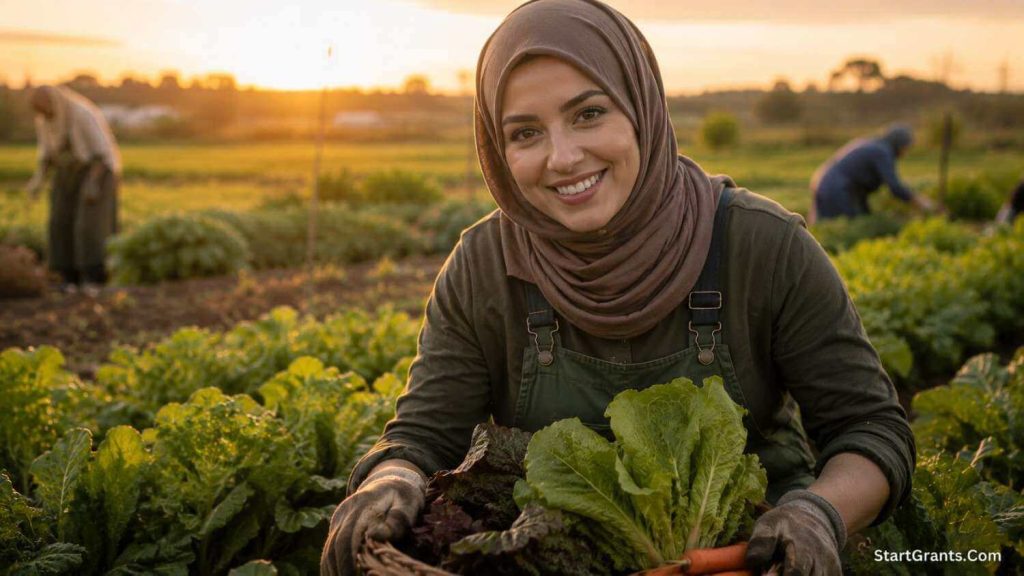
Muslim farmers should distinguish nonrepayable assistance from interest-bearing debt and review every contract before accepting funds.
Scams and Misleading Claims to Avoid
- “Every woman gets 90% funding”: Payment rates depend on the program, practice, contract, and whether the applicant meets the applicable category.
- “USDA grants buy any farm or tractor”: Most federal grants have a defined public purpose and narrow allowable-cost rules.
- “BFRDP gives startup checks”: BFRDP funds qualifying partnerships that serve beginning farmers; individuals cannot apply directly.
- “Targeted FSA money is a grant”: Targeted funds remain loans and must be repaid.
- “WOSB certification comes with money”: Federal contracting certification is not a grant and does not guarantee a contract.
- “Pay a processing fee to release your award”: Do not send gift cards, cryptocurrency, or banking credentials in response to an unsolicited grant message.
Frequently Asked Questions
Is there a government farm grant exclusively for women?
There is no standing federal grant that every woman farmer can claim solely because of gender. Women may qualify for project grants, conservation assistance, loans, training, or state and local programs when they meet each program’s applicant, farm, location, and project requirements.
Does being a woman automatically make a USDA applicant socially disadvantaged?
No universal rule applies across all USDA programs. Current NRCS guidance defines socially disadvantaged status by racial or ethnic prejudice, while FSA loan funding expressly includes women in its targeted categories. Applicants should use the definition in the specific program’s current rules.
Can a woman receive a federal grant to buy farmland?
Federal programs generally do not provide unrestricted personal grants to purchase a farm. FSA farm ownership loans may finance eligible land purchases, but they are debts that must be repaid. Some private or local programs may support land-access planning or limited project costs under their own rules.
Is EQIP a grant?
EQIP is better described as technical and financial assistance provided through an NRCS conservation contract. Applications are ranked, payments are tied to approved practices and payment schedules, and participants must complete the agreed conservation work.
How much can an eligible producer receive in advance through EQIP?
NRCS states that the historically underserved advance-payment option provides at least 50% of the contracted payment for each approved practice before implementation. The money must be used within 90 days for authorized materials or services, and unused funds must be returned.
Is the Value-Added Producer Grant open now?
No. The FY 2026 VAPG application window closed on April 22, 2026, at 1:00 p.m. Eastern Time. Monitor the official USDA Rural Development page for a future notice and do not assume that award limits or rules will remain unchanged.
Can an individual woman farmer apply directly for BFRDP?
No. NIFA states that BFRDP applications must come from a qualifying collaborative network or partnership. An individual farmer may receive training or technical assistance from a funded project but cannot submit the federal BFRDP application herself.
Are FSA microloans grants for women?
No. FSA microloans are repayable loans, even though FSA targets part of its loan funding to women and other specified applicants. The current maximum is $50,000 for either an operating or farm-ownership microloan, subject to eligibility and underwriting requirements.
Where should a woman look for smaller farm grants?
Check the official websites of the state department of agriculture, local conservation district, Tribal government, Cooperative Extension, regional SARE program, and reputable agricultural nonprofits. Verify the current application page because location, deadlines, eligible costs, and applicant types change.
Are farm grants taxable or repayable?
Tax treatment depends on the recipient, program, and use of funds. A legitimate grant is not an ordinary loan, but an agency or sponsor may recover money used for unallowable costs or after a breach of the agreement. Keep records and consult a qualified tax professional about the actual award.
Bottom Line
Women farmers have access to meaningful USDA and nonprofit resources, but gender alone does not guarantee a grant, priority score, or higher payment. Begin with the exact need, identify the correct agency, and verify whether the opportunity is a grant, conservation contract, reimbursement, loan, or service. As of September 10, 2026, major 2026 rounds such as VAPG, BFRDP, and AFT’s National Farm Viability Grant are closed, while EQIP continues accepting applications subject to state ranking dates and available funds.
Important disclaimer: StartGrants.com is an independent information portal. It is not a government agency, grantmaker, application administrator, lender, law firm, tax adviser, or religious authority. StartGrants.com does not issue grants, loans, conservation contracts, certifications, legal advice, tax advice, or fatwas. Program availability, deadlines, eligibility, award amounts, payment rates, fees, matching requirements, and terms can change. Verify every opportunity with the responsible agency or sponsor and seek qualified professional guidance for your circumstances.