Last Updated: | Author: Munir Ardi
Most farmers cannot get a federal grant simply to buy a tractor, combine, pickup, or other ordinary machinery. The practical federal options are usually repayable USDA Farm Service Agency (FSA) loans, financing for eligible storage and handling equipment, or project-based assistance tied to conservation or energy improvements. True equipment grants are narrower and may be limited to institutions, nonprofit intermediaries, or a specific public-purpose project.
This guide explains which programs may support farm equipment, which ones do not, and how to approach an application without confusing a grant with a loan or cost-share contract. For the broader funding landscape, start with our agriculture grants and farm assistance overview.
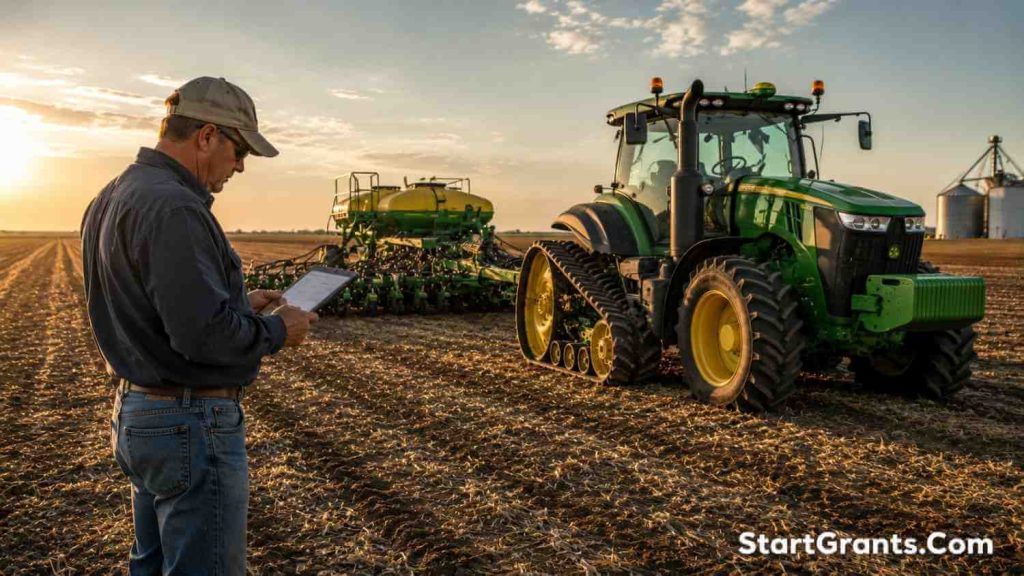
Farm equipment may be financed through a loan or supported as part of an eligible conservation, storage, or energy project; it is not automatically grant-funded.
Can You Get a Government Grant for Farm Equipment?
Sometimes—but usually not for a stand-alone purchase of ordinary machinery. A federal opportunity may help when the equipment is an eligible part of a defined project, such as installing an approved conservation practice or improving a rural business’s energy efficiency. The award document, conservation plan, or loan rules determine what is eligible; the equipment name alone does not.
For a standard tractor or other machinery needed to operate a farm, an FSA Direct Operating Loan or FSA Microloan is often a more realistic federal route. These are loans, not grants, and must be repaid.
Farm Equipment Funding Options at a Glance
| Funding route | What it is | Potential equipment use | Current point to verify |
|---|---|---|---|
| FSA Direct Operating Loan or Microloan | Repayable federal loan | Farm equipment and other eligible operating needs | Loan amount, rate, repayment ability, security, and program eligibility |
| Farm Storage Facility Loan (FSFL) | Low-interest FSA loan | Eligible on-farm storage facilities and handling equipment | Commodity, facility or equipment type, down payment, security, and loan term |
| NRCS EQIP | Conservation assistance delivered under a contract | Implementation of approved conservation practices; not a general machinery shopping fund | Local priorities, ranking, contract terms, and state payment schedule |
| USDA REAP | Energy-project financing | Eligible renewable-energy systems or energy-efficiency improvements | As of this update, USDA says REAP grant applications are not being accepted; guaranteed-loan applications may be submitted |
| Value-Added Producer Grant (VAPG) | Competitive planning or working-capital grant | Does not pay for equipment purchases | The FY 2026 application period closed at 1:00 p.m. Eastern Time on April 22, 2026; monitor USDA for any future notice |
| NIFA Equipment Grants Program | Competitive research-equipment grant | Shared special-purpose scientific equipment at eligible institutions—not an individual farmer’s tractor | The FY 2026 competition closed at 5:00 p.m. Eastern Daylight Time on June 25, 2026; monitor NIFA for a future notice |
Status note: Program availability, funding notices, interest rates, payment schedules, and application periods can change. Always confirm the current terms on the official page before committing to a purchase.
1. FSA Loans for Tractors and Other Farm Machinery
FSA operating financing is the clearest federal option when the primary goal is to purchase equipment used in regular farm operations. Eligible uses of Direct Operating Loans include purchasing farm equipment, while the Microloan program provides a smaller and streamlined loan option for eligible operations. The official maximum for an FSA Operating Microloan is $50,000.
A loan officer still evaluates eligibility and repayment ability. Depending on the program and circumstances, the file may also involve collateral, a feasible farm operating plan, production history, training or management experience, and other documentation. FSA publishes current rates on its monthly interest-rate page; do not rely on a rate quoted in an old article.
Direct versus guaranteed FSA loans
With a direct loan, FSA is the lender. With an FSA guaranteed loan, a commercial lender makes and services the loan while FSA guarantees part of the lender’s loss exposure. The interest rate and underwriting process are not the same. Ask the USDA Service Center and participating lenders which route fits the purchase before allowing a dealer to structure the transaction.
2. Farm Storage Facility Loans for Eligible Handling Equipment
The Farm Storage Facility Loan Program is narrower than a general machinery loan. It finances eligible on-farm storage and handling facilities and equipment for qualifying commodities. Official terms can run from three to 12 years, depending on the amount and collateral. This program is worth checking for a storage or handling project, but it should not be presented as a free-equipment grant.
3. EQIP: Assistance for a Conservation Practice, Not a Free Tractor
The Environmental Quality Incentives Program (EQIP), administered by USDA’s Natural Resources Conservation Service (NRCS), provides technical and financial assistance to eligible agricultural producers and landowners who address natural-resource concerns. Applications are accepted continuously, but states use ranking periods and available funds to select projects.
EQIP does not have a universal list promising reimbursement for a no-till drill, GPS unit, tractor, or other named machine. The producer and NRCS develop an eligible conservation plan, and the contract identifies the approved practices and payments. Rates vary by state and activity, so check the current NRCS payment schedules and local rules.
Historically underserved participants may qualify for higher payment rates or an advance payment option. The advance is not an automatic 90% equipment reimbursement: NRCS explains that at least 50% of the contracted practice payment may be advanced for eligible materials or contracting services and generally must be used within 90 days. For related conservation and certification pathways, see our organic farming grants and assistance guide.
4. REAP for Energy Projects
The Rural Energy for America Program (REAP) supports eligible rural small businesses and agricultural producers pursuing renewable-energy systems or energy-efficiency improvements. Depending on the project, eligible costs may involve energy-efficient equipment or systems. The applicant must establish that the project—not merely a preferred machine—fits the program’s technical and financial rules.
Current status: As of September 13, 2026, the official USDA REAP page says the agency is not accepting REAP grant applications. Guaranteed-loan applications may be submitted. A guaranteed loan is repayable debt, not a grant. Check the official page and contact the state Rural Development energy coordinator before ordering equipment or beginning work.
5. Programs Commonly Misrepresented as Equipment Grants
Value-Added Producer Grants
The Value-Added Producer Grant can support eligible planning or working-capital expenses for a value-added agricultural project, subject to the applicable notice and matching requirement. It does not pay for equipment purchases. An eligible award might support supplies or marketing and indirectly free other business funds, but applicants should not put a bottling line, commercial kitchen appliance, or processor in the VAPG budget as an equipment cost. The FY 2026 application period closed at 1:00 p.m. Eastern Time on April 22, 2026; do not assume a future round will use the same dates or terms.
NIFA Equipment Grants Program
The National Institute of Food and Agriculture’s Equipment Grants Program is real, but it is designed for eligible colleges and universities seeking shared, special-purpose scientific equipment. It is not a source of tractors for individual farmers. The FY 2026 application period ended at 5:00 p.m. Eastern Daylight Time on June 25, 2026. Our USDA NIFA grants and eligibility overview explains why many NIFA awards go to institutions, agencies, or organizations rather than directly to a farm owner.
SARE producer grants
Sustainable Agriculture Research and Education (SARE) grants support research and education projects. SARE states that its grants generally cannot fund large purchases of land, equipment, or capital improvements, although a reasonable share of a project budget may cover materials needed to conduct the research. Treat a SARE grant as project funding, not as a machinery-purchase program.
How to Match the Equipment to the Right Funding Route
- Define the operational problem. Write down what the equipment must accomplish—planting capacity, cold storage, manure management, water efficiency, energy savings, or another measurable need.
- Separate the item from the project. A tractor purchase is an asset request. A conservation or energy project has a defined outcome, technical specifications, timeline, and approved budget.
- Identify the correct financial instrument. Decide whether the realistic route is a loan, conservation contract, guaranteed loan, state reimbursement, local grant, or institutional research award.
- Speak with the administering office before purchasing. Many programs do not reimburse costs incurred before authorization or a signed agreement.
- Compare total cost. Include freight, dealer fees, taxes, installation, insurance, maintenance, training, and the cash needed while waiting for a payment or reimbursement.
Location and farm type can change the options. Urban producers can review our urban farming grant and assistance guide, while producers in Hawaii should account for state programs, shipping, and island-specific eligibility through our Hawaii agriculture grants guide. Women producers can also use our farm funding guide for women to distinguish targeted loan funds and outreach resources from actual grants.
Application Steps
Start at the local USDA Service Center
Use the USDA Service Center Locator to contact FSA and NRCS. The staff can explain the records needed for the specific program and help determine whether the proposed purchase belongs in a loan file or an eligible conservation plan. Do not assume every applicant must complete identical registrations before the first conversation.
Build a purchase file
Prepare a written description of the need, dealer quotes, specifications, expected useful life, repair history for replaced equipment, projected revenue or cost savings, cash-flow estimates, and a list of other financing sources. For an energy project, obtain the assessment, audit, vendor certifications, or technical documents required for that project’s size and technology. For a conservation project, use the practice and payment information approved by NRCS rather than a dealer’s description.
Confirm timing and registrations
Ask whether the program prohibits starting work, signing a binding purchase contract, or paying a deposit before approval. Organizational grant applications through Grants.gov may require SAM.gov registration and a Unique Entity ID, but an individual farm-loan application through a USDA Service Center follows a different process. Register only for the system the official instructions require.
Save This Farm Equipment Funding Checklist
- [ ] Describe the production, storage, conservation, or energy problem the equipment will solve.
- [ ] Decide whether you need a grant, cost-share contract, direct loan, or guaranteed loan.
- [ ] Obtain itemized quotes with model, capacity, installation, freight, and warranty details.
- [ ] Check the official program page for current status, deadlines, rates, and eligible costs.
- [ ] Ask the administering office whether a purchase or deposit made now would be ineligible.
- [ ] Prepare farm records, cash-flow projections, tax returns, and ownership or lease documents requested for the route.
- [ ] Confirm matching funds, down payment, collateral, reimbursement timing, and reporting duties.
- [ ] Keep the approval, contract, invoices, proof of payment, serial numbers, and project records together.
Costs and Contract Terms to Review
Do not compare programs by the advertised assistance percentage alone. Review the complete transaction:
- Repayment: Loans require principal and interest payments even when a project does not produce the expected savings or revenue.
- Matching funds or borrower contribution: Some grants and loans require cash or eligible third-party contributions.
- Reimbursement timing: A cost-share payment may arrive after an approved practice is installed and certified.
- Ownership and useful-life requirements: Selling or changing the use of an assisted asset may violate the agreement.
- Clawback and default: Misuse of funds, false statements, early disposal, or failure to complete the project may trigger repayment or other remedies.
- Taxes: A grant, cost-share payment, debt forgiveness, or financed asset can have different tax consequences. Ask a qualified tax professional about the actual transaction.
Common Mistakes and Farm Funding Scams
- Buying first and asking later. Pre-award purchases may be ineligible.
- Calling every program a grant. FSA operating and storage programs are loans; EQIP assistance is governed by a conservation contract.
- Using a national percentage without checking the state schedule. EQIP rates and available practices vary.
- Putting equipment in a VAPG budget. VAPG does not cover equipment purchases.
- Applying to an institution-only opportunity. NIFA’s Equipment Grants Program is not an individual-producer tractor program.
- Paying someone who promises a guaranteed award. Government agencies do not guarantee approval because an applicant pays a consultant or processing fee.
- Sharing banking or identity information with an unofficial site. Confirm the web address and staff contact through USDA.gov, Farmers.gov, Grants.gov, or the relevant state agency.
A Muslim Perspective: Evaluating Equipment Funding and Riba
Muslim farmers may wish to distinguish nonrepayable assistance from debt before signing. A genuine grant or conservation payment may resemble a gift or restricted assistance, but the award can still contain matching requirements, permitted-use rules, reporting duties, and repayment or clawback clauses. Read the actual agreement instead of assuming that every program labeled “grant” has the same legal or religious character.
FSA direct loans, FSA guaranteed loans, dealer financing, and many commercial equipment loans involve interest. Farmers concerned about riba can compare non-debt assistance, retained earnings, community support, a documented qard hasan arrangement, leasing, or an asset-sale or partnership structure reviewed for the specific circumstances. A contract called murabaha, lease-to-own, or profit-sharing should not be treated as compliant based on its label alone; ownership, risk, price, late-payment terms, insurance obligations, and default remedies all matter.

Muslim farmers concerned about riba should review the complete equipment contract, not just the product label, with qualified advisers.
If zakat funds, sadaqah, a mosque, or another community organization may assist, confirm the fund’s eligibility rules and whether assistance is restricted to basic needs, productive assets, or another approved purpose. Treatment of farm inventory, harvested crops, cash, debts, and productive equipment can depend on facts and scholarly approach. For individualized guidance, consult a qualified Islamic finance scholar and, where appropriate, an attorney and tax professional.
Frequently Asked Questions
Are there government grants for farm equipment?
There is no universal federal grant that lets any farmer buy ordinary machinery. Some programs may support equipment or materials within an approved conservation, energy, research, or local development project, while standard tractors and machinery are more commonly financed with repayable loans.
Can USDA give me a free tractor?
USDA does not advertise a general free-tractor program for individual farmers. A tractor may be financed through an eligible FSA loan, but a loan must be repaid. State, tribal, nonprofit, or disaster programs may occasionally have narrower assistance, so verify the sponsor, current rules, and eligible costs.
Can an FSA Operating Loan pay for farm equipment?
Yes. FSA lists farm equipment as an eligible use of Direct Operating Loan funds. Approval is not automatic; the applicant must meet the program’s eligibility, feasibility, repayment, security, and documentation requirements.
What is the maximum FSA Operating Microloan amount?
The official maximum for an FSA Operating Microloan is $50,000. Interest rates and other terms can change, so check FSA’s current rate page and discuss the proposed equipment purchase with a loan officer.
Does EQIP buy farm equipment?
EQIP provides assistance under a conservation plan and contract for approved practices; it is not a general equipment-purchase grant. Whether materials, installation, or contracted work qualifies depends on the approved practice, state payment schedule, and signed agreement.
Is REAP accepting farm equipment grant applications?
As of September 13, 2026, USDA says it is not accepting REAP grant applications. The official page says guaranteed-loan applications may be submitted, but those are repayable loans. Recheck the USDA page because availability can change.
Can VAPG pay for processing equipment?
No. USDA states that the Value-Added Producer Grant does not cover equipment purchases. It may fund eligible planning or working-capital costs under a current notice, subject to applicant eligibility, matching requirements, and the approved budget.
Who can apply for the NIFA Equipment Grants Program?
The program serves eligible colleges and universities seeking shared, special-purpose scientific equipment. It is not an individual-farmer machinery grant. The FY 2026 competition closed at 5:00 p.m. Eastern Daylight Time on June 25, 2026, and any future round will have its own notice and rules.
Can an FSFL finance storage and handling equipment?
Yes, if the facility or equipment and commodity meet Farm Storage Facility Loan rules. FSFL is a low-interest loan, not a grant, and the borrower must satisfy the applicable down-payment, security, repayment, and documentation requirements.
Do I need SAM.gov registration or a UEI?
It depends on the program. An organization applying for a federal grant through Grants.gov may need active SAM.gov registration and a Unique Entity ID. A farmer seeking an FSA loan or working with NRCS through a USDA Service Center follows that program’s records and application process instead.
Bottom Line
The best route depends on why the equipment is needed. Use FSA loan programs for ordinary machinery and eligible operating needs, FSFL for qualifying storage and handling projects, EQIP for approved conservation practices, and the currently available REAP guaranteed-loan route for eligible energy projects. Do not plan an equipment purchase around VAPG or NIFA’s institution-focused Equipment Grants Program.
Contact the responsible office before signing a purchase agreement, verify the current status and payment rules, and compare the full cost of debt or reimbursement—not just the advertised assistance.
Important disclaimer: StartGrants.com is an independent information portal. It is not USDA, a government agency, grantmaker, application administrator, lender, law firm, tax adviser, or religious authority. StartGrants.com does not issue grants, loans, conservation contracts, legal advice, tax advice, financial advice, or fatwas. Program availability, deadlines, eligibility, award amounts, loan limits, interest rates, payment schedules, and terms can change. Verify every opportunity with the responsible agency or sponsor and seek qualified professional guidance for your circumstances.