Last Updated: | Author: Munir Ardi
USDA NIFA grants primarily fund research, education, Extension, workforce development, and community projects in food and agriculture. They are not a general source of personal cash for buying a farm, paying household bills, or covering routine farm expenses. Some NIFA notices allow individuals or businesses to apply, but many are limited to colleges, nonprofits, government agencies, Tribal organizations, or partnerships.
If you are looking beyond NIFA, start with our broader overview of agriculture grants and USDA assistance. That distinction matters because the right program may be a NIFA project grant, a Farm Service Agency loan, an NRCS conservation contract, or a regional SARE grant.

NIFA commonly supports agricultural research, education, and Extension projects rather than unrestricted farm startup costs.
What NIFA Funds
The National Institute of Food and Agriculture is a USDA agency that advances agriculture-related sciences. Its portfolio includes competitive grants, capacity grants, and other funding mechanisms supporting research, education, and Cooperative Extension. A successful application must fit a specific Notice of Funding Opportunity, commonly called a NOFO.
Depending on the program, funded work may address plant or animal health, food safety, nutrition, agricultural technology, natural resources, rural communities, workforce education, beginning-farmer training, or outreach. The award is tied to an approved project, budget, performance period, reporting duties, and federal terms. It is not unrestricted “free money.”
NIFA Grants Compared With Other USDA Assistance
| Funding route | What it supports | Who normally applies | Important distinction |
|---|---|---|---|
| NIFA competitive grant | A defined research, education, Extension, or integrated project | Eligibility varies by NOFO and may include institutions, organizations, agencies, businesses, partnerships, or individuals | The proposal must advance the program’s public purpose; ordinary farm purchases are not automatically eligible |
| FSA farm loan | Eligible farm ownership, operating, or emergency financing | Eligible farmers and ranchers | It is repayable debt, whether made directly by FSA or through a guaranteed lender |
| NRCS EQIP assistance | Selected conservation practices under an approved plan and contract | Eligible agricultural producers and nonindustrial private forest managers | Applications are ranked; assistance and payment schedules vary by state and practice |
| Regional SARE grant | Research and education projects advancing sustainable agriculture | Applicant types and award categories vary among the four SARE regions | Some regional programs accept farmer-led proposals; applicants follow the regional call, not a general NIFA application |
| NIFA-funded local service | Training, outreach, technical assistance, or scholarships delivered by an award recipient | An eligible institution or organization applies to NIFA; people participate through the funded project | A farmer or student may be a beneficiary without being the federal grant applicant |
For official comparisons, review the FSA Farm Loan Programs, the NRCS Environmental Quality Incentives Program, and SARE grant information.
Who Can Apply Directly?
There is no single eligibility rule for every NIFA program. The current NOFO controls. Depending on the competition and project type, eligible applicants may include land-grant universities, other colleges, state or local governments, federally recognized Tribes, Tribal organizations, nonprofit organizations, for-profit businesses, small businesses, agricultural experiment stations, or individuals.
An individual farmer should not assume that being part of the target audience makes the farmer eligible to submit the federal application. For example, the Beginning Farmer and Rancher Development Program supports education, mentoring, and technical assistance for beginning producers, but applications must come from an eligible collaborative network or partnership. NIFA expressly excludes applications from individuals and from organizations applying without a qualifying partnership.
NIFA Funding Status as of September 12, 2026
The following snapshot uses NIFA’s official funding pages. Deadlines and eligibility can change through amendments, and AFRI includes program-area deadlines that may differ from the date displayed on its umbrella page. Always open the current NOFO before preparing an application.
| Program | Status checked September 12, 2026 | Primary applicant | What readers should know |
|---|---|---|---|
| AFRI Foundational and Applied Science | Open umbrella opportunity; page lists December 31, 2026, but program-area dates vary | Eligibility varies by project type and can include institutions, organizations, businesses, and individuals | The current NOFO identifies the applicable priority, deadline, project type, budget cap, and matching rule |
| Hispanic-Serving Institutions Education Grants Program | Open; closes December 3, 2026 | Eligible Hispanic-Serving Institutions and qualifying partners described in the NOFO | Supports institutional education, applied research, and related community-development capacity |
| 1890 Institution Teaching, Research and Extension Capacity Building Grants | Open; closes November 4, 2026 | Eligible 1890 land-grant institutions | This is institutional capacity funding, not a direct farm grant |
| National Needs Graduate and Postgraduate Fellowship | Open; closes October 15, 2026 | Eligible higher-education institutions | The institution applies to support graduate training; a student does not submit the NIFA application directly |
| Beginning Farmer and Rancher Development Program | FY 2026 closed; deadline was June 16, 2026 | A qualifying collaborative network or partnership | Individuals cannot apply directly. The program generally requires a 25% match, subject to the statutory waiver rules described by NIFA |
| Organic Agriculture Research and Extension Initiative | FY 2026 closed; deadline was May 14, 2026 | Eligible institutions, organizations, businesses, and individuals listed in the NOFO | Funds high-priority research, education, and Extension projects benefiting organic agriculture; it is not a routine organic-farm operating subsidy |
| Gus Schumacher Nutrition Incentive Program | FY 2026 closed; Nutrition Incentive deadline was June 16 and Produce Prescription deadline was July 16, 2026 | Eligible organizations and project partnerships identified in the applicable NOFO | Projects connect food access, nutrition, retail, agriculture, and health partners; the federal award is not personal cash for consumers |
Check the live NIFA Funding Opportunities page for new notices, amendments, and current closing dates.
Programs Often Mistaken for Direct Farm Grants
Beginning Farmer and Rancher Development Program
BFRDP funds organizations and partnerships that train and assist beginning farmers and ranchers. A producer may receive education, mentoring, or technical assistance from a funded project, but cannot apply as an individual for the federal BFRDP award. Our focused explanation of the Beginning Farmer and Rancher Development Program explains the difference between the applicant and the participant.
Opportunities for women farmers
NIFA does not maintain a standing, unrestricted cash grant that every woman farmer can claim. Women may be eligible applicants, partners, participants, or priority beneficiaries under particular programs, but the current NOFO still controls entity type, project purpose, location, and other requirements. See our article on government farm assistance for women for a broader comparison of grants, loans, conservation assistance, and training.
SARE farmer and rancher grants
SARE is supported through NIFA, but farmer-facing competitions are administered by regional SARE programs. Some regions accept producer-led research and education proposals. Award types, geographic eligibility, deadlines, project length, payment schedules, and permitted costs differ, so use the official regional call rather than assuming rules from another region.
Match Your Agricultural Idea to the Right Funding Path
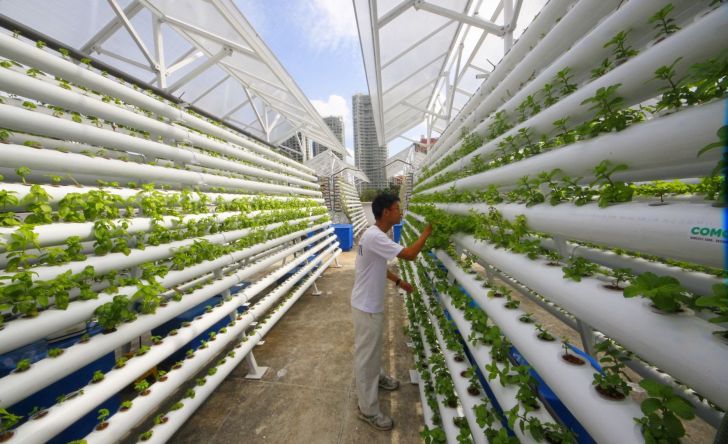
A project topic does not establish eligibility by itself. A hydroponic greenhouse, apiary, or organic farm may fit a research or education competition, an NRCS practice, a state program, or no grant at all. These topic guides can help you identify the right agency before investing time in a proposal:
- Urban farming grant and assistance options for food access, community, education, and production projects.
- Grants and assistance for beekeeping for pollinator, research, conservation, and producer needs.
- Farm equipment grants and financing alternatives if your primary need is machinery rather than a research or education project.
How to Apply for a NIFA Grant
1. Start with the NOFO, not a general idea
Search the official NIFA funding page and open the current NOFO. Confirm the assistance listing number, closing date and time zone, eligible applicant types, program priorities, project types, award range, project period, cost-sharing rule, and submission instructions. The NOFO and its amendments control when a summary page conflicts with older guidance.
2. Test both applicant and project eligibility
Separate two questions: Is your entity eligible to apply, and is your proposed work responsive to a listed program-area priority? Passing only one test is not enough. Also confirm whether a partnership, institutional accreditation, land-grant status, geographic service area, or prior experience is required.
3. Contact the program team before the deadline
NIFA funding pages identify program contacts. Ask concise questions that the published documents do not answer. Program staff can clarify rules but cannot promise an award or write the proposal for you.
4. Complete federal registrations early
Organization applicants generally need an active SAM.gov registration and Unique Entity Identifier, followed by Grants.gov registration and appropriate workspace roles. These steps can take time, and SAM registration must be renewed. Do not pay an unofficial service that claims it can guarantee registration or grant approval. Follow NIFA’s official How to Apply instructions and the application guide attached to the specific opportunity.
5. Build a compliant work plan and budget
Connect each activity to a program objective, measurable result, responsible team member, timeline, and allowable cost. Explain why the work adds public value beyond the applicant’s ordinary commercial operations. If matching funds are required, document the source, valuation, availability, and any restrictions. Never assume that volunteer time, donated equipment, land value, or another federal award is an allowable match.
6. Submit before the last day
Upload the complete package through the required system, resolve validation errors, and retain the submission confirmation. A late application or missing attachment may be rejected even when the project idea is strong.
Read the Financial and Legal Terms Carefully
- Matching funds: Requirements vary. Some programs have no match, while others require cost sharing or apply it only to certain project types. Waivers are available only when authorized and approved.
- Allowable costs: The approved budget, NOFO, award terms, and federal cost principles determine what may be charged. A cost being useful does not automatically make it allowable.
- Payment method: Do not assume every award is reimbursement-only. NIFA awards may use authorized drawdowns or another payment method specified in the award documents.
- Reporting and records: Recipients may have financial, performance, property, subaward, and closeout duties. Keep contemporaneous records and follow prior-approval rules.
- Repayment and disallowed costs: A grant is not an ordinary loan, but misspent, unsupported, or unallowable costs can be disallowed and become repayable.
- Tax, data, and intellectual property: Federal awards can carry tax, publication, data-management, invention, licensing, acknowledgment, and public-record implications. Review the actual award with qualified advisers.
Save This NIFA Application Checklist
- [ ] Download the current NOFO and every amendment.
- [ ] Confirm that the applicant type and project type are both eligible.
- [ ] Record the deadline, time zone, assistance listing number, and Grants.gov opportunity number.
- [ ] Verify SAM.gov, UEI, Grants.gov, and workspace access well before submission.
- [ ] Match the narrative, work plan, evaluation measures, and budget to the same objectives.
- [ ] Document required partners, letters, subawards, and cost sharing.
- [ ] Check allowable costs, indirect-cost rules, and prior-approval requirements.
- [ ] Submit early enough to correct validation errors.
- [ ] Save the final application, confirmation, NOFO, and all award-related records.
A Muslim Perspective: Reviewing Agricultural Grant Terms
A grant may help a Muslim applicant avoid an interest-bearing loan, but the word “grant” alone does not determine whether every term or use is appropriate. Review the actual agreement, including matching requirements, prohibited activities, reporting duties, clawback provisions, intellectual-property terms, and any bridge financing needed before federal funds become available.
If a match is required, consider permissible cash reserves, documented in-kind contributions allowed by the NOFO, philanthropic support, or a properly structured qard hasan rather than automatically using interest-bearing credit. Project activities and revenue sources should also be reviewed for halal compliance. Questions about zakat on crops, livestock, cash, receivables, equipment, or grant funds depend on ownership, use, timing, thresholds, and scholarly interpretation; a universal percentage should not be applied without analysis.
For a material award, consult a qualified Islamic finance scholar together with an attorney and tax professional who can read the same grant documents. This section is general educational information, not a fatwa.
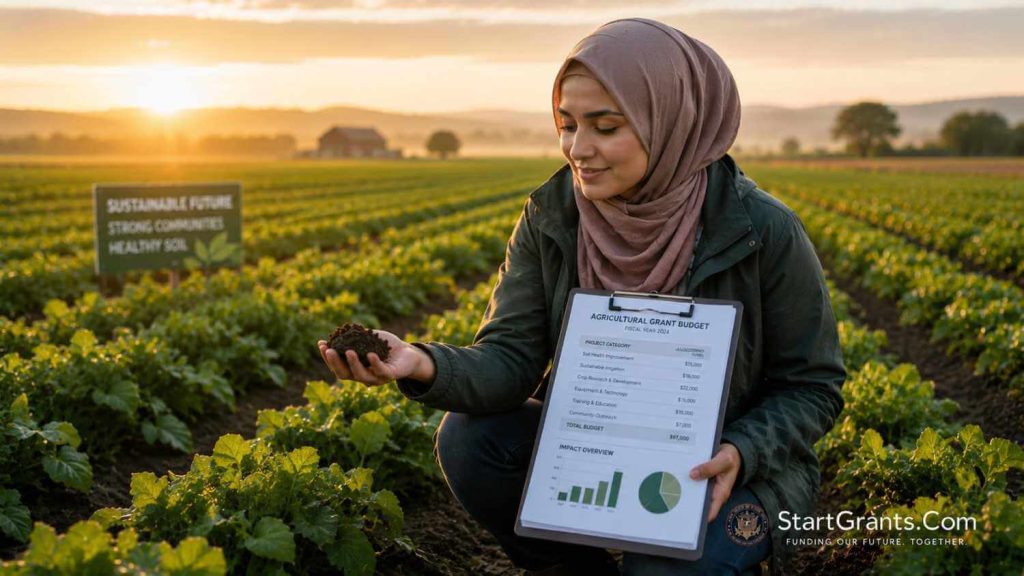
Muslim applicants should review the actual funding agreement, project activities, matching source, and repayment risks before accepting an award.
Common Mistakes and Grant Scams
- Applying as the wrong entity: A farmer may be an intended beneficiary but not an eligible federal applicant.
- Treating a business purchase as research: Buying a tractor, greenhouse, livestock, or land does not become an eligible NIFA project merely because data will be collected.
- Using an expired announcement: Archived webinars and old NOFOs can help with background, but they do not establish current eligibility or deadlines.
- Ignoring the match: An unsupported match can make an otherwise promising proposal noncompliant.
- Paying for a guarantee: USDA does not authorize private services to guarantee a federal award. Be cautious with unsolicited messages, application fees, gift-card requests, or demands for banking credentials.
- Confusing loans and contracts with grants: FSA loans are repayable, while NRCS assistance is tied to a conservation contract and approved practices.
Frequently Asked Questions
What is USDA NIFA?
The National Institute of Food and Agriculture is a USDA agency that supports research, education, and Extension in agriculture, food, natural resources, and related sciences through competitive grants, capacity funding, and other programs.
Does NIFA give grants directly to farmers?
Sometimes, but only when a current NOFO lists individuals or the farmer’s business type as eligible and the proposed project fits the stated purpose. Many NIFA awards go to institutions, organizations, agencies, or partnerships that serve farmers through research, education, or technical assistance.
Can NIFA pay for land, tractors, seed, or normal operating costs?
Not as a general farm startup or operating subsidy. A specific cost may be allowable only when the NOFO permits it, it is necessary for the approved project, and it is included in an approved budget. FSA loans, NRCS assistance, or other programs may be a better fit for ordinary farm needs.
Who is eligible for AFRI?
AFRI eligibility varies by project type and program-area priority. The official page lists a broad group that can include institutions, nonprofit and for-profit organizations, small businesses, and individuals, but restrictions apply to certain integrated projects. The current NOFO controls.
Is BFRDP a direct grant for beginning farmers?
No. BFRDP funds qualifying networks and partnerships to provide education, mentoring, outreach, and technical assistance. NIFA states that individuals and organizations applying without a qualifying partnership are not eligible for the federal award.
Are there NIFA grants specifically for women farmers?
NIFA does not offer a standing unrestricted grant that every woman farmer can claim. Women may qualify as applicants, partners, or participants under particular programs, but each NOFO determines the eligible applicant, project purpose, location, and terms.
How do farmers apply for SARE grants?
Farmers should identify their SARE region and use that region’s current call for proposals. Applicant categories, deadlines, award limits, payment schedules, and project requirements vary among the Northeast, North Central, Southern, and Western regions.
Do NIFA applications require SAM.gov and a UEI?
Organization applicants generally need an active SAM.gov registration and Unique Entity Identifier, followed by Grants.gov registration and appropriate workspace access. Applicants should follow the registration instructions in the current NOFO and NIFA application guide and start well before the deadline.
Do NIFA grants require matching funds?
It depends on the program and project type. Some opportunities have no match, while others require cost sharing or apply it only in defined circumstances. Use the current NOFO and NIFA matching guidance, and do not assume that a waiver or a proposed contribution will be accepted.
Are NIFA grants taxable or repayable?
A NIFA grant is not an ordinary loan, but tax treatment depends on the recipient and use of funds. Unallowable, unsupported, or misspent costs may be disallowed and become repayable. Recipients should review the award with a qualified tax professional and comply with all reporting and recordkeeping duties.
Bottom Line
NIFA is a strong source of competitive funding for agricultural research, education, Extension, and public-purpose projects, but it is not a universal farm cash program. Begin with the live funding page, verify applicant eligibility and project fit in the current NOFO, and distinguish direct applicants from people who receive services through an award. If your goal is land, operating capital, conservation work, or a producer-led sustainability project, compare FSA, NRCS, and regional SARE options before choosing a route.
Important disclaimer: StartGrants.com is an independent information portal. It is not a government agency, grantmaker, application administrator, lender, law firm, tax adviser, or religious authority. StartGrants.com does not issue grants, loans, contracts, legal advice, tax advice, or fatwas. Program availability, deadlines, eligibility, award amounts, matching requirements, payment methods, and terms can change. Verify every opportunity with the responsible agency or sponsor and seek qualified professional guidance for your circumstances.