Last Updated: | Author: Munir Ardi
Government support for raising honey bees is available, but most programs are not unrestricted startup grants for buying colonies, hives, land, or extraction equipment. The strongest federal routes serve different purposes: SARE funds research and education projects; NRCS conservation programs may help establish pollinator habitat; ELAP assists with qualifying honey bee losses; the FSA Honey Program provides marketing loans or loan deficiency payments; and Value-Added Producer Grants may support eligible processing or marketing projects during an open competition.
Before choosing a program, review our broader agriculture grants and farm funding overview. It explains why a grant, conservation contract, disaster payment, commodity loan, and farm operating loan should not be treated as the same type of assistance.

Beekeepers should match each expense or loss to the correct program instead of assuming that a general USDA startup grant is available.
Honey Bee Funding Options at a Glance
The following status and program details were checked against official sources on September 14, 2026. Regional deadlines, payment schedules, eligibility rules, and future funding rounds can change.
| Program or route | Type of assistance | Potential beekeeper use | Current status or key limitation |
|---|---|---|---|
| SARE regional grants | Competitive research and education grant | An on-farm trial involving pollinator health, production practices, pest management, or marketing, with results shared with other producers | Application types and deadlines vary across four regions. SARE does not fund the ordinary cost of starting a farm and generally does not pay for major land, equipment, animals, or capital purchases. |
| NRCS EQIP or CSP | Conservation technical and financial assistance under an approved plan or contract | Pollinator forage and habitat practices, such as eligible cover crops, wildflowers, native grasses, buffers, or improved land management | Applications are accepted continuously, but state ranking dates apply. Assistance is not automatically available for buying bees or hive boxes. |
| FSA ELAP | Disaster assistance payment | Eligible honey bee colony, hive, and feed losses caused by qualifying adverse conditions | Not startup funding. For 2026 program-year losses, the notice of loss and payment application are due March 1, 2027. A 15% normal mortality rate applies to eligible 2026 colony losses. |
| FSA Honey MAL or LDP | Marketing assistance loan or loan deficiency payment | Harvest-time cash flow for eligible honey producers who retain beneficial interest in the honey | Authorized for crop years 2026–2031. The national loan rate is $1.50 per pound. A MAL generally involves repayment or settlement; an eligible LDP does not require repayment. |
| FY 2026 Value-Added Producer Grant | Competitive planning or working-capital grant with matching funds | An eligible project involving the processing or marketing of a value-added agricultural product | Closed. The FY 2026 deadline was April 22, 2026, at 1:00 p.m. ET. Maximum awards were $50,000 for planning and $200,000 for working capital, with a dollar-for-dollar match. |
| FSA Operating Microloan | Interest-bearing farm loan | Eligible equipment, feed, supplies, repairs, marketing, and operating costs | Up to $50,000, subject to FSA eligibility, credit, management, security, interest, and repayment requirements. It is not a grant. |
1. SARE Grants for Beekeeping Research and Education
The Sustainable Agriculture Research and Education program is one of the clearest grant routes for an established producer who wants to test a practical idea. Pollinators are an eligible topic, and past SARE projects have addressed beekeeper education, mite-resistant queens, bee health, forage, and business sustainability.
However, SARE’s official national grants page says the program funds research and education—not the general cost of starting a farm. It also says major purchases of land, equipment, animals, and capital investments generally are not eligible. Each of SARE’s four regions publishes its own grant types, application calendar, award limits, and detailed budget rules.
What a suitable beekeeper proposal might contain
- A defined production, health, forage, pest-management, or marketing question.
- A repeatable field trial or demonstration rather than a request to buy ordinary inventory.
- Records showing how results will be measured and compared.
- An outreach plan to share useful findings with other producers.
- A budget tied only to allowable project costs in the applicant’s region.
SARE is supported through USDA’s National Institute of Food and Agriculture, but this does not mean every NIFA opportunity accepts an individual beekeeper or pays commercial apiary expenses. Our USDA NIFA grants and eligibility overview explains why universities, research institutions, Extension systems, nonprofits, and other organizations are often the direct applicants for federal research and education funding.
2. NRCS Assistance for Pollinator Habitat
NRCS offers technical and financial assistance to agricultural producers and forest landowners who address documented natural-resource concerns. Its pollinators and honey bees guidance identifies practices that can provide safer and more diverse food sources for pollinators, including cover crops, wildflowers, native grasses, buffers, and improved grazing-land management.
EQIP should be described as conservation assistance, not a general bee grant or an automatic percentage reimbursement. An NRCS planner evaluates the property and develops a conservation plan. The application is ranked using local resource priorities, and the applicant signs a contract before completing the approved practice. Payment rates and available practices vary by state.
The official EQIP page says applications are accepted continuously, but producers should apply by their state’s ranking date to compete in the current cycle. Payment normally follows implementation and inspection, although some qualifying producers may receive an advance payment. Do not purchase materials or begin work based solely on this article; ask NRCS when an expense becomes eligible under the signed agreement.
3. ELAP Assistance for Honey Bee Losses
The Emergency Assistance for Livestock, Honeybees, and Farm-Raised Fish Program is a disaster-assistance safety net administered by FSA. It does not finance a new apiary. The official ELAP page says eligible assistance may cover qualifying honey bee colony, hive, and feed losses associated with colony collapse disorder, eligible adverse weather, and other qualifying conditions.
Starting with program year 2026, FSA uses a 15% normal mortality rate when calculating eligible honey bee colony losses. This does not mean that every loss above 15% will be paid. The producer must still show an eligible cause, acceptable documentation, compliance with program requirements, and loss above the applicable normal mortality level.
For 2026 program-year losses, FSA states that both the notice of loss and application for payment must be submitted to the local FSA office by March 1, 2027. Earlier FSA materials used other notice periods, which is why beekeepers should follow the current program page and contact the local office promptly instead of relying on an older article.
Records that may help support an ELAP claim
- Beginning and ending colony inventories tied to dates and locations.
- Hive, package-bee, queen, and feed purchase records.
- Photographs, inspection notes, weather information, and other evidence of the loss event.
- Management, treatment, feeding, movement, and mortality records.
- Receipts or other documents requested by the local FSA office.
Documentation does not guarantee eligibility or payment. FSA decides whether the loss, cause, quantity, and evidence satisfy current rules.
4. The FSA Honey Program: MALs and LDPs
A significant 2026 development is the return of federal commodity support for honey. The FSA Honey Program authorizes nonrecourse Marketing Assistance Loans and Loan Deficiency Payments for crop years 2026 through 2031.
These are not startup grants. A Honey MAL provides interim financing and may be repaid or settled according to program rules. An LDP is a direct benefit calculated from the applicable loan-rate difference and does not need to be repaid. Producers should ask FSA about beneficial-interest, quantity, quality, storage, AGI, documentation, and deadline rules before selling or transferring control of the honey.
For crop years 2026–2031, the national honey loan rate is $1.50 per pound. Requests may begin April 1 in the year the honey is produced and extracted, and the final availability date is March 31 of the following calendar year. The actual benefit is not automatically $1.50 per pound; the loan or LDP calculation depends on the applicable program rules and market conditions.
5. Value-Added Producer Grants for Honey Products
An eligible honey producer may consider VAPG when the project is about processing or marketing a value-added product rather than buying bees or maintaining ordinary apiary operations. Planning grants can support eligible feasibility studies, business plans, or marketing plans. Working-capital grants may support eligible processing, packaging, advertising, inventory, and personnel costs.
The FY 2026 competition is closed. According to the official FY 2026 VAPG opportunity, applications were due at 1:00 p.m. Eastern Time on April 22, 2026. The competition anticipated approximately $25 million, up to 185 awards, and required matching funds. The official notice set maximums of $50,000 for planning grants and $200,000 for working-capital grants.
Applicants needed to fit one of the eligible producer categories, demonstrate project viability, obtain a UEI and TIN, maintain an active SAM.gov registration, and apply through the Grant Application Portal. These requirements applied to VAPG; they should not be copied onto every beekeeper assistance program. Monitor the official page for a future competition rather than reusing the FY 2026 deadline or terms.
6. Loans and Equipment Financing
If the immediate need is hive bodies, extraction equipment, feed, a vehicle, repairs, land, or working capital, a grant may not be the appropriate tool. FSA Operating Microloans can provide up to $50,000 for eligible farm operating needs, but they carry interest and must be repaid. Eligibility includes credit, management experience or education, farm-plan, citizenship or qualifying immigration, and security requirements.
Before financing an extractor, storage building, forklift, trailer, or other major asset, compare the actual program with our farm equipment grants and financing guide. A low-interest loan, conservation payment, tax incentive, rebate, and competitive grant can produce very different cash-flow and compliance obligations.
7. Organic Honey and Certification Assistance
A beekeeper cannot lawfully use the USDA Organic seal simply because the hives are placed near land described as organic. USDA says honey may be certified under current production and handling standards and must comply with organic labeling rules. The beekeeper should discuss forage, hive management, inputs, processing, storage, records, and labeling with a USDA-accredited certifying agent.
Certification is not itself a startup grant. Cost-share or technical-assistance programs may help with certain certification expenses when available, but eligibility and reimbursement limits must be checked for the applicable year. See our organic farming grants and certification assistance guide, then verify the current requirements with USDA and the selected certifier.
State, Local, and Nonprofit Opportunities
Some of the most practical assistance is local. State departments of agriculture, conservation districts, Extension programs, beekeeper associations, universities, foundations, and local-food organizations may periodically offer research awards, habitat assistance, equipment-sharing programs, training, or small project grants. Availability differs by location and year.
Before listing a local opportunity as active, confirm that the sponsor provides a current application page, eligibility rules, deadline, award amount, and contact information. An old press release describing prior recipients is not proof that a new round is open.
How to Match Your Apiary Need to the Right Program
| Your primary need | Route to investigate | Question to ask first |
|---|---|---|
| Test a new bee-health or production method | Regional SARE producer or partnership grant | Does the project include valid research, measurable results, and producer outreach? |
| Improve nectar, pollen, or pollinator habitat | NRCS conservation planning and possible EQIP or CSP assistance | Does NRCS identify an eligible natural-resource concern and approved practice on this property? |
| Recover from qualifying colony, hive, or feed loss | ELAP | Is the cause eligible, and can the quantity and timing of the loss be documented? |
| Manage cash flow after producing honey | Honey MAL or LDP | Do you retain beneficial interest, and which option produces the correct obligation or benefit? |
| Plan or market an eligible value-added product | Future VAPG competition | Does the applicant, commodity, project, budget, and match satisfy the current notice? |
| Buy routine equipment or cover operating expenses | Savings, partner capital, equipment financing, or an eligible farm loan | Can the apiary repay the obligation under conservative production and price assumptions? |
Save This Honey Bee Funding Checklist
- [ ] Define whether the request concerns research, habitat, disaster recovery, marketing, certification, or operating capital.
- [ ] Confirm the official program status and use the current notice rather than an old award announcement.
- [ ] Record colony, hive, feed, honey-production, treatment, and movement information before a loss occurs.
- [ ] Verify ownership or control of the apiary site and obtain required farm records.
- [ ] Check state apiary registration, inspection, zoning, labeling, food-processing, and sales requirements.
- [ ] Separate ordinary hive and equipment purchases from allowable project expenses.
- [ ] Confirm the deadline and time zone, matching contribution, payment timing, and record-retention rules.
- [ ] Complete SAM.gov, UEI, TIN, farm-number, or other registrations only when the chosen program requires them.
- [ ] Ask the responsible USDA or regional program office to clarify uncertain eligibility before submitting.
- [ ] Keep the application, contract, receipts, photographs, production records, loss evidence, and reports together.
Compliance, Taxes, and Scams
Read the complete agreement before accepting assistance. A grant or conservation contract may restrict expenses, require matching funds, impose procurement standards, specify acknowledgement or publicity language, require progress and financial reports, and allow repayment or recovery when funds are misused. Research projects may also carry data-sharing, publication, or intellectual-property provisions. The exact terms—not the program’s marketing summary—control.
Disaster payments, LDPs, conservation payments, grants, loan proceeds, and loan forgiveness can have different tax and accounting treatment. Ask a qualified tax professional how a particular payment applies to the apiary and its owners. If an award involves partners, land access, product licensing, or intellectual property, appropriate legal review may also be useful.
Avoid anyone who promises approval, sells access to a “secret bee grant,” or disguises an interest-bearing loan as free funding. Confirm the domain, sponsor, application system, and contact details independently. Never submit a Social Security number, tax ID, banking details, or SAM.gov credentials through an unverified website or message.
A Muslim Perspective: Funding a Beekeeping Operation
Honey and bees have religious significance for many Muslims, but that significance does not determine whether a modern funding contract is permissible. A competitive grant may resemble a hibah in some respects, yet the applicant should still examine restrictions, matching obligations, reporting, repayment clauses, and clawbacks. ELAP, an LDP, a conservation payment, a marketing loan, and an equity investment are materially different arrangements.
Muslim beekeepers concerned about riba should recognize that an FSA Operating Microloan and a Honey MAL are loan products with contractual financial obligations. Possible alternatives may include retained earnings, preorders, community crowdfunding, a properly documented qard hasan, equipment sharing, charitable support for a genuinely eligible purpose, or carefully structured equity or profit-sharing. The name of an arrangement does not settle its substance, risk allocation, ownership, or religious treatment.
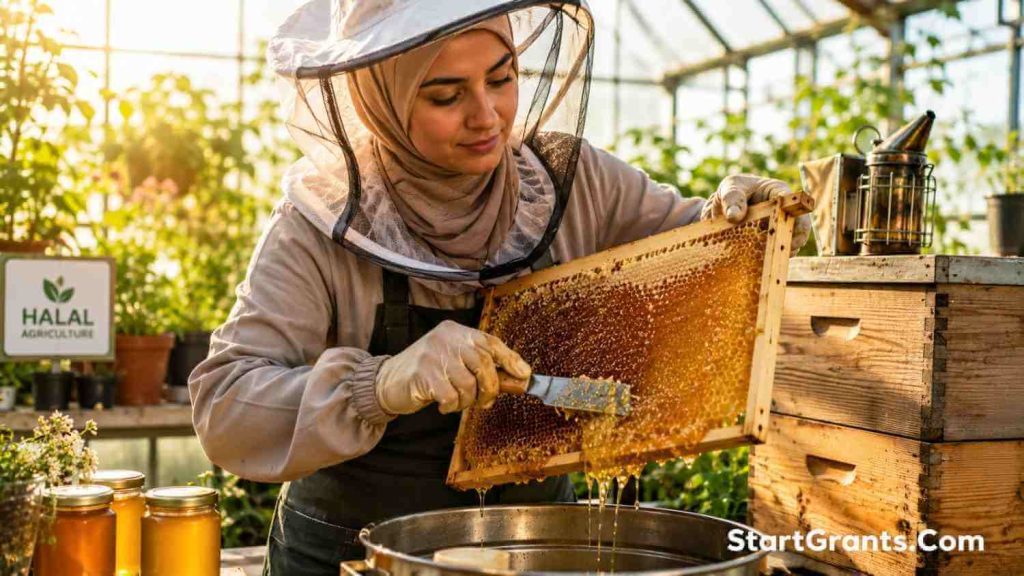
Muslim beekeepers may wish to review both program compliance and the underlying financial contract before accepting assistance.
Zakat treatment of honey is not uniform across all schools of jurisprudence or business circumstances. The applicable analysis may depend on the amount produced, ownership, purpose, expenses, inventory, cash proceeds, debts, and other facts. This article does not prescribe a fixed percentage or threshold. Consult a qualified Islamic finance scholar for questions involving zakat, riba, gharar, insurance, sadaqah, waqf, or investment structures, and use legal and tax professionals for the contract and tax analysis.
Frequently Asked Questions
Are there government grants for raising honey bees?
Yes, but most opportunities fund a defined research, education, conservation, or value-added project rather than unrestricted apiary startup costs. Eligibility and application status depend on the specific program.
Does USDA offer a direct startup grant to buy bees and hives?
USDA does not advertise a universal startup grant that simply pays any new beekeeper to purchase colonies and hive equipment. SARE generally excludes farm-startup and major capital costs, while other USDA programs serve conservation, disaster, marketing, research, or loan purposes.
What does ELAP cover for honey bee producers?
ELAP may provide assistance for eligible honey bee colony, hive, and feed losses caused by qualifying conditions. It is disaster assistance, not funding to establish or expand an apiary, and FSA requires acceptable evidence of the loss and its cause.
What is the ELAP deadline for 2026 honey bee losses?
The current FSA page states that the notice of loss and application for payment are due March 1, 2027, for 2026 program-year losses. Producers should contact their local FSA office promptly rather than wait until the final date.
What does the 15% ELAP normal mortality rate mean?
Starting with program year 2026, FSA uses a 15% normal mortality rate when calculating eligible honey bee colony losses. It does not guarantee payment for every loss above 15%; the cause, documentation, eligibility, and other program requirements still apply.
Can a SARE grant pay for new hives or routine equipment?
Generally, no. SARE funds research and education projects and says it generally cannot fund major purchases of animals, land, equipment, or capital investments. A regional program may allow limited materials needed specifically for an approved research project.
Will EQIP buy honey bees or hive boxes?
EQIP is designed to address natural-resource concerns through approved conservation practices. It may help with eligible pollinator habitat practices, but applicants should not assume it will purchase bees, hive boxes, or ordinary apiary inventory.
What is the difference between a Honey MAL and an LDP?
A Honey Marketing Assistance Loan provides interim financing and is repaid or settled under program rules. An eligible Loan Deficiency Payment is a direct benefit based on the applicable rate difference and does not have to be repaid.
Is the FY 2026 Value-Added Producer Grant still open?
No. The FY 2026 competition closed on April 22, 2026, at 1:00 p.m. Eastern Time. Beekeepers interested in a future value-added honey project should monitor the official USDA Rural Development page for a new notice and current terms.
Do beekeepers always need an LLC, EIN, SAM.gov registration, and a UEI?
No. Requirements depend on the program and applicant. FY 2026 VAPG applicants needed a TIN, UEI, and active SAM.gov registration, while FSA or NRCS producer programs use their own identity, farm-record, land-control, and eligibility procedures. An LLC is not universally required.
Bottom Line
The best funding route depends on the actual need. Use SARE for a qualifying research-and-education project, ask NRCS about pollinator habitat, report eligible losses to FSA for ELAP, examine the Honey Program for post-production cash flow, and monitor VAPG for a future value-added competition. Routine startup and equipment costs may require savings, partner capital, or a repayable farm loan rather than a grant.
Important disclaimer: StartGrants.com is an independent information portal. It is not a government agency, grantmaker, application administrator, lender, insurer, law firm, tax adviser, or religious authority. StartGrants.com does not issue grants, loans, disaster payments, conservation assistance, insurance, legal advice, tax advice, or fatwas. Program availability, deadlines, eligibility, award amounts, loan rates, payment calculations, and other terms can change. Verify every opportunity with the responsible agency or sponsor and seek qualified professional guidance for your circumstances.