Last Updated: | Author: Munir Ardi
Urban farming grants do exist, but there is no single federal program that gives every city grower unrestricted startup cash. The best route depends on who is applying, what the project will accomplish, where the site is located, and whether the expense fits a grant, a conservation contract, or a loan. Some federal opportunities primarily fund eligible nonprofits and public entities, while individual producers may have a better fit with USDA conservation assistance or farm financing.
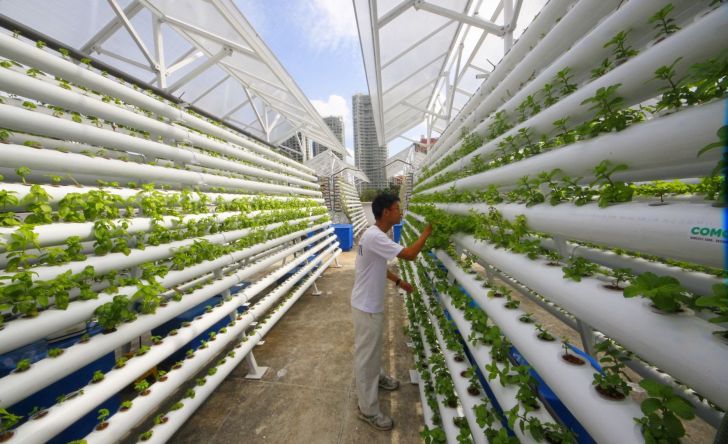
Start with our broader agriculture grants and farm funding overview if you need to compare urban programs with other USDA assistance. This page focuses specifically on urban, suburban, indoor, rooftop, hydroponic, aquaponic, and community-based food production.
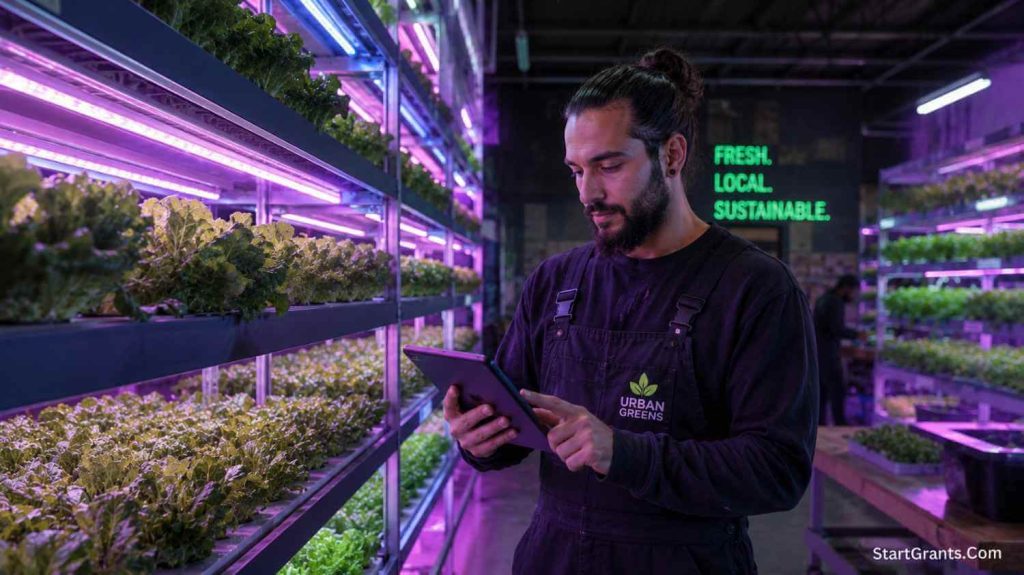
Indoor and vertical production may fit certain urban agriculture programs, but the technology alone does not guarantee eligibility or an award.
Urban Farming Funding at a Glance
The table below separates competitive grants from contracts and loans. Status reflects official pages reviewed on September 13, 2026. Always check the linked agency page before preparing an application because new notices, ranking dates, and funding levels can change.
| Funding route | What it supports | Who normally applies | Current status and important distinction |
|---|---|---|---|
| USDA Urban Agriculture and Innovative Production (UAIP) grants | Planning and implementation projects that improve local food access and support community gardens, urban farms, rooftop farms, food forests, and related innovative practices | The current USDA summary identifies eligible nonprofits, local and Tribal government organizations, Soil and Water Conservation Districts, and school districts | Upcoming/Cyclical. The official page does not display an active application period. Do not treat this as open until USDA publishes a current notice and application instructions. |
| NIFA Urban, Indoor, and Emerging Agriculture (UIE) | Integrated research, education, and Extension projects addressing urban, indoor, and emerging agriculture | Eligible research and education institutions, agencies, organizations, corporations, individuals, or qualifying groups, subject to the notice | Closed. The FY 2026 opportunity closed July 27, 2026. It offered $50,000 to $500,000 awards, estimated total funding of $4 million, and no matching requirement. It was not an unrestricted farm startup grant. |
| NRCS Environmental Quality Incentives Program (EQIP) | Approved conservation practices such as high tunnels, irrigation, soil health, pest management, and composting facilities | Eligible agricultural producers with control of the land and required USDA records | Continuous applications; local ranking periods apply. This is competitive conservation assistance under a contract. Payment generally follows implementation and inspection of an approved practice. |
| FSA Operating Microloan | Equipment, seed, supplies, minor improvements, repairs, marketing costs, and other eligible operating needs | Eligible beginning, small-family, niche, and nontraditional farm operators who meet citizenship or eligible immigration, credit, and management requirements | Loan, not a grant. Operating Microloans are available for up to $50,000, carry interest, and require repayment. |
1. USDA Urban Agriculture and Innovative Production Grants
The USDA Office of Urban Agriculture and Innovative Production coordinates federal support for city and suburban growers. Its UAIP competitive grants can support planning and implementation projects involving urban farms, community gardens, rooftop production, food access, education, and related local-food infrastructure.
However, the program should not be described as an open grant for any individual who wants to start an indoor farm. The current USDA program page marks the application window as Upcoming/Cyclical and lists organizational applicant categories. As of this update, it does not show a current application period, deadline, award range, or live notice of funding opportunity.
What to do while the next UAIP round is unavailable
- Read the current USDA page and subscribe to official urban agriculture updates.
- Decide whether your organization fits an eligible category rather than assuming an individual or informal garden can apply directly.
- Build a project with measurable community benefits, a realistic budget, site control, and qualified partners.
- Wait for the new notice before relying on a deadline, funding amount, cost-share rule, or list of allowable expenses.
A commercial grower who is not an eligible applicant may still participate in a broader community project led by an eligible nonprofit or public entity, but the relationship, budget, procurement rules, and flow of funds must follow the actual notice and award agreement. A partnership is not a workaround for eligibility.
2. NIFA Funding for Research, Education, and Extension
The National Institute of Food and Agriculture administers the Urban, Indoor, and Emerging Agriculture program. The FY 2026 opportunity supported integrated projects across production, harvesting, transportation, aggregation, packaging, distribution, and markets. It required more than a plan to buy equipment: the notice called for an integrated project with a research component and education or Extension work.
The official FY 2026 UIE page states that the opportunity was posted June 12, 2026, and closed July 27, 2026. Estimated program funding was $4 million, the award range was $50,000 to $500,000, and no match was required. Those figures apply to that closed competition and should not be projected onto a future round.
If your proposed work involves a university, research organization, Extension professionals, or community partners, review our USDA NIFA grants and eligibility overview. Most NIFA programs are competitive project grants, not direct operating subsidies for a neighborhood farm.
3. NRCS Conservation Assistance for Urban Growers
For an operating farm that needs a high tunnel, irrigation improvements, soil-health practices, pest management, or composting infrastructure, NRCS may be a more realistic first stop than a broad competitive grant. The official NRCS urban agriculture page specifically identifies those conservation practices and explains the application process.
EQIP is not a blank check and should not be presented as reimbursement for any greenhouse or urban farm purchase. A conservation planner assesses the site, the application is ranked against local resource concerns, and only approved practices in a signed contract qualify. NRCS states that most applications are accepted continuously, but state or local ranking dates determine when they are considered.
Applicants seeking financial assistance generally need an official tax ID, a deed or lease showing control of the property, and a USDA farm number. An LLC is not universally required. NRCS also explains that, after an approved practice is installed and inspected to verify that it meets agency standards, the producer receives the applicable payment. That timing means the applicant must plan for upfront cash flow unless the contract provides another approved arrangement.
4. FSA Financing When a Grant Is Not the Right Tool
Many urban growers search for a grant when their actual need is working capital or equipment financing. The FSA Operating Microloan can finance eligible equipment, seed, supplies, repairs, minor farm improvements, marketing costs, and other operating expenses. The maximum is $50,000 per loan.
This is a federal farm loan with interest and repayment obligations—not free money. FSA reviews eligibility, credit history, management experience or education, financial information, and the farm business plan. Producers comparing machinery, growing systems, delivery equipment, or other capital needs can also review our farm equipment grants and financing guide, which distinguishes grants, conservation payments, and loans.
5. Hydroponic, Aquaponic, and Organic Urban Farms
USDA recognizes hydroponic, aeroponic, aquaponic, rooftop, and vertical operations as examples of urban agriculture. That recognition does not create automatic grant eligibility. A technology must still fit the purpose, eligible applicant rules, allowable costs, geographic requirements, and current status of a specific program.
Hydroponic operations
A hydroponic project may fit research funding, conservation assistance, a local economic-development program, or farm financing depending on its purpose. A proposal that only requests LED lights and growing racks is different from a research-and-Extension project or a community food-access project. See our focused guide to funding options for hydroponic farming for the technology-specific search process.
Aquaponic operations
Aquaponics combines plant production with aquatic animals in a recirculating system. Applicants may need to address both crop and aquaculture requirements, water quality, permitting, animal health, energy use, and market feasibility. Our guide to aquaponics grants and federal funding routes explains why an aquaponic system is not automatically grant-funded.
Organic certification and practices
Growing indoors or in raised beds does not automatically make certification easy or make a farm organic. Certification depends on the applicable USDA organic standards, production records, inputs, site history, and inspection. If certification is part of the business plan, use our organic farming assistance guide to separate certification cost-share or technical support from general startup funding.
6. Local and State Sources Worth Checking
Urban agriculture is shaped by local rules, so city and state sources may be as important as federal programs. Check the official websites of your city, county, state department of agriculture, land-grant university Extension office, conservation district, and local economic-development agency. Possible opportunities may include land access, technical assistance, mini-grants, water or soil testing, business training, compost, market development, or site-specific incentives. Availability varies and should be verified locally.
USDA maintains urban service centers and thousands of broader service-center locations where FSA, NRCS, and Rural Development staff can help producers identify the correct program. A local office can also help establish farm records and explain whether a leased rooftop, community plot, warehouse, or vacant lot meets a program’s site-control requirements.
Some opportunities may target beginning, veteran, limited-resource, or historically underserved producers, but priority rules do not guarantee approval. Women operators who want applicant-specific context can consult our government farm funding guide for women and then verify every current program through its sponsoring agency.
How to Build a Stronger Urban Farming Funding Search
- Define the applicant. Record whether the applicant is an individual producer, farm business, nonprofit, school district, local government, Tribal organization, university, or partnership. Eligibility follows the applicant named in the notice.
- Separate the project from the shopping list. Explain the problem, beneficiaries, location, activities, outcomes, schedule, and evaluation method before listing equipment.
- Confirm site control and local permission. Verify the deed, lease term, zoning, water access, building approval, food-safety rules, and any permits that apply.
- Match the expense to the funding type. Community planning may fit a grant; a high tunnel may fit an approved conservation contract; routine inventory or equipment may require farm financing.
- Read the current notice. Confirm the status, deadline and time zone, eligible applicants, allowable costs, match, reimbursement terms, reporting duties, and application portal.
- Complete only the registrations actually required. Federal organizational grants may require SAM.gov registration and a Unique Entity Identifier, while producer assistance through a USDA service center follows a different process. Do not form an LLC or obtain an EIN solely because a generic funding list says it is always required.
- Budget for timing and compliance. Account for procurement, permits, insurance if required, recordkeeping, reporting, reimbursement delays, taxes, and the possibility that an award can be reduced or recovered for noncompliance under its terms.
Save This Urban Farm Funding Checklist
- [ ] Identify the legal applicant and confirm that category in the current notice.
- [ ] Document ownership or a lease long enough to complete the proposed project.
- [ ] Check zoning, building, water, food-safety, and livestock or aquaculture rules.
- [ ] Obtain written estimates for growing systems, site work, labor, and professional services.
- [ ] Separate grant-eligible project costs from ordinary business operating costs.
- [ ] Confirm whether funding is paid in advance, by reimbursement, or after inspection.
- [ ] Record the deadline, time zone, match requirement, and reporting schedule.
- [ ] Complete SAM.gov, UEI, Grants.gov, farm-number, or tax-ID steps only when the program requires them.
- [ ] Ask the USDA service center or sponsor to clarify ambiguous eligibility before submission.
- [ ] Keep the notice, application, budget, award terms, receipts, and reports in one compliance file.
Costs, Restrictions, and Scams to Watch
Award amount is only one part of the decision. Before accepting assistance, determine whether the program requires a match, reimbursement spending, procurement procedures, environmental review, insurance, public acknowledgement, performance reporting, record retention, or repayment after misuse or noncompliance. Review the actual award agreement for publicity, data, privacy, and intellectual-property terms; do not rely on a summary article for contract obligations.
Grants and conservation payments may have tax consequences, while loans create debt and interest expense. A qualified tax professional can explain how a particular payment affects the farm and its owners. An attorney may be appropriate for leases, partnerships, procurement, intellectual property, or award conditions.
Be cautious of companies that guarantee approval, demand payment to reveal a “secret” USDA grant, or blur the difference between a grant and a loan. Use a government domain or the sponsor’s verified website to confirm the program, and never send sensitive identity or banking information to an unverified contact.
A Muslim Perspective: Choosing Urban Farm Funding Carefully
Muslim applicants may wish to distinguish a genuine nonrepayable award from an interest-bearing loan. A grant may resemble a hibah in some respects, but its restrictions, reporting duties, matching contributions, repayment provisions, and clawback terms still need to be reviewed. It is not accurate to declare every grant automatically permissible without reading the governing documents.
An FSA Operating Microloan is a loan with interest, even though it is a public program designed for farmers. Applicants concerned about riba may want to compare nondebt options such as retained earnings, a properly structured qard hasan, community crowdfunding, preorders, charitable support for an eligible purpose, or equity and profit-sharing arrangements. The economic substance, risk allocation, ownership, and exit terms matter; labels alone do not resolve the religious or legal analysis.
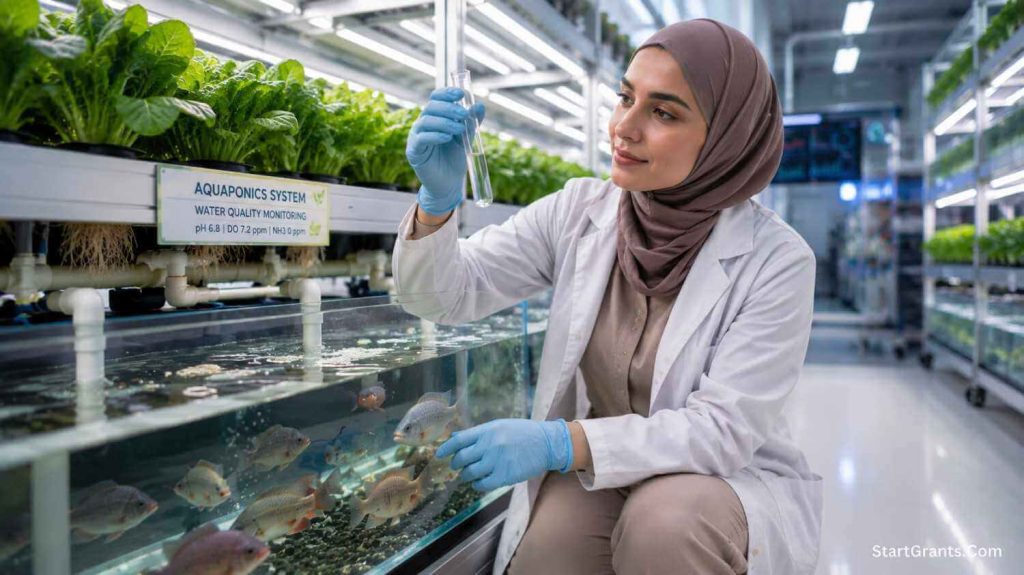
Muslim farm owners may consider both program compliance and the underlying financial structure before accepting funding.
Zakat treatment can vary with the assets, crops, production method, ownership structure, debts, harvest, and school of jurisprudence. Do not apply a fixed percentage to every urban farm or hydroponic harvest based only on a general article. Questions about zakat, riba, gharar, insurance, charitable funds, or a proposed investment structure should be taken to a qualified Islamic finance scholar who can review the facts. Legal and tax professionals should separately review the contract and tax consequences.
Frequently Asked Questions
Are there federal grants for urban farms?
Yes, but federal urban agriculture grants are competitive and program-specific. Some primarily fund eligible nonprofits, public entities, schools, or research partnerships rather than giving unrestricted startup cash directly to every individual farmer.
Is the USDA UAIP grant accepting applications now?
No active application period is displayed on the official USDA page as of September 13, 2026. USDA labels the application window Upcoming/Cyclical, so applicants should wait for a current notice before relying on a deadline, award amount, or application procedure.
Can an individual farmer apply directly for a UAIP grant?
The current USDA summary lists eligible nonprofits, local and Tribal government organizations, Soil and Water Conservation Districts, and school districts. An individual grower should not assume direct eligibility and may need to participate through a properly structured project led by an eligible organization.
Is the NIFA Urban, Indoor, and Emerging Agriculture grant open?
No. The FY 2026 opportunity closed on July 27, 2026. That competition supported integrated research, education, and Extension projects and should not be treated as an unrestricted commercial farm expansion grant.
Will EQIP pay for an urban farm high tunnel?
It may provide financial assistance for an approved high-tunnel conservation practice, but funding is not automatic. NRCS must determine eligibility, develop or approve the conservation plan, rank the application, and inspect completed work under the signed contract.
Is an FSA Operating Microloan a grant?
No. It is an interest-bearing federal farm loan that must be repaid. The program offers up to $50,000 for eligible operating purposes, subject to FSA eligibility, credit, management, security, and repayment requirements.
Do hydroponic or aquaponic systems automatically qualify for federal funding?
No. USDA recognizes these systems as forms of urban or innovative production, but eligibility depends on the specific program, applicant, project purpose, location, allowable costs, and current application rules.
Do I need an LLC, EIN, SAM.gov registration, and a UEI?
Not for every program. Federal organizational grant applications may require SAM.gov registration and a UEI, while USDA producer assistance may use a Social Security number or EIN, property-control records, and a farm number. Follow the current instructions for the exact program.
Can urban farming assistance pay for equipment upfront?
It depends on the program and contract. Some grants allow approved equipment costs, some NRCS payments follow installation and inspection, and FSA equipment financing is a repayable loan. Confirm cash-flow timing before committing to a purchase.
Where should a new urban farmer start?
Start with the local USDA service center, Cooperative Extension office, city or county planning department, and state department of agriculture. Bring a site address, deed or lease, project description, budget estimates, and questions about zoning and program eligibility.
Bottom Line
The most useful urban farm funding search begins by choosing the right type of assistance. Monitor UAIP for a future organizational grant notice, consider NIFA only when the work fits a research-and-Extension competition, ask NRCS about conservation practices, and evaluate FSA financing as debt rather than grant money. Verify the current rules before spending money or promising a project start date.
Important disclaimer: StartGrants.com is an independent information portal. It is not a government agency, grantmaker, application administrator, lender, law firm, tax adviser, or religious authority. StartGrants.com does not issue grants, loans, conservation payments, legal advice, tax advice, or fatwas. Program availability, deadlines, eligibility, award amounts, loan terms, payment schedules, and other requirements can change. Verify every opportunity with the responsible agency or sponsor and seek qualified professional guidance for your circumstances.