
Last Updated: April 2026 | Author: Robert
Earning a commission as an officer in the United States Navy or Marine Corps is one of the most prestigious career paths in the military. To attract the sharpest minds to the fleet, the Department of the Navy offers the National Naval Reserve Officers Training Corps (NROTC) scholarship. This massive grant covers 100% of your college tuition, provides a textbook stipend, and pays a monthly living allowance.
However, securing this funding requires navigating an application matrix that is significantly more rigid than civilian college grants. Before you commit to the high-stakes academic and physical requirements of the Naval service, you must ensure this path aligns with your ultimate career goals. We highly recommend mapping out your complete strategy using our headquarters guide on military scholarships and grants for college to compare the Navy’s 5-year active duty service obligation against other branches.
If you are ready to command nuclear submarines, pilot F-35s, or lead Marine infantry platoons, you must understand that the NROTC program actually contains two completely different scholarships under one roof: The Navy Option and the Marine Corps Option. To win, you must decode their requirements.
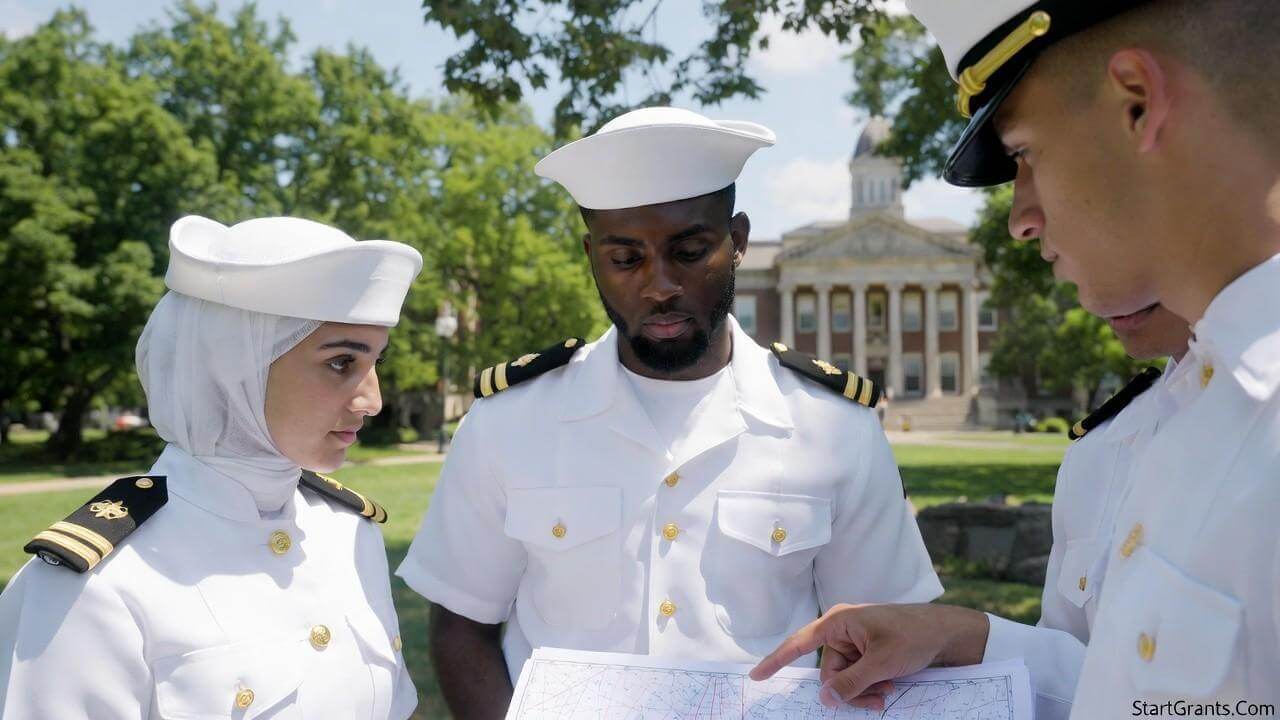
The US Navy ROTC scholarship offers full-tuition funding for future officers, fully accommodating diverse religious backgrounds such as wearing a Hijab.
Phase 1: The STEM Obsession (The Major Tier System)
If you are applying for the Navy Option scholarship, you must understand one undeniable truth: The modern Navy runs on nuclear power, advanced computing, and aerospace engineering. Consequently, the Naval Education and Training Command (NETC) heavily discriminates based on your chosen college major.

Approximately 85% of Navy Option scholarships are awarded to students pursuing Tier 1 and Tier 2 STEM degrees like engineering and physics.
The Navy categorizes all academic majors into a strict three-tier system. Historically, approximately 85% of all Navy Option scholarships are awarded to students in Tier 1 and Tier 2.
- Tier 1 (Engineering of Navy Interest): This is the golden ticket. If you major in Aerospace, Chemical, Electrical, Mechanical, Nuclear, or Systems Engineering, your application jumps to the front of the line.
- Tier 2 (Other STEM): Highly competitive, but slightly below Tier 1. This includes Physics, Chemistry, Computer Science, Mathematics, and Biological Engineering.
- Tier 3 (Humanities & Languages): This includes History, English, Political Science, and Business. If you select a Tier 3 major, your mathematical odds of winning a Navy Option scholarship drop drastically, as only 15% of the national budget is allocated to this tier.
The Academic Catch: Regardless of your major, every single Navy Option scholarship student (even Tier 3) is mandated by the Navy to take and pass two semesters of calculus and two semesters of calculus-based physics during college.
Phase 2: The Marine Corps Option (The Physical Pivot)
What if you want to be a military officer, but your brain is wired for History or Political Science rather than Calculus and Thermodynamics? The NROTC program has a “backdoor” designed specifically for tactical leaders: The Marine Corps Option.
The Marine Corps falls under the Department of the Navy and uses the exact same NROTC scholarship application portal. However, the Marine Corps does not care about the Tier System. You can major in English or Art History and still win a full-tuition scholarship. The Marine Corps replaces the Navy’s obsession with STEM with an obsession with intense physical dominance.

The Marine Corps Option does not heavily restrict your academic major, but you must completely dominate the physical fitness test (PFT) to win.
The Marine Physical Fitness Test (PFT):
While Navy Option applicants must pass a physical test, Marine Option applicants are graded on a brutal PFT that carries massive weight in their National Board evaluation. To be competitive, you must achieve near-perfect scores in:
- Pull-ups: Dead-hang pull-ups to maximum exhaustion.
- Abdominal Crunches or Plank: Testing extreme core endurance.
- 3-Mile Run: A high-paced aerobic test that separates average athletes from future Marine officers.
If you have a 3.2 GPA in a non-STEM major but are a varsity cross-country captain who can do 20 pull-ups, the Marine Corps Option is your highest probability of winning an NROTC scholarship.
Phase 3: The Intersection of Faith (Halal Funding & 2026 Grooming Updates)
For Muslim students pursuing a commission in the Navy or Marine Corps, military scholarships offer a powerful dual advantage: debt-free education and protected religious liberties.
1. The Riba-Free (Halal) Degree
Civilian student loans rely heavily on compounding interest, violating the Islamic prohibition of Riba (usury). The NROTC scholarship is fundamentally Halal. It is a direct exchange of labor—your 4 to 5-year active duty service obligation—for the military’s financial resources. You graduate from top-tier universities without borrowing money or paying interest.
2. The 2026 Religious Accommodation (Beards & Hijabs)
The Department of Defense has made critical updates to grooming standards for facial hair and religious apparel. Under the new policies issued in March 2026, Navy and Marine Corps policies explicitly allow service members and NROTC midshipmen to request waivers based on “sincerely held religious beliefs.”
- The Hijab: Muslim female midshipmen can request accommodations to wear a uniform-matching hijab underneath their Navy covers (hats) and while in uniform.
- The Beard Accommodation: Muslim male applicants are no longer forced to shave their beards prior to accession. You may submit a sworn written attestation affirming your sincere religious belief to maintain a neat, professional beard. The command evaluates these requests individually, ensuring they do not interfere with safety equipment (like gas masks) during specific shipboard deployments.
Becoming a Naval Officer allows you to maintain your spiritual identity while providing elite leadership to the fleet.
Phase 4: The Officer Interview (NTAG Evaluation)
A flawless SAT score and a Tier 1 major will get you past the initial computer screening, but the final decision rests on human evaluation. Every highly competitive NROTC applicant must conduct an Officer Interview.
Unlike the Army (where you interview with a university professor), the Navy requires you to interview with an active-duty Naval or Marine Corps Officer at a local Navy Talent Acquisition Group (NTAG) or recruiting station.
Tactical Interview Preparation:
- Military Bearing: The interviewing officer is assessing your confidence, posture, and communication skills under pressure. Treat this as a formal job interview for a mid-level management position. Wear a conservative suit and ensure your grooming is impeccable.
- The “Why Navy” Question: You must be able to articulate why you want to serve at sea or lead Marines, rather than joining the Army or Air Force. Mentioning a desire to travel or just “pay for college” will drastically lower your officer potential score.
- STEM Articulation: If you are applying as a Tier 1 or Tier 2 major, be prepared to discuss your passion for mathematics and science, and how you plan to handle the intense academic workload while balancing military training.
Pro-Tip: Master the Officer Interview
The Officer Interview can make or break your application. Watch this breakdown by a former NROTC coordinator on what specific traits the interviewing officer is grading you on, and how to avoid the most common traps that disqualify applicants:
Phase 5: Evaluating Alternative Pathways (The Silo Strategy)
The Naval service is not for everyone. If you realize that taking high-level calculus is not your strength, or if you prefer a ground-combat focus without taking the Marine Corps route, you have elite alternatives.
- The Army Pivot: If you want a scholarship that allows you to major in anything (without the strict STEM Tier system) and gives you the option to use the funds for room and board instead of tuition, you must immediately read our tactical breakdown of the Army ROTC scholarship application.
- The Dependent Pivot: If you are the child of a Navy sailor or Marine and do not wish to serve in the military yourself, do not sign a contract. Instead, utilize your family benefits by following our guide on how to get military dependent scholarships.
Conclusion: Your Strategic Action Plan
Winning the US Navy ROTC scholarship requires academic brilliance in STEM, physical endurance, and the unyielding desire to lead. By aligning your major with the Navy’s Tier system or dominating the PFT for the Marine Corps option, you secure a debt-free degree and a prestigious commission.
Execute this tactical checklist to secure your Naval funding:
- Select Your Track: Decide early if you are applying for the Navy Option (focusing heavily on Tier 1/Tier 2 STEM majors) or the Marine Corps Option (focusing heavily on physical fitness and leadership).
- Conquer the Math Requirement: Ensure you are taking the highest level of math and physics available at your high school (AP or IB classes) to prove to the board you can handle the mandatory college calculus requirement.
- Train for the Fitness Assessment: If applying for the Marine Option, start doing daily pull-ups and distance running. If Navy Option, ensure you can comfortably pass the forearm plank and 1.5-mile run.
- Submit by the Deadline: The NROTC application window typically opens in April of your junior year and closes in January of your senior year. Submit your packet to the earliest possible board to maximize your statistical chances of selection.
Frequently Asked Questions (FAQs)
Q1: Does the Navy ROTC scholarship cover room and board?
A: No. Unlike the Army ROTC scholarship, the National NROTC scholarship only pays for tuition and mandatory fees. However, to attract NROTC students, many individual universities will voluntarily offer a “Room and Board Grant” to midshipmen out of their own institutional funds. You must check with each specific college.
Q2: Do I have to serve on a submarine if I take a Navy Option scholarship?
A: No. While the Navy heavily recruits for its Nuclear Propulsion program (submarines and aircraft carriers), NROTC graduates can also commission as Surface Warfare Officers (SWO), Naval Aviators (pilots), Naval Flight Officers, or Special Warfare/Operations (SEAL/EOD).
Q3: What happens if I fail the DoDMERB medical exam?
A: Every NROTC scholarship winner must be medically cleared by the Department of Defense Medical Examination Review Board (DoDMERB). If you have a disqualifying condition, your scholarship is paused while the Navy determines if they will grant you a medical waiver based on the needs of the fleet.
Q4: Can I switch from the Navy Option to the Marine Corps Option later?
A: Yes, but it is not guaranteed. You can apply for an “Option Change” during your freshman or sophomore year. Approval depends on your physical fitness scores, your academic standing, and the current quota requirements of the Marine Corps.
Q5: What happens if I drop my calculus or physics class?
A: For Navy Option midshipmen, failing or dropping the mandatory calculus and physics courses can result in a “Performance Review Board” (PRB). This could lead to you being placed on probation, losing your scholarship, or being required to repay the Navy for your tuition.
Q6: Can I still join NROTC if I don’t win the National Scholarship in high school?
A: Yes! You can join your university’s NROTC unit as a “College Program” midshipman (Basic Standing). You will not receive tuition money initially, but if you perform well, you can compete for a 2-year or 3-year “Sideload” scholarship once you are on campus.
Q7: What is the Nurse NROTC Scholarship?
A: The Navy offers a highly specialized, separate NROTC track exclusively for students pursuing a Bachelor of Science in Nursing (BSN). These midshipmen do not have to take calculus or physics and commission directly into the Navy Nurse Corps after passing their NCLEX exam.
Q8: How long is my active duty service obligation after graduation?
A: Generally, Navy Option midshipmen must serve a minimum of five (5) years on active duty. Marine Corps Option midshipmen typically serve a minimum of four (4) years on active duty. Aviation tracks require significantly longer commitments (up to 8-10 years) after completing flight school.
Q9: Are military scholarships considered Halal?
A: Yes, from an Islamic financial perspective, the NROTC scholarship is considered Halal. It does not involve borrowing money from a bank or paying interest (Riba). It is a direct service-for-education contract, allowing Muslim students to graduate completely debt-free.
Q10: Can I wear a Hijab during NROTC training?
A: Yes. Under the updated Department of Defense grooming regulations, Muslim female midshipmen can request an official religious accommodation to wear a uniform-matching Hijab, and male midshipmen can request a waiver for a neat beard, provided it does not interfere with critical safety equipment.
Important Disclaimer: StartGrants.com is an independent information portal. We are not a government agency. Always verify the current status of NROTC requirements and deadlines with an official Navy or Marine Corps Officer Recruiter.