
Last Updated: April 2026 | Author: Munir Ardi
When a soldier, sailor, airman, or marine raises their right hand to serve, their entire family serves with them. The Department of Defense and countless private organizations recognize the immense sacrifices made by military spouses and children (often proudly referred to as “military brats”). To honor this sacrifice, there is a massive ecosystem of financial aid exclusively reserved for military families.
Unlike ROTC candidates, dependents do not have to sign a service contract, wear a uniform, or pass a physical fitness test to receive this money. However, navigating the bureaucracy of veteran benefits and private grants can be overwhelming. Before diving into dependent-specific funds, we highly recommend mapping out the broader funding landscape by reviewing our headquarters guide on military scholarships and grants for college to ensure your family is maximizing every available resource.
If you are the spouse or child of an active-duty service member, a veteran, or a fallen hero, here is your tactical blueprint on how to get military dependent scholarships and secure a debt-free degree.

Spouses and children of military members have access to millions of dollars in federal and private scholarships that require zero military service from the student.
Phase 1: Federal VA Benefits (The Heavyweights)
The largest and most reliable source of dependent funding comes directly from the federal government via the Department of Veterans Affairs (VA). These are not competitive scholarships; if you meet the criteria, you are legally entitled to the money.
1. Survivors’ and Dependents’ Educational Assistance (DEA – Chapter 35)
If your parent or spouse is permanently and totally disabled (100% P&T rating) due to a service-connected condition, or if they died in the line of duty, you are eligible for DEA. In 2026, the DEA program provides a tax-free monthly stipend (often exceeding $1,400 per month for full-time students) paid directly to the student for up to 36 months to help cover tuition, housing, and books.
2. The Marine Gunnery Sergeant John David Fry Scholarship
The Fry Scholarship is an elite benefit specifically for the children and surviving spouses of service members who died in the line of duty on or after September 11, 2001. It is incredibly powerful because it mirrors the Post-9/11 GI Bill. It pays 100% of in-state public school tuition directly to the university, plus provides a monthly housing allowance (MHA) and a books/supplies stipend to the student.
Phase 2: Branch-Specific Relief Societies

Branch-specific relief societies like AER and NMCRS offer massive pools of merit and need-based grants specifically for military dependents.
If you do not qualify for Chapter 35 or the Fry Scholarship (e.g., your parent is active duty or a veteran without a 100% disability rating), your next target should be the military branch’s official relief society. These organizations offer massive pools of interest-free loans and merit/need-based grants exclusively for dependents.
- Army Emergency Relief (AER): The Maj. Gen. James Ursano Scholarship Program offers grants to children of active duty and retired Army soldiers. Awards are based on financial need and academic performance.
- Navy-Marine Corps Relief Society (NMCRS): Offers the Vice Admiral E.P. Travers Scholarship and Loan Program, providing grants ranging from $500 to $3,000 to children and spouses of active duty or retired Sailors and Marines.
- Air Force Aid Society (AFAS): The General Henry H. Arnold Education Grant program provides needs-based grants (ranging from $500 to $4,000+) to eligible Air Force and Space Force dependents.
- Coast Guard Mutual Assistance (CGMA): Offers supplemental education grants and interest-free loans to Coast Guard families.
Phase 3: The Faith Perspective (Halal Funding Without the Uniform)
For Muslim families, navigating the American college system often brings the heavy burden of avoiding Riba (interest-based student loans), which is strictly prohibited in Islam. While joining the military via ROTC is a Halal pathway for the student, many parents do not want their children entering active combat roles.
Military dependent scholarships are the ultimate Halal financial strategy.
By utilizing Chapter 35 DEA, the Fry Scholarship, or branch relief society grants, Muslim military dependents can completely bypass the predatory banking system. This money is categorized as pure grants, entitlements, or zero-interest relief loans. It is the government and private sector fulfilling a moral obligation to the family of the service member. You can secure a 100% Riba-free degree at a top university without ever signing a military contract or compromising your Islamic values.
Phase 4: Private Foundations & The GI Bill Transfer (TEB)
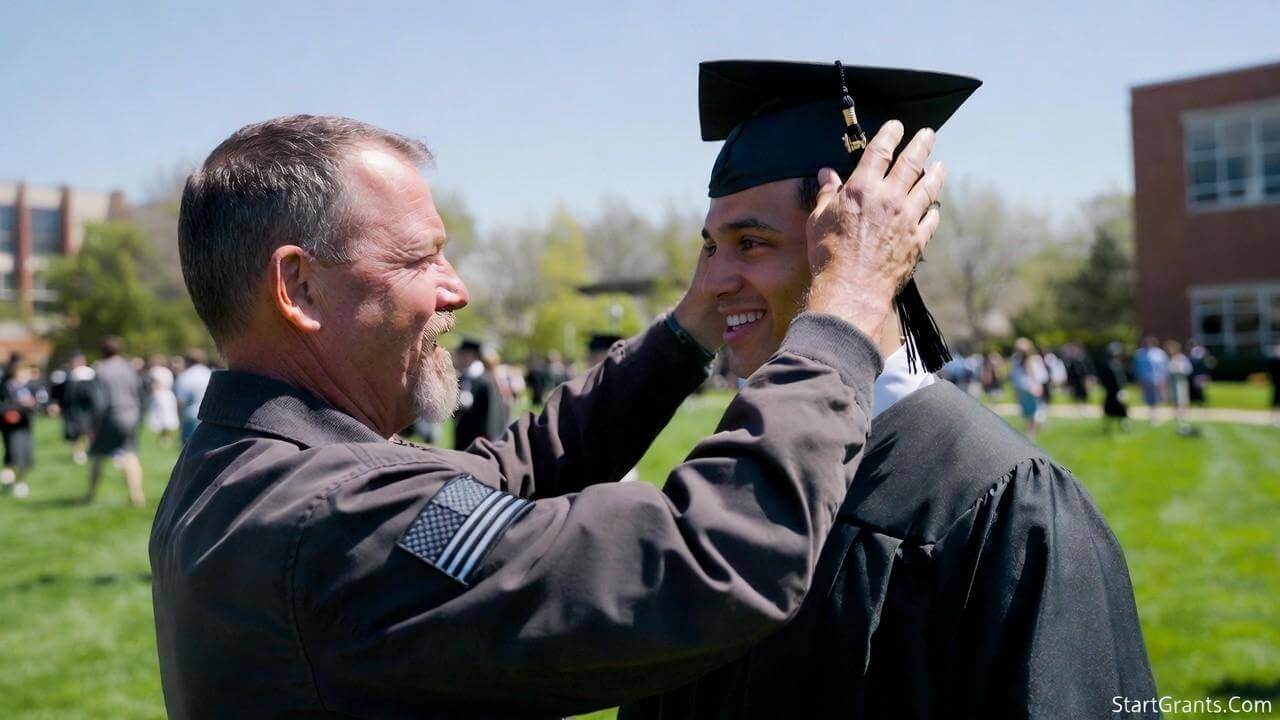
Active-duty service members can execute a Transfer of Education Benefits (TEB) to pass their Post-9/11 GI Bill directly to their children or spouse.
Beyond the federal government and branch relief societies, the private sector has established massive endowments specifically for military dependents. One of the most prominent is the Fisher House Foundation, which administers the “Scholarships for Military Children” program. They award hundreds of $2,000 grants annually to students possessing a valid military ID.
The Post-9/11 GI Bill Transfer (TEB)
Perhaps the most lucrative “scholarship” is not a grant at all, but a direct transfer of your parent’s or spouse’s military benefits. Under the Post-9/11 GI Bill, active-duty service members can execute a Transfer of Education Benefits (TEB) to their dependents via the official milConnect portal.
To qualify for this transfer, the service member must have served at least six years and legally commit to serving four additional years. This transfers up to 36 months of 100% tuition coverage, a monthly housing allowance (MHA), and a book stipend directly to the spouse or children.
Pro-Tip: Finding Dependent Grants
Navigating the sheer volume of dependent scholarships can be tricky. Watch this breakdown to understand exactly where to look to claim the educational funds your family has earned:
Phase 5: Evaluating Alternative Pathways (The Silo Strategy)
If you are a military dependent but you feel the calling to put on the uniform yourself, you do not have to rely on family benefits. You can secure your own massive federal funding by becoming a commissioned officer.
- The Ground Commander Pivot: If you want to lead soldiers and want the flexibility to choose any major (and apply funds to room and board), study our tactical guide on the Army ROTC scholarship application.
- The Naval Elite Pivot: If you excel in STEM and want to command ships, submarines, or Marine platoons, execute our breakdown of the Navy ROTC scholarship requirements.
Conclusion: Your Strategic Action Plan
Being a military dependent comes with unique challenges, but paying for college should not be one of them. By leveraging federal entitlements, relief societies, and private foundations, you can secure a completely debt-free degree.
Execute this tactical checklist to secure your funding:
- Register in DEERS: Ensure you are properly registered in the Defense Enrollment Eligibility Reporting System (DEERS) and possess a valid military dependent ID card. This is required for almost all applications.
- Check VA Eligibility First: Before looking at private grants, verify if you qualify for Chapter 35 DEA, the Fry Scholarship, or a GI Bill TEB transfer. These are the largest sources of funding.
- Apply to Branch Societies: Submit your FAFSA early, then apply to AER, NMCRS, or AFAS depending on your sponsor’s military branch.
- Embrace the Halal Route: Recognize that these grants allow Muslim families to fund education cleanly, entirely avoiding the Riba (interest) associated with traditional student loans.
Frequently Asked Questions (FAQs)
Q1: Up to what age can a military child use transferred GI Bill benefits?
A: A dependent child can begin using transferred Post-9/11 GI Bill benefits after the service member has completed at least 10 years of service. The child must use these benefits before they reach the age of 26.
Q2: Can a spouse use the GI Bill while the service member is on active duty?
A: Yes. A spouse can use transferred GI Bill benefits immediately upon approval. However, if the service member is still on active duty, the spouse is not eligible to receive the Monthly Housing Allowance (MHA) stipend.
Q3: Can I receive both Chapter 35 DEA and the Fry Scholarship?
A: No. If you are eligible for both the Survivors’ and Dependents’ Educational Assistance (DEA) and the Fry Scholarship, you must legally choose one. You cannot use them concurrently, so you must calculate which benefit pays more for your specific university.
Q4: Do I need to sign a military contract to get these dependent scholarships?
A: No. Military dependent scholarships, unlike ROTC grants, carry absolutely no service obligation. You do not have to join the military to receive or keep the money.
Q5: Are military dependent scholarships taxable?
A: Generally, no. According to the IRS, veterans’ benefits, including education and training allowances like Chapter 35 DEA and the Fry Scholarship, are tax-free and do not need to be reported as income on your tax return.
Q6: What is a TEB in military terms?
A: TEB stands for Transfer of Education Benefits. It is the official process through the milConnect portal where an active-duty service member transfers their earned Post-9/11 GI Bill months to their registered dependents.
Q7: Can stepchildren receive military dependent scholarships?
A: Yes, provided they are legally recognized as dependents of the service member and are officially enrolled in the Defense Enrollment Eligibility Reporting System (DEERS) with a valid military ID.
Q8: What is the Fisher House Foundation Scholarship?
A: The Fisher House Foundation administers the “Scholarships for Military Children” program. It awards $2,000 grants annually to students who are dependents of active duty, reserve, guard, or retired military personnel to help cover tuition and fees.
Q9: Are military dependent scholarships considered Halal?
A: Yes. Because these scholarships are pure grants, entitlements, or zero-interest loans given as a benefit of the sponsor’s service, they do not involve borrowing money at interest. This makes them a 100% Riba-free and Halal way to fund a college education.
Q10: Do dependent scholarships pay for room and board?
A: It depends on the program. The Fry Scholarship and transferred GI Bill benefits provide a Monthly Housing Allowance (MHA) that can be used for room and board. Chapter 35 DEA provides a flat monthly stipend. Private grants usually only cover tuition.
Important Disclaimer: StartGrants.com is an independent information portal. We are not a government agency. Always verify the current status of VA benefits and scholarship deadlines with an official VA representative or your installation’s education office.