
Last Updated: April 2026 | Author: Munir Ardi
Winning a National Army Reserve Officers’ Training Corps (ROTC) scholarship is highly competitive, but the payout is life-changing. If selected, the U.S. Army will pay 100% of your college tuition and mandatory fees at over 1,000 participating universities, provide a generous textbook allowance, and pay you a tax-free monthly living stipend of $420.
However, this is not a standard civilian academic grant. The Army is not just looking for smart students; they are recruiting future combat and logistical commanders. Before you begin the rigorous Army ROTC scholarship application process, you must understand where this fits into the broader ecosystem of military benefits. We highly recommend reviewing our headquarters guide on military scholarships and grants for college to ensure the active-duty service obligation aligns with your long-term career goals.
If you are ready to commit to the uniform, you must approach the application like a military operation. To win, you must dominate the Army’s evaluation matrix known as the “Whole Person Concept.”
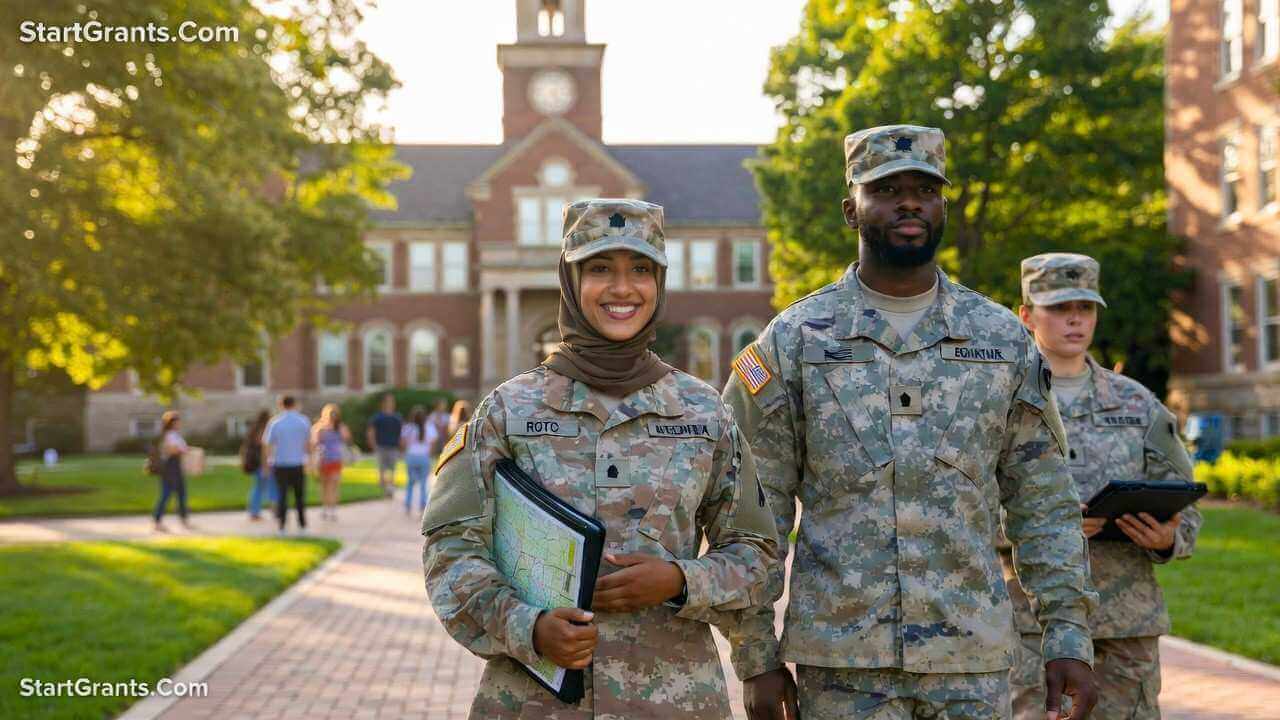
Successfully submitting your Army ROTC scholarship application can lead to 100% tuition coverage, a monthly stipend, and a career as a commissioned officer, fully accommodating diverse religious backgrounds like wearing a Hijab.
Phase 1: The “Whole Person” Concept (The SAL Criteria)
Civilian scholarships often weigh your GPA and SAT/ACT scores above all else. The Army uses a completely different algorithm. When your application is reviewed by the National Board, they grade you based on the Scholar, Athlete, Leader (SAL) criteria.
You can have a perfect 4.0 GPA, but if you have zero athletic history and have never held a leadership position, your application will likely be rejected.
- Scholar (Academics): You must have a minimum unweighted high school GPA of 2.50 to apply, though competitive winners usually have a 3.5 or higher. You must also submit your SAT or ACT scores. The Board looks for academic discipline, especially in STEM (Science, Technology, Engineering, and Mathematics) majors.
- Athlete (Physicality): You must prove you have the baseline physical endurance required of a soldier. Playing varsity high school sports, being a team captain, or participating in martial arts heavily boosts your score in this category.
- Leader (Character): The Army wants future officers. You must demonstrate leadership potential. Being an Eagle Scout, student body president, JROTC commander, or the captain of a debate team are prime examples of the leadership metrics the Board is looking for.
Phase 2: Dominating the Physical Fitness Assessment
The single biggest point of failure for high school applicants is underestimating the physical requirements of the Army. As part of your Army ROTC scholarship application, you must pass a physical fitness test.
Historically, applicants took a basic Presidential Fitness Test (push-ups, sit-ups, and a 1-mile run). However, as you prepare to enter the modern Army, you must prepare for the mechanics of the Army Combat Fitness Test (ACFT). While your initial high school assessment may still use basic metrics, once you arrive on campus, you must pass the ACFT to activate your scholarship money.

To activate your Army ROTC scholarship, you must train for and pass the rigorous six-event Army Combat Fitness Test (ACFT).
The ACFT Trap:
Do not wait until your freshman year of college to start training. The ACFT is a grueling 6-event test designed to simulate combat movements. You can review the official event standards on the Army’s official ACFT portal. It includes:
- 3-Repetition Maximum Deadlift: Testing lower body strength.
- Standing Power Throw: Throwing a 10-pound medicine ball backward over your head.
- Hand-Release Push-up: Testing upper body endurance.
- Sprint-Drag-Carry: A cardiovascular and anaerobic test involving dragging a 90-pound sled and carrying 40-pound kettlebells.
- Plank: Testing core stability.
- Two-Mile Run: Testing aerobic endurance.
Action Item: Start incorporating deadlifts, sled pulls, and long-distance running into your weekly routine the summer before your senior year of high school.
Phase 3: The Intersection of Faith (Muslim Accommodations & Halal Funding)
For Muslim students aiming to become Army Officers, the military presents a unique dual advantage: it offers a path to higher education completely free of usury (Riba), while also legally protecting your religious rights.
1. The Riba-Free (Halal) Financial Strategy
The traditional college route often forces students into interest-bearing federal or private student loans, which fundamentally conflicts with Islamic financial ethics. The Army ROTC scholarship is a pure, Halal transaction. It is an exchange of your time and leadership (service obligation) for the Army’s financial resources (tuition and stipends). There is no money borrowed, and absolutely zero interest charged, allowing you to earn your degree without compromising your faith.
2. AR 670-1 Religious Accommodations
A common hesitation among Muslim applicants is the strict grooming and uniform standards of the U.S. Army. However, thanks to recent and massive updates to Army Regulation (AR) 670-1, the Army is more inclusive than ever.
- The Hijab: Muslim female cadets and soldiers are explicitly permitted to request a religious accommodation to wear a subdued, uniform-matching hijab underneath their patrol caps and helmets.
- Beards: Muslim male cadets can apply for an exception to policy to maintain a neat, professional beard in accordance with their faith.
- Halal Rations: During field training exercises (FTX) and deployments, the Army logistics system provides certified Halal MREs (Meals, Ready-to-Eat) for Muslim soldiers.
- Daily Prayer: Commanders are trained to accommodate the five daily prayers and Friday Jum’ah services whenever training and mission requirements safely allow.
Becoming an Army Officer does not mean leaving your religious identity at the door. You are bringing diverse leadership to the ranks.
Phase 4: The Professor of Military Science (PMS) Interview
Your GPA and physical fitness scores only tell the National Board what you are capable of on paper. To win an Army ROTC scholarship, you must sit for an in-person or virtual interview with a Professor of Military Science (PMS) at a university.
The PMS is an active-duty Army Lieutenant Colonel (O-5) who commands a university’s ROTC battalion. Their evaluation carries massive weight in the final National Board scoring. This is not a standard college admissions interview. The PMS is evaluating you as a future subordinate officer.

The PMS interview is heavily weighted by the National Board. Dress professionally and be prepared to articulate your desire to lead soldiers.
Tactical Interview Preparation:
- Dress to Impress: Wear professional business attire (a suit and tie for men, a professional suit or conservative dress for women). Your grooming standard should reflect military bearing.
- Know Your “Why”: The PMS will ask why you want to be an Army Officer. “To pay for college” is the wrong answer. You must articulate a desire to lead soldiers and serve the nation.
- Prepare for Situational Questions: You will be asked how you handle failure, how you manage conflict within a team, and how you prioritize high-stress tasks. Use the STAR method (Situation, Task, Action, Result) to structure your answers.
Pro-Tip: Ace the PMS Interview
Because the interview is weighted so heavily by the National Board, you cannot afford to go in blind. Watch this insider breakdown by a former Professor of Military Science detailing the exact questions you will be asked during your Army ROTC interview and how to answer them strategically:
Phase 5: The University Strategy (Host vs. Affiliate)
When filling out your Army ROTC scholarship application via the official GoArmy portal, you must list your top university choices. Strategy here is critical.
Not all colleges have their own ROTC battalion. Universities are classified as either Host Programs or Cross-Town Affiliates.
- Host Programs: These universities have the ROTC headquarters on their campus. Training, classes, and physical fitness happen right where you live. Applying to a Host school often gives you a slight logistical advantage and direct access to the PMS.
- Cross-Town Affiliates: These colleges do not have an ROTC headquarters. You attend regular classes at your college, but you must commute to the Host university several times a week for early morning PT (Physical Training) and military science labs. Ensure you factor in commute times if you select an affiliate school.
Phase 6: Evaluating Alternative Pathways
If you reach the end of this application process and realize that leading ground troops is not your calling, or if you have a medical condition that disqualifies you from military service, you still have highly lucrative, debt-free options available.
- The Naval Pivot: If maritime leadership, naval aviation, or submarine warfare aligns better with your technical skills, shift your focus immediately to our tactical breakdown of the Navy ROTC scholarship requirements.
- The Dependent Pivot: If you are the child or spouse of a veteran, you do not have to join the military to receive military money. Do not sign an ROTC contract. Instead, execute our guide on how to get military dependent scholarships to secure funding with zero service obligation.
Conclusion: Your Application Action Plan
The Army ROTC scholarship application is a test of your discipline, athleticism, and leadership long before you ever put on a uniform. By dominating the SAL criteria and acing the PMS interview, you can secure a debt-free degree and a guaranteed career as an Army Officer.
Execute this tactical checklist to secure your victory:
- Build Your SAL Resume: In your junior year of high school, take on leadership roles (club president, team captain) and maintain a high GPA to maximize your Scholar, Athlete, and Leader scores.
- Train for the ACFT: Begin rigorous physical training focusing on deadlifts, push-ups, and running so you are fully prepared for the physical fitness assessment.
- Schedule the Interview: Reach out to the Recruiting Operations Officer (ROO) at your top-choice university to schedule your PMS interview early in the application window.
- Submit Early: The National Board meets several times throughout your senior year. Submitting your packet for the very first board (usually in October) drastically increases your mathematical odds of winning a scholarship.
Frequently Asked Questions (FAQs)
Q1: Does the Army ROTC scholarship cover room and board?
A: The National Army ROTC scholarship allows you to choose: you can apply the funds to cover 100% of your tuition and mandatory fees, OR you can apply it toward a flat rate for room and board (typically up to $12,000 per year). It will not cover both simultaneously.
Q2: What happens if I fail the DoDMERB medical exam?
A: All scholarship winners must pass the Department of Defense Medical Examination Review Board (DoDMERB). If you are flagged for a medical condition (like asthma or a past surgery), your scholarship is put on hold. You must work with the university’s ROTC battalion to submit a medical waiver to the Army for final approval.
Q3: What if I do not win a National Scholarship in high school?
A: You can still join ROTC in college as a “non-contracted” cadet. If you prove yourself to the PMS during your freshman year by getting good grades and high ACFT scores, you can compete for a “Campus-Based Scholarship” (a 3-year or 2-year grant) funded directly by the local battalion.
Q4: Can I use the Army ROTC scholarship to become a medical doctor?
A: Yes, but it is highly competitive. You must apply for an “Educational Delay.” If approved, the Army will allow you to attend medical school (often paying for it via the HPSP scholarship) before you begin your active duty service as an Army physician.
Q5: Are there specific height and weight requirements for the scholarship?
A: Yes. To activate your scholarship and contract with the Army, you must meet the Army’s strict height and weight standards (AR 600-9), or pass the body fat percentage tape test if you exceed the initial weight screening.
Q6: Does my college major matter for the Army ROTC scholarship?
A: Yes. The Army categorizes majors into Academic Discipline Mix (ADM) tiers. STEM (Science, Technology, Engineering, and Math) majors are highly preferred by the National Board and receive priority funding. However, nursing programs and critical foreign languages also rank very high in priority.
Q7: Will I be deployed to a combat zone while I am in college?
A: No. Once you sign an Army ROTC contract, you are placed in a non-deployable status. Your primary mission is to graduate and earn your degree. You cannot be deployed until after you graduate, commission as an officer, and complete your Basic Officer Leader Course (BOLC).
Q8: Can I participate in Army ROTC while in the National Guard?
A: Yes. This is known as the Simultaneous Membership Program (SMP). You can shadow a commissioned officer in a local National Guard or Reserve unit one weekend a month while participating in ROTC on your college campus. This allows you to earn Guard drill pay on top of your ROTC stipend.
Q9: Are religious accommodations, such as wearing a Hijab, allowed in Army ROTC?
A: Yes. Under the updated Army Regulation (AR) 670-1, Muslim cadets can request an official religious accommodation to wear a subdued, uniform-matching Hijab while in uniform, and male cadets can request an exception to policy to maintain a neat beard.
Q10: How does the Army decide what my job will be after graduation?
A: Your future job (Branch) is determined by the Order of Merit List (OML). During your senior year of college, you are ranked nationally against every other graduating cadet based on your GPA, ACFT scores, and leadership evaluations. The higher you rank on the OML, the more likely you are to get your first choice of career field.
Important Disclaimer: StartGrants.com is an independent information portal. We are not a government agency. Always verify the current status of ROTC requirements and deadlines with an official Army ROTC Recruiting Operations Officer (ROO).