
Last Updated: August 2026 | Author: Munir Ardi
The lifestyle of a military family is defined by sacrifice, resilience, and constant motion. For the active-duty service member, a Permanent Change of Station (PCS) order means a new command and career progression. However, for the military spouse, a PCS move often means resigning from a job, packing up a household, and attempting to rebuild a professional network from scratch in a completely new state. This transient reality has historically resulted in alarmingly high unemployment and underemployment rates for military spouses.
To combat this systemic issue, the Department of Defense (DoD) engineered a highly targeted financial solution designed specifically to help spouses build “portable careers”—professions that can easily transfer across state lines or be executed remotely. This solution is widely known as the My Career Advancement Account (MyCAA) Scholarship, which has recently been integrated into the rebranded SpouseWorks initiative in 2026.
Before committing to a specific vocational path or degree program, it is essential to anchor your financial strategy by reviewing our comprehensive master pillar on the broader ecosystem of military scholarships and grants for college.

The MyCAA (SpouseWorks) scholarship provides critical funding for military spouses to build portable careers that survive frequent relocations.
Phase 1: 2026 MyCAA (SpouseWorks) Eligibility & Financial Benefits
The MyCAA program is not a traditional student loan; it is a direct workforce development grant. Its primary objective is to fund the specific licenses, certifications, and Associate degrees required to enter high-demand, portable fields such as nursing, information technology, dental hygiene, real estate, and human resources.
Historically, this grant was strictly limited to the spouses of junior enlisted members. However, as of the latest 2026 fiscal updates under the SpouseWorks rebranding, the Department of Defense has massively expanded eligibility to support middle and senior leadership families as well. To leverage this capital effectively, you must understand its exact parameters:
- Eligible Ranks: The grant is now available to spouses of active-duty service members in pay grades E-1 through E-9, W-1 through W-3, and O-1 through O-3 (including National Guard and Reserve members on Title 10 orders).
- Financial Cap: The scholarship provides a maximum lifetime benefit of $4,000, which is distributed with an annual fiscal year cap of $2,000 (though waivers for the annual cap are available for programs requiring high upfront licensure costs).
- Eligible Programs: Funds can strictly be used for Associate degrees, vocational certifications, and state professional licensures at accredited or DoD-approved institutions.
- Ineligible Uses: The DoD will not authorize MyCAA funds for Bachelor’s degrees, Master’s degrees, or general liberal arts programs that lack a clear, immediate pathway to a specific civilian career.
To initiate your Education and Training Plan (ETP) and verify your sponsor’s Title 10 status via the Defense Enrollment Eligibility Reporting System (DEERS), you must apply directly through the official government portal at SpouseWorks / MyCAA Military OneSource.
Pro-Tip: Navigating the Expanded MyCAA Funding & Remote Careers
The recent expansion of the MyCAA (SpouseWorks) program to include senior enlisted and junior officer spouses is a game-changer. But knowing you are eligible is only half the battle; knowing which certifications lead to high-paying remote jobs is the key. Watch this up-to-date breakdown by veteran career advisors detailing how to use this $4,000 grant for Project Management (PMP) and IT certifications that allow you to work from anywhere:
Phase 2: Strategic Execution & Inter-Branch Networking
Acquiring the MyCAA grant is merely the first step. True financial dominance in a military household requires viewing this $4,000 scholarship as just one piece of a much larger, interconnected educational puzzle. A military family possesses unparalleled access to multi-generational federal funding, provided you know exactly how to network your benefits together.
As a military spouse utilizing MyCAA to build your own portable career, you should simultaneously audit the educational trajectory of your entire household. By aligning your grants with the programs available to your sponsor and children, you can entirely eliminate the threat of student debt from your family’s future:
- Active-Duty Alignment: If your active-duty sponsor wishes to pursue a degree concurrently while you use MyCAA, they must not touch their GI Bill yet. Instead, coordinate their educational goals through specialized military tuition assistance programs to ensure their active-duty tuition is covered by the DoD.
- The Dependent Blueprint: If your children are approaching college age, you must secure their foundational funding by mastering the protocols detailed in how to get the military dependent scholarships.
- The GI Bill Synergy: If your sponsor has transferred their Post-9/11 GI Bill to your children, but they aspire to attend an elite or private university where tuition exceeds federal caps, you must bridge the financial gap by utilizing Yellow Ribbon Program participating schools.
- Inter-Branch Commissioning: If you or your dependents decide that enlisting or commissioning as an officer is the ultimate goal, you must compare the rigorous standards of the Army ROTC scholarship application, the aerospace focus of the Air Force ROTC scholarship requirements, and the maritime operations outlined in the US Navy ROTC scholarship requirements. Additionally, families anchored to the Marine Corps have exclusive access to philanthropic endowments via the Marine Corps Scholarship Foundation.
Phase 3: The Muslim Perspective (Riba, Insurance, & Halal Financing)
For Muslim military spouses, returning to school and entering the workforce is an empowering endeavor that provides critical financial stability to the family unit. However, navigating the American higher education system requires immense spiritual vigilance. When pursuing vocational degrees, the secular system is heavily saturated with interest-bearing debt and speculative contracts. A Muslim must rigorously evaluate these financial instruments through the lens of Islamic jurisprudence (Shariah) to ensure their career begins with absolute purity.
The most severe danger in higher education is the acceptance of federal or private student loans that mandate the payment of compounding interest. In Islam, any contract stipulating interest is explicitly classified as Riba (usury). Engaging in Riba is a major sin that actively strips the Barakah (divine blessing) from your household wealth.
Fortunately, the MyCAA scholarship is entirely Halal. It operates under a mechanism of purity:
- The Mandate of Hibah: Because MyCAA is a non-dilutive government grant that requires zero financial repayment and accrues zero interest, it is classified in Fiqh as Hibah (a pure gift). Utilizing this fund is a deeply Halal method of career advancement.
- Seeking Qard Hasan: If the $4,000 MyCAA cap does not fully cover your IT bootcamp or nursing Associate degree, you must not resort to credit cards. Muslim spouses should seek Qard Hasan (zero-interest benevolent loans) from national community organizations like A Continuous Charity (ACC).
- Navigating Gharar (Liability Insurance): Many portable careers funded by MyCAA (like nursing or massage therapy) require students to purchase clinical malpractice insurance before starting their practicum. Classical Islamic finance prohibits commercial insurance due to Gharar (excessive uncertainty) and Maisir (gambling). Ideally, Muslims should use Takaful (cooperative insurance), but it is virtually unavailable in the U.S. clinical sector. Therefore, contemporary scholars apply the principle of Dharurah (legal necessity). If the state or university legally mandates this insurance to operate in your field, purchasing the baseline policy is permitted to protect public welfare and secure employment.
- Zakat on Grants: The DoD pays MyCAA funds directly to the academic institution, meaning the cash never touches your personal bank account. Because you do not hold the liquid cash, you owe absolutely no Zakat on the $4,000 scholarship value.
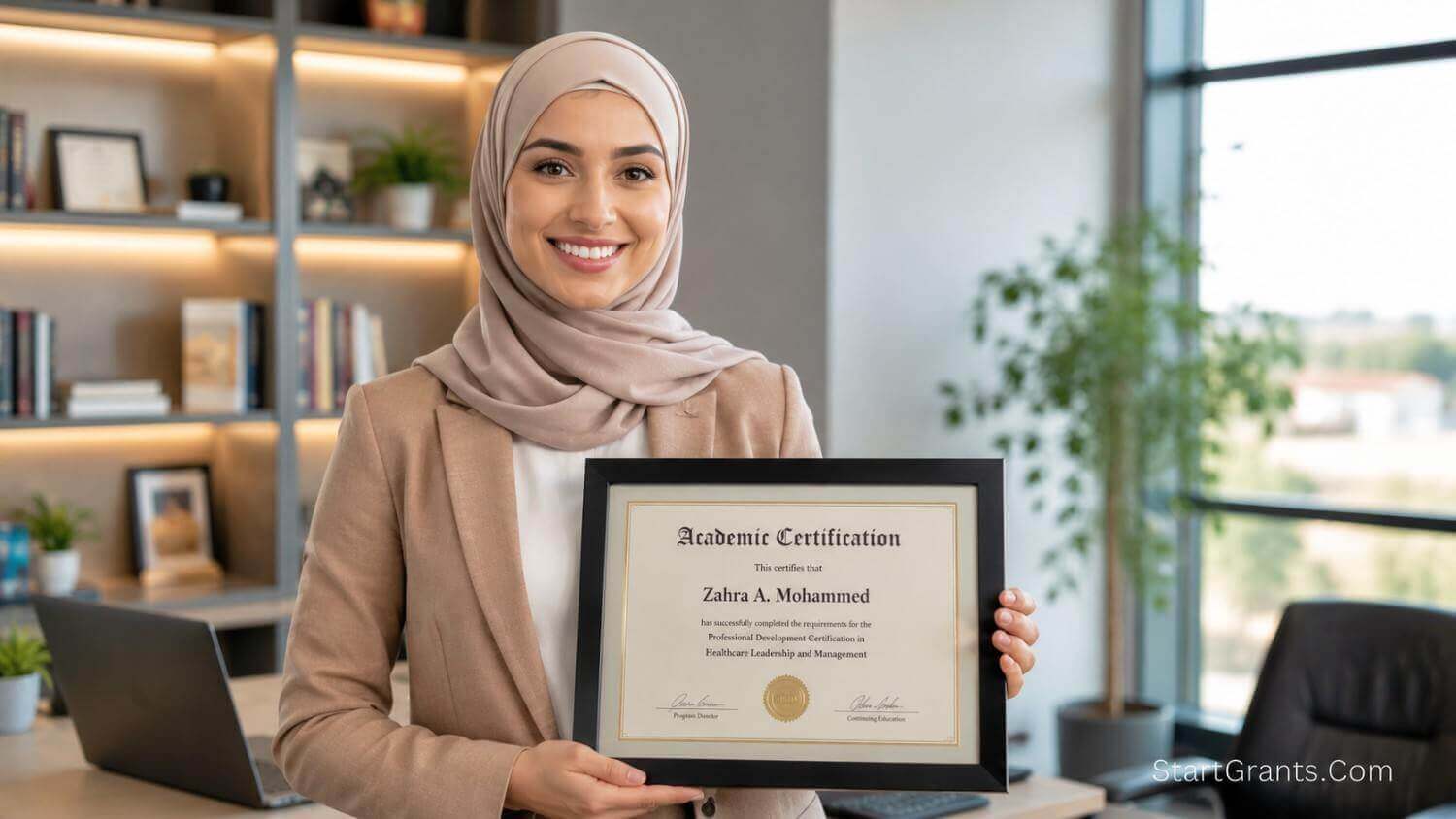
Securing a portable career through Halal, non-dilutive grants ensures military spouses can contribute financially without compromising their Islamic values.
Frequently Asked Questions (FAQs)
Q1: What exactly is a “portable career” under the MyCAA guidelines?
A: A portable career is an occupation that allows you to easily find employment regardless of where your spouse is stationed. This includes high-demand fields like healthcare (nursing, dental hygiene), technology (cybersecurity, software development), education, financial services, and remote freelance contracting. The DoD prioritizes funding for these specific sectors to ensure your career survives frequent PCS moves.
Q2: Can I use the MyCAA scholarship if my spouse is in the National Guard?
A: Yes, but only under specific operational conditions. Spouses of National Guard and Reserve members are eligible for MyCAA funding exclusively while their military sponsor is activated on federal Title 10 military orders. If the sponsor is on state-level Title 32 orders or inactive drill status, the spouse does not qualify.
Q3: Will the MyCAA program pay for my Bachelor’s degree?
A: No. The MyCAA (SpouseWorks) program is strictly capped at the Associate degree level. It is designed for rapid workforce entry via certifications, licensures, and two-year degrees. If you wish to pursue a Bachelor’s or Master’s degree, you will need to utilize transferred GI Bill benefits, Pell Grants, or specialized university-level scholarships.
Q4: What happens if my spouse gets promoted above the O-3 rank while I am in school?
A: You are protected by a grandfather clause. If your active-duty spouse is promoted beyond the eligible pay grades (e.g., promoted from O-3 to O-4), you remain fully eligible to receive the remaining balance of your $4,000 scholarship, provided you had an approved Education and Training Plan (ETP) in place before the official date of their promotion.
Q5: Can I combine MyCAA with the Pell Grant?
A: Yes, this is a highly recommended strategy. You can seamlessly stack the MyCAA scholarship with the federal Pell Grant. Because MyCAA is applied specifically to tuition, any excess Pell Grant funds you receive can be refunded to your personal bank account to legally cover housing, textbooks, and childcare costs while you study.
Q6: Why is taking out a standard student loan considered Haram for a Muslim spouse?
A: Standard federal and private student loans in the United States operate on a system of compounding interest. In Islamic jurisprudence, any contract that guarantees a fixed return on money lent (interest) is defined as Riba. Engaging in Riba is strictly prohibited (Haram) as it represents an exploitative financial practice. Muslims must seek non-repayable grants (Hibah) like MyCAA to ensure their income remains spiritually pure (Tayyib).
Q7: Does MyCAA cover the cost of laptops or textbooks?
A: No. MyCAA funds are strictly designated for academic tuition, certification exams, and mandatory licensing fees. It does not cover the cost of equipment, laptops, standard textbooks, uniforms, or transportation. You must budget for these ancillary costs separately or use other federal grants to cover them.
Q8: Is there a time limit to use the MyCAA funds?
A: Yes. Once you begin your approved program, you must complete your coursework within three (3) years from the start date of your first class. Additionally, the scholarship immediately terminates if your military sponsor separates from the military, retires, or otherwise leaves active duty. Timing your education correctly is critical.
Important Disclaimer: StartGrants.com is an independent educational portal. We are not affiliated with the United States Department of Defense, Military OneSource, or the SpouseWorks initiative. Ranks, eligibility criteria, and funding caps are subject to change by congressional mandate. Always consult an official SECO counselor via Military OneSource for exact programmatic rules, and a qualified Islamic scholar regarding Fiqh rulings on Riba and Dharurah.