
Last Updated: | Author: Munir Ardi
An in-kind donation gives a nonprofit something other than money: useful goods, professional help, volunteer work, or access to space. It can solve a specific need, but it cannot automatically replace a cash grant. A donated computer helps only if it runs the software your team uses; donated event food cannot pay the rent. Start with what your organization would otherwise buy, then ask for that exact item or service.
This guide covers how a U.S. nonprofit can plan, request, accept, document, and thank donors for these contributions. For a broader mix of cash and noncash fundraising methods, see how to get donations for a fundraiser.

Useful donated goods can meet a documented program or operating need.
Why in-kind gifts can help—and when they cannot
Picture a shelter that planned to purchase sturdy paint for its common room. A hardware store has unopened paint in the approved color and donates it before work begins. The gift can reduce the shelter’s spending. Now picture a shipment of expired paint in an unsuitable color: the shelter would have to pay for storage and disposal. The same label, “donation,” describes two very different outcomes.
Goods can also arrive with delivery costs, license fees, repair needs, data-security concerns, and donor restrictions. Ask program staff whether they will actually use the gift before presenting it as an alternative to cash. Corporate approvals and tax treatment vary; there is no evidence that requests for surplus inventory always bypass a company’s budget process.
Four kinds of help to request
| Contribution | Possible request | Check before acceptance |
|---|---|---|
| Goods and inventory | Working laptops, unopened food, paint, books, auction items | Condition, shelf life, specifications, storage and delivery |
| Professional services | Legal review, audit work, graphic design, web development | Scope, credentials, confidentiality, ownership of work |
| Use of space and media | Event room, office access, advertising placement | Dates, insurance, accessibility, written use terms |
| Volunteer labor | Painting, packing kits, sorting donated supplies | Supervision, safety, materials and meaningful tasks |
These are planning examples, not tax values. The tax treatment of donated inventory, labor, and use of space differs; see IRS Publication 526.
Goods: match the real need
For technology, request a minimum operating-system version, usable battery, chargers, data wiping, and any transferable software license. A software subscription or license is subject to its provider’s actual terms; do not assume a used license transfers with a computer. For food, medical products, building materials, and pet supplies, consult the staff who will distribute or use them. Refuse items that are unsafe, unusable, or too expensive to handle. A small, specific wishlist beats a standing invitation to drop off anything.
Expert help: write a project brief
A lawyer may review a contract, an accounting firm may advise on a defined project, and a designer may build a brochure. Describe deliverables, timing, points of contact, conflicts of interest, client confidentiality, and ownership of the final work. Ask a qualified professional about regulated work such as a formal audit. The IRS says the value of volunteered time or services generally cannot be deducted as a charitable contribution, although qualifying unreimbursed expenses may be deductible. Do not pitch an hourly-rate tax deduction; see IRS Publication 526.
Space and volunteers: clarify the arrangement
Borrowing a meeting room, receiving a building outright, and signing a below-market lease are different transactions. Put permitted use, insurance, access, cleaning, cancellation, and who pays utilities in writing. The mere free use of space generally does not give the owner a deduction equal to the market rent: IRS rules restrict deductions for donating a partial interest or right to use property. For an actual property transfer, seek legal and tax advice; our guide to getting a building donated to a nonprofit addresses that narrower project.
For group volunteers, offer a realistic task and a trained supervisor. Track participation for your own operations if useful, but do not turn a published “value of volunteer time” estimate into a donor tax receipt or claim that every hour replaces a paid hour.
Build a wishlist a donor can act on
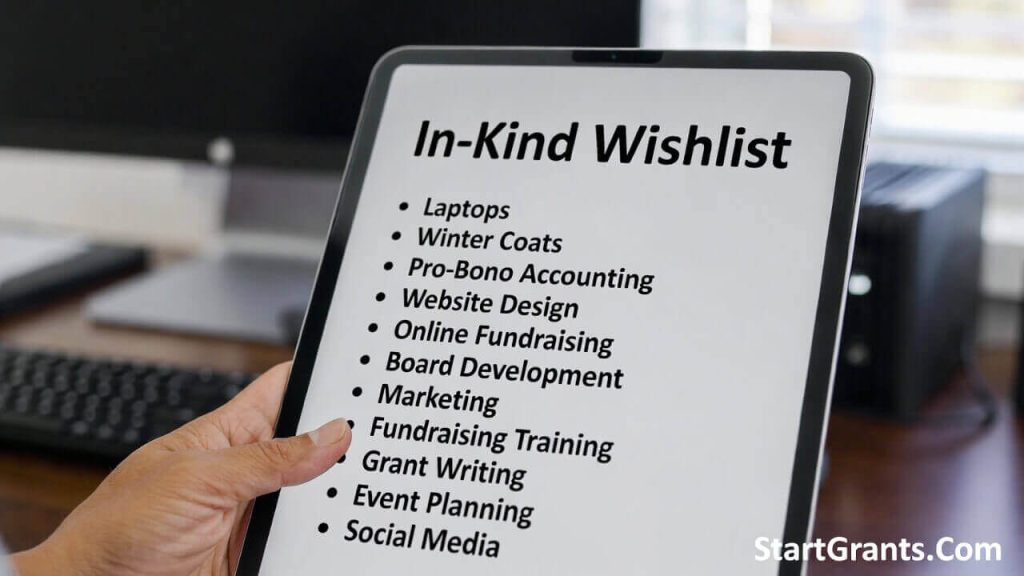
A wishlist should name specifications, quantities and a contact person.
Ask each team what it plans to buy or use in the next three months. For each item, write down the quantity, acceptable condition, deadline, place of delivery, staff owner, and reason for the request. “Fifteen functional laptops with chargers that meet our software requirements” is more useful than “old computers wanted.” A shelter might request washable blankets in specific sizes; an animal rescue may need unopened food that meets its veterinary guidelines.
Publish only the needs your organization has approved. Give a contact email or intake form, ask donors to confirm before shipping, and remove fulfilled requests. For images or stories about clients, obtain appropriate permission and avoid exposing private details merely to make a pitch.
Approach local businesses with a practical proposal
Find the right match
Make a short list of companies whose products, skills, or facilities fit a current need: a restaurant for event meals, a printer for signs, a hardware store for approved supplies, or a law firm for a limited legal project. Research the company’s existing giving process, then identify the appropriate manager. Ask if they have an application or approval process; do not assume the store manager can authorize a large gift.
Explain the benefit without promising a deduction
State what your nonprofit does, the precise request, when it is needed, and how the donation will be used. Ask whether the company wants public thanks and get permission before displaying its name or logo. Prominent logo placement, advertising, exclusive rights, or other benefits can change the tax analysis; discuss the arrangement with your organization’s adviser before promising sponsorship recognition. Verify deductible status when relevant through the IRS Tax Exempt Organization Search, and direct donors to their tax advisers for the value or availability of any deduction.
For a longer outreach letter, use our formal donation request letter guide. If the need is specifically cash to purchase goods, consider crowdfunding for a nonprofit instead of presenting donated inventory as a substitute.
Three adaptable request scripts
Replace the bracketed fields and confirm the offer and any recognition terms with your team. These drafts do not promise tax deductions, public exposure, or a pickup time the nonprofit cannot deliver.
1. Event food or supplies
Subject: Could [Business Name] help with [Event Name] on [Date]?
Hello [Name],
I’m [Name] from [Nonprofit Name]. We’re organizing [Event Name] to support [specific purpose] on [Date]. Would your business consider contributing [quantity and exact item, such as 50 boxed lunches or printing for 20 event signs]?
We can confirm delivery details and any food or printing specifications before you decide. With your permission, we would thank [Business Name] [describe the specific recognition your team has approved]. Could I send you a one-page event description and our item requirements?
Thank you,
[Name, role, contact]
2. Skilled professional service
Subject: Short pro bono project for [Nonprofit Name]
Hello [Name],
Our organization [one sentence on mission] needs help with [defined legal, accounting, design, or technology task]. The work would involve [deliverable], ideally by [date], with [staff member] serving as your contact.
Would your team consider a brief introductory conversation to see whether this project fits your capacity and professional requirements? We can provide a written scope and discuss confidentiality before any documents are shared.
Thank you for considering it,
[Name, role, contact]
3. Useful surplus inventory
Subject: Request for [specific items] for [program]
Hello [Name],
[Nonprofit Name] serves [community or mission]. Our [program] currently needs [quantity, item, condition and deadline]. If [Business Name] has suitable surplus stock, would you consider a donation? We can review specifications and arrange a practical delivery plan before accepting anything.
We can acknowledge items actually received. Your tax adviser can explain whether and how a contribution may be deductible. May I send you our short wishlist?
Best,
[Name, role, contact]
Accept, acknowledge and record a gift carefully
- Check fit before saying yes. Verify condition, restrictions, delivery, safety and whether your staff can use the contribution. Document any written agreement for restricted gifts and large property transfers.
- Record the transfer. Note the donor, receipt date, item descriptions and quantities, program destination, and relevant condition. Keep donor contact information secure.
- Send an accurate acknowledgment. For a deductible property gift, the donor needs a contemporaneous written acknowledgment if the claimed contribution is $250 or more. It should name the organization, describe the property rather than certify the donor’s valuation, and state whether the donor received goods or services in exchange; where applicable describe them and make the required good-faith estimate. The IRS lays out those requirements in its IRS acknowledgment rules.
- Handle valuation and returns separately. The nonprofit may need to determine amounts for its own accounting or Form 990; that does not mean its thank-you letter establishes the donor’s deductible value. A donor claiming qualifying noncash deductions may need Form 8283, and an appraisal may be required depending on the item, amount and exceptions. The IRS Form 8283 instructions distinguishes inventory and certain other exceptions. Bring vehicle or real-estate gifts to qualified advisers before accepting them.
Sample goods acknowledgment: “Thank you for the 20 functional laptops with chargers received on [date] by [Nonprofit Name]. No goods or services were provided in exchange for this contribution.” Adapt the last sentence if the donor received something in return. Do not add a speculative dollar value or issue the same language for professional services as though the donor’s hourly fee were deductible.
For nonprofits filing Form 990, reporting is more nuanced than entering the retail value of every donation as both revenue and expense. Property, contributed services, and use of facilities have different reporting and accounting treatments. Ask the person preparing your return to review the relevant instructions and your organization’s records. A receipt to the donor and your internal accounting serve different purposes.
A Muslim Perspective

A useful asset may support a community program for years when its maintenance is planned.
A mosque or Muslim-led nonprofit may invite appropriate gifts of books, equipment, building materials, or professional help as sadaqah. Some donors may think about enduring benefit when supporting a school or clinic, but an organization should not promise a particular spiritual reward or label every arrangement a waqf. A waqf may involve a formal endowment, property restrictions and legal documentation; temporary free use of an office is not automatically one.
Honor a donor’s stated restrictions and consider whether the project, stewardship and intended recipients meet the organization’s own policies. If the request is for zakat-funded goods, check eligibility and distribution with qualified religious and legal advisers rather than assuming all nonprofit expenses qualify. Offer donors a way to give discreetly when public recognition would compromise privacy.
Make the next request specific
Choose one current need, ask the staff member who will use it to set minimum specifications, and contact a business that can plausibly supply it. A useful gift can reduce a real expense or improve a program; a gift accepted for its headline value alone can create more work than help. Keep fundraising for unrestricted cash alongside in-kind requests so that staff, rent and essential services remain funded.
Frequently Asked Questions
What counts as an in-kind donation to a nonprofit?
It is a contribution other than money, such as usable goods or professional help. Volunteer time and free use of space can also help an organization, but their tax and accounting treatment differs from donated property.
How should a nonprofit acknowledge a donated item?
Describe the property and state whether the donor received any goods or services in return. If something was provided, describe it and provide any required good-faith estimate of its value. The organization should not certify the donor’s claimed value of the donated property.
Can a donor deduct the value of volunteer time or professional services?
Generally no. The IRS does not allow a charitable deduction for the value of time or services. Some unreimbursed expenses incurred while volunteering may qualify under applicable rules.
Can a company deduct the retail price of excess inventory?
Not automatically. The allowable deduction depends on the inventory, tax basis, donor and other rules; special rules may apply to qualifying food inventory. The donor should consult a tax professional rather than rely on a nonprofit’s estimate.
Can a nonprofit use donated goods to pay salaries?
Goods generally do not replace payroll cash or employment obligations. A useful donation may reduce a planned expense, leaving cash available for other approved costs, but it does not automatically increase the organization’s budget.
Does a free event venue give the owner a deduction for the rent waived?
Usually, donating only the right to use property does not create a charitable deduction equal to market rent. Costs or a transfer of ownership may be subject to different rules; the owner should obtain tax advice.
Do large donations require Form 8283 or an appraisal?
The donor may need Form 8283 when claiming a noncash charitable deduction above applicable thresholds. Qualified appraisal rules generally apply to certain higher-value property, but exceptions exist, including some inventory and vehicle cases. Consult the current IRS instructions before filing.
Does a nonprofit need to report donated goods and services on Form 990?
Reporting depends on the type of contribution and the organization’s filing requirements. The acknowledgment given to a donor does not determine accounting or Form 990 treatment. Have the return preparer review records and the applicable instructions.
Can an in-kind gift to a Muslim charity be treated as zakat or waqf?
That depends on the donor’s intent, the recipient, the gift terms and the charity’s policies. A temporary loan of space is not automatically a waqf, and not every nonprofit expense is eligible for zakat. Consult qualified religious and legal advisers where appropriate.