
Last Updated: August 2026 | Author: Munir Ardi
Social justice advocacy is the heartbeat of societal progress. Whether your organization is fighting to dismantle systemic racism, providing pro-bono legal defense for marginalized communities, or advocating for equitable housing, the mission is noble—but it is astronomically expensive. Holding rallies and raising awareness is important, but executing systemic, permanent legislative and societal reform requires massive, sustained capital.
For community organizers and nonprofit directors, knowing how to get grants for social justice is the critical difference between a temporary grassroots movement and a formidable, permanent institution. While massive endowments are eager to fund civil rights, they do not hand out millions of dollars to unorganized activists; they fund highly structured, legally compliant entities.
Before you begin pitching your advocacy campaigns to massive foundations, you must ensure your organization’s structural and legal foundation is impenetrable. Anchor your bureaucratic strategy by reviewing our Master Pillar: Government Grants for Nonprofit Organizations & 501(c)(3) Opportunities.
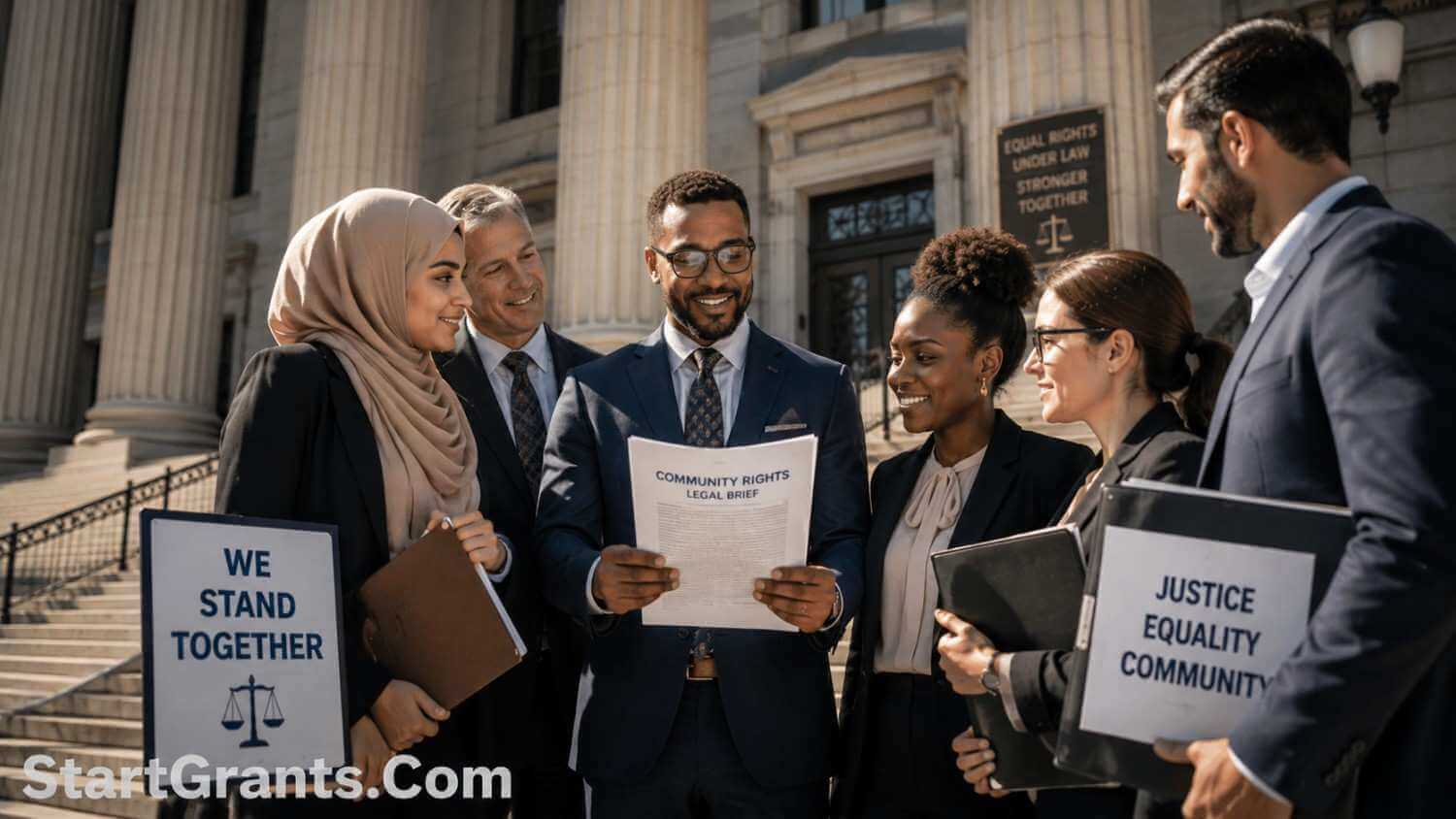
Social justice advocacy is the core of democratic progress, but it requires sustained financial support. Specialized grants provide the non-dilutive capital needed for legal aid, community research, and civil rights outreach.
Phase 1: The Nature of Social Justice Funding
Unlike medical research or infrastructure grants, which are heavily funded directly by the federal government, social justice funding is overwhelmingly dominated by the private sector. Megafoundations—such as the Ford Foundation, the Open Society Foundations, and the W.K. Kellogg Foundation—dedicate hundreds of millions of dollars annually specifically to advance racial equity, criminal justice reform, and immigrant rights.
The IRS 501(c)(3) Warning: You must understand the absolute legal boundary of your funding. Federal law strictly prohibits 501(c)(3) organizations from engaging in partisan political activity (e.g., endorsing a specific political candidate). Therefore, your grant proposals must focus strictly on issue advocacy, educational outreach, systemic research, and providing direct legal services to marginalized individuals, completely divorced from partisan politics.
Phase 2: Winning the Narrative (The Winning Proposal)
Because social justice is an inherently emotional field, rookie grant writers make the fatal mistake of drafting proposals based entirely on anger, grief, or passion. A grant committee reading your application already knows injustice exists. They do not want to fund your outrage; they want to fund your highly calculated, measurable solution.
Your proposal must act as a precise strategic roadmap. To master the foundational elements of drafting a compelling, data-driven argument, you must study the core principles outlined in Writing Grants for Nonprofits.
Furthermore, if you are targeting state or federal funding designed for community equality programs, you must structure your application to survive brutal government scrutiny. Learn the exact bureaucratic architecture required to pass these reviews by reading How to Write a Government Grant Proposal.
Pro-Tip: Funding Social Impact
Securing capital for advocacy requires shifting your language from “activism” to “impact metrics.” To understand exactly how massive philanthropic foundations evaluate social justice proposals and what data they demand to see before approving funding, watch this excellent breakdown from industry insiders: Grant Writing for Social Justice & Advocacy Organizations:
Phase 3: Synergizing Your Non-Profit Portfolio
The most successful civil rights and social justice NGOs do not isolate their work. They understand that systemic oppression intersects with the environment, healthcare, and academia. By “stacking” your advocacy with these other sectors, you unlock completely different pools of massive grant funding.
- The Research Intersection: If your organization is combating systemic bias in the criminal justice system, you need hard data. You can secure massive federal and university grants to conduct the ethnographic studies required to prove your case. Learn how to fund this vital social science research in How to Get Anthropology Research Grants, and master the academic peer-review process via Applying for Research Grants: The Ultimate Tips.
- Environmental Justice: Low-income and minority neighborhoods are disproportionately affected by industrial pollution, toxic water, and a lack of green infrastructure. Fighting this is a core pillar of social justice. Secure capital to combat these specific disparities by reading How to Get Government Grants for Environmental Projects, and learn to build tangible community assets in Grants for Recycling Programs.
Phase 4: Operational Excellence (Tracking & Digital Reach)
Winning a $250,000 grant from the Ford Foundation is only the beginning. Foundations expect flawless execution and transparent reporting. Social justice organizations are often audited aggressively. You cannot manage massive grant funds on an Excel spreadsheet; doing so puts your NGO at risk of having to return the money.
To shield your organization from compliance failures, you must implement dedicated tracking architecture. Discover the necessary tools in our guide to Grant Tracking Software for Nonprofits.
Additionally, modern social justice advocacy is fought online. If your NGO does not control the digital narrative, your mission will be suppressed by counter-campaigns. You can force your organization to the top of Google search results—raising awareness and driving donor traffic—by claiming $10,000 a month in free search advertising. Master this digital takeover in Google Grants Application Know-How.
Phase 5: The Muslim Perspective (Amar Ma’ruf, Riba, & Zakat)
For Muslim-led NGOs, legal clinics, and community organizers operating in the United States, social justice is not a modern political trend; it is the absolute core of the Islamic faith. The Qur’an explicitly commands believers to stand firmly for justice (Qist), even if it is against themselves or their parents (4:135). Fulfilling the mandate of Amar Ma’ruf Nahi Munkar (enjoining good and forbidding evil) requires robust institutions. However, scaling an advocacy NGO requires strict adherence to Islamic financial jurisprudence (Shariah).
The Trap of Riba in NGO Expansion
Advocacy is expensive. Hiring elite civil rights attorneys, renting office space, and launching national educational campaigns drains capital rapidly. When donations run low, secular NGOs often turn to commercial banks for “bridge loans” or operational credit lines to stay afloat.
In Islam, intentionally taking on a loan that mandates compounding interest is explicitly Riba. Engaging in Riba is strictly Haram (forbidden) and entirely eradicates the spiritual Barakah (blessing) from the organization’s mission. A Muslim board of directors must adamantly refuse these loans.
This elevates the pursuit of Foundation Grants (Hibah) into a religious necessity. Because grants require no repayment, they are 100% Halal capital. If grant disbursements are delayed, the NGO must rely on internal reserves, seek Qard Hasan (zero-interest benevolent loans) from the community, or utilize the yields of an ethical Islamic endowment (Waqf).

Fighting for justice (Al-‘Adl) is a divine imperative. Muslim organizations must secure Halal funding (Hibah) to support their advocacy work, ensuring that every dollar serves the community without the burden of interest-bearing debt.
Gharar and Liability Insurance
If your NGO engages in high-stakes civil rights litigation, exposes corporate corruption, or hosts massive public rallies, you become a prime target for retaliatory lawsuits. Major grant foundations will legally mandate that your NGO carries extensive Directors & Officers (D&O) Liability and Commercial General Liability Insurance.
Traditional commercial insurance involves Gharar (excessive uncertainty). Ideally, Islamic organizations should utilize Takaful (Islamic cooperative insurance). Because authentic commercial Takaful is practically non-existent in the U.S. market, contemporary Islamic scholars apply the principle of Dharurah (legal and operational necessity). This permits the Muslim NGO to purchase the required commercial policy to protect its leadership and ensure the survival of its advocacy mission, provided the intent is pure protection, not speculative profit.
Zakat vs. Sadaqah in Advocacy
A fatal theological error in Muslim advocacy organizations involves the mismanagement of Zakat. A Muslim board must be impeccably precise with its accounting:
- Sadaqah Jariyah & Grants (Operations): Zakat cannot be used to pay the rent for the NGO’s office, fund the marketing budget, or pay the general salaries of the administrative staff. These operational overhead costs must be funded exclusively through government/private grants (Hibah) or general Sadaqah (voluntary charity).
- Zakat (Fi Sabilillah & Al-Masakin): However, if your NGO operates a pro-bono legal clinic representing impoverished refugees fighting deportation, or defending wrongly incarcerated Muslims who have no money, those individuals qualify as Al-Masakin (the needy) or fall under the category of Fi Sabilillah (in the path of Allah, defending the oppressed). It is entirely Halal to utilize community Zakat specifically to pay the direct legal fees and court costs required to liberate and protect these vulnerable individuals.
Conclusion
Figuring out how to get grants for social justice requires moving beyond activism and stepping into institutional professionalism. By aligning your mission with the strategic goals of megafoundations, backing your proposals with bulletproof sociological and environmental research, and deploying elite grant-tracking software, your NGO can secure the multi-year funding needed to force systemic change.
For Muslim-led organizations, fighting for Qist (justice) is an act of profound worship. By fiercely rejecting the predatory trap of Riba-laced commercial debt in favor of Halal grants (Hibah), navigating insurance mandates ethically via Dharurah, and strictly separating operational Sadaqah from Zakat-eligible legal defense funds, your organization becomes an unstoppable, spiritually pure force for equality and human dignity.
Frequently Asked Questions (FAQs)
Q1: Who provides the most grants for social justice programs?
A: Unlike medical or infrastructural grants, the vast majority of social justice and civil rights funding comes from private philanthropic megafoundations (e.g., Ford Foundation, Open Society Foundations, W.K. Kellogg Foundation) rather than direct federal government agencies.
Q2: Can a 501(c)(3) nonprofit use grant money to support a political candidate?
A: Absolutely not. Under strict IRS regulations, a 501(c)(3) tax-exempt organization is legally prohibited from participating in, or intervening in, any political campaign on behalf of (or in opposition to) any candidate for elective public office. Doing so will result in the immediate revocation of your tax-exempt status and the loss of all grant funding.
Q3: How do we prove our social justice impact to grant reviewers?
A: Grant reviewers demand measurable metrics. You cannot simply claim you “raised awareness.” You must provide concrete data: the number of pro-bono legal cases won, specific local policies or laws your research helped change, or the exact number of individuals trained in community advocacy programs.
Q4: Why is it Haram for an Islamic NGO to use a commercial bank loan for operational costs?
A: Commercial bank loans require the borrowing organization to pay back the principal amount plus a percentage of compounding interest over time. In Islamic finance, any transaction that requires the payment of interest is classified as Riba, which is strictly forbidden (Haram). Islamic NGOs must rely on cash reserves, grants (Hibah), or Qard Hasan (interest-free loans) to survive.
Q5: Can Zakat be used to fund a social justice legal clinic?
A: Yes, but with strict limitations. Zakat cannot be used to pay the clinic’s rent, electricity, or general marketing. However, Zakat CAN be used to pay the direct legal fees and defense costs for specific, impoverished individuals who are facing oppression, unjust incarceration, or deportation, as they qualify under the Asnaf categories of Al-Masakin (the needy) or Fi Sabilillah (in the path of Allah).
Disclaimer: The information provided in this article is for educational and informational purposes only. We are not a federal agency, a legal firm, or a religious fatwa council. IRS regulations regarding 501(c)(3) lobbying limits and foundation funding priorities are subject to constant legislative changes. Always consult with a certified CPA regarding nonprofit grant compliance, an attorney for advocacy boundaries, and a qualified Islamic finance scholar regarding Halal institutional structuring, avoiding Riba, and strict Zakat accounting rules.