
Last Updated: April 2026 | Author: Zee
The landscape of modern law enforcement is rapidly evolving. Today, a high school diploma and police academy training are often just the baseline. To secure promotions to detective, sergeant, or specialized federal task forces, law enforcement professionals are increasingly required to hold an undergraduate or graduate degree in Criminal Justice, Public Administration, or Criminology.
However, public servants already sacrifice enough for their communities; they should not have to sacrifice their financial future to further their education.
Because police officers are considered critical public assets, the financial aid ecosystem offers highly specialized funding streams designed exclusively for active-duty law enforcement, their dependents, and the families of fallen heroes. Whether you are a rookie patrol officer looking to earn your bachelor’s degree at night, or a veteran seeking command-level education, massive pools of free money are waiting to be claimed.
In this comprehensive 2026 guide, we will break down the specialized grant ecosystem for police officers. We will explore how to hack departmental tuition reimbursement, how to leverage police union endowments, and how Muslim officers can secure interest-free educational funding to advance their careers without taking on predatory student loans.

Furthering your education as a police officer is critical for promotion. Before applying for external scholarships, always check your specific precinct’s tuition reimbursement policies.
Phase 1: The First Line of Defense (Departmental Tuition Reimbursement)
Before you fill out a single external scholarship application, your financial investigation must begin inside your own precinct. The most lucrative and accessible source of college funding for an active-duty police officer is their direct employer.
To incentivize a highly educated police force, the vast majority of medium-to-large police departments and sheriff’s offices offer robust Tuition Reimbursement Programs.
How Departmental Funding Works
Unlike traditional grants that pay the university upfront, tuition reimbursement requires you to pay for the classes initially (or use a payment plan). Once you successfully complete the course with a passing grade (usually a “C” or higher), the police department writes you a check to reimburse the cost of tuition and sometimes textbooks.
- The Major Restriction: Departments will not pay for just any degree. To qualify for reimbursement, your major must directly benefit the department. Degrees in Criminal Justice, Sociology, Psychology, Public Administration, and Law are almost universally approved. If you try to use police funds to get a degree in Art History, your request will be denied.
- The Service Contract: This money comes with strings attached. Most departments require you to sign a retention contract stating that you will remain employed with the force for a specific period (typically 1 to 3 years) after receiving the reimbursement. If you resign to join a different agency before the contract expires, you must pay the money back.
To maximize these departmental funds, you must still establish your baseline federal aid. Ensure you review our master operational guide on undergraduate and career-specific college scholarships to trigger any state or federal money you might be eligible for before dipping into precinct funds.
As a working adult and public servant, your approach to financial aid is entirely different from a high school senior. Watch this official, animated breakdown from the U.S. Department of Education on how working professionals can secure federal grants and navigate the FAFSA system to supplement their departmental reimbursement:
Phase 2: Union Endowments (The FOP Scholarships)
If your specific police department does not offer tuition reimbursement, or if the annual funding cap is too low, your next target is your police union.
The Fraternal Order of Police (FOP) is the world’s largest organization of sworn law enforcement officers, and they control massive educational endowments at both the national and state levels.
National and State Lodge Grants
If you are an active member of the FOP in good standing, you have exclusive access to union scholarships. These grants are entirely closed off to the general public, meaning the competition is drastically lower than federal or state-wide awards.
- For the Officer: Many state FOP lodges offer direct grants to officers enrolled in undergraduate or graduate programs. You must contact your local lodge president to request the specific application, as these funds are often not advertised online.
- For the Dependents: The FOP also heavily funds the education of police families. If you are a police officer, your children can apply for FOP dependent scholarships. If your family is located in states with massive union presence, like Ohio or Florida, you should cross-reference our specific guide on scholarships for college students in Ohio to stack state grants on top of your union money.
Phase 3: The Federal Shield (Survivor and Disability Grants)
Law enforcement is an inherently dangerous profession. When tragedy strikes, the federal government and national non-profit organizations step in to ensure that the educational futures of a fallen or catastrophically injured officer’s family are fully protected. These are not traditional scholarships; they are federal entitlements and memorial grants designed to cover the total cost of attendance.
The PSOEA Program (Public Safety Officers’ Educational Assistance)
The crown jewel of federal survivor benefits is the Public Safety Officers’ Educational Assistance (PSOEA) program. Administered by the U.S. Department of Justice, this program provides massive financial assistance to the spouses and eligible children of local, state, and federal police officers who were killed or permanently disabled in the line of duty.
- The Benefit Amount: The PSOEA provides a monthly educational assistance allowance that is mathematically tied to the GI Bill for veterans. As of recent academic years, this can equal over $1,400 per month for full-time students, which can be used for tuition, room, board, and textbooks.
- The Eligibility Window: Spouses can use this benefit for up to 45 months of full-time education, completely free from the time limits that restrict other grants. However, children of the fallen officer must generally use the benefit before their 27th birthday.
State-Mandated Tuition Waivers
Beyond the federal PSOEA, almost every state legislature in the country has passed mandatory tuition waiver laws for the dependents of fallen heroes. For example, in states like Florida and Texas, if a police officer is killed in the line of duty, their children are legally entitled to a 100% tuition waiver at any public state university or community college. If your family resides in a state with these absolute waivers, you must review our state-specific guides, such as our breakdown of the Florida Student Assistance Grant, to understand how to stack your survivor benefits with standard state financial aid for room and board costs.
C.O.P.S. Scholarships (Concerns of Police Survivors)
If state waivers and federal funds do not cover the complete cost of a private university, families must turn to C.O.P.S. (Concerns of Police Survivors). This national organization operates a massive endowment dedicated strictly to the surviving spouses and children of law enforcement officers. They distribute millions of dollars annually in supplemental scholarships that can be applied to elite private universities (like USC or NYU) where state waivers hold no legal power.
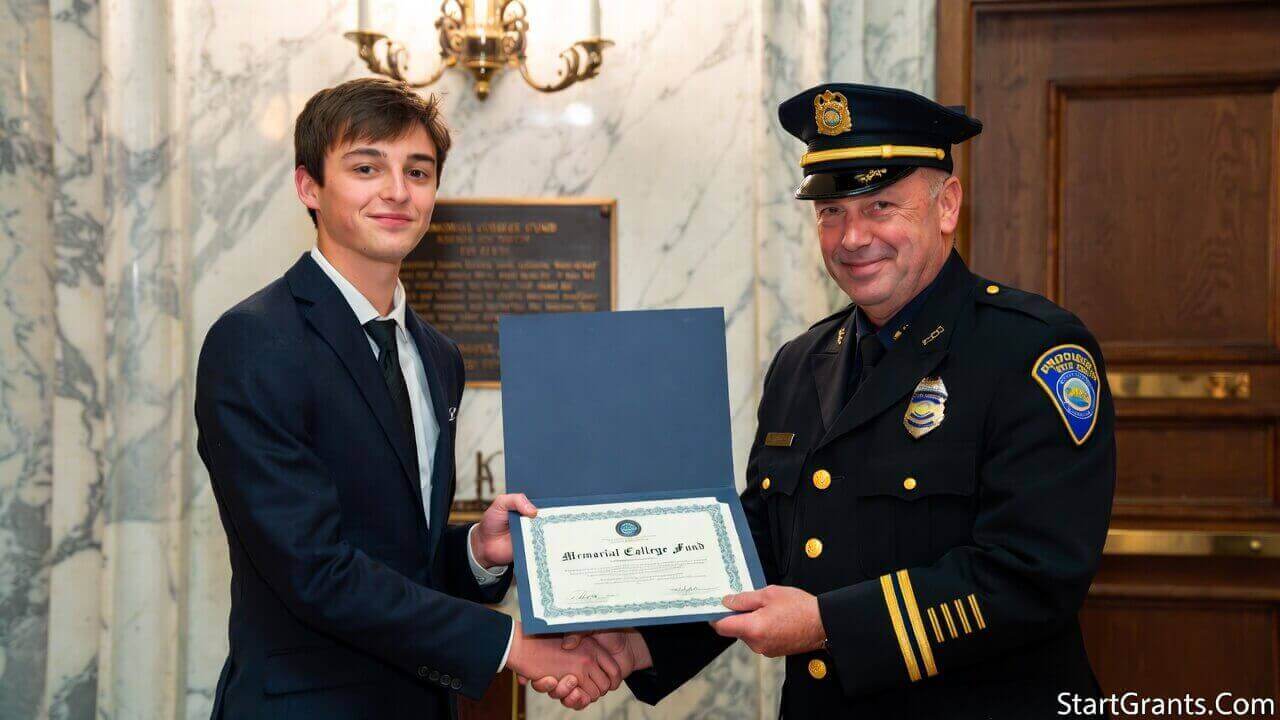
National organizations like C.O.P.S. and federal programs like the PSOEA ensure that the children and spouses of fallen law enforcement officers can attend college completely debt-free.
Phase 4: The PSLF Trap and Minority Grants
For active-duty officers attempting to fund their own graduate or undergraduate degrees, the financial aid office will often aggressively push them toward the Public Service Loan Forgiveness (PSLF) program. You must understand the danger of this advice.
Why Upfront Grants Beat PSLF
The PSLF program is mathematically designed to forgive your federal student loans after you make 120 qualifying monthly payments (10 years) while working full-time for a government or non-profit agency (which includes all public police departments). However, PSLF is not a grant; it is debt forgiveness. Relying on PSLF means you must first take out massive federal loans, accrue interest for a decade, and pray that the complex federal bureaucracy actually approves your forgiveness application 10 years later. Thousands of police officers have been denied PSLF due to minor paperwork errors. Therefore, you must exhaust every upfront grant, departmental reimbursement, and union scholarship before you ever sign a federal loan promissory note.
Specialized Grants for Minority Officers
To diversify the leadership ranks of local and federal law enforcement, several private foundations offer massive grants specifically for minority officers returning to college.
- NOBLE Scholarships: The National Organization of Black Law Enforcement Executives (NOBLE) provides highly competitive scholarships for African American students and active-duty officers pursuing degrees in criminal justice or public administration.
- WIFLE Endowments: Women in Federal Law Enforcement (WIFLE) offers annual scholarships for female officers and female college students who are actively pursuing careers in federal agencies like the FBI, DEA, or Secret Service. These private funds bypass the FAFSA entirely and are awarded based on career dedication and leadership potential.
Phase 5: A Tactical Note on Riba (The Muslim Perspective)
Serving in law enforcement is a noble profession that aligns deeply with the Islamic principle of protecting the community and upholding justice. However, for Muslim police officers seeking to elevate their rank through higher education, the traditional American financial aid system presents a severe religious boundary.
If your departmental tuition reimbursement does not cover the full cost of your bachelor’s or master’s degree, the university will offer you federal or private student loans. Because these loans inherently accrue interest, they are a direct violation of the Islamic prohibition against Riba.
Advancing Your Rank Without Riba
As a Muslim officer, you cannot justify taking on Riba-based loans simply to secure a promotion to sergeant or detective. You must construct a Halal financial strategy. First, aggressively leverage your FOP union grants and departmental reimbursements, as these are interest-free and mathematically Halal. If a funding gap remains, you must completely reject federal loans (and the PSLF trap) and seek out zero-interest community endowments. National organizations like A Continuous Charity (ACC) provide specialized, interest-free educational loans specifically for Muslim students and professionals in the U.S.
For a comprehensive operational breakdown of how to navigate the U.S. college system without compromising your faith, you must study our master directory on how to get grants and scholarships for Muslim college students in the U.S..
Conclusion: Your Law Enforcement Funding Action Plan
Advancing your career in law enforcement should not result in a lifetime of financial debt. The funding exists; you simply need to know the correct chain of command to access it.
Execute this tactical checklist to secure your educational funding:
- Audit Your Precinct: Go directly to your human resources or union representative and demand the exact paperwork for your department’s Tuition Reimbursement Program. Understand the grade requirements and the service contract.
- Leverage the FOP: Contact your local or state Fraternal Order of Police lodge to access exclusive, union-only scholarships for yourself or your dependents.
- Claim Survivor Benefits: If you are the spouse or child of a fallen or disabled officer, immediately file for the federal PSOEA program and verify your state’s mandatory tuition waiver laws.
- Avoid the PSLF Trap: Prioritize upfront, free grant money over the promise of loan forgiveness 10 years down the line.
- Protect Your Faith: If you are a Muslim officer, reject interest-bearing loans and utilize Halal, zero-interest alternatives like ACC to fund your promotion.
A badge earns you respect, but a degree earns you rank. Review your union contract today, submit your FAFSA to establish your federal baseline, and leverage your precinct’s educational budget to command your next promotion.
Frequently Asked Questions (FAQs)
Q1: Do police departments pay for your college degree?
A: Yes, the vast majority of medium-to-large police departments and sheriff’s offices offer Tuition Reimbursement Programs. If you pursue a degree that benefits the department (such as Criminal Justice, Public Administration, or Criminology), the precinct will reimburse your tuition costs upon successful completion of the courses, provided you agree to remain employed with the department for a set number of years.
Q2: What is the Public Safety Officers’ Educational Assistance (PSOEA) program?
A: Administered by the U.S. Department of Justice, the PSOEA program provides significant federal financial assistance to the spouses and eligible children of local, state, and federal police officers who were killed or permanently disabled in the line of duty.
Q3: Do the children of police officers get free college?
A: In many cases, yes, if the officer was killed or catastrophically injured. The federal PSOEA program provides monthly funding, and almost every U.S. state has passed mandatory tuition waiver laws ensuring the children of fallen heroes are legally entitled to a 100% tuition waiver at public state universities.
Q4: Can active-duty police officers get the Pell Grant?
A: Yes. There is no occupational restriction on the Federal Pell Grant. If you are an active-duty police officer, especially a rookie on a lower starting salary, you should always file the FAFSA. If your family income and Student Aid Index (SAI) fall within the federal limits, you will receive the grant.
Q5: Is Public Service Loan Forgiveness (PSLF) a grant for police officers?
A: No. PSLF is a loan forgiveness program, not an upfront grant. It requires you to make 120 qualifying monthly payments on federal student loans while working in public service before the remaining balance is forgiven. Upfront college grants and tuition reimbursements are always mathematically superior to PSLF.
Q6: Are there interest-free educational funds for Muslim police officers?
A: Yes. Because traditional student loans accrue interest (Riba), Muslim police officers seeking to fund their college degrees should maximize their interest-free departmental tuition reimbursements and union grants. To cover any remaining costs, they can apply for zero-interest community educational loans through organizations like A Continuous Charity (ACC).
Q7: Can I use my military G.I. Bill at the same time as police tuition reimbursement?
A: It depends on your precinct’s specific union contract. While the VA allows you to use your Post-9/11 G.I. Bill while working as a police officer, many police departments operate on a “last-payer” policy. This means they will only reimburse you for tuition costs that were not already covered by the G.I. Bill. You must read your specific HR policy regarding double-dipping.
Q8: What happens to my departmental tuition reimbursement if I resign or transfer precincts?
A: Almost all police departments attach a “retention contract” to their educational funding. If the precinct pays for your degree, you are typically legally bound to remain employed with them for 1 to 3 years after graduation. If you resign or transfer before that contract expires, you will be legally required to pay the money back in full.
Important Disclaimer: StartGrants.com is an independent information portal. We are not a government agency and do not provide direct grants or products. Always verify the current status of programs with the providing organization.