
Last Updated: July 2026 | Author: Munir Ardi
A highly trained Police K9 is one of the most effective, versatile, and irreplaceable assets in modern law enforcement. From tracking missing children and detecting hidden narcotics to locating explosive devices and protecting human officers, these working dogs save lives daily. However, deploying a K9 unit is astronomically expensive. A fully trained dual-purpose police dog can cost $15,000 to $20,000, and retrofitting a police cruiser with specialized K9 climate controls and kennels adds another $50,000 to the bill.
For municipal police departments facing severe budget cuts, the upfront cost of establishing or maintaining a K9 unit is often prohibitive. To bridge this massive financial gap, departments must look beyond local taxes and tap into a dedicated network of police K9 grants. Private foundations and corporate endowments have amassed millions of dollars specifically to fund these heroic working animals.
Before launching a grant application for specialized law enforcement assets, it is critical to understand the overarching institutional and medical funding architecture that supports first responders. Anchor your department’s funding strategy by reviewing our master pillar: Medical Research and Institutional Grants.
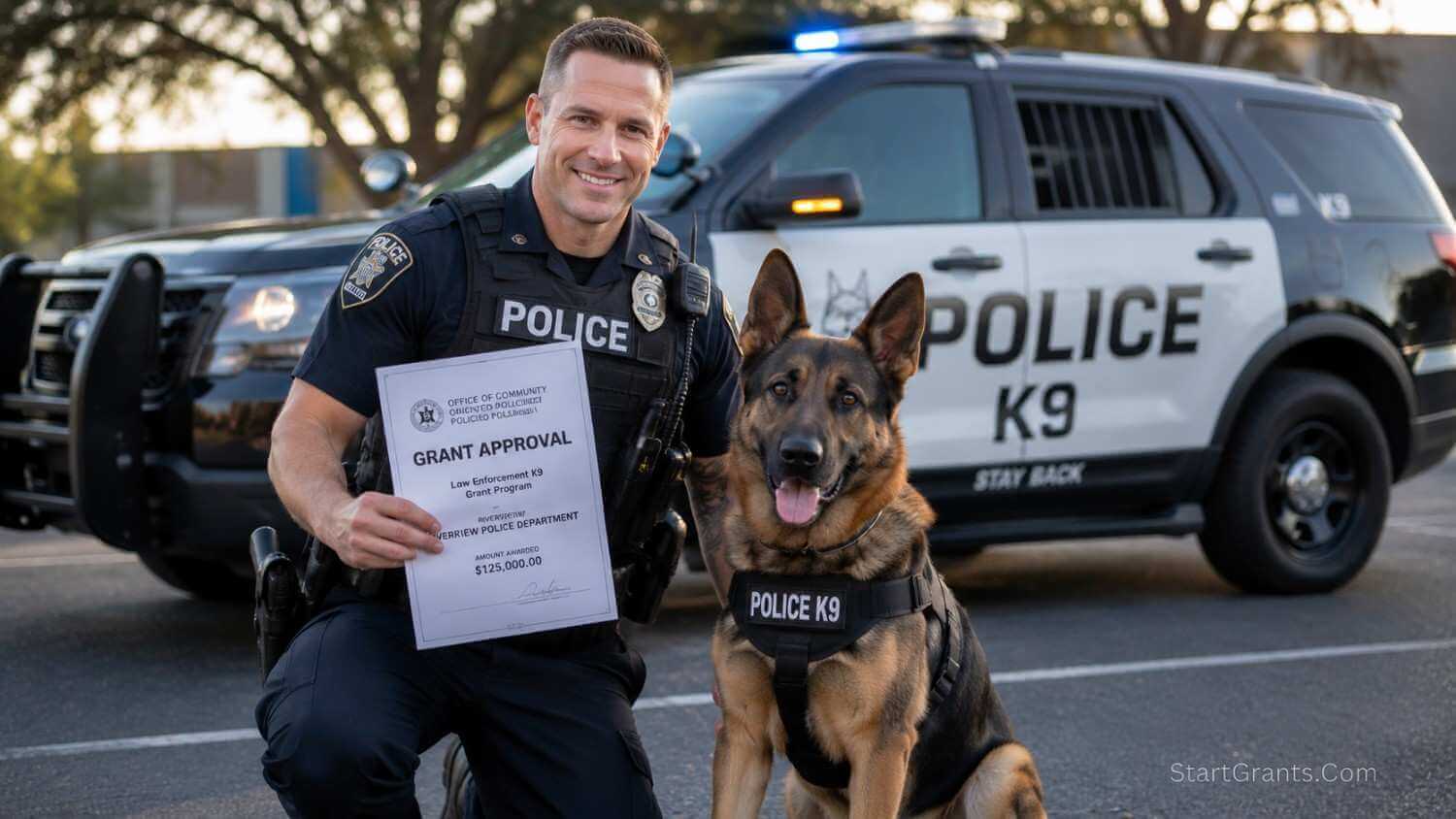
Establishing a specialized K9 unit can cost a police department upwards of $70,000 in initial capital. Securing private foundation grants is the most effective way for local law enforcement to fund these life-saving working dogs without draining municipal budgets.
Phase 1: The Federal vs. Private Reality
When searching for funding, many police chiefs look directly to the federal government (such as the Department of Homeland Security or the DOJ). While federal grants exist, they are highly restrictive. Federal money is usually reserved exclusively for counter-terrorism efforts, specifically funding bomb-sniffing or mass-transit security dogs. They rarely fund standard patrol or narcotics K9s for local towns.
Therefore, the ultimate strategy for municipal and county law enforcement is to aggressively target Private Endowments and Non-Profit Police Foundations. These organizations offer massive, agile grants with significantly less red tape than federal agencies.
Phase 2: Top Private Endowments for K9 Units
In 2026, the following private foundations operate the most lucrative and accessible funding pipelines for local K9 units:
1. The Stanton Foundation
This is the holy grail for departments that currently do not have a K9 unit. The Stanton Foundation offers grants of up to $30,000 specifically designed to help local police departments create a brand new K9 program. Their grant covers the purchase of the dog, the initial handler training academy, and basic veterinary care. However, they strictly require that the dog be trained for patrol and at least one scent-detection specialty.
2. National Police Dog Foundation (NPDF)
The NPDF is a phenomenal resource for established units. They offer recurring grants not just for purchasing new dogs, but heavily focus on Medical Care Grants. Working dogs sustain injuries and face unique health challenges. The NPDF helps departments cover unexpected, massive veterinary bills that the city budget cannot absorb.
3. Vested Interest in K9s, Inc.
A police dog is a sworn officer and deserves the exact same level of physical protection as their human handler. Vested Interest in K9s provides grants to purchase custom-fitted, NIJ-certified ballistic and stab-proof vests for active-duty dogs. These vests can cost upwards of $1,200 each, and this foundation absorbs the cost entirely for approved departments.
Pro-Tip: Seeing K9 Foundation Grants in Action
Understanding how private police foundations actually allocate their funds can give your department a strategic advantage when writing your proposal. Grant committees prioritize the safety and tactical efficiency of the dogs. To see exactly how these grants are deployed in the real world to purchase critical safety equipment for K9s, watch this official breakdown: K9 Unit Equipment Grant | Phoenix Police Foundation:
Phase 3: Synergizing First Responder Operations
A successful grant writer integrates their K9 funding proposal with broader public safety initiatives. Grant committees love to see departments that utilize cross-training and synergy.
- The Arson K9 Synergy: Fire departments and police departments frequently overlap. “Accelerant Detection Dogs” (Arson Dogs) are specialized K9s used to investigate suspicious fires. You can stack your K9 grant proposals with fire safety funds by exploring our guide on Fire Prevention Grants.
- Medical Emergencies in the Cruiser: A K9 handler operates a highly specialized police cruiser. Because these officers are often the first on the scene, their vehicles must be equipped to handle human cardiac emergencies as well. Fund this essential trauma gear by reading: Automated External Defibrillator Grants.
Phase 4: The Bureaucratic Shield (The Aftercare Budget)
Private foundations will not give your department a $15,000 dog if they suspect you cannot afford to take care of it. The fastest way to get your grant application rejected is by failing to provide an “Aftercare Budget.”
Your grant proposal must serve as an impenetrable bureaucratic shield. You must present the foundation with a mathematical breakdown of how the municipality intends to fund the dog’s ongoing food, specialized K9 trauma kits (which include Narcan for dogs exposed to fentanyl), routine veterinary care, and—most importantly—the dog’s eventual retirement and end-of-life care. A proposal lacking this long-term financial commitment will be instantly discarded.
Phase 5: The Muslim Perspective (Kalbal Mu’allam, Riba, Gharar & Zakat)
For Islamic community organizations, Muslim police chiefs, and local Muslim business owners in the United States, supporting local law enforcement and public safety is a profound civic duty. However, when the topic involves funding Police K9s, cultural misunderstandings regarding dogs often clash with actual Islamic jurisprudence (Shariah). Navigating this requires a clear understanding of Islamic theology and Halal financial ethics.
The Theology of Kalbal Mu’allam (The Working Dog)
There is a widespread cultural misconception among some Muslims that all dogs are categorically forbidden and must be avoided. While Islamic law restricts keeping dogs inside the home merely as indoor pets due to ritual purity (Najasa), the Shariah makes a massive, explicitly clear exception for working dogs.
In Islamic jurisprudence, a highly trained working dog is known as Kalbal Mu’allam. The Qur’an itself (Surah Al-Ma’idah 5:4) explicitly permits the use of trained dogs for hunting, and the Prophet Muhammad (?) permitted keeping dogs for guarding property, livestock, and hunting (Sahih al-Bukhari). By extension, modern Islamic scholars universally agree that utilizing highly trained Police K9s for bomb detection, narcotics, and public security is completely Halal. Supporting these K9 units fulfills the supreme Islamic objective of Hifz al-Nafs (the preservation and protection of human life).
The Riba Trap in Police Foundations
Many local police departments rely on independent “Police Foundations” (which are 501(c)(3) charities) to raise money for their K9 units. If these foundations experience a cash-flow gap, they sometimes take out commercial bank loans to purchase the dogs quickly, paying compounding interest.
In Islam, any loan that stipulates the payment of interest is explicitly Riba, which is strictly Haram (forbidden) and eradicates spiritual Barakah. If a Muslim community or business wants to sponsor a local K9 unit, they must do so via direct Grants (Hibah) or immediate cash donations, ensuring the department does not rely on Riba-laced debt to secure public safety assets.
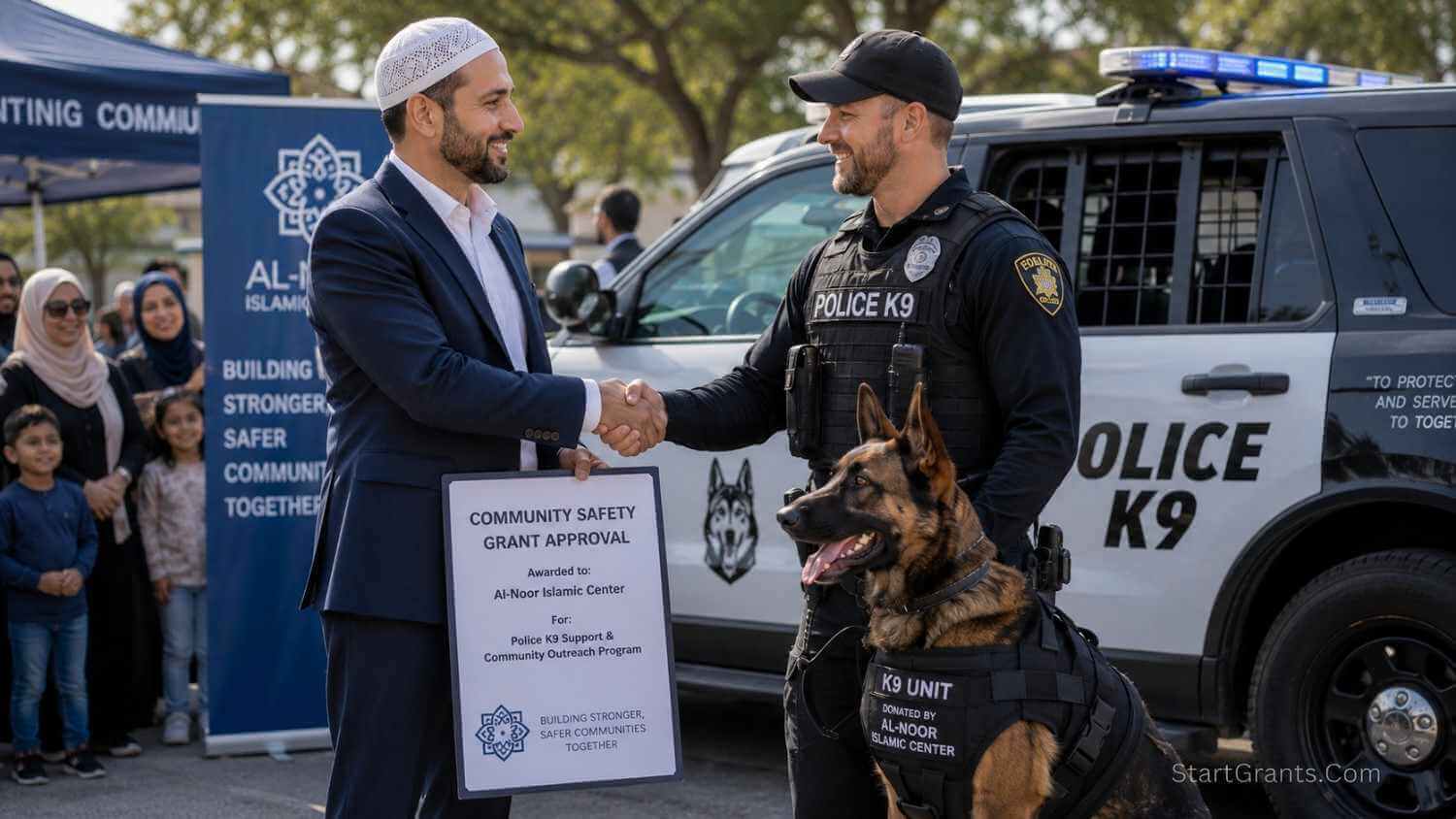
In Islamic jurisprudence, specially trained working dogs (Kalbal Mu’allam) used for public safety and security are highly respected. By utilizing Halal grants (Hibah) and community Sadaqah, Muslim organizations can ethically support local K9 units to fulfill the divine objective of Hifz al-Nafs (protecting human life).
Gharar and K9 Medical Insurance
Police K9s operate in highly dangerous environments and frequently sustain injuries. To manage this liability, departments and grant foundations often require the purchase of K9 Medical and Liability Insurance. Traditional commercial pet insurance contains Gharar (excessive uncertainty) and elements of gambling.
Because authentic Islamic cooperative insurance (Takaful) for working animals is practically non-existent in the U.S. market, contemporary Islamic scholars apply the principle of Dharurah (legal and operational necessity). This permits the department or the supporting Islamic foundation to purchase the required commercial insurance to protect the $20,000 public safety asset and ensure the dog receives life-saving medical care when injured in the line of duty.
Zakat vs. Sadaqah Jariyah for Law Enforcement
When an Islamic Center wishes to donate to the local police department to buy a K9 bulletproof vest, they must be perfectly precise with their accounting.
Zakat funds cannot be used to buy a police dog or a ballistic vest. Zakat is a divine tax strictly restricted to eight specific human categories (the Asnaf), primarily the destitute and refugees. Using Zakat to fund government infrastructure or animal equipment is a severe theological violation.
Instead, the Muslim community must use Sadaqah Jariyah (continuous voluntary charity) or general community outreach funds to sponsor the K9 unit. This acts as a powerful civic bridge-building initiative, demonstrating the Muslim community’s commitment to protecting their city, while keeping Zakat strictly reserved for the poor.
Conclusion
Securing police K9 grants requires a strategic pivot away from slow-moving federal bureaucracy toward agile, private endowments like the Stanton Foundation and Vested Interest in K9s. By proving to grant committees that your department has a sustainable, long-term aftercare budget and a commitment to officer safety, you can fund a world-class K9 unit without stressing local taxpayers.
For the Muslim community, supporting law enforcement K9s is a beautiful execution of Civic Duty and Hifz al-Nafs. By understanding the profound Islamic respect for the working dog (Kalbal Mu’allam), fiercely rejecting the trap of Riba in municipal funding, and ensuring that civic donations are made purely through Sadaqah rather than Zakat, Islamic organizations can build powerful, ethical alliances with local first responders that radiate with divine Barakah.
Frequently Asked Questions (FAQs)
Q1: Will the federal government (FEMA/DHS) give my local police department a grant for a patrol dog?
A: Generally, no. Federal homeland security grants are highly restrictive and are typically reserved for specialized counter-terrorism units, bomb-sniffing dogs, or mass-transit security. For a standard patrol, tracking, or narcotics K9, local police departments must apply to private foundations and corporate endowments.
Q2: How much does the Stanton Foundation grant provide for a K9 unit?
A: The Stanton Foundation offers highly lucrative grants specifically for departments establishing a new K9 program. Their grant typically covers up to $30,000, which pays for the cost of acquiring the dog, the initial intensive training academy for the dog and handler, and basic startup veterinary expenses.
Q3: Do K9 grant programs pay for the specialized police vehicle?
A: Rarely. Most private K9 grants cover the dog, the training, or ballistic vests. Retrofitting a police cruiser with custom K9 kennels, heat alarms, and automated door-poppers (which can cost tens of thousands of dollars) is usually the responsibility of the municipality, though some local community fundraisers can help offset this cost.
Q4: Is it Haram in Islam to support or use a Police K9?
A: No, it is completely Halal. While keeping dogs inside the home merely as pets is restricted in Islam, the Qur’an and Sunnah explicitly permit the use of highly trained working dogs (Kalbal Mu’allam) for hunting, herding, and security. Police K9s serve the vital function of protecting human life and property (Hifz al-Nafs), making them highly respected working animals in Islamic law.
Q5: Can an Islamic Center use Zakat money to buy a bulletproof vest for a Police K9?
A: No. Zakat is an obligatory, divinely mandated tax restricted entirely to specific human categories (the Asnaf), primarily the extreme poor and destitute. Zakat cannot be used to purchase equipment for government agencies or animals. The Islamic Center must use Sadaqah (voluntary charity) or general community outreach funds to sponsor the K9 unit.
Disclaimer: The information provided in this article is for educational and informational purposes only. We are not a federal law enforcement agency, a municipal grant writer, or a religious fatwa council. Private foundation grant guidelines, K9 compliance rules, and funding limits are subject to change. Always consult directly with the specific foundation (e.g., the Stanton Foundation) for official application criteria, a certified CPA regarding municipal charitable donations, and a qualified Islamic finance scholar regarding Halal civic support, Zakat restrictions, and Kalbal Mu’allam Fiqh.