
Last Updated: | Author: Munir Ardi
Environmental science students can find scholarships for environmental leadership, NOAA-related study, scientific research, conservation fieldwork, horticulture, arboriculture, and other specialized paths. The strongest opportunities are not all conventional tuition scholarships: some fund research or summer study, while others combine academic support with a paid internship. Eligibility, current status, and application method matter more than broad labels such as “green grant.”
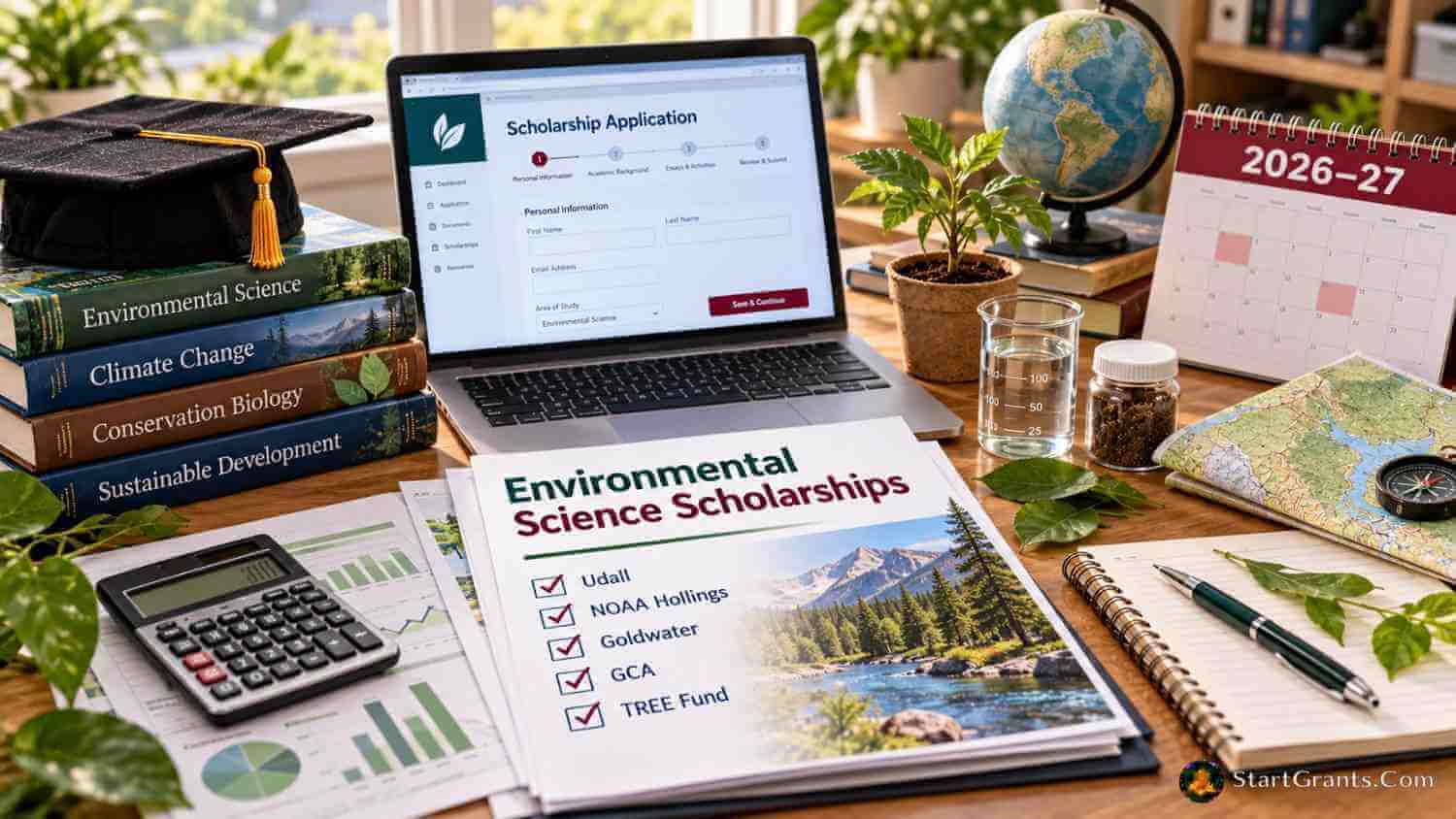
Environmental Science Scholarships Available for 2026–27
The following programs illustrate different funding models. A student should not apply to all of them automatically. Udall emphasizes environmental leadership, NOAA Hollings serves eligible students in NOAA mission fields, Goldwater supports future research careers, and several nonprofit programs fund narrower areas or experiences.
| Program | Best fit | Award or support | Status checked September 23, 2026 |
|---|---|---|---|
| Udall Undergraduate Scholarship | Eligible sophomores and juniors with a record of environmental commitment and leadership | Up to $7,500 for eligible academic expenses | 2027 application available; national deadline March 4, 2027. Campus deadlines can be much earlier. |
| NOAA Hollings Undergraduate Scholarship | Eligible full-time sophomores in disciplines supporting NOAA’s mission | Up to $9,500 per academic year for two years plus a paid 10-week NOAA internship | 2027 cycle open September 1, 2026, through January 31, 2027. |
| NOAA EPP/MSI Undergraduate Scholarship | Normally serves eligible rising juniors at Minority Serving Institutions in NOAA-aligned fields | When offered, combines academic support, research, and internships | Paused for 2027: NOAA states that it will not host a 2027 undergraduate scholar class because of budget uncertainty. |
| Goldwater Scholarship | Eligible sophomores and juniors planning research careers in natural sciences, mathematics, or engineering | Up to $7,500 per academic year after other support is considered | Institutional nomination required; 2027 nominations due January 29, 2027, at 5:00 p.m. Central Time. Campus deadlines are earlier. |
| Garden Club of America scholarships | Students pursuing conservation, ecology, horticulture, wetlands, botany, pollinator research, and related projects | Varies by named scholarship, fellowship, or summer-study award | Multiple 2027 opportunities listed; applicants may apply for only one GCA award per year. |
| TREE Fund scholarships | Students entering careers in arboriculture, urban forestry, horticulture, or related green industries | Several named scholarships list $5,000 awards | The 2026 application period closed March 15, 2026. TREE Fund states that several applications are accepted January 15–March 15 each year; verify the next cycle. |
Award amounts, deadlines, and program funding can change. Recheck every official page before applying.
Udall Undergraduate Scholarship
The Udall Undergraduate Scholarship identifies future leaders in environmental fields as well as Native health care and Tribal public policy. Environmental applicants do not have to belong to a federally recognized Tribe, but they must meet the program’s general eligibility requirements and demonstrate commitment to environmental issues.
For 2027, the Udall Foundation anticipates awarding up to 65 scholarships of $7,500 each. The Foundation’s submission deadline is March 4, 2027, but students cannot submit independently. An authorized faculty representative must register and nominate the applicant, and a college may impose an internal deadline months earlier.
What a Strong Udall Application Demonstrates
Udall is not simply a reward for declaring an environmental major. The application examines the student’s activities, public service, leadership, career goals, and understanding of environmental issues. Use accurate evidence: explain your role, the problem addressed, what you did, what changed, and what you learned. Do not invent percentages, volunteer hours, or community outcomes.
Contact the campus Udall representative early enough to receive guidance and meet the institutional selection process. If your institution has no listed representative, follow the Foundation’s instructions for contacting the program.
NOAA Hollings Undergraduate Scholarship
The Ernest F. Hollings Undergraduate Scholarship is relevant to environmental science students whose discipline supports NOAA’s oceanic, atmospheric, climate, coastal, resource-management, education, or related mission.
The 2027 application cycle opened September 1, 2026, and closes January 31, 2027. NOAA lists up to $9,500 per academic year for two years of full-time study, along with a 10-week paid internship. Applicants must verify citizenship, enrollment, class standing, GPA, major, and graduation-date rules on the current eligibility page.
An environmental science major is not automatically eligible merely because the degree title contains “environmental.” Connect your coursework and career plans to NOAA’s mission and confirm that your academic timeline fits the program.
Do Not Confuse Hollings With EPP/MSI
The Educational Partnership Program with Minority Serving Institutions has different institutional, class-standing, and GPA requirements. More importantly, NOAA’s current internship system states that EPP/MSI will not host a class of undergraduate scholars for the 2027 academic year because of budget uncertainty. Do not submit an old application or describe the program as open. Monitor the official EPP/MSI Undergraduate Scholarship page for future updates.
Goldwater for Environmental Research Careers
The Goldwater Scholarship is appropriate for environmental science students who intend to pursue research careers in natural sciences, mathematics, or engineering. Its official fields include areas such as environmental science, earth system science, hydrology, biogeochemistry, marine ecology, atmospheric chemistry, remote sensing, and climate dynamics.
It is not designed for every sustainability, advocacy, policy, education, or environmental-management career. Students should compare their planned work with Goldwater’s research-career definition. Like Udall, Goldwater requires institutional nomination, so the effective deadline is usually the college’s earlier internal date.
Students who are specifically searching by class year can consult the scholarship guide for college sophomores, but this page should remain the primary resource for environmental-field opportunities.
Conservation, Fieldwork, and Specialized Scholarships
Garden Club of America
The Garden Club of America scholarship directory lists opportunities in conservation, ecology, horticulture, botany, wetlands, pollinator research, landscape architecture, and environmental field study. These awards vary significantly: some fund academic study, while others support research, travel, or a summer project.
Applicants may apply for only one GCA scholarship, fellowship, or award per year. Read the page for the named award instead of assuming that a general environmental science major meets every program’s requirements.
TREE Fund
TREE Fund scholarships serve narrower career paths such as commercial arboriculture, urban forestry, horticulture, and related industries. The Robert Felix Memorial Scholarship, for example, lists a $5,000 award, specific year-of-study requirements, a minimum 3.0 GPA, International Society of Arboriculture student membership, recommendations, and career-focused criteria.
This is why searching by specialty can help: not because niche awards are automatically easy or undersubscribed, but because eligibility and selection criteria may align more closely with your education and career plan.
How to Find Scholarships That Match Your Environmental Specialty
Begin with your actual academic and career path rather than substituting trendy terms. Useful search combinations include:
- Environmental science plus your state or university
- Hydrology, watershed science, or water resources
- Atmospheric science, climate science, or meteorology
- Marine biology, fisheries, oceanography, or coastal science
- Ecology, wildlife biology, conservation, or restoration
- Forestry, urban forestry, arboriculture, or horticulture
- Environmental chemistry, toxicology, geology, or soil science
- Renewable-energy engineering or environmental engineering
- GIS, remote sensing, geospatial science, or environmental data
- Sustainable agriculture or natural-resource management
Search the official pages of your academic department, college foundation, state higher education agency, professional society, local conservation organization, and prospective employer. Treat a research stipend, internship wage, travel award, tuition scholarship, and reimbursement as different benefits.
Build an Evidence-Based Application
Environmental scholarship committees do not all use the same selection formula. A perfect GPA does not guarantee an award, and a particular volunteer activity does not produce a measurable probability of winning. Follow each rubric rather than a universal “winning strategy.”
Describe Your Contribution Accurately
Explain what you personally did in a research project, internship, campus organization, community initiative, or field assignment. Quantify outcomes only when records support them. If a project did not produce a final result, discuss your method, obstacles, revisions, and learning rather than manufacturing an impact number.
Connect Experience to the Program’s Purpose
A NOAA application should show how your field and goals support NOAA’s mission. Goldwater requires a research trajectory. Udall evaluates environmental commitment and leadership. TREE Fund looks for a path toward arboriculture or related industries. Reusing one generic essay without adapting it to these distinctions weakens the application.
Protect Research and Personal Information
Do not disclose confidential research data, precise locations of vulnerable species, protected cultural information, account credentials, or unnecessary identity documents in an essay. Use only the sponsor’s official submission system and review its privacy notice.
If your environmental program includes international fieldwork, the separate summer study-abroad scholarship guide may help you evaluate travel-focused funding without confusing it with ordinary tuition aid.
Save This Environmental Scholarship Checklist
[ ] File the FAFSA and check state and college priority deadlines.
[ ] Define your environmental specialty and intended career path.
[ ] Verify citizenship, residency, class year, enrollment, GPA, major, and graduation-date requirements.
[ ] Determine whether the opportunity is tuition aid, research funding, travel support, wages, or reimbursement.
[ ] Ask whether campus nomination or institutional endorsement is required.
[ ] Record both the campus deadline and sponsor deadline.
[ ] Confirm that the program is open for the correct year.
[ ] Request recommendations early and give recommenders the official criteria.
[ ] Use documented examples instead of invented impact statistics.
[ ] Protect confidential research, species-location, and personal data.
[ ] Save a copy of the final application and submission confirmation.
A Muslim Perspective
Muslim students may understand environmental study through stewardship, responsibility, moderation, and avoiding harm. These values can explain an authentic motivation when they genuinely relate to the student’s experience and the application question. Faith should not be presented as a tactical device or a guaranteed advantage, and students should not claim to represent all Muslims.
Scholarships and genuine grants generally do not require repayment, but recipients should honor the award terms as an amanah. Research funding may restrict eligible expenses, require reports, or require unused funds to be returned. Students seeking to avoid riba can prioritize grants, scholarships, paid research, employer support, personal savings, and properly structured qard hasan assistance.
An interest-free education loan is still repayable and should not be labeled a scholarship. Review the complete agreement and consult a qualified Islamic finance scholar if a contract raises religious questions. Zakat or sadaqah support depends on the fund’s rules and the student’s actual circumstances; financial need alone should not be presented as automatic zakat eligibility.
Frequently Asked Questions
What are environmental science scholarships?
Environmental science scholarships are awards for students whose studies, research, leadership, or career plans relate to environmental fields. Some pay eligible college expenses, while others support research, internships, travel, or summer fieldwork.
Is the 2027 Udall Undergraduate Scholarship open?
Yes. The 2027 application is available, and the Udall Foundation’s deadline is March 4, 2027. Students must be nominated by their institution and may face a much earlier campus deadline.
How much is the 2027 Udall Scholarship?
The Udall Foundation anticipates awarding up to 65 scholarships of $7,500 each for eligible academic expenses in 2027.
Is the NOAA Hollings Scholarship open for 2027?
Yes. The 2027 application cycle runs from September 1, 2026, through January 31, 2027. Applicants must satisfy NOAA’s current citizenship, enrollment, class-standing, GPA, major, and graduation-date requirements.
Is the NOAA EPP/MSI Undergraduate Scholarship open for 2027?
No. NOAA states that the EPP/MSI program will not host a class of undergraduate scholars for the 2027 academic year because of budget uncertainty. Students should monitor NOAA for later updates.
Do environmental science students qualify for Goldwater?
Some do. Goldwater includes several environmental and earth-science research fields, but applicants must intend to pursue a qualifying research career and meet the scholarship’s other requirements. Institutional nomination is required.
Do I need a 4.0 GPA for every environmental scholarship?
No. GPA requirements vary by program. Meeting a minimum GPA does not guarantee selection, and some programs also evaluate research, leadership, service, career direction, or project quality.
Can international students apply for these scholarships?
It depends on the program. Udall, NOAA, and Goldwater have specific citizenship or residency rules, while private and institutional awards may use different criteria. International students should verify eligibility on each official page.
Disclaimer: StartGrants.com is an independent informational portal. It is not a government agency, college, scholarship provider, application administrator, lender, or religious authority. Program funding, status, deadlines, award amounts, and eligibility can change. Verify all information with the official sponsor and your college’s financial aid or fellowship office before applying or making financial decisions.