
Last Updated: July 2026 | Author: Munir Ardi
American football is a phenomenal sport for teaching youth the values of teamwork, extreme discipline, and physical resilience. However, it is also one of the most astronomically expensive youth sports on the planet. Fully outfitting a single player with a high-quality helmet, shoulder pads, cleats, and practice gear can easily cost between $500 and $1,000. For a standard roster of 40 players, a school or community league must raise up to $40,000 just to safely step onto the field.
The stakes are incredibly high. Forcing youth athletes to play in worn-out, expired, or improperly fitted helmets is a deadly hazard that drastically increases the risk of traumatic brain injuries and concussions. Protecting these young athletes requires massive capital, which is exactly why uncovering youth football equipment grants is the most critical skill a modern coach or athletic director can possess.
Before executing the specific acquisition strategies for football gear, you must understand the broader ecosystem of educational and athletic funding. Anchor your overarching strategy by reviewing our Master Pillar: K-12 School Facility and Program Grants.

Outfitting a youth football team with modern, concussion-resistant safety equipment can cost tens of thousands of dollars. By tapping into NFL Foundation endowments and federal education grants, schools can keep their athletes safe and their programs fully funded.
Phase 1: The Corporate Titans (NFL Foundation & USA Football)
If you need capital for youth football, your absolute first target must be the organizations that profit billions from the sport at the professional level. The NFL recognizes that their future talent pipeline and fan base rely on healthy youth leagues, and they fund them accordingly.
The NFL Foundation Grassroots Program
The NFL Foundation, often in partnership with the Local Initiatives Support Corporation (LISC), provides massive “Grassroots Grants.” While these grants are famous for funding the construction of artificial turf fields, they frequently provide direct operational capital to low-to-moderate-income schools to upgrade safety equipment and recondition expired helmets.
USA Football Grants
As the sport’s national governing body, USA Football operates an annual grant program specifically designed to address equipment shortages. They offer direct financial assistance to youth leagues and high school programs explicitly to purchase new 5-star Virginia Tech-rated safety helmets, shoulder pads, and tackling dummies that reduce player-to-player impact during practice.
Phase 2: The “In-Kind” Pivot (Good Sports & PIFF)
What happens if your cash grant application is denied because of intense competition? Elite athletic directors immediately deploy the “In-Kind” pivot. Instead of asking a foundation to wire $10,000 to your bank account, you ask them to ship $10,000 worth of physical gear directly to your locker room.
Organizations like Good Sports specialize in exactly this. They partner with massive athletic manufacturers (like Nike, Under Armour, and Riddell) to secure brand-new, high-quality sports equipment. Good Sports then donates these physical items—including cleats, padded compression shirts, and practice uniforms—directly to youth organizations located in high-poverty areas. Similarly, the PIFF (Pitch In For Baseball & Softball) model exists for multiple sports, providing the physical assets you need to keep your athletes on the field.
Pro-Tip: Leveraging Good Sports for Your League
Navigating the application process for in-kind donations requires proving your community’s financial need and your program’s impact. To understand exactly how organizations like Good Sports operate behind the scenes to supply your team with brand new gear, watch this brief organizational breakdown: Good Sports helps us with grants and sponsorship:
Phase 3: Synergizing School Athletics
To win a youth football equipment grant, you must convince the grant committee that your team is more than just a sports league; it is a vital community intervention program. You must “stack” your funding requests by proving your program solves multiple societal crises simultaneously:
- The Anti-Crime Ecosystem: Keeping youth engaged in a structured, disciplined environment from 3:00 PM to 6:00 PM is the most effective way to keep them off the streets and out of the juvenile justice system. Position your football team as an after-school intervention by exploring Grants for After School Programs.
- The Cardiac Safety Mandate: Contact sports carry an inherent risk of Sudden Cardiac Arrest (SCA), particularly from impacts like commotio cordis (the rare injury that caused Damar Hamlin’s cardiac arrest). Grant committees will prioritize safety. You must pair your helmet funding requests with funding for emergency defibrillators. Master this critical safety acquisition by reading AED Grants for Schools.
- Building the Faith-Based League: If you are launching a football program at an Islamic or Christian private school, your funding avenues are highly specific. Learn how to navigate the private sector effectively in our guide to Grants for Private Schools (K-12).
Phase 4: Federal Funding (ESSA Title IV, Part A)
The federal government does not issue checks labeled “Football Helmet Grants.” However, they do distribute massive block grants to state education departments under the Every Student Succeeds Act (ESSA).
Specifically, Title IV, Part A (Student Support and Academic Enrichment – SSAE) allocates funds for activities that support “Healthy and Safe Students.” School districts can, and frequently do, use these federal funds to upgrade physical education facilities, improve playground safety, and purchase protective athletic gear to ensure students remain physically active without risking injury. You must lobby your local school board to allocate a portion of these federal block grants to the athletic department’s safety budget.
Phase 5: The Muslim Perspective (Hifz al-Nafs, Riba, & Gharar in Sports)
For Islamic private schools and Muslim community centers in the United States, launching a youth football program is an incredible way to build brotherhood (Ukhuwah), physical strength, and discipline among Muslim youth. However, managing the extreme financial and physical risks of contact sports requires uncompromising adherence to Islamic jurisprudence (Shariah).
Theology of Safety (Hifz al-Nafs)
In Islamic law (Maqasid ash-Shariah), one of the five supreme, non-negotiable objectives is Hifz al-Nafs (the preservation of life and intellect). American football carries a severe risk of traumatic brain injury (concussions). If a coach or school administrator sends a Muslim child onto the field wearing an expired, cracked, or improperly fitted helmet because the school “lacks funding,” it is a catastrophic betrayal of the Amanah (trust) placed in them by the parents and by Allah.
Consequently, aggressively seeking out Government and Corporate Grants (Hibah) to purchase state-of-the-art, 5-star safety-rated helmets is not just an administrative task; it is a profound act of worship (Ibadah) dedicated to protecting the health and intellect of the Ummah’s youth.
The Trap of Riba (Credit Cards)
Because starting a football program easily costs $15,000, passionate, well-meaning coaches at underfunded Islamic schools often resort to desperate measures. A coach will frequently put the cost of new jerseys, shoulder pads, and tackling sleds on their personal or business credit card, hoping to pay it off slowly through ticket sales or future school fundraisers.
If that balance is not paid off immediately, the bank will charge compounding interest. In Islam, intentionally engaging in a contract that generates interest is explicitly Riba, which is strictly Haram (forbidden). Funding a Muslim youth program with Riba destroys the spiritual Barakah (blessing) of the team. Coaches must adamantly refuse to finance sports with interest-bearing debt. If Halal grants (Hibah) are insufficient, the program must be funded through community donations (Sadaqah Jariyah) or Qard Hasan (zero-interest benevolent loans).
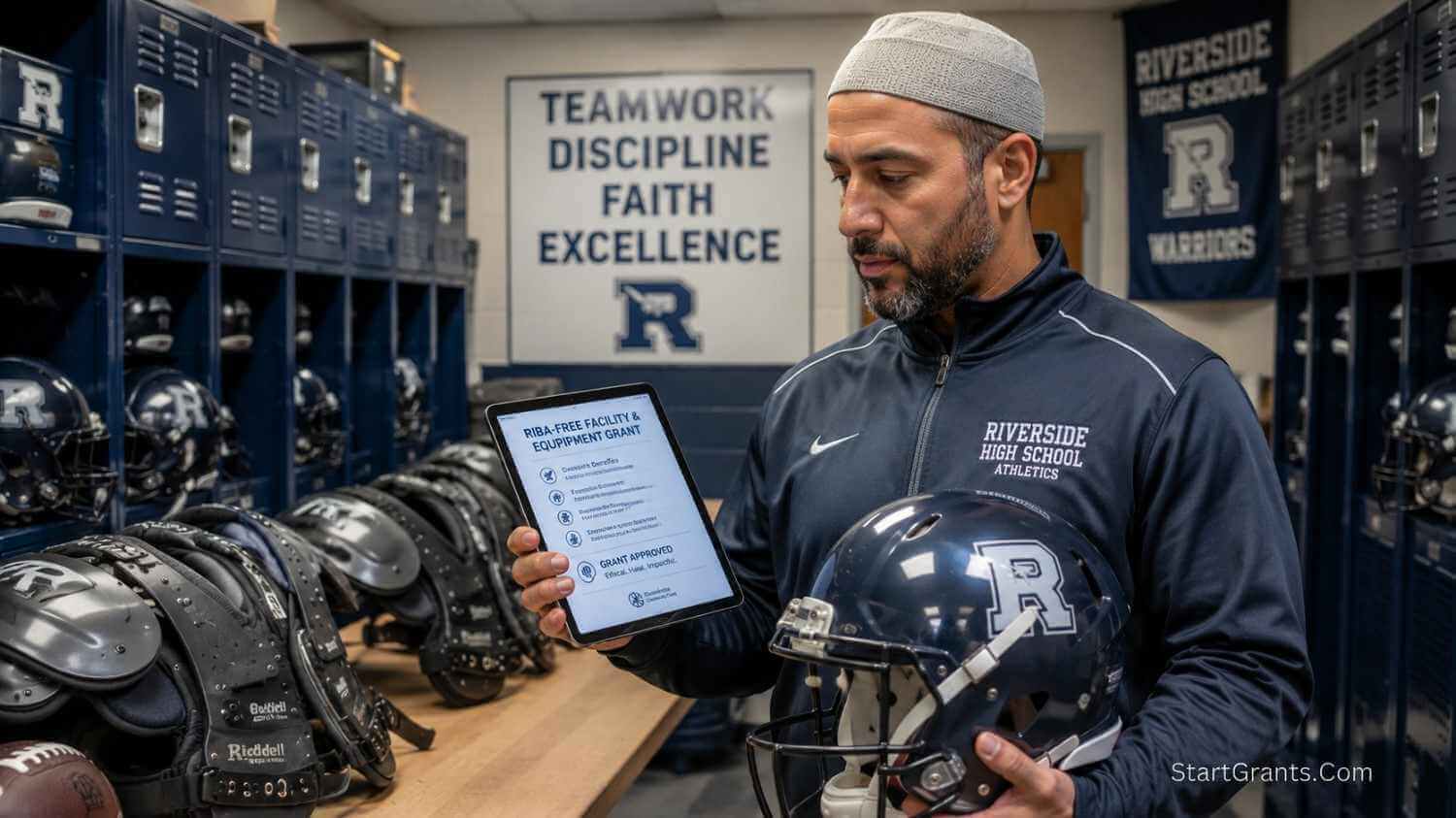
In Islam, protecting the physical health of youth (Hifz al-Nafs) is a sacred trust. Muslim schools must secure ethical, Riba-free government grants (Hibah) to purchase critical safety gear, avoiding the trap of high-interest commercial debt.
Gharar & Sports Liability Insurance
To operate a contact sports league, or to receive a massive athletic grant, the governing body or federal agency will legally mandate that the school carries extensive Sports Liability Insurance. If a player sustains a severe spinal cord injury on the field, this insurance protects the Islamic school from ruinous lawsuits.
Traditional commercial liability insurance contains Gharar (excessive uncertainty) and elements of gambling, making it problematic in Islamic finance. Ideally, an Islamic school should utilize Takaful (Islamic cooperative B2B insurance). However, because commercial Takaful for contact sports liability is practically non-existent in the U.S. market, contemporary Islamic scholars apply the principle of Dharurah (legal and operational necessity). This permits the school to purchase the required commercial policy to protect the institution from absolute financial collapse and satisfy state laws, provided the intent is pure protection, not speculative profit.
Conclusion
Securing youth football equipment grants is not about asking for luxury items; it is a high-stakes campaign to prevent traumatic brain injuries. By aggressively targeting the NFL Foundation, pivoting to “in-kind” physical gear donations from Good Sports when cash is scarce, and lobbying your school board for ESSA Title IV federal safety funds, you can outfit your roster without passing exorbitant costs down to the parents.
For Islamic schools and Muslim coaches, fielding a team must be done with absolute ethical discipline. By fulfilling the mandate of Hifz al-Nafs (protecting the athletes), fiercely rejecting the spiritual trap of Riba-laced credit card debt, and navigating insurance mandates through Dharurah, your football program will build physical strength and character while remaining shielded by divine Barakah.
Frequently Asked Questions (FAQs)
Q1: Does the NFL Foundation give grants directly to individual players?
A: No. The NFL Foundation and USA Football provide grants specifically to organizations, such as 501(c)(3) youth leagues, middle schools, and high school athletic departments. Individuals cannot apply for personal grants to buy their own helmet or cleats.
Q2: What is an “In-Kind” sports donation?
A: An “in-kind” donation means the charitable organization (like Good Sports) does not wire cash to your bank account. Instead, they purchase the physical sporting goods—such as new footballs, padded pants, cleats, and practice jerseys—from manufacturers and ship them directly to your locker room.
Q3: Can federal education grants be used for sports equipment?
A: Yes, indirectly. Under the Every Student Succeeds Act (ESSA), Title IV, Part A block grants are awarded to states and school districts to provide “Healthy and Safe Students” programs. Districts have the flexibility to use a portion of these funds to upgrade physical education equipment and athletic safety gear.
Q4: Why is it Haram for a Muslim coach to buy team jerseys using a credit card?
A: If the coach uses a credit card and cannot pay the balance in full by the due date, the bank will charge compounding interest on the remaining balance. In Islamic finance, intentionally taking on debt that stipulates the payment of interest is classified as Riba, which is strictly forbidden (Haram) and destroys the spiritual purity of the effort.
Q5: Is it Halal for an Islamic school to buy Sports Liability Insurance?
A: Traditional commercial insurance contains Gharar (uncertainty) and is generally problematic in Shariah. However, because failing to have liability insurance exposes the Islamic school to catastrophic lawsuits in the event of an athlete’s injury, scholars universally permit purchasing the required commercial policy under the principle of Dharurah (legal and operational necessity) due to the lack of available Takaful alternatives in the U.S.
Disclaimer: The information provided in this article is for educational and informational purposes only. We are not a federal agency, a sports governing body, or a religious fatwa council. NFL Foundation grant cycles, ESSA Title IV guidelines, and USA Football equipment regulations are subject to frequent changes. Always consult directly with your school board or league commissioner before applying, and seek guidance from a qualified Islamic finance scholar regarding Halal financing, Riba avoidance, and commercial insurance mandates via Dharurah.