
Last Updated: July 2026 | Author: Munir Ardi
For community leaders, researchers, and religious directors, securing capital is the greatest barrier to scaling a mission. While private donations and crowdfunding are essential, the ultimate engine for massive organizational growth in the United States is the federal funding ecosystem. In 2026 alone, the federal government will distribute hundreds of billions of dollars in grants for nonprofit organizations.
However, federal agencies do not write blank checks. The application process is a bureaucratic gauntlet designed to filter out the unprepared. This guide will walk you through the absolute prerequisites for securing federal funds, how to navigate the official government portals, and the strategic art of writing a winning proposal.
Before diving into organizational grants, ensure you have a firm grasp of the overarching federal grant framework by reviewing our Master Pillar: The Ultimate Guide to Government Grants in 2026.

Securing federal funding is the ultimate catalyst for scaling a nonprofit organization, but it requires strict 501(c)(3) compliance and strategic proposal writing.
Phase 1: The 501(c)(3) Shield (The Absolute Prerequisite)
If you are searching for 501c3 grant opportunities, you already know the golden rule: the federal government rarely issues grants to unregistered charities. To be eligible for 95% of federal and state organizational grants, your entity must be officially recognized by the IRS as a tax-exempt 501(c)(3) nonprofit organization.
A 501(c)(3) status proves to the government that your organization serves a legitimate charitable, religious, educational, or scientific purpose, and that none of its earnings benefit a private shareholder or individual. Without this IRS determination letter, your grant application will be immediately discarded.
Pro-Tip: Nonprofit vs. 501(c)(3)
Many founders confuse incorporating a nonprofit at the state level with being a tax-exempt 501(c)(3) at the federal level. They are two entirely different steps! Watch this critical breakdown, NONPROFIT vs 501c3- Here’s the difference!, to ensure your legal foundation is flawless before applying for federal funds:
Phase 2: The Federal Gatekeepers (SAM.gov & Grants.gov)
Once your 501(c)(3) status is secure, you cannot simply email a government agency asking for money. You must pass through two highly secure federal gatekeepers.
1. System for Award Management (SAM.gov)
Before you can apply for a single federal grant, your nonprofit must be registered in the System for Award Management (SAM.gov). This is the government’s central database for vendors and grantees. Registering will generate your Unique Entity ID (UEI), which has replaced the old DUNS number. Warning: SAM.gov registration is 100% free. Never pay a third-party website to register your nonprofit.
2. The Grants.gov Portal
After acquiring your UEI from SAM.gov, you will create an organizational workspace on Grants.gov. This is the centralized portal where all 26 federal grant-making agencies post their funding opportunities (Notice of Funding Opportunities, or NOFOs). Here, you can search for grants specific to your mission—whether it is youth education, homelessness prevention, or medical research.
Phase 3: The Art of the Proposal (Winning the Funds)
Finding a grant opportunity on Grants.gov is only 10% of the battle. The other 90% relies entirely on your ability to write a flawless, data-driven grant proposal. Federal grants are highly competitive; you are competing against well-funded universities and national charities.
Your proposal must clearly define the problem, present a measurable solution, and provide a meticulously detailed budget. To dominate this process, you must master the specialized skill of grant writing.
We have broken down this critical ecosystem into eight specialized Tier-3 battle plans. Choose the guide that matches your immediate operational needs:
- The Core Fundamentals: Learn the anatomy of a winning proposal, from the executive summary to the needs statement, in our guide to writing grants for nonprofits.
- The Step-by-Step Template: Ready to start drafting? Use our structured framework to ensure you don’t miss a single federal requirement by reading how to write a government grant proposal.
- The Scientific Approach: If your organization is a university, hospital, or STEM-focused 501(c)(3), the rules are entirely different. Master the rigorous peer-review process with our guide on applying for research grants.
- The Post-Award Reality (Compliance): Winning the money is only the beginning. To survive a strict federal Single Audit and avoid financial clawbacks, you must abandon spreadsheets and deploy dedicated grant tracking software for nonprofits.
- The Digital Marketing Grant: If your charity needs immediate traffic to attract donors, bypass federal waitlists and claim your $10,000/month in free Google Search ads. Master the compliance rules in: Google Grants Application Know-How.
- The Environmental Infrastructure Focus: If your NGO specializes in sustainability, massive federal funds (like the EPA’s SWIFR program) are available to build physical recycling hubs and compost fleets. Learn how to secure this heavy capital in: Grants for Recycling Programs.
- The Social Sciences & Fieldwork Focus: If your organization or academic institution conducts international ethnographic research, securing capital for travel and translators is a unique challenge. Discover how to fund these massive logistical endeavors ethically in: How to Get Anthropology Research Grants.
- The Civil Rights & Advocacy Focus: Operating a legal clinic or fighting for systemic equality requires meticulous strategy to navigate IRS lobbying restrictions. Discover how to fund these powerful initiatives in our guide: How to Get Grants for Social Justice.
Pro-Tip: Crafting the Narrative
Federal reviewers read hundreds of proposals a week. If your executive summary is vague or you lack foundational data, your application will be rejected immediately. Watch this essential masterclass, Grant Writing for Nonprofits: 7 MUST Haves Before You Start, to ensure your organization is truly grant-ready:
Phase 4: The Muslim Perspective (Ethical Expansion & Waqf)
For Islamic community centers, Masjids, and Muslim-led charities operating in the United States, expanding infrastructure and services presents a unique spiritual challenge. When a Masjid needs to build a new community hall or a Muslim charity needs to fund a domestic violence shelter, the default financial advice in the West is to take out a commercial bank loan.
The Trap of Riba and Gharar in Nonprofits
In Islamic jurisprudence, funding an Islamic center or charity through a commercial loan that involves Riba (compounding interest) is strictly prohibited (Haram). Using interest-bearing debt to build a house of Allah or fund a charitable mission completely contradicts the core tenets of Islamic ethics. Furthermore, securing these loans often requires purchasing commercial insurance policies that contain Gharar (excessive uncertainty), adding another layer of spiritual contamination.
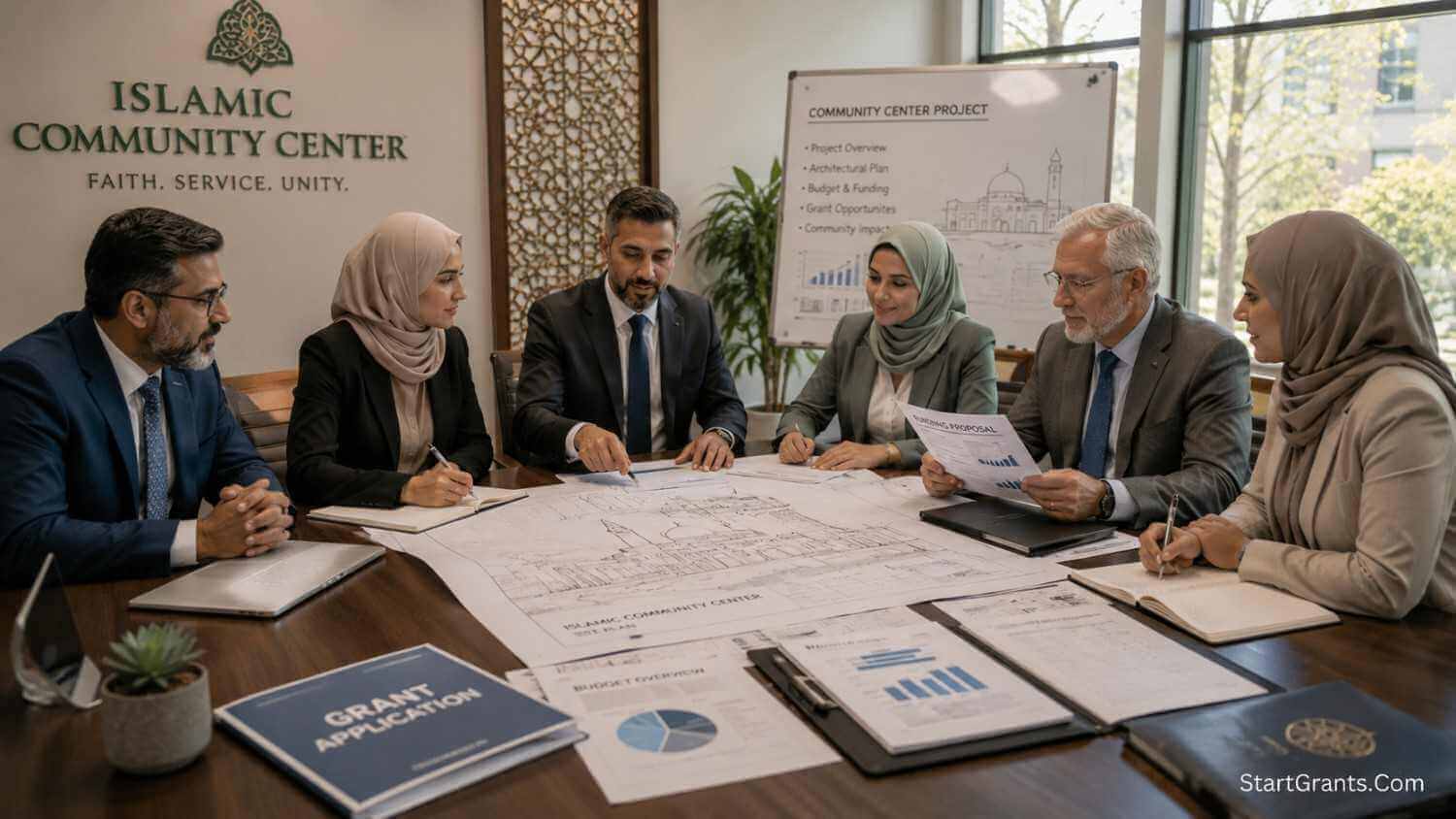
For Islamic nonprofits and Masjids, securing government grants (Hibah) is the most effective way to fund community expansions without falling into the trap of interest-bearing commercial loans (Riba).
Government Grants as “Hibah” (The Halal Solution)
This is why mastering the federal and state grant ecosystem is a strategic imperative for Muslim nonprofits. Government grants are classified as Hibah (a gift given without the expectation of financial return). Because grants require no repayment of principal and accumulate zero interest, they are a 100% Halal method of capital injection.
Federal agencies regularly issue grants for community security (such as the FEMA Nonprofit Security Grant Program, which is crucial for protecting Masjids), youth education, and refugee resettlement. By securing these grants, Islamic organizations can scale their impact purely through Halal means.
The Power of Waqf (Islamic Endowments)
If government grants fall short, Islamic nonprofits should avoid Riba loans by establishing a Waqf (an irrevocable Islamic endowment). By placing assets (like real estate or ethical investments) into a Waqf, the principal remains untouched, but the Halal profits generated are used to fund the charity in perpetuity. National organizations like the Islamic Society of North America (ISNA) and the North American Islamic Trust (NAIT) specialize in helping local Masjids establish and protect Waqf properties legally in the U.S.
Conclusion
Government grants for nonprofit organizations are the most powerful financial instruments available for scaling a charitable mission. They provide massive, debt-free capital injections that allow 501(c)(3) entities to hire staff, expand facilities, and execute their programs.
To succeed in 2026, you must ensure your IRS status is flawless, register meticulously on SAM.gov, and dedicate serious resources to mastering the art of proposal writing. For Islamic organizations, treating the grant application process with the utmost seriousness is the key to expanding your community services while maintaining absolute adherence to Halal financial principles and avoiding the destructive trap of Riba.
Frequently Asked Questions (FAQs)
Q1: Can an individual apply for a nonprofit grant?
A: No. Grants designed for nonprofit organizations require the applicant to possess a valid Employer Identification Number (EIN), a Unique Entity ID (UEI), and typically an IRS 501(c)(3) determination letter. Individuals seeking personal financial assistance must look for individual benefit programs, not organizational grants.
Q2: Do federal grants cover the operating costs of a nonprofit?
A: Generally, no. Most federal grants are “program-specific” or “project-restricted.” This means the money must be used exactly as outlined in your proposal to execute a specific project (e.g., running an after-school tutoring program). They rarely provide “unrestricted operating funds” just to keep the lights on or pay general executive salaries.
Q3: How long does it take to get approved for a federal grant?
A: It is a slow process. From the moment you begin writing the proposal to the moment the funds are actually disbursed into your organization’s bank account, it can take anywhere from 6 to 12 months. Nonprofits should never rely on a pending federal grant to solve a short-term cash flow crisis.
Q4: What is the Nonprofit Security Grant Program (NSGP)?
A: The NSGP is a highly relevant FEMA grant designed to provide funding for physical security enhancements and other security-related activities to nonprofit organizations that are at high risk of a terrorist attack. This is extremely popular among religious institutions, including Masjids, Synagogues, and Churches, to install cameras, reinforced doors, and hire security personnel.
Q5: Is it Halal for an Islamic charity to accept money from the U.S. government?
A: Yes. The overwhelming majority of Islamic scholars agree that accepting a government grant (which is classified as Hibah or a gift) is completely Halal. Since the funds do not require repayment and do not involve Riba (interest), it is a permissible and encouraged way to fund community projects, provided the grant’s stipulations do not force the organization to compromise its Islamic principles.




Iam low income and can,t afford a laptop,or tablet,can i get one free?
I am single mom, trying get on my feet and I am in need of a bed with mattress. Cant aford pne for my self.