
Last Updated: April 2026 | Author: Munir Ardi
For Native American and Indigenous students, the journey to higher education often involves navigating a dual system. You must balance the standard college admissions process with the complex legal and bureaucratic requirements of tribal sovereignty and federal recognition. However, this unique legal status also unlocks access to some of the most dedicated and well-funded educational endowments in the United States.
In 2026, the funding landscape for Indigenous students is expanding. Federal agencies, private philanthropic foundations, and the sovereign tribes themselves are aggressively deploying millions of dollars in scholarships for Native Americans. Their goal is clear: to build the next generation of Indigenous leadership in healthcare, law, STEM, and education while preserving cultural heritage.
This comprehensive guide will demystify the Native American scholarship process. We will break down the crucial paperwork required to prove your eligibility, explore the massive national foundations that fund Indigenous scholars, and help you navigate the specific funding available at Tribal Colleges and Universities (TCUs).
Phase 1: The “Identity” Protocol (CDIB & Enrollment)
Before you write a single scholarship essay, you must secure your foundational paperwork. Unlike general minority scholarships that may only require a self-identification checkbox, Native American scholarships often require legal documentation to prevent fraud and ensure funds reach actual Indigenous communities.
1. The CDIB (Certificate of Degree of Indian Blood)
The vast majority of national and federal scholarships require a CDIB. This is an official document issued by the federal government that certifies an individual possesses a specific degree of Native American blood of a federally recognized Indian tribe.
- The Action Step: If you do not have your CDIB, you must apply for it through the Bureau of Indian Affairs (BIA). (Note: As a federal government agency, this is a highly trusted source). The process can take months, so you must initiate this during your junior year of high school.
2. Tribal Enrollment
Having a CDIB does not automatically make you an enrolled member of a tribe. Because tribes are sovereign nations, each has its own distinct constitution and enrollment criteria. Some scholarships require you to be an officially enrolled member of a federally or state-recognized tribe, while others only require you to prove you are a descendant of an enrolled member.
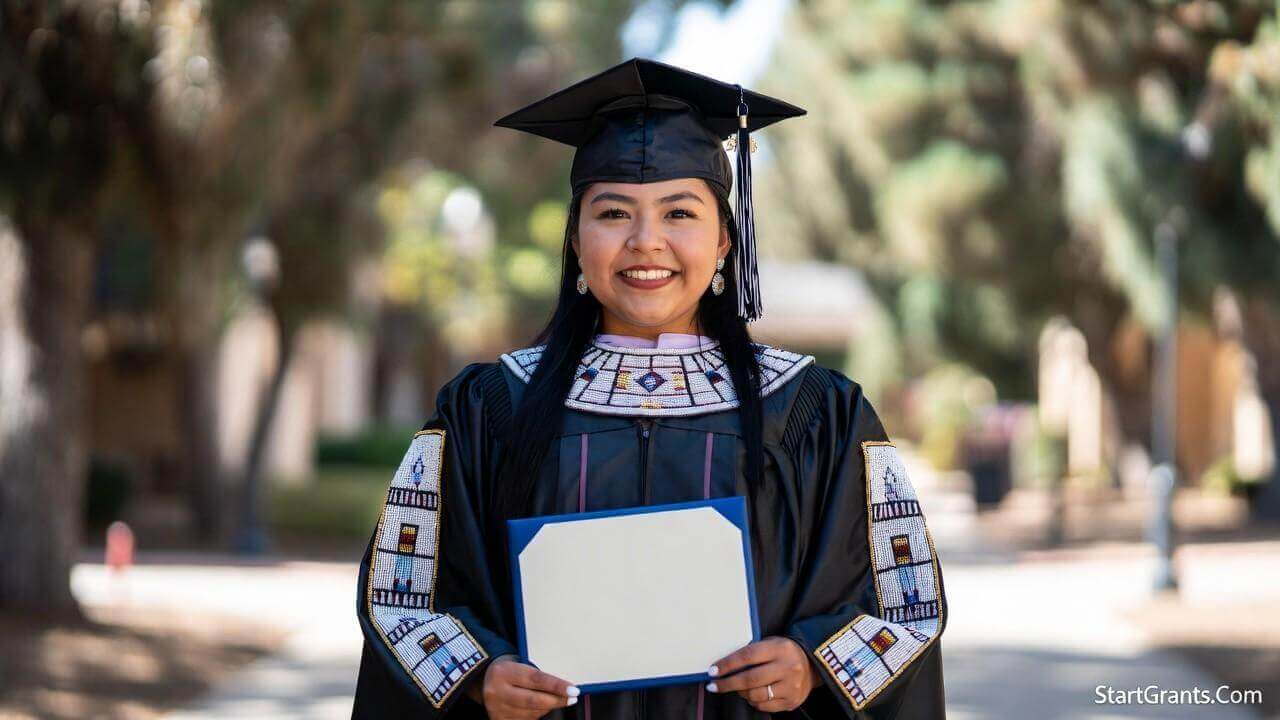
Securing your Certificate of Degree of Indian Blood (CDIB) is the first critical step to unlocking massive national endowments and graduating debt-free.
Phase 2: The “Big Three” National Funds
Once your paperwork is secured, your first targets should be the three largest national endowments dedicated exclusively to Indigenous students. These organizations act as massive funding hubs.
1. The American Indian College Fund (AICF)
The AICF is the largest charity supporting Native student access to higher education. Their “Full Circle Scholarship” program is legendary.
- The Strategy: The AICF provides funding for students attending both mainstream universities and Tribal Colleges. The beauty of their system is that one single application puts you in the running for dozens of different scholarships. Find their application deadlines at the official AICF portal.
2. Native Forward Scholars Fund (Formerly AIGC)
Native Forward has empowered over 20,000 Native students from over 500 tribes. They are renowned for funding not just undergraduate degrees, but also highly expensive graduate, medical, and law degrees.
- The Hook: If you are pursuing a professional degree (like becoming a doctor or a lawyer), Native Forward offers massive fellowships that can cover the bulk of your graduate tuition. You can review their criteria at Native Forward.
3. Catching the Dream
This organization has a highly specific mission: they want to fund Native students who intend to return to their communities to improve the lives of Indigenous people.
- The Requirement: Catching the Dream requires applicants to apply for at least 10 other scholarships before applying to theirs. They want to see that you are aggressively pursuing all avenues of funding. To build your strategy and find those other demographic scholarships, utilize the tactics found in our overarching headquarters guide on demographic and heritage college scholarships.
Pro-Tip: Navigating Native American Scholarships
Understanding which specific heritage grant applies to your exact enrollment status can be confusing. Watch this quick breakdown by Dr. Amanda Cheromiah, an expert in Indigenous higher education, on how to navigate and secure Native American specific scholarships:
If you are a Native American woman, your funding opportunities do not stop at heritage grants. You have access to a massive secondary tier of funding through corporate women’s endowments and advocacy groups. To double your funding potential, you must cross-reference this list with our specialized guides on Scholarships for Women and our breakdown of Scholarships for Hispanic Women (for those with Afro-Indigenous or Afro-Latino dual heritage).
Phase 3: Tribal Colleges and Universities (TCUs)
Mainstream state universities are not the only option for Indigenous students. The United States is home to over 30 Tribal Colleges and Universities (TCUs). These institutions are chartered by their respective tribal governments and are uniquely designed to support Indigenous students by integrating cultural preservation with modern academics.
1. TCU-Specific Funding
If you choose to attend a TCU (such as Navajo Technical University or Salish Kootenai College), your funding opportunities increase exponentially. Organizations like the American Indian College Fund (AICF) reserve a massive portion of their endowment strictly for students attending TCUs. Because the applicant pool is smaller compared to mainstream universities, the statistical probability of winning these localized grants is much higher.
2. Federal BIE Support
The Bureau of Indian Education (BIE) heavily subsidizes TCUs. As a result, the baseline tuition at a TCU is often significantly lower than a standard state university. When you combine this lower tuition with dedicated TCU scholarships, many Indigenous students are able to complete their degrees completely debt-free.
Phase 4: STEM, Healthcare, and Professional Pathways
To build sovereign infrastructure and improve public health on reservations, both the federal government and private corporations are aggressively funding Indigenous students who pursue degrees in Science, Technology, Engineering, and Mathematics (STEM) or medicine.
1. AISES (American Indian Science and Engineering Society)
If you are pursuing a STEM degree, AISES is your premier resource. They partner with massive tech corporations (like Intel and Google) to offer highly lucrative scholarships. They do not just provide money; they provide direct pipelines to internships and corporate careers.
For Indigenous women pursuing technical degrees, the funding opportunities are even more massive due to the corporate push for intersectional gender diversity. To ensure you are capturing all corporate STEM funding, Native American women must cross-reference their applications with our specialized guide on Where to Find Women in Engineering Scholarships.
2. Indian Health Service (IHS) Scholarship Program
The federal IHS Scholarship is an incredible opportunity for Native students pursuing nursing, dentistry, or medicine. The government will pay your full tuition and provide a monthly living stipend. In exchange, you commit to working in an Indian health program for a specified number of years after graduation—allowing you to graduate debt-free while directly serving your community.

Organizations like the American Indian Science and Engineering Society (AISES) provide massive scholarships and corporate internships for Indigenous students pursuing STEM degrees.
Phase 5: The Intersection of Faith (The Muslim Native American Perspective)
In 2026, scholarship committees highly value students with unique, intersectional identities. While often overlooked by mainstream media, there is a vibrant and growing community of Muslim Native Americans. For these students, navigating higher education means balancing deep ancestral heritage with Islamic values.
If you identify as an Indigenous Muslim, you have the unique advantage of accessing both heritage-based funding and faith-based educational endowments.
1. Expanding the Funding Net
While applying to the AICF and Native Forward, Indigenous Muslim students should also apply to the Islamic Scholarship Fund (ISF). The ISF funds Muslim students based on religious identity and academic discipline (such as Law, Media, and Public Policy), regardless of ethnic background. An Indigenous Muslim aiming to become a civil rights attorney can leverage both tribal grants and ISF funding (up to $10,000) simultaneously.
2. The Essay Narrative
The essay is where intersectionality wins. When applying for broad national scholarships, articulate how your dual identity shapes your worldview. Discussing how Indigenous principles of environmental stewardship align with Islamic teachings of protecting the earth creates a profound, memorable essay that scholarship committees are eager to fund.
Conclusion: Claiming Your Ancestral and Educational Future
Securing funding as a Native American student requires diligent administrative work, but the financial payoff is life-changing. Do not let the bureaucracy of CDIBs or tribal enrollment deter you.
Your Action Plan:
- Secure Your Paperwork: Request your CDIB and verify your tribal enrollment status immediately.
- Apply Broadly: Submit the master applications for the “Big Three” (AICF, Native Forward, Catching the Dream).
- Target Your Niche: If you are in STEM, join AISES. If you are pursuing medicine, apply for the federal IHS program.
- Embrace Your Identity: Use your intersectional identity (including faith, gender, and heritage) as your primary essay narrative to stand out from the crowd.
The funds are waiting. Claim your scholarship, earn your degree, and bring that knowledge back to empower your community.
Frequently Asked Questions (FAQs)
Q1: Do I have to be a registered tribal member to get a scholarship?
A: Not always. While many national scholarships (and federal grants) require you to be an enrolled member of a federally recognized tribe, some organizations (like the American Indian College Fund) offer specific scholarships for “descendants” who can prove their heritage but lack official enrollment status.
Q2: What is a CDIB?
A: A CDIB (Certificate of Degree of Indian Blood) is an official document issued by the Bureau of Indian Affairs (BIA) that certifies an individual possesses a specific quantum (percentage) of Native American blood of a federally recognized tribe. It is the foundational document for most Native financial aid.
Q3: What are Tribal Colleges and Universities (TCUs)?
A: TCUs are higher education institutions chartered by their respective tribal governments. They offer culturally relevant curriculums and generally have much lower tuition rates. Students attending TCUs have access to highly specific, less competitive funding pools.
Q4: Does the federal government offer specific Native American grants?
A: Yes. Beyond general Pell Grants, the federal government offers specialized funding like the Indian Health Service (IHS) Scholarship for students entering medical and healthcare fields, which covers full tuition in exchange for a service commitment.
Q5: Are there scholarships for Native Americans in STEM?
A: Absolutely. The American Indian Science and Engineering Society (AISES) is the largest provider of STEM-specific scholarships, mentorships, and corporate internships for Indigenous students.
Q6: Can Native American Muslims apply for Islamic scholarships?
A: Yes. Organizations like the Islamic Scholarship Fund (ISF) base their awards on Islamic religious identity and academic discipline, not race. Muslim Native Americans are highly encouraged to apply to access these massive faith-based endowments.
Q7: Can I use Native American scholarships for graduate school?
A: Yes. Organizations like Native Forward Scholars Fund (formerly AIGC) specialize in funding Indigenous students pursuing highly expensive professional degrees, including Medical (MD), Law (JD), and doctoral programs.
Q8: Will winning a tribal scholarship reduce my federal financial aid?
A: It depends on the university’s “award displacement” policies. In some cases, winning a large private or tribal scholarship can cause the university to reduce your institutional grants. Always communicate with your college’s financial aid office to ensure your tribal scholarship is stacked properly with your FAFSA awards.
Important Disclaimer: StartGrants.com is an independent information portal. We are not a government agency and do not provide direct grants or products. Always verify the current status of programs with the providing organization.