Last Updated: July 2026 | Author: Munir Ardi
The global economy is undergoing a massive, irreversible shift toward automation, artificial intelligence, and advanced manufacturing. The United States government and Fortune 500 tech companies recognize that the engineers who will dominate the next century are currently sitting in middle school and high school classrooms. However, preparing these students requires more than just textbooks; it requires hands-on experience building complex, programmable machines.
Starting and sustaining a competitive school robotics team is astronomically expensive. A basic entry-level VEX or LEGO spike kit can cost over $500, while a high school FIRST Robotics Competition (FRC) team requires thousands of dollars just to purchase the metal extrusions, motors, and micro-controllers. Factor in the $5,000 regional tournament registration fees, and a single robotics season can easily cost a public school upwards of $15,000.
Because local school district budgets rarely cover these extreme costs, teachers and mentors must become master fundraisers. Securing robotics grants programs is the ultimate strategic maneuver to build a sustainable, debt-free STEM lab. Before diving into the specific corporate ecosystems that fund these robots, ensure you understand the broader federal funding architecture for schools by reviewing our Master Pillar: K-12 School Facility and Program Grants.
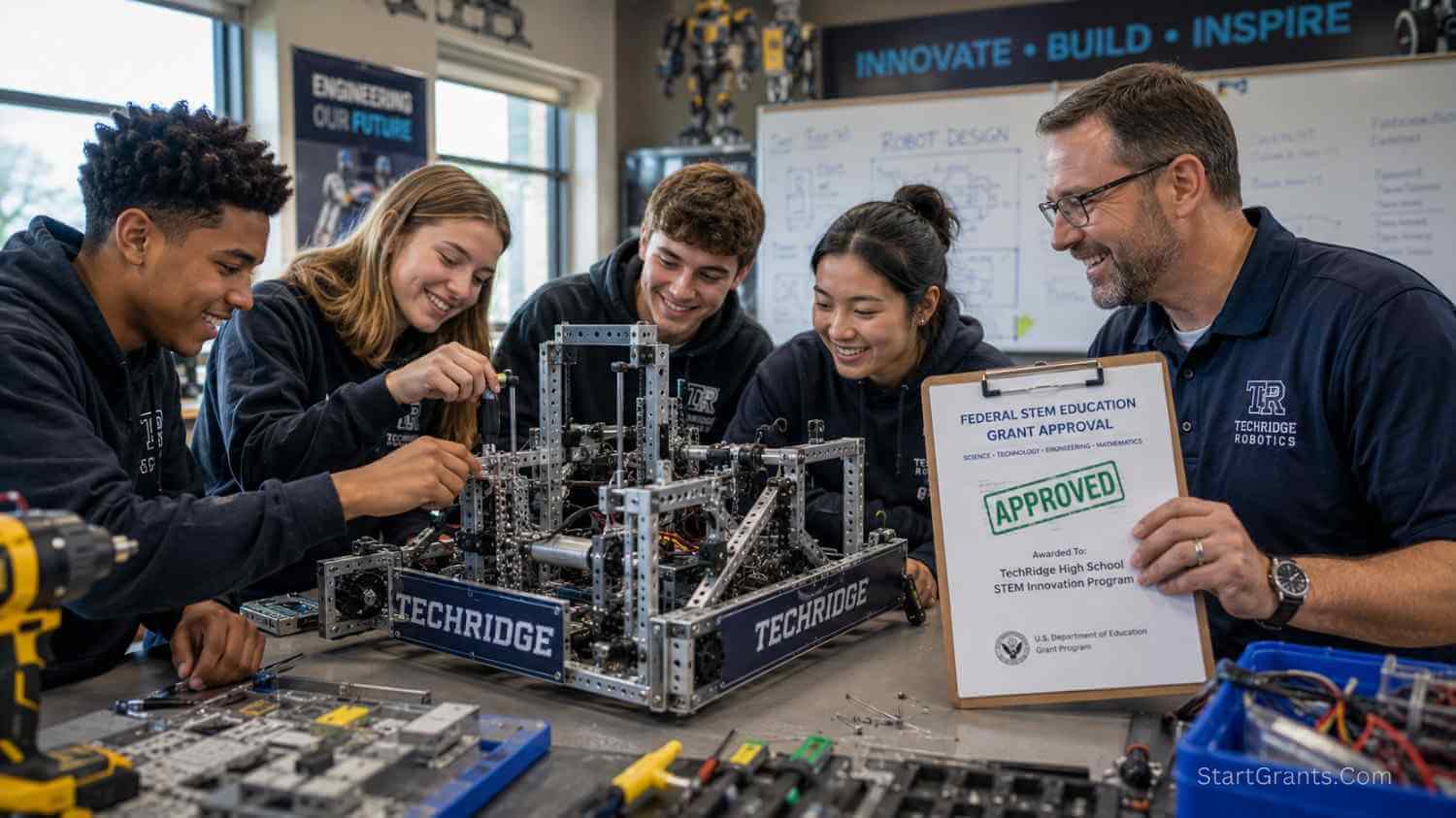
Building a competitive robotics team requires massive upfront capital for metal kits, motors, and competition registration fees. Securing federal STEM grants and corporate sponsorships ensures schools can prepare students for the future tech economy debt-free.
Phase 1: The Federal STEM Engine (Title IV & NASA)
While tech corporations get the most media coverage, the United States federal government is actually the largest overarching funder of K-12 STEM education. You must know which bureaucratic levers to pull to access these funds.
ESSA Title IV, Part A
Under the Every Student Succeeds Act (ESSA), the U.S. Department of Education distributes massive block grants to states through Title IV, Part A. These funds are specifically designated to provide students with a “Well-Rounded Education,” which explicitly includes STEM (Science, Technology, Engineering, and Mathematics) programming. Local school districts can, and frequently do, use these federal block grants to purchase expensive robotics kits, 3D printers, and coding software. As a mentor or teacher, you must actively lobby your school board to allocate a portion of their Title IV funds specifically to your robotics lab.
NASA Robotics Alliance Project (RAP)
The National Aeronautics and Space Administration (NASA) operates the Robotics Alliance Project. NASA recognizes that funding high school robotics teams directly creates a pipeline for future aerospace engineers. They issue highly prestigious, massive cash grants specifically to teams competing in the FIRST Robotics ecosystem to cover their exorbitant tournament registration fees. Winning a NASA grant not only provides capital but attaches massive prestige to your school’s program.
Phase 2: The Mega-Ecosystems (FIRST & REC Foundation)
If you want to secure rapid corporate funding, you cannot simply build robots in isolation; you must join the massive, recognized competition ecosystems. Global defense contractors and tech giants (like Boeing, Lockheed Martin, Google, and Amazon) funnel their grant money almost exclusively through these two governing bodies.
1. FIRST Robotics (The Corporate Magnet)
For Inspiration and Recognition of Science and Technology (FIRST) is the titan of the robotics world. If your school registers a new team within their ecosystem, you immediately gain access to “Rookie Grants.” FIRST partners with corporate sponsors who aggressively subsidize the registration fees and basic metal kits for first-year and second-year teams to help them survive the grueling startup phase.
2. The REC Foundation (VEX Robotics)
The Robotics Education & Competition (REC) Foundation oversees the VEX Robotics ecosystem. They are phenomenal for middle schools and high schools looking for a slightly lower barrier to entry than FIRST. The REC Foundation frequently offers specific equipment grants for brand-new VEX IQ or VEX V5 teams, shipping the physical robot “brains” and motors directly to the school.
Pro-Tip: The Truth About Corporate Sponsorships
Securing a $5,000 corporate grant requires more than just filling out a form on the FIRST website; you have to treat your robotics team like a tech startup pitching investors. To understand the psychological approach required to win these highly competitive corporate funds, watch this excellent breakdown from an industry insider: The Hidden Truths About FIRST Robotics Sponsorships:
Phase 3: Synergizing School Programs
The most successful grant writers do not just ask for “robot money.” They stack their funding requests by demonstrating how the robotics team solves multiple, simultaneous school district problems.
- The After-School Hook: A robotics team is not a standard classroom lecture; it is an intensive, after-school intervention that keeps teenagers engaged and off the streets from 3:00 PM to 6:00 PM. Frame your grant proposal around juvenile delinquency prevention by targeting funds found in our guide to Grants for After School Programs.
- The Competition Travel Hurdle: Building the robot is only half the battle. Transporting 15 teenagers and a 120-pound metal machine to a regional championship across state lines requires hotels, flights, and massive logistics budgets. You must secure dedicated travel funding. Learn how to cover these exact costs by exploring Grants for School Field Trips.
- Faith-Based and Private Scaling: If you are launching a STEM lab at an Islamic Academy or private Christian school, your funding avenues are distinct from the public school sector. Master these specific philanthropic networks in our breakdown of Grants for Private Schools (K-12).
Phase 4: The Bureaucratic Shield (Workforce Development)
When drafting your proposal for a robotics grant, you must eliminate the word “toys” from your vocabulary. Corporate and federal grant committees do not give out $10,000 for children to “play with Legos.”
You must build an impenetrable bureaucratic shield around your application by framing it entirely as Workforce Development. You must explicitly outline how your team teaches CAD (Computer-Aided Design), Java/C++ programming, CNC machining, project management, and rapid prototyping. You must prove to the grant committee that an investment in your team yields a direct Return on Investment (ROI) by producing the highly skilled manufacturing and software workforce the United States desperately needs.
Phase 5: The Muslim Perspective (Ilmu Nafi’, Riba, & Zakat Rules)
For Islamic private schools and Muslim community centers in the United States, launching a competitive robotics program is not just an extracurricular activity; it is a profound religious imperative. However, financing a $15,000 STEM lab requires strict adherence to Islamic financial jurisprudence (Shariah) to ensure the educational environment remains spiritually pure.
The Theology of Technology (Ilmu Nafi’)
In Islam, the pursuit of Ilmu Nafi’ (beneficial knowledge) is highly encouraged. In the modern era, mastering artificial intelligence, robotics, and engineering is widely considered a Fardu Kifayah (a communal obligation). If the Muslim community fails to produce experts in these critical fields, the entire Ummah suffers from a lack of self-reliance and technological independence. Therefore, aggressively seeking out Government and Corporate Grants (Hibah) to fund these labs is an act of proactive worship and community defense.
The Trap of Riba (Credit Cards)
Because schools are chronically underfunded, passionate Muslim science teachers and mentors frequently resort to desperate measures. When a team needs a $300 motor controller the week before a tournament, a teacher will often put the expense on their personal credit card.
If that balance is not paid off immediately, the bank charges compounding interest. In Islam, intentionally engaging in a contract that generates interest is explicitly Riba, which is strictly Haram (forbidden). Funding a Muslim youth STEM program with Riba destroys the spiritual Barakah (blessing) of the education. Mentors must absolutely refuse to finance the team with interest-bearing debt. If Halal grants (Hibah) are insufficient, the lab must be funded through community donations (Sadaqah Jariyah) or Qard Hasan (zero-interest benevolent loans).

In Islam, the pursuit of beneficial knowledge (Ilmu Nafi’) such as technology and engineering is highly encouraged. Muslim schools must fund their STEM labs ethically, actively seeking Halal grants (Hibah) and Sadaqah Jariyah while strictly avoiding Riba-laced commercial loans.
Zakat vs. Sadaqah Jariyah (The Metal Rule)
When an Islamic school launches a fundraising campaign to start a robotics team, they frequently make a catastrophic theological error regarding Zakat. A Muslim board of directors must be impeccably precise with its accounting:
- Sadaqah Jariyah (Fixed Assets): Zakat cannot be used to purchase aluminum metal channels, VEX brains, laptops, or CNC machines for the school’s robotics lab. In Islamic law, Zakat is restricted to specific human recipients (the poor and needy), not for purchasing fixed physical assets for an institution. The physical robots and lab equipment must be funded exclusively through government grants (Hibah) or Sadaqah Jariyah (continuous voluntary charity).
- Zakat (Specific Students): However, what if a brilliant Muslim student who is an orphan or lives below the poverty line wants to join the robotics team, but their family cannot afford the $500 travel fee to attend the World Championship? In this highly specific scenario, the school can legally utilize Zakat funds to subsidize that specific impoverished student’s travel and registration fees, ensuring poverty does not block their access to STEM education.
Gharar and Property Insurance
To receive massive corporate grants (like a $20,000 lab grant from an aerospace company), the school is often legally mandated to carry extensive Commercial Property Insurance to protect the expensive robotic equipment from fire or theft. Traditional commercial insurance involves Gharar (excessive uncertainty). Because commercial Takaful (Islamic cooperative insurance) is rare in the U.S., Islamic scholars widely apply the principle of Dharurah (legal and operational necessity), permitting the school to purchase the mandated commercial policy to protect the community’s assets.
Conclusion
Securing robotics grants programs requires transitioning your mindset from a teacher running a club into a CEO managing a workforce development pipeline. By aligning your team with massive ecosystems like FIRST or VEX, targeting NASA RAP funding, and pitching your students as the highly skilled engineers of tomorrow, you can unlock the massive corporate and federal capital required to dominate the competition.
For Islamic schools, building a STEM lab is the ultimate execution of seeking Ilmu Nafi’. By fiercely rejecting the predatory trap of Riba-laced credit card debt in favor of Halal grants (Hibah), navigating insurance mandates via Dharurah, and strictly separating Zakat from the purchase of physical robots (Sadaqah Jariyah), your robotics program will forge brilliant, technologically advanced minds while remaining fully shielded by divine Barakah.
Frequently Asked Questions (FAQs)
Q1: Does the government provide grants directly to buy LEGO or VEX robots?
A: Rarely directly. The federal government (via the Department of Education) provides massive block grants like ESSA Title IV to state and local school districts. It is up to the local school board and principals to allocate a portion of that federal money specifically to purchase robotics kits for their classrooms.
Q2: What is a FIRST Rookie Grant?
A: When a new school registers a team for their very first (or sometimes second) year in the FIRST Robotics ecosystem, they are eligible for “Rookie Grants.” These are subsidies funded by massive corporate sponsors (like NASA, Boeing, or DoD STEM) that cover the exorbitant initial registration fees and provide the team with a baseline kit of parts to start building.
Q3: Can we use a robotics grant to pay for student travel to a competition?
A: It depends entirely on the specific grant’s rules. Many corporate equipment grants explicitly forbid using the funds for travel, lodging, or food. However, specialized travel grants or general after-school enrichment funds can often be deployed to cover the massive logistical costs of attending a regional or world championship.
Q4: Why is it Haram for an Islamic school to use Zakat to buy a 3D printer for the robotics lab?
A: In Islamic jurisprudence, Zakat is a divine, obligatory tax strictly restricted to eight specific human categories (the Asnaf), primarily the absolute poor and destitute. Zakat cannot be used to purchase physical infrastructure or fixed assets for an organization (like robots, laptops, or 3D printers). Those capital expenses must be paid using Sadaqah Jariyah (continuous voluntary charity) or government grants.
Q5: Why must a mentor avoid putting robot parts on a personal credit card?
A: If a mentor uses a credit card to buy urgent robot parts and cannot pay the balance in full by the due date, the bank will charge compounding interest on the remaining balance. In Islamic finance, intentionally engaging in a contract that stipulates the payment of interest is classified as Riba, which is strictly forbidden (Haram) and destroys the spiritual purity of the educational effort.
Disclaimer: The information provided in this article is for educational and informational purposes only. We are not a federal education agency, a robotics governing body (like FIRST or REC), or a religious fatwa council. ESSA Title IV guidelines, NASA RAP grant cycles, and corporate sponsorship rules are subject to frequent changes. Always consult directly with your school district’s grant administrator before applying, and seek guidance from a qualified Islamic finance scholar regarding Halal financing, Riba avoidance, and strict Zakat accounting rules.